BIOB 170 - Test 2
 Call Kai
 Learn
Learn Practice Test
 Spaced Repetition
 Match
Match Flashcards
 Knowt Play
1/187

There's no tags or description
Looks like no tags are added yet.
Name | Mastery | Learn | Test | Matching | Spaced | Call with Kai |
|---|
No analytics yet
Send a link to your students to track their progress
188 Terms
Which of the following is evidence for the Endosymbiont Theory?
All of the options
True or false: Eukaryotes are monophyletic
true
If you find a green, leafy, nonvascular plant with stomata growing on your neighbor's damp front lawn, you can assume that is a
moss
archaea are:
paraphyletic
Several important adaptations evolved in the common ancestor of land plants to allow the successful colonization of land. Which change is not of those?
Evolution of a carbohydrate energy-storage molecule
Which of the following is the closest known relative of eukaryotes?
Asgard Archaea
Nonvascular land plants have never evolved to the size of vascular plants, most likely because they lack
an efficient system for conducting water and minerals.
Who are the Asgard Archaea more closely related to?
humans
True or False: Unicellular eukaryotes in the diplomonad, trichomonad and microsporadia groups are the descendents of the first, mitochondrion-lacking eukaryotes.
false
Although Earth is estimated to be 4-5 billion years old, and although life at first appeared a little less than 4 billion years ago, land plants did not appear until about ____________ years ago.
400-500 million
The red algal polysaccharide agar (and its main component, agarose) is used as a gelling agent in:
All of the options
Which of the organisms below is estimated to contribute the greatest amount of biomass to the biosphere?
plants
All land plants produce ____________ by mitosis and _____________ by meiosis.
gametes; spores
The Setaphyta hypothesis is a recent, well-supported hypothesis that liverworts and mosses are a clade. What does this hypothesis imply about stomata?
Stomata were likely lost in the common ancestor of modern liverworts
Many mosses and hornworts form symbiotic associations with cyanobacteria that primarily provide these plants with:
Nitrogen
Throughout the evolution of the land plants, the sporophyte generation has become __________ and more independent of the gametophyte, and the gametophyte generation has become ____________ and more dependent on the sporophyte.
larger; smaller
One reason for the enormous evolutionary success of seed plants is their possession of
seeds with a resting stage that can remain viable for many years, germinating when conditions are favorable for growth of the sporophyte
Which group contains the palmlike plants of the tropics and was the earliest-diverging clade of gymnosperms?
cycads
One difference between gymnosperms and angiosperms is that gymnosperms
do not form flowers
Which of the following statements about eukaryotic diversity is correct?
Multicellularity has evolved more than once during eukaryotic diversification
Which of the following statements about stramenopiles is correct?
All of the options
Which of the following statements about protists is correct?
The ability to perform photosynthesis has been acquired multiple times by secondary endosymbiosis
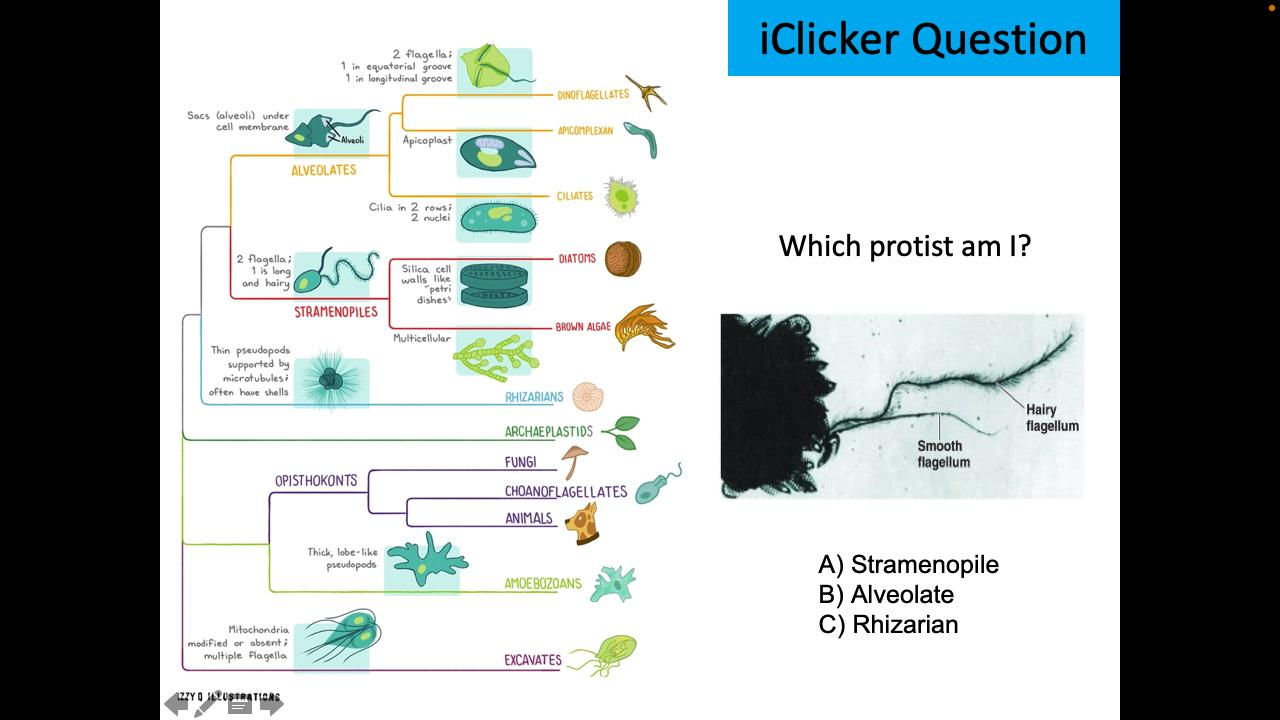
Which protist am I?
stramenopile
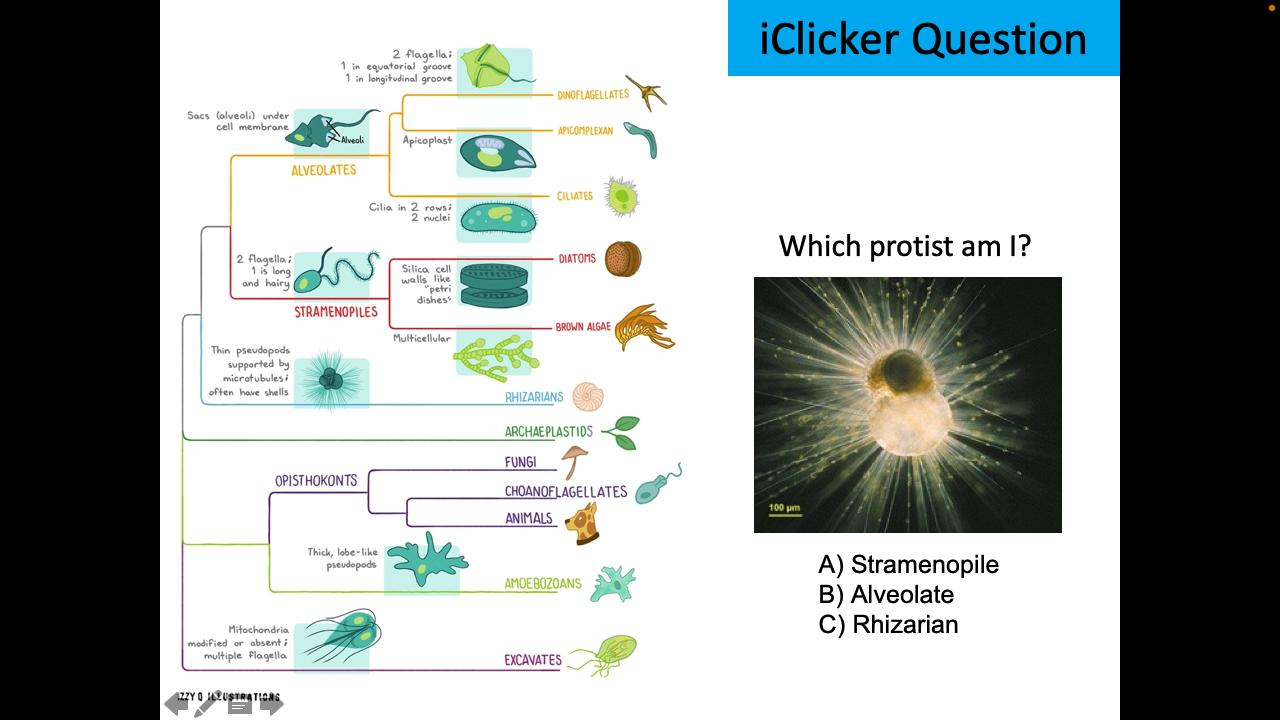
Which protist am I?
rhizarian
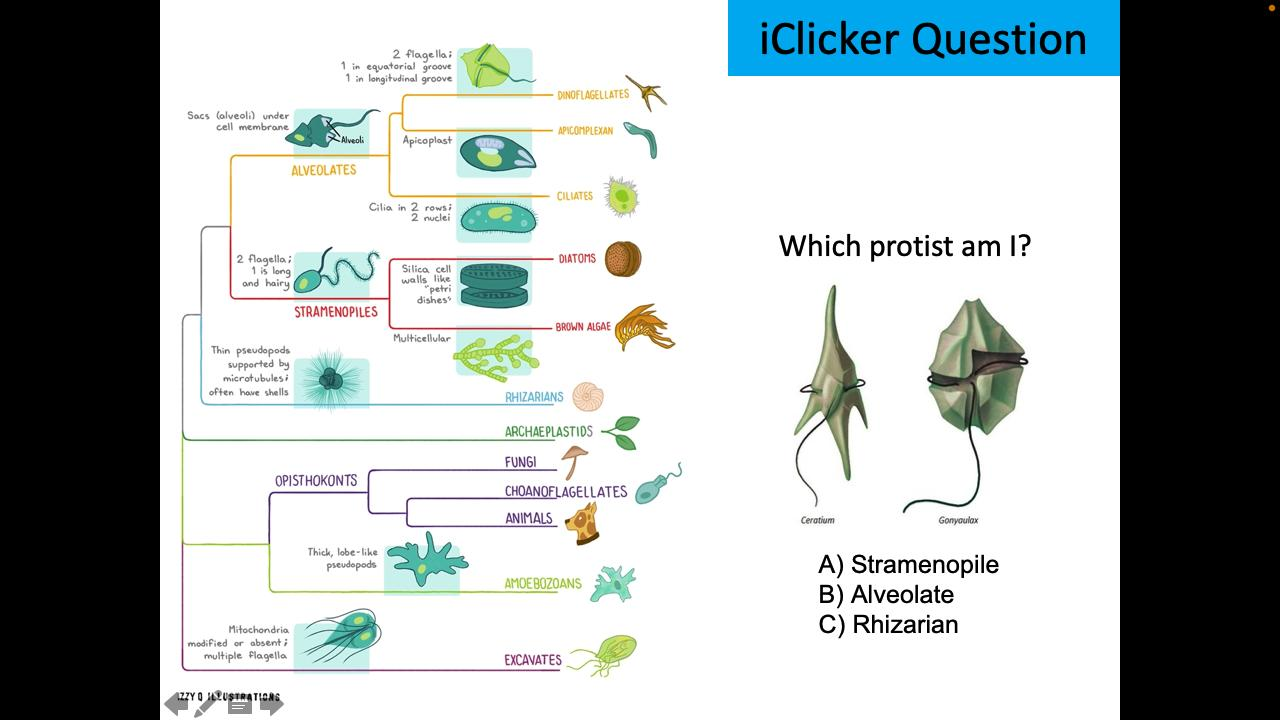
Which protist am I?
alveolate
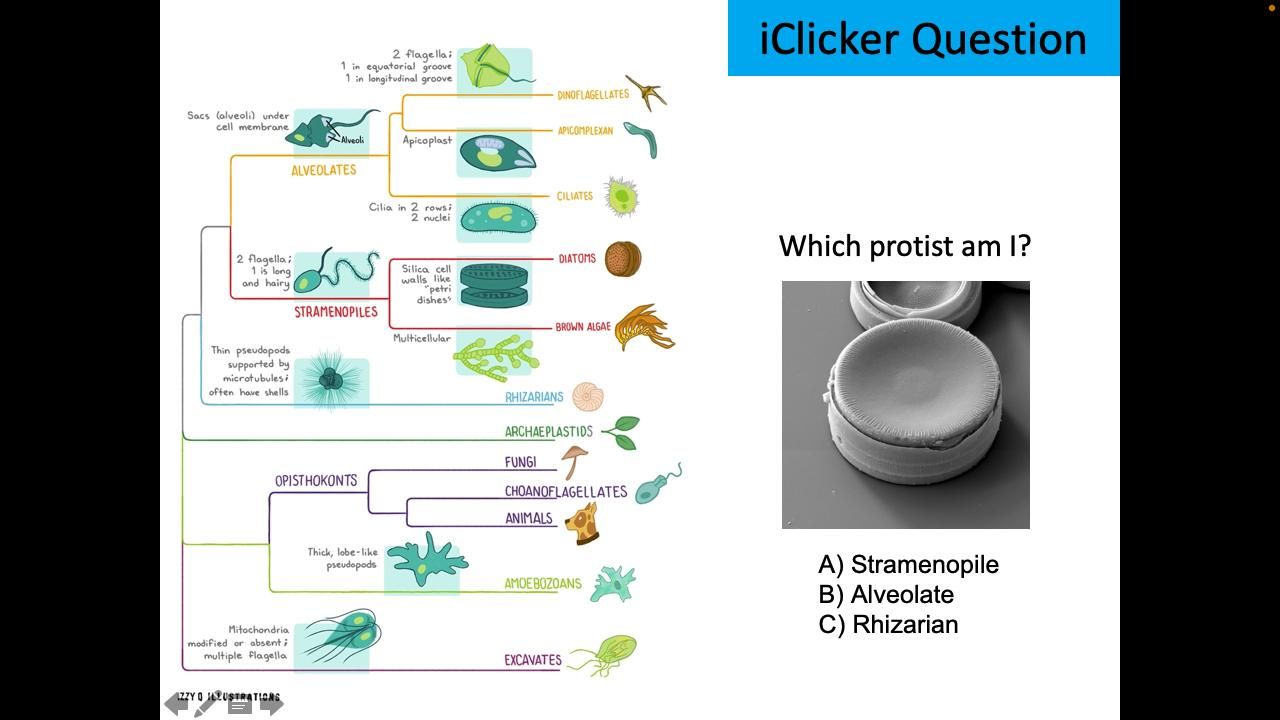
Which protist am I?
stramenopile
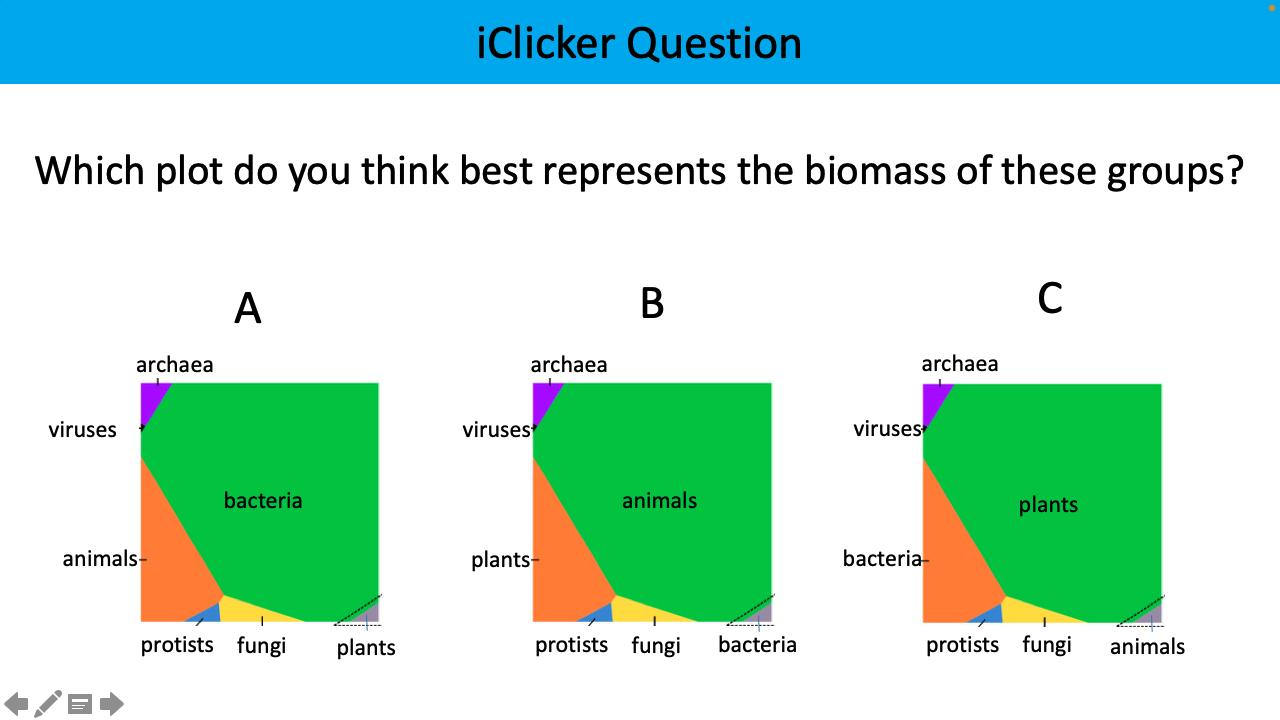
Which plot do you think best represents the biomass of these groups?
C - plants
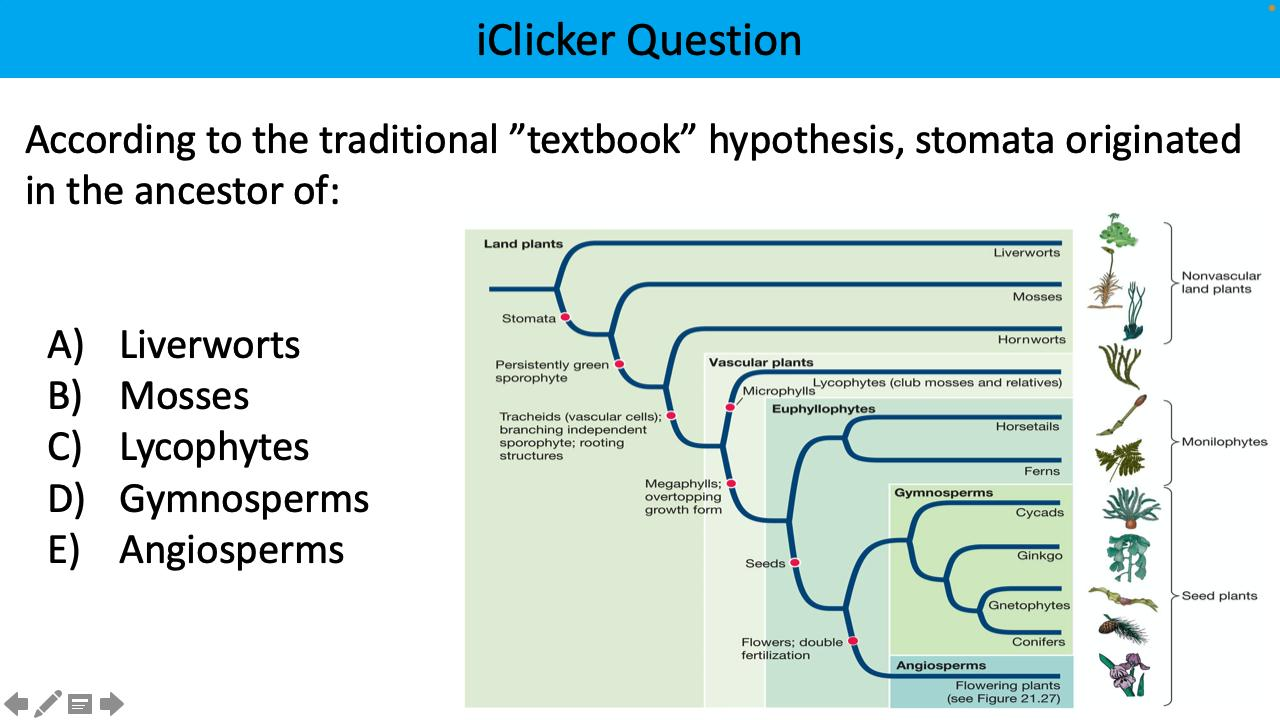
According to the traditional ”textbook” hypothesis, stomata originated in the ancestor of:
mosses
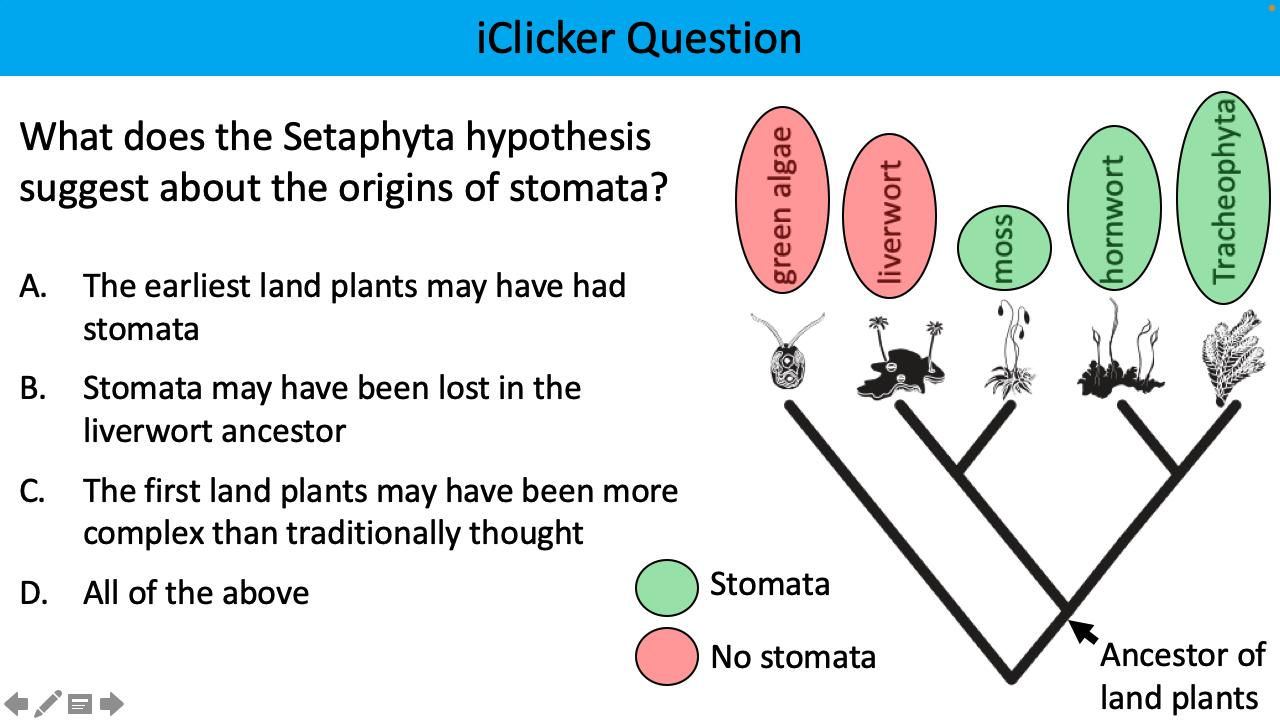
What does the Setaphyta hypothesis suggest about the origins of stomata?
All of the options
Which of these statements about mosses is correct?
Some moss form symbiotic associations with Nitrogen-fixing cyanobacteria
Which of the following statements regarding sister chromatids and homologous chromosomes are correct?
All of the options
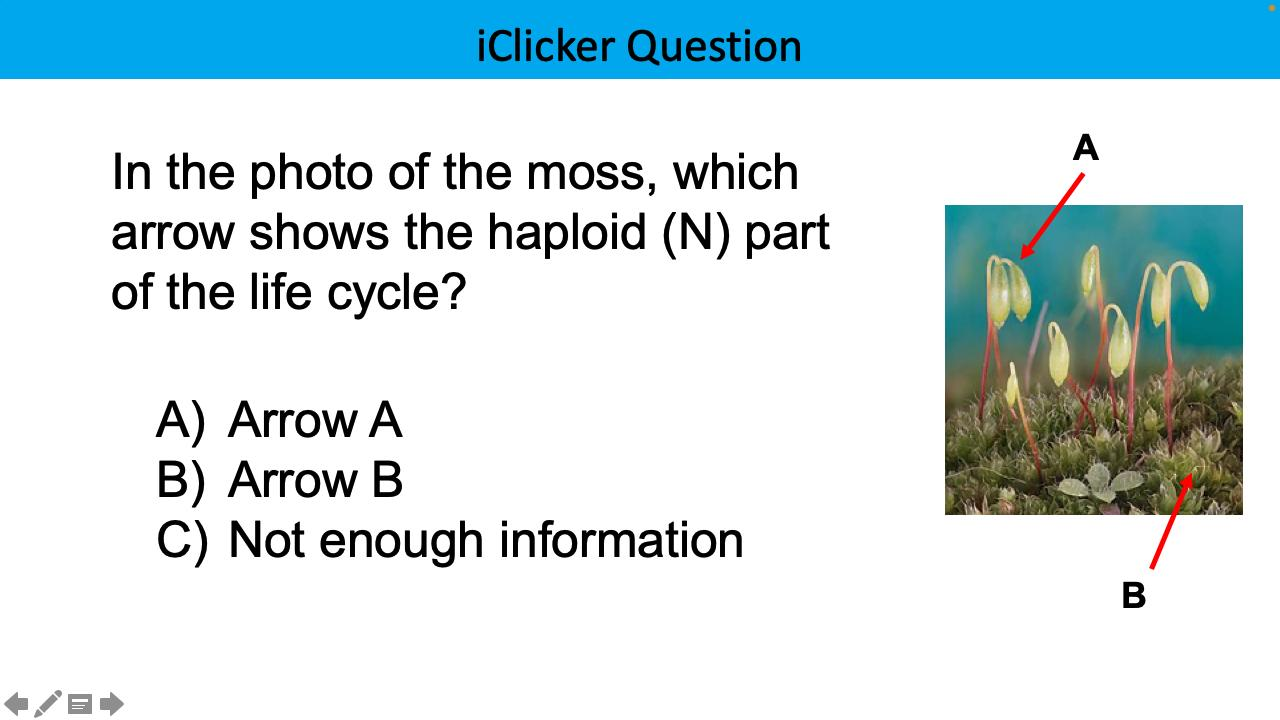
In the photo of the moss, which arrow shows the haploid (N) part of the life cycle?
Arrow B
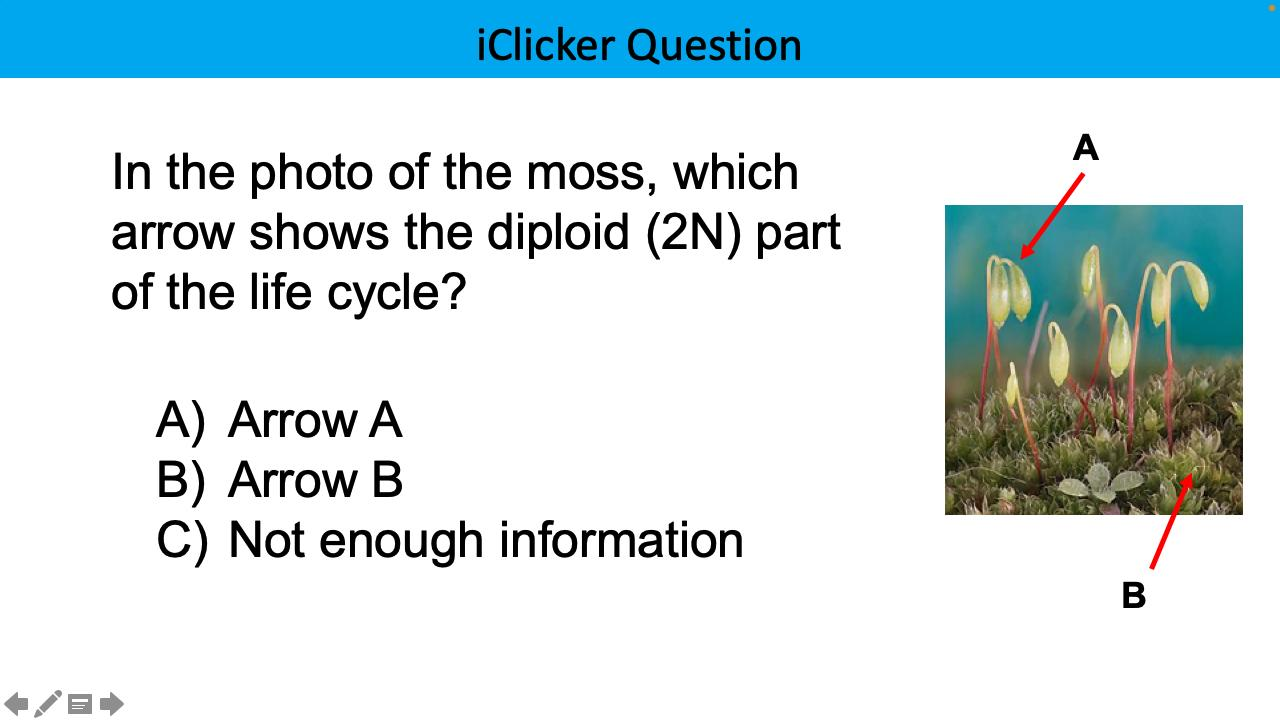
In the photo of the moss, which arrow shows the diploid (2N) part of the life cycle?
Arrow A
A major evolutionary trend during land plant diversification has been:
For the haploid gametophyte to become less prominent, and the diploid sporophyte generation to become more prominent.
The major evolutionary innovation(s) that allowed land plants to become so big and now constitute so much of the Earth’s biomass was:
tracheids and roots
We identified that a major challenge for plants colonizing the land was to reduce the reliance on water for getting sperm and egg together. A major innovation that enabled this to happen was:
pollen
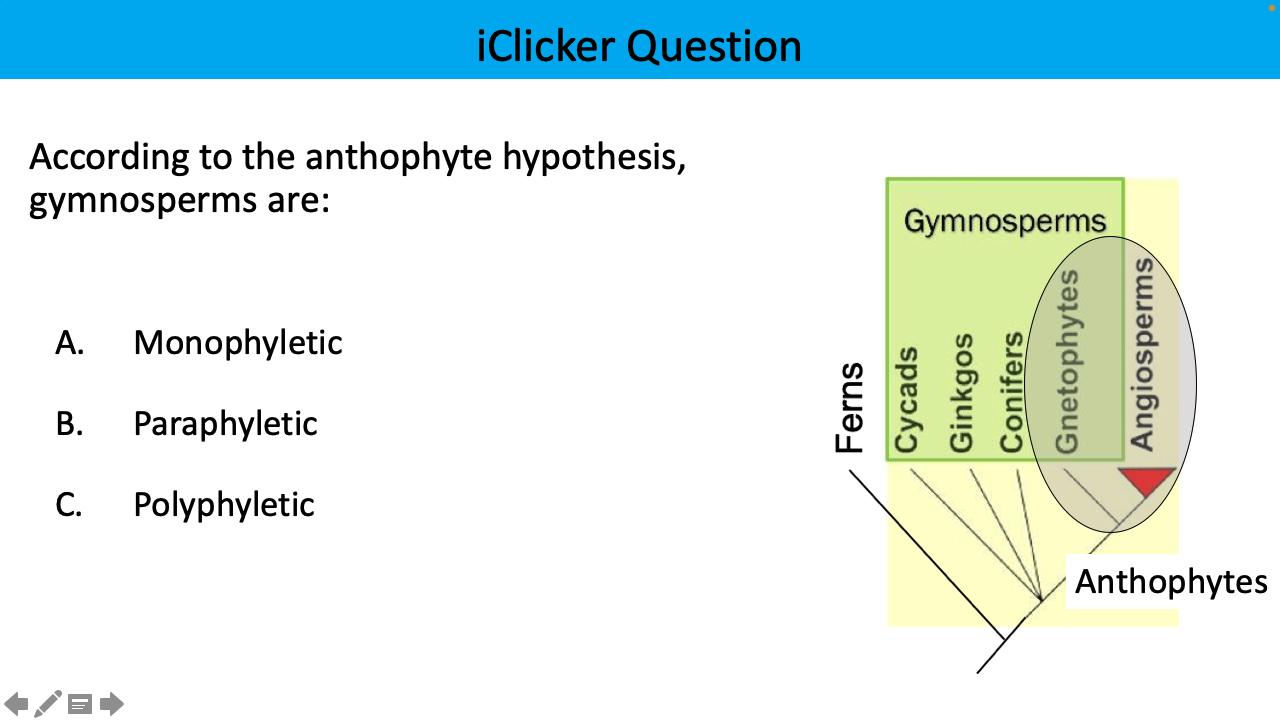
According to the anthophyte hypothesis, gymnosperms are:
paraphyletic
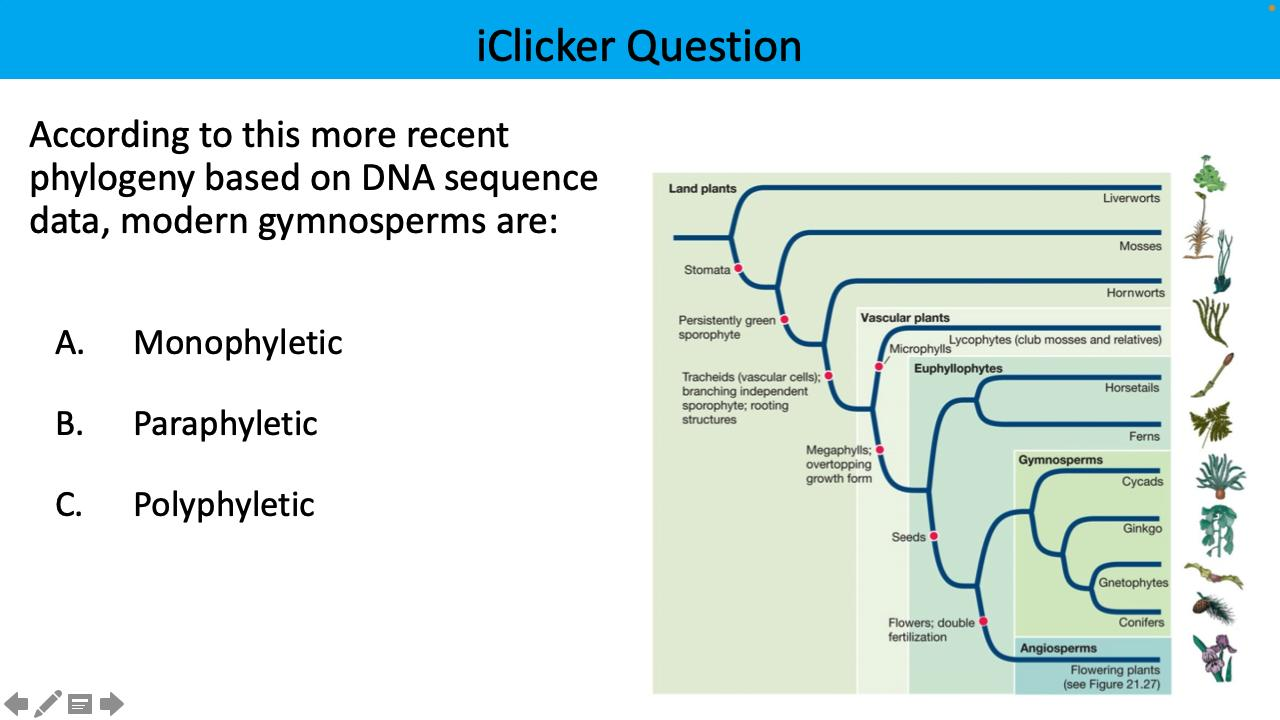
According to this more recent phylogeny based on DNA sequence data, modern gymnosperms are:
monophyletic
Many plants are capable of self-fertilization. That is, haploid pollen grains produce male gametes that can fertilize haploid female gametes produced by the ovule of the same plant. This is an example of:
sexual reproduction
The flowers of a new kind of tropical vine are bright scarlet in color but are not highly scented. These plants are most likely pollinated by:
birds
You discover a new angiosperm with very large white flowers that open at night and have a musty odor. This plant is most likely pollinated by:
bats
The fruit of Angiosperms is:
Used to entice seed dispersers.
You find a new species of plant with very small seeds with fleshy attachments that are rich in amino acids and fats. You suspect the plant is dispersed by:
ants
Normal car tire pressure is about 30 psi… how pressurized do you think plant cells are?
>5x that of tire pressure
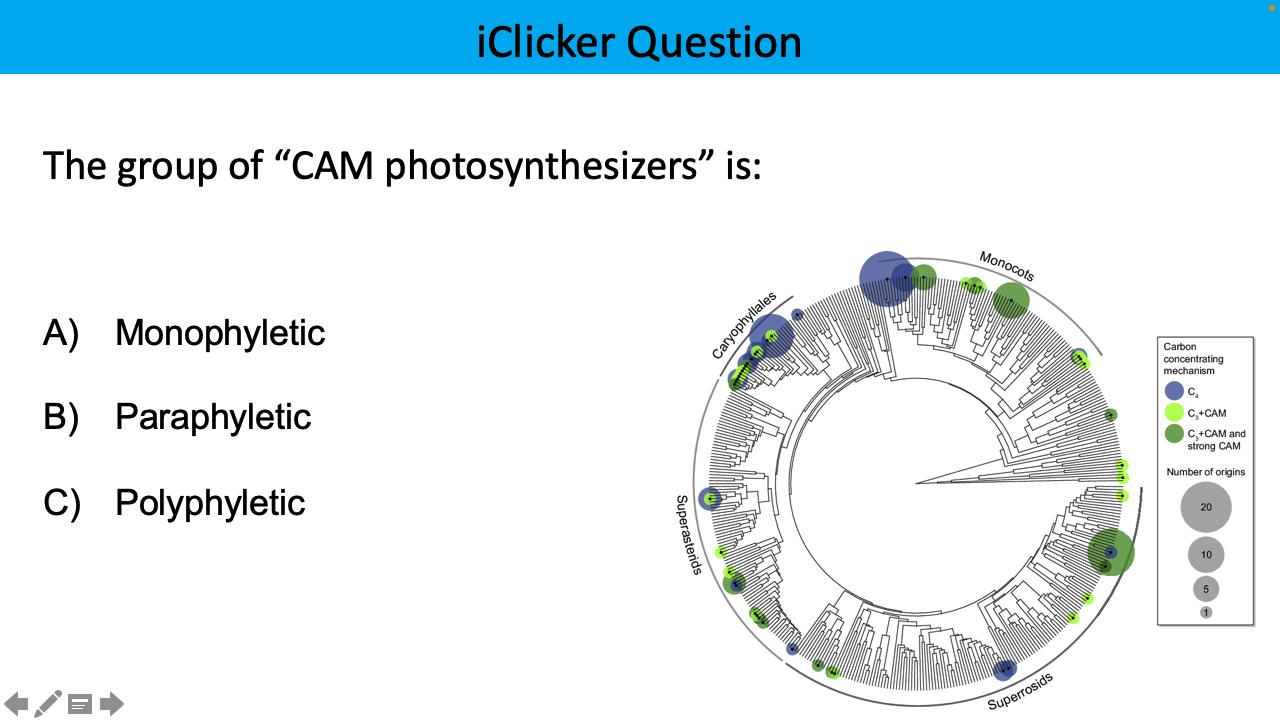
The group of “CAM photosynthesizers” is:
polyphyletic
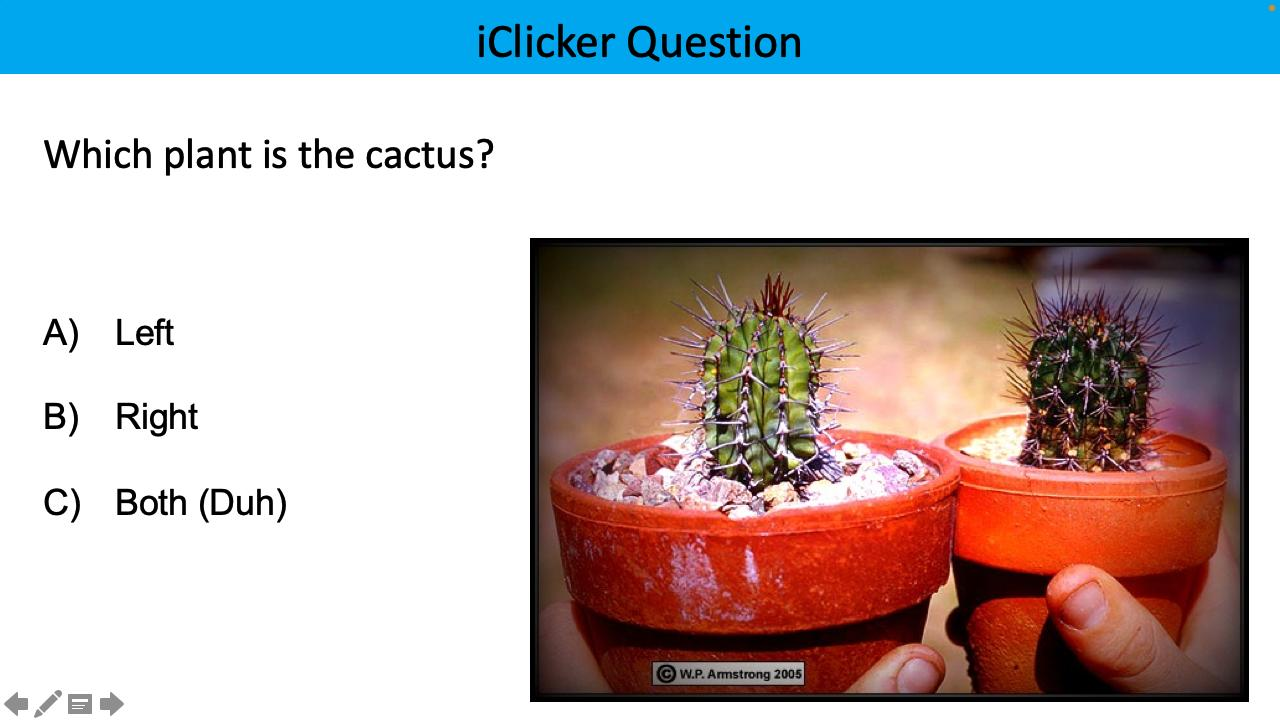
which plant is the cactus?
right
What puzzled Darwin so much about Angiosperms that he called it “the abominable mystery”?
Shortly after they appeared in the fossil record, they diversified very rapidly and now make up >99% of seed plant species
The closest unicellular relative of animals is a(n):
Choanoflagellate
If all fungi were to disappear, Earth’s _______ cycle would slow down greatly.
carbon
Fungi play a key role in:
All of the options
what is endosymbiosis?
One cell lives inside another and they both benefit.
What does the Endosymbiont Theory explain?
How mitochondria and chloroplasts came from bacteria living inside early cells.
Evidence for endosymbiosis?
Own DNA, double membranes, reproduce like bacteria.
what do both mitochondria and chloroplasts have?
double membranes
DNA
ribosomes
what is the Three-domain hypothesis?
Bacteria, Archaea, Eukarya are all separate groups.
what is the Eocyte hypothesis?
Eukaryotes evolved from within Archaea.
which hypothesis is better supported?
Eocyte hypothesis
are both the three-domain hypothesis and eocyte hypothesis correct?
no, neither is exactly correct. the eocyte hypothesis was correct about the eukaryote’s origin within archaea, but our closest relatives were archaea.
what are Asgard Archaea?
Closest known relatives to eukaryotes.
why are Asgard Archaea important?
They have cell features and proteins similar to eukaryotes (including proteins from the eukaryotic cytoskeleton)
bacteria vs. archaea
cell walls and membranes use different building blocks
package DNA differently
transcription machinery is different
look alike, but cells are very different
when did mitochondria likely evolve?
Early in eukaryote evolution (best-supported idea)
what are protists?
Diverse eukaryotes that aren’t plants, animals, or fungi.
Why are protists called a “garbage bin”?
They were grouped together just because they didn’t fit elsewhere.
What is primary endosymbiosis?
A cell directly engulfs a photosynthetic bacterium.
Is primary endosymbiosis common?
no, it’s rare.
What is secondary endosymbiosis?
A cell engulfs another eukaryote that already has a chloroplast
what are the major Archaeplastids?
Red algae, green algae, land plants
what are the major Opisthokonts?
animals and fungi
are most eukaryotes multicellular?
no, most are microscopic
did multicellularity evolve once?
no, many times independently
when did the 8 major clades of eukaryotes diverge?
about 1.5 BYA
what are stramenopiles?
two unequal flagella: 1 hairy, 1 hairless
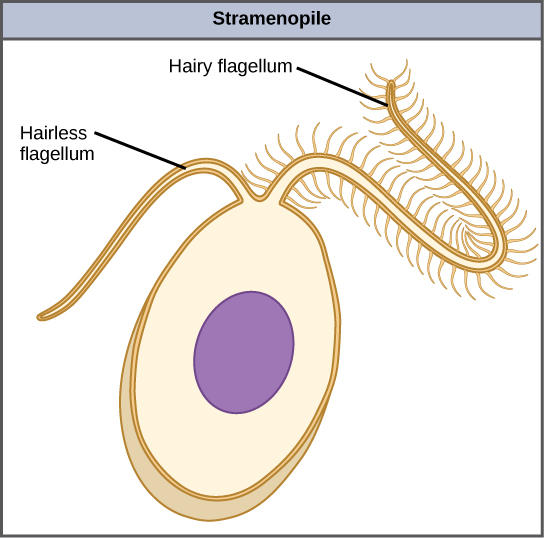
how was photosynthesis acquired in stramenopiles?
by secondary endosymbiosis of red alga
what are examples of stramenopiles?
unicellular diatoms, multicellular brown algae (and kelps), and nonphotosynthetic oomycetes
what are haptophytes?
mostly marine, unicellular, photosynthetic eukaryotes (algae), known for their role as major primary producers
what are haptophytes key components of?
phytoplankton
how are haptophytes similar to stramenopiles?
they are both examples of secondary endosymbiosis
what is an example of a haptophyte?
coccolithophores → cells are surrounded by calcium carbonate plates
what are alveolates?
unicellular organisms with hollow sacs on their peripheral membrane (arrow shaped)
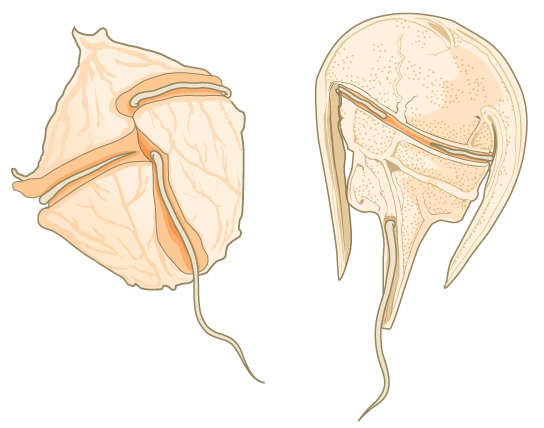
what are examples of alveolates?
marine dinoflagellates, parasitic apicomplexans, and highly motile ciliates
how did dinoflagellates acquire chloroplasts?
through tertiary endosymbiosis many times
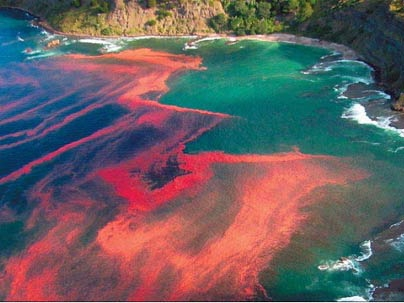
what do dinoflagellates cause?
red tides → massive fish kills and toxic shellfish poisoning
what is a type of apicomplexan?
Plasmodium → causes malaria
what do apicomplexans require to invade host cells?
a DNA-containing organelle called the apicoplast
where do apicoplasts come from?
derived from a chloroplast
what are rhizaria?
they have thin pseudopods supported by microtubules, mainly amoeboid (sun shaped)
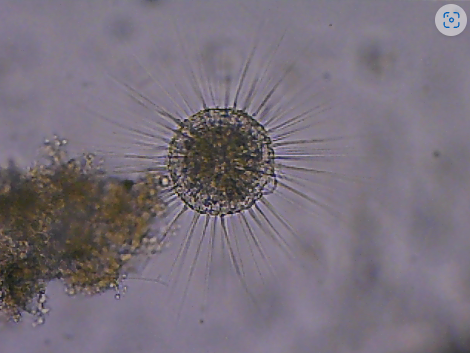
what is an example of rhizaria?
foraminiferans → foram shells and fossils made of calcium carbonate
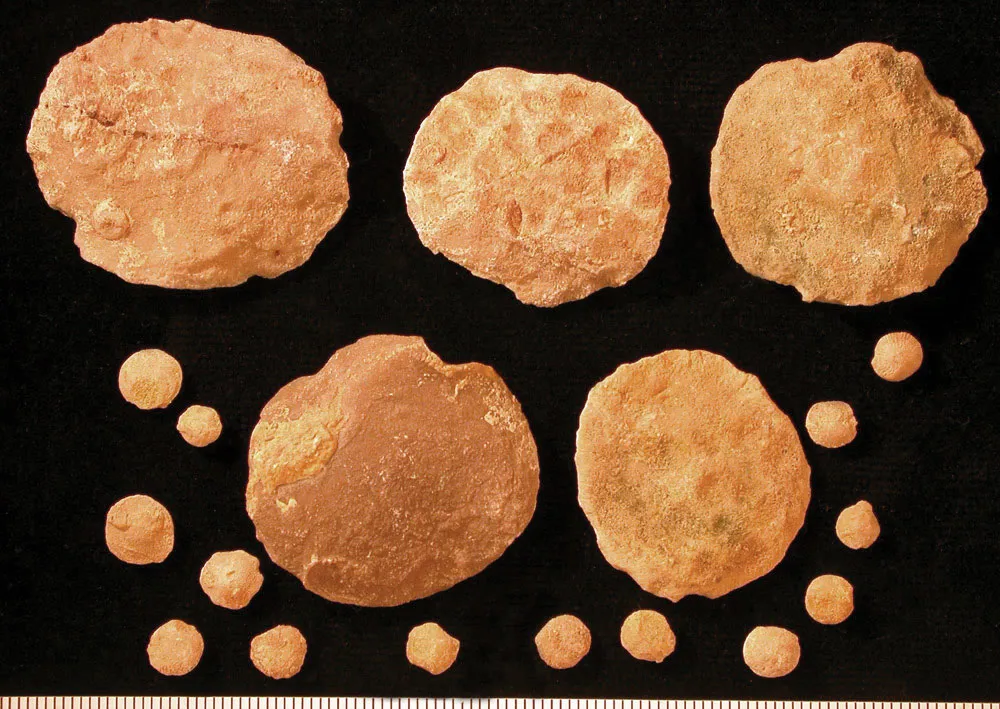
what are excavates?
many (but not all) have reduced mitochondria and multiple flagella (squid shaped)
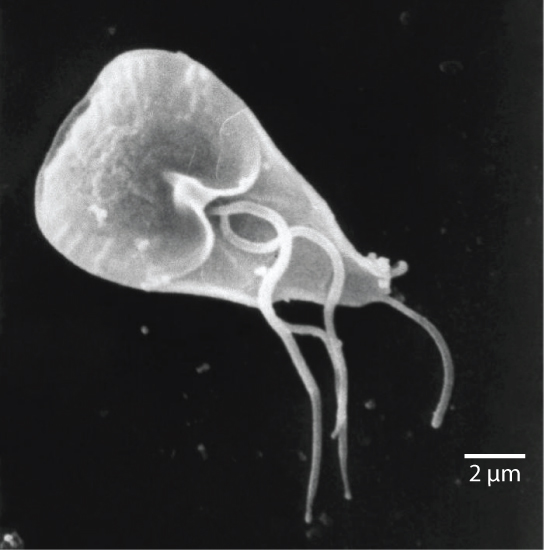
what are examples of excavates?
diplomonads, trypanosomes, and photosynthetic euglenids
what are amoeboza?
united by thick, lobe-shaped pseudopods used for feeding at some point in their life (blob shaped)
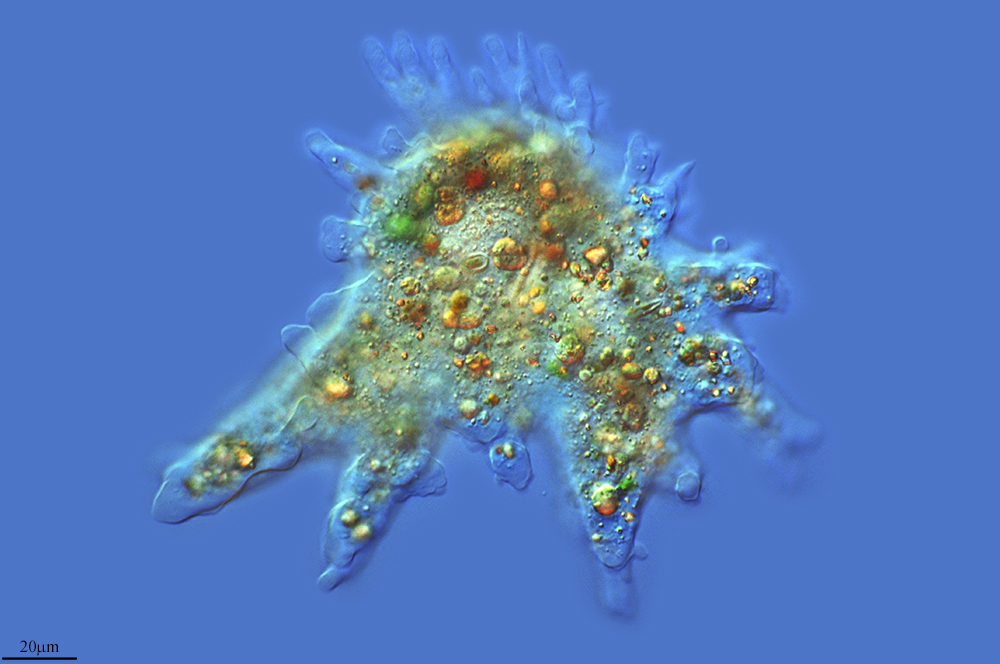
what are examples of amoeboza?
slime molds and dictyostelium
what are archaeplastids?
the direct descendants of the primary endosymbiosis that gave rise to the chloroplast
what were the first archaeplastids?
aquatic microbes
when did the earliest multicellular green algal “seaweed” evolve?
~1 BYA
when did the first land plants evolve?
~700 MYA (after archaeplastids arose)
when did old land plant spores evolve?
~500 MYA
when did the first forests develop?
~390 MYA
what were the challenges of plants moving to land?
drying out, no support, reproduction without water dispersal, getting nutrients
what happened to the first plants to colonize land?
they did not grow high and were periodically restricted to wet habitats

