mertons strain theory
 Studied by 0 people
 Call Kai
 Learn
Learn Practice Test
 Spaced Repetition
 Match
Match Flashcards
 Knowt Play
1/18

There's no tags or description
Looks like no tags are added yet.
Name | Mastery | Learn | Test | Matching | Spaced | Call with Kai |
|---|
No analytics yet
Send a link to your students to track their progress
19 Terms
how do strain theories argue that people engage in deviant behaviour ?
For example, they may become f____ and resort to c____ m___ of getting what they want or lash out at others in a____, or find comfort for their f____ in d____ u____
Stram theories argue that people engage in deviant behaviour when they are unable to achieve socially approved goals by legitimate means.
For example, they may become frustrated and resort to criminal means of getting what they want or lash out at others in anger, or find comfort for their failure in drug use.
The first strain theory was that developed by who? that adapted which of Durkheim’s concepts?
The first strain theory was that developed by the functionalist Robert K. Merton (1938), who adapted Durkheim's concept of anomie to explain deviance.
what does Anomie means?
Durkheim argued that in times of r____ s___ c___, people no longer know what is e____ of them, creating c____ and l____ of g___, which can lead to d___ b___.
Anomie means a state of normlessness — when society’s rules and values become unclear, weakened or break down.
Durkheim argued that in times of rapid social change, people no longer know what is expected of them, creating confusion and lack of guidance, which can lead to deviant behaviour.
Merton's explanation combines two elements - what are the 2 elements?
Merton's explanation combines two elements:
Structural factors - society's unequal opportunity structure.
Cultural factors - the strong emphasis on success goals and the weaker emphasis on using legitimate means to achieve them.
For Merton, deviance is the result of a strain between two things - what are these two things ?
For example, American culture values what?
For Merton, deviance is the result of a strain between two things:
The goals that a culture encourages individuals to achieve.
What the institutional structure of society allows them to achieve legitimately.
For example, American culture values 'money success' - individual material wealth and the high status that goes with it.
The American Dream and strains to achieve it
The goal in the American Dream is m____ s____ and u____ s___ m____ (e.g., getting a g____ j____, e____ a g____ i____, o____ a h____, and achieving a c_____ l____).
Americans are expected to pursue this goal how?
what does the ideology of the American Dream tells Americans about their society?
The American Dream and strains to achieve it
The goal in the American Dream is material success and upward social mobility (e.g., getting a good job, earning a good income, owning a home, and achieving a comfortable lifestyle).
Americans are expected to pursue this goal through legitimate means:
self-discipline, studying, gaining qualifications, and working hard in a career.The ideology of the American Dream tells Americans that their society is meritocratic, meaning anyone who works hard can succeed because opportunities are supposedly available to all.
The American Dream and strains to achieve it
However Merton believed that the reality of the American Dream is m____ d____.
Many disadvantaged groups are denied what?
As a result the strain between what 2 things? means to achieve it produces f___, and this in turn leads to a p____ to resort to i_____ means such as c____ to achieve it.
Merton calls this pressure to d____, the strain to a____.
According to Merton, the pressure to d___ is further increased by the fact that American c____ puts more emphasis on achieving success at any price than upon doing so by legitimate means.
Winning the game becomes more important than what?
The American Dream and strains to achieve it
However Merton believed that the reality of the American Dream is much different.
Many disadvantaged groups are denied opportunities to achieve legitimately. E.g. poverty, inadequate schools and discrimination in the job market may block opportunities for many ethnic minorities.
As a result the strain between the cultural goal of money and success and the lack of legitimate means to achieve it produces frustration, and this in turn leads to a pressure to resort to illegitimate means such as crime to achieve it.
Merton calls this pressure to deviate, the strain to anomie.
According to Merton, the pressure to deviate is further increased by the fact that American culture puts more emphasis on achieving success at any price than upon doing so by legitimate means.
Winning the game becomes more important than playing by the rules.
The American Dream and strains to achieve it
summarise the process of the america dream and the strain to crime
The American Dream and strains to achieve it
To summarise,
Cultural goal of success
⬇
Creates strong desire to achieve it
⬇
Blocked / unequal opportunities
⬇
Creates pressure (strain) to find alternative ways to succeed
⬇
Weak social norms fail to stop deviance
⬇
Some individuals turn to illegitimate means → crime
Deviant adaptations to strain
Merton uses strain theory to explain what?
He argues that an individual's position in the social structure affects what?
Logically, there are five different types of a_____, depending on whether an i_____ a____, rejects or replaces approved c____ g____ and the l____ means of a____ them.
Deviant adaptations to strain
Merton uses strain theory to explain some of the patterns of deviance found in society.
He argues that an individual's position in the social structure affects the way they adapt or respond to the strain to anomie.
Logically, there are five different types of adaptation, depending on whether an individual accepts, rejects or replaces approved cultural goals and the legitimate means of achieving them.
Deviant adaptations to strain
What are the 5 different types of adaptations to strain. (How people respond to pressure by turning to deviant or criminal behaviour) ?
Deviant adaptations to strain
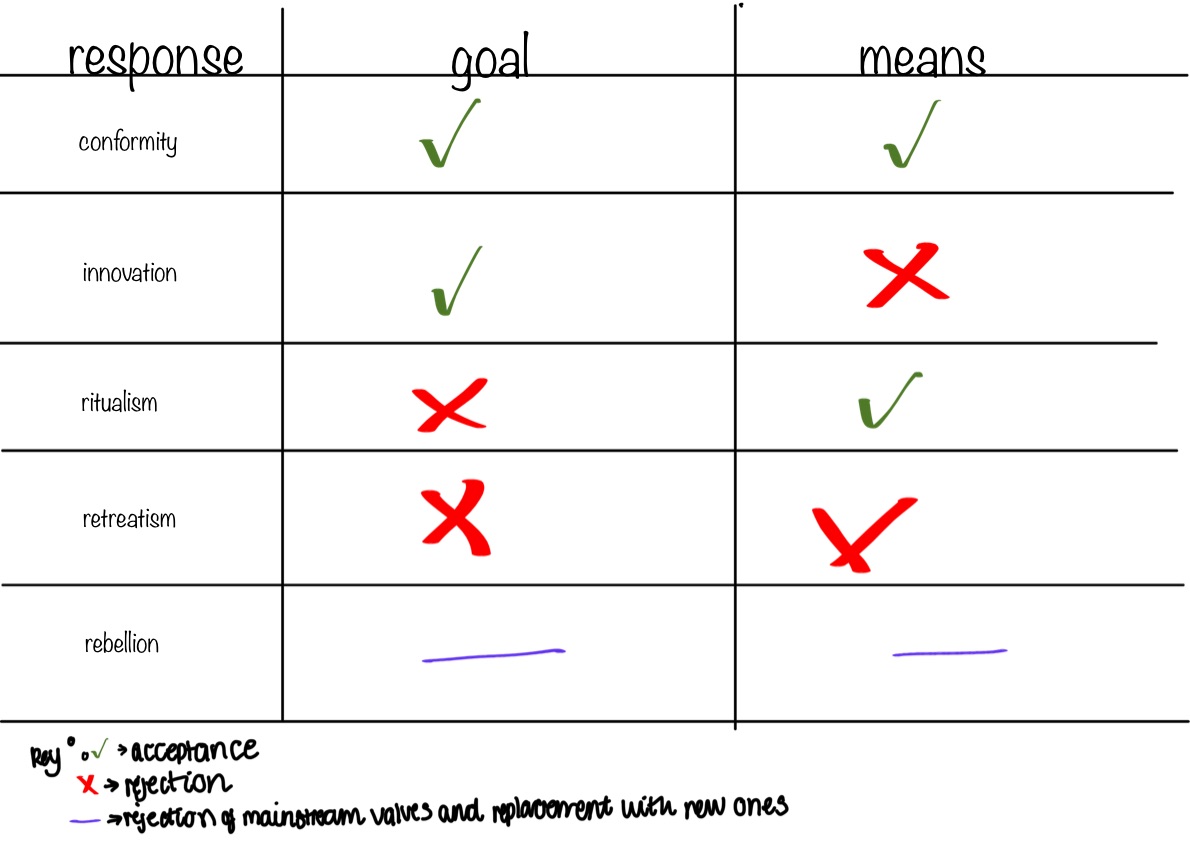
conformity
innovation
ritualism
retreatism
rebellion
Deviant adaptations to strain - Conformity
Individuals accept the c____ a____ goals and strive to a____ them like .
This is most likely among what type of individuals who have good o____ to achieve, but Merton sees it as the typical r____ of most A____.
Deviant adaptations to strain - Conformity
Individuals accept the culturally approved goals and strive to achieve them legitimately.
This is most likely among middle-class individuals who have good opportunities to achieve, but Merton sees it as the typical response of most Americans.
Deviant adaptations to strain - Innovation
Individuals accept what? but use 'n___', i____ means such as t___ or f___ to a____ i___.
As we have seen, those at the lower end of the class structure are under what?
Deviant adaptations to strain - Innovation
Individuals accept the goal of money success but use 'new', illegitimate means such as theft or fraud to achieve it.
As we have seen, those at the lower end of the class structure are under greatest pressure to innovate.
Deviant adaptations to strain - Ritualism
Individuals give up what? , but have i____ the l____ means and so they follow the rules for their own sake.
This is typical of who?
↓
They have been strongly socialised to r____ r____, p____, and h___ w____, so they continue to follow the l_____ m____ (e.g., turning up on t___, completing p___) even when they no longer believe what?
Their jobs offer little chance of p____ or a____ the cultural goal of f___ s____, so they stop striving for u___ m____ but still stick rigidly to the r____ because that is what they’ve been taught to value.
Deviant adaptations to strain - Ritualism
Individuals give up on trying to achieve the goals, but have internalised the legitimate means and so they follow the rules for their own sake.
This is typical of lower-middle class office workers in dead-end, routine jobs.
↓
They have been strongly socialised to respect rules, procedures, and hard work, so they continue to follow the legitimate means (e.g., turning up on time, completing paperwork) even when they no longer believe these efforts will lead to success.
Their jobs offer little chance of promotion or achieving the cultural goal of financial success, so they stop striving for upward mobility but still stick rigidly to the rules because that is what they’ve been taught to value.
Deviant adaptations to strain - Retreatism
Individuals rejectwhat 2 things? and become d____.
Merton includes who as examples?
Deviant adaptations to strain - Retreatism
Individuals reject both the goals and the legitimate means and become dropouts.
Merton includes psychotics, outcasts, vagrants, tramps, chronic drunkards and drug addicts' as examples.
Deviant adaptations to strain - Rebellion
Individuals reject what? , but they replace them with n___ ones in a desire to bring about what?
Rebels include p____ r___ and c___-c___ such as h___.
Deviant adaptations to strain - Rebellion
Individuals reject the existing society's goals and means, but they replace them with new ones in a desire to bring about revolutionary change and create a new kind of society.
Rebels include political radicals and counter-cultures such as hippies.
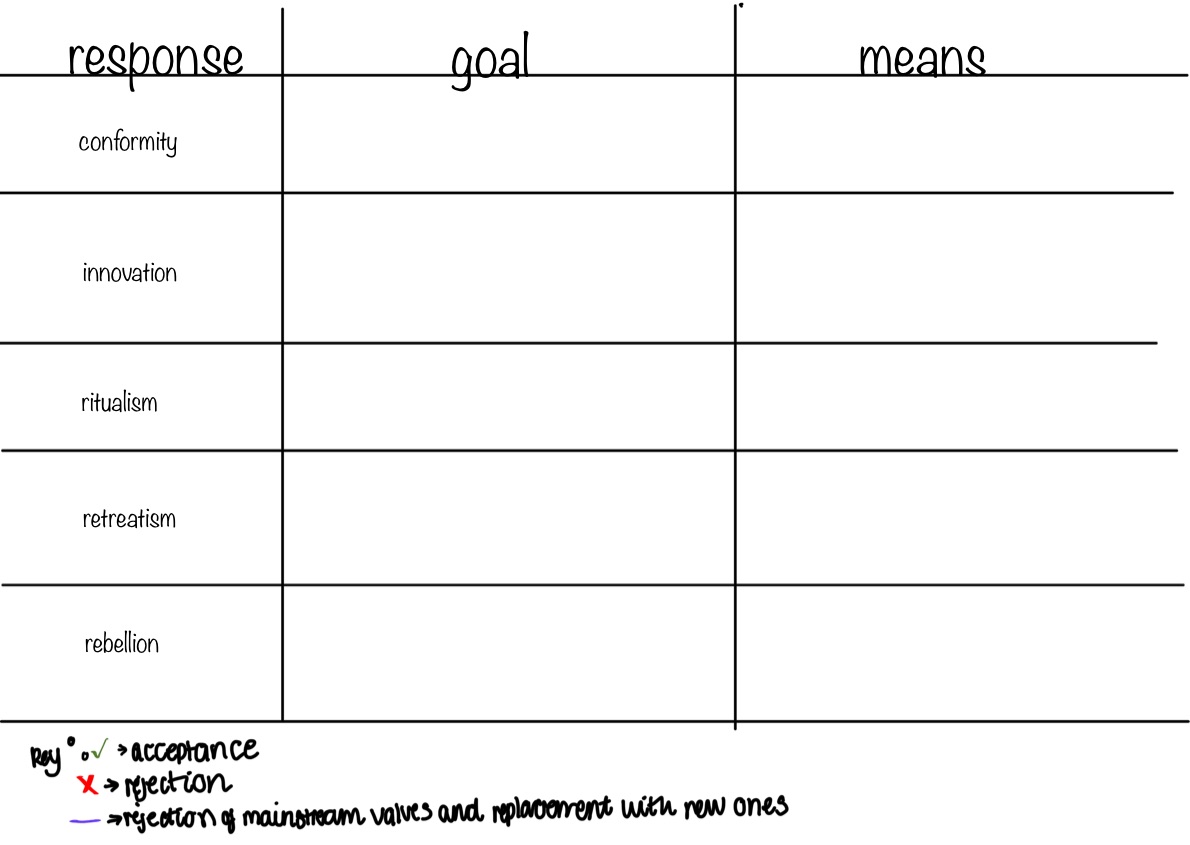
Deviant adaptations to strain
fill out how different reactions respond to goals and means
Evaluation of Merton - ✓- strengths
✓- Merton shows how both n____ and d____ behaviour can arise from the same m____ g___.
Both c____ and i____ are pursuing m____ s____ - one g____, the other i____.
✓- He explains the patterns shown in o___ c___ s____:
Most crime is property crime, _ why?
Lower-class crime rates are higher, - why?
Evaluation of Merton - ✓- strengths
✓- Merton shows how both normal and deviant behaviour can arise from the same mainstream goals.
Both conformists and innovators are pursuing money success - one legitimately, the other illegitimately.
✓- He explains the patterns shown in official crime statistics:
Most crime is property crime, because American society values material wealth so highly.
Lower-class crime rates are higher, because they have least opportunity to obtain wealth legitimately.
Evaluation of Merton - ✗limitations
✗- It takes official crime statistics at f_____ v___.
These over-represent what crime? , so Merton sees crime as a mainly what?
It is also too deterministic: - why?
B____ (1963) shows that crime statistics are b____ and s______ c____, supporting the claim that Merton wrongly accepts them as o___.
✗- Marxists argue that Merton ignores what?
As C____ (1975) shows, laws often serve the i____ of the b_____, meaning that w_____-c____ behaviours are more likely to be labelled c___ while the crimes of the wealthy are i____ or h___
✗- It assumes there is a v____ c_____ - that everyone strives for 'm______ s____' - and ignores the possibility that many may not s____ this g____.
✗- It only accounts for what type of crime , and not shat other types of crimes? is also hard to see how it could account for s___ c____ such as g_____ or t____.
✗- It explains how deviance results from individuals adapting to the strain to anomie but ignores what?
Evaluation of Merton - ✗limitations
✗- It takes official crime statistics at face value.
These over-represent working-class crime, so Merton sees crime as a mainly working-class phenomenon
It is also too deterministic: the working class experience the most strain, yet they don't all deviate.
Becker (1963) shows that crime statistics are biased and socially constructed, supporting the claim that Merton wrongly accepts them as objective.
✗- Marxists argue that Merton ignores the power of the ruling class to make and enforce laws in ways that criminalise the poor but protect the rich.
As Chambliss (1975) shows, laws often serve the interests of the bourgeoisie, meaning that working-class behaviours are more likely to be labelled criminal while the crimes of the wealthy are ignored or hidden
✗- It assumes there is a value consensus - that everyone strives for 'money success' - and ignores the possibility that many may not share this goal.
✗- It only accounts for utilitarian crime for monetary gain, and not crimes of violence, vandalism etc. It is also hard to see how it could account for state crimes such as genocide or torture.
✗- It explains how deviance results from individuals adapting to the strain to anomie but ignores the role of group deviance, such as delinquent subcultures.
Evaluation of Merton - ✗limitations
on what 2 grounds does Cohen (subcultural strain theories) criticise?
Evaluation of Merton - ✗limitations
✗- Merton sees deviance as an individual response to strain, ignoring the fact that much deviance is committed in or by groups, especially among the young.
Merton focuses on utilitarian crime committed for material gain, such as theft or fraud. He largely ignores crimes such as assault and vandalism, which may have no economic motive.
 Note
Note  Flashcards (43)