HC: Alkenes (w/ Alkynes)
 Call Kai
 Learn
Learn Practice Test
 Spaced Repetition
 Match
Match Flashcards
 Knowt Play
1/40

Earn XP
Description and Tags
Name | Mastery | Learn | Test | Matching | Spaced | Call with Kai | Chat |
|---|
No analytics yet
Send a link to your students to track their progress
41 Terms
true or false: majority of drugs are alkenes
true or false: alkynes are rare in drugs
olefins
other name for alkenes
acetylenes
other name for alkynes
oil forming
olefins meaning
double bond
fxn group of alkene
unsaturated or saturated?
alkenes are unsaturated
degree of unsaturation
number of rings and/ or multiple bonds on the molecule
thermal cracking
breaking large hydrocarbons into smaller ones using heat
(alkene + steam + 900° + few seconds —→ alkene)
characteristics of alkene
nonpolar
liquid at room temperature
less dense than water
aliphatic
unsaturated
due to multiple HC
reason why alkenes are non-polar
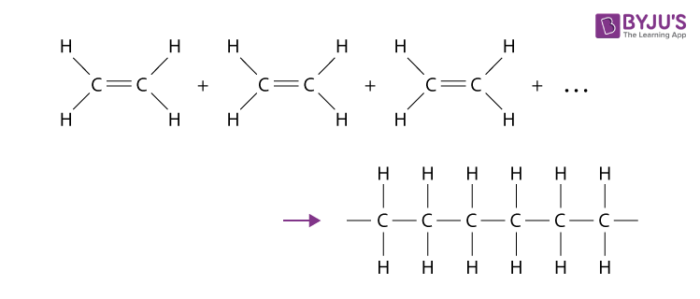
polymerization
repeated molecule units
alkynes
contains at least 1 triple bond
CnH2n-2
general formula for alkynes that has only 1 triple bond
triple bond
fxn group of alkynes
-yne
suffix for alkynes in iupac naming
-ene
suffix for alkenes in iupac naming
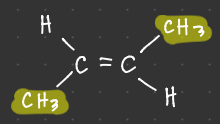
trans-2-butene
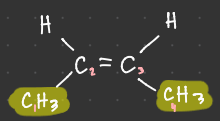
cis-2-butene
E-entgegen
heavy and opposite sides
Z-zusammen
heavy and same side
E,Z naming using Cahn-Ingold-Prelog system
System of naming based on the 4 substituents around the double bond
Alkene stability
depends on how many alkyl groups (carbon groups) are attached to the double bond.
tetrasubstituted > trisubstituted > disubstituted > monosubstituted
stability of alkenes in decreasing order
true or false: more alkyl groups = more stable alkene
tetrasubstitued
most stable alkene; 4 alkyl groups around C=C
monosubstitued
least stable alkene; 1 alkyl group around C=C
Electrophilic addition
Markovnikov’s Rule
reaction of alkenes
Electrophilic Addition
double or triple bond is broken, and two new single bonds are formed. It occurs when an electron-rich bond (like a \(C=C\) double bond) is attacked by an electrophile (an electron-loving, positively charged or neutral species)
Markovnikov’s rule
helps predict where atoms attach in unsymmetrical alkenes; “the rich gets richer”; carbon with more H gets more H.; the double bond breaks
Hydrochlorination
Hydration
Hydrogenation
Bromination
4 reactions of alkenes
Hydrochlorination
addition of HCl to an alkene; product: haloalkane/ alkylhalide; follows Markovnikov’s rule
Hydration
addition of H2O to an alkene w/ catalyst like H2SO4;
product is an alcohol (-OH);
follows Markovnikov’s rule
Bromination
addition of Bromine (Br2) to an alkene;
product: dibromoalkane;
adds Br across both carbons equally;
does not follow Markovnikov’s rule
Hydrogenation
addition of H2 (hydroen) to an alkene with Ni, Pt, or Pt catalyst
Product: Alkane
Gives a fully saturated alkane
= reduction
Hydrochlorination
Hydration
rxns that follows Markovnikov’s rule
Bromination
Hydrogenation
does not follow Markovnikov’s rule

hydrochlorination

hydration

bromination
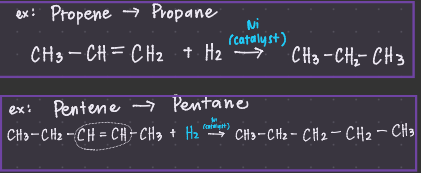
hydrogenation