Wave Intensity
 Studied by 0 people
 Call Kai
 Learn
Learn Practice Test
 Spaced Repetition
 Match
Match Flashcards
 Knowt Play
1/17

There's no tags or description
Looks like no tags are added yet.
Name | Mastery | Learn | Test | Matching | Spaced | Call with Kai |
|---|
No analytics yet
Send a link to your students to track their progress
18 Terms
Progressive waves transfer:
Energy
The intensity of a wave is the:
Amount of energy passing through a unit area per unit time
Intensity of a wave is defined as:
Power per unit area
Equation for intensity:
I=P/A, where I is intensity in W/m², P is power in W, and A is area in m²
The area the wave passes through is perpendicular to the:
Direction of its velocity
The intensity of a progressive wave is proportional to:
Amplitude squared and frequency squared
If the frequency of a wave is doubled, the intensity:
Increases by a factor of 4 (2²)
If the amplitude of a wave is doubled, the intensity:
Increases by a factor of 4 (2²)
A spherical wave is a:
Wave from a point source which spreads out equally in all directions
The area that a spherical wave passes through is the:
Surface area of the sphere
The surface area of a sphere is:
4 pi r²
As spherical waves travel further from the source, the energy it carries passes through:
Increasingly larger areas
Draw a diagram of spherical waves:
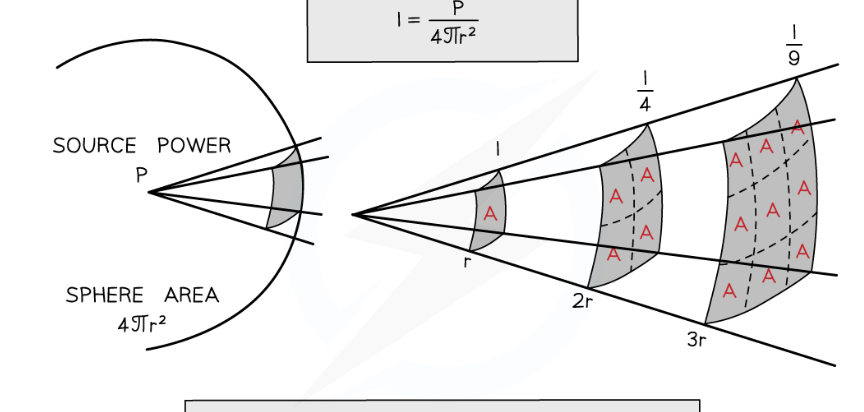
Equation for intensity at surface of sphere from which a spherical wave spreads out from:
I=P/(4 pi r²)
As energy from spherical waves moves by a factor of a times the distance away from the source, the intensity is:
1/a² of the initial intensity
Why is the intensity of spherical waves 1/a² of the initial intensity when the wave is a times the distance from the source?
Because I=P/ (4 pi r²), so if radius is increased by factor of a, intensity is increased by factor of 1/a²
Intensity of spherical waves is proportional to:
Amplitude squared
The intensity of a spherical wave decreases with:
Increasing distance from source
 Note
Note  Flashcards (26)