Terms List for Midterm - Islamic Architecture
 Studied by 6 people
 Call Kai
 Learn
Learn Practice Test
 Spaced Repetition
 Match
Match Flashcards
 Knowt Play
1/81

There's no tags or description
Looks like no tags are added yet.
Name | Mastery | Learn | Test | Matching | Spaced | Call with Kai |
|---|
No analytics yet
Send a link to your students to track their progress
82 Terms
Art History
The writing about art from all around the world and all time periods. (Giorgio Vasari’s Lives of the Artists from the 16th century is often considered the first work of art history.)
Islamic Art History
The study of art and architecture made by people who identify with the Islamic faith, lived under Muslim governments, and or are influenced by Islamic ideals and styles
Islam
A monotheistic religion in which you believe in Allah (God) and believe that the Prophet Muhammad was the final prophet of Islam.
Muslim
A follower of the religion of Islam
Mecca
Mecca is known as the Holy City of Islam. It is located in Saudi Arabia, and is the home location of the Kaaba and the Black Stone.
Medina
The second holy city also known; where Muhammad and his followers arrived after the hijra
The Prophet Muhammad
The final Prophet of Islam, born in Mecca; Quran was revealed to Prophet Muhammad.
Hijra
The pilgrimage that the prophet Muhammad made from Makkah to Medina that marks the start of the Islamic calendar
Lunar Calendar
A calendar based on the monthly cycles of the Moon phases. The Islamic calendar is a lunar calendar
Kaaba
Black, cube shaped structure in a courtyard in Mecca. It holds the sacred stone. It is a Holy Site.
Minaret
A tall, slim tower that was/is used for the call to prayer. It is also a symbol of Islam.
Azan
The Azan is the ‘call to prayer’ prayer, that is called from the Minaret by the Muezzin
Muezzin
The person who calls the community to prayer; symbolic figure
Qibla wall
The wall in a mosque that faces Mecca, the holy city towards which Muslims perform their prayers
Ablutions Fountain
A fountain in which people make the mandatory ablution before prayer
Minbar
Raised platform (with stairs) where the sermon is delivered
Mihrad
The prayer niche that denotes the direction of Mecca
Qubba
It is the Arabic word for dome, may symbolically represent heaven.
Waqf
An Islamic trust set up by an individual or a community to support the public with education, food security, and health care. (Ex: Suleymaniye Mosque)
Ramadan
Is the ninth Islamic Lunar month. Individuals that are healthy and able are required to fast for the entire month, from sunup to sundown. This is also the month the Quran was revealed to the prophet Muhammad.
Calligraphy
Comes from the Greek word Calla meaning beautiful and Graphy meaning writing. Arabic calligraphy is a prominent element of Islamic architecture.
Five Pillars of Islam
Are the core duties of a Muslim. (Shahada, Salat, Sawn, Zakah, Hajj)
Shahada
(Pillar of Islam) Word that means to proclaim faith in one God. It states: "There is no god but God, and Muhammad is his messenger”.
Salat
(Pillar of Islam) Five daily prayers facing the Ka’ba at the prescribed times
Sawm
(Pillar of Islam) This is the fasting, withholding from food, drink, and other physical needs from sunrise to sunset in the month of Ramadan.
Zakah
(Pillar of Islam) Means to give alms. It is the obligatory annual donation of 2.5% of a Muslim's wealth that has been above a minimum threshold (nisab) for a full lunar year.
Hajj
(Pillar of Islam) Is the pilgrimage to Mecca for every physically and financially able Muslim to be performed at least once in their lifetime.
Monotheism
The belief that there is only one single God. Judaism, Christianity and Islam are all monotheistic religions.
Christianity
Originated in the 1st century CE, has about 2.2 billion followers. The main text is the Bible/ New Testament. Important figures in Christianity are: Jesus, Mary, Abraham, and Moses.
Judaism
Originated in 2000 B.C.E. There are 15 million followers around the globe. Important figures in Judaism are Abraham and Moses.
Qur’an
Holy book of Islam; revealed to the prophet Mohammad in the language of Arabic. The Quran provides detailed accounts of the stories of Abraham, Moses, Jesus, and numerous other prophets.
Hadith
Arabic word that means “report” or an “account”. These are the sayings, traditions, and practices of the Prophet Muhammad, which are reported by the companions of the Prophet. Muslims use it as a guide to understand the Quran and daily life activities.
Isnad
Arabic word that means a chain of narration. The Haith are considered authentic if many people state the same facts. Scholars evaluate the credibility of each person in the isnād to determine the strength of a Hadith.
Abrahamic
This term refers to the three Abrahamic faiths: Judaism, Christianity, and Islam. These religions honor the faith and dedication of Abraham to one God and the sacrifice of his son, which was replaced with a ram..
Mosque
The Muslim place of worship. The Arabic word for Mosque is Masjid, which means a place of prostration or worship. It often serves as a place of community gatherings and religious education.
Allah
The Arabic word for God. In Islam, Allah is the same God as the God Jews and Christians believe in. It means that there is only one God.
Ummah
Is an Arabic word meaning 'community,' often referring to the global community of Muslims, united by the Qur'an, and considered brothers and sisters.
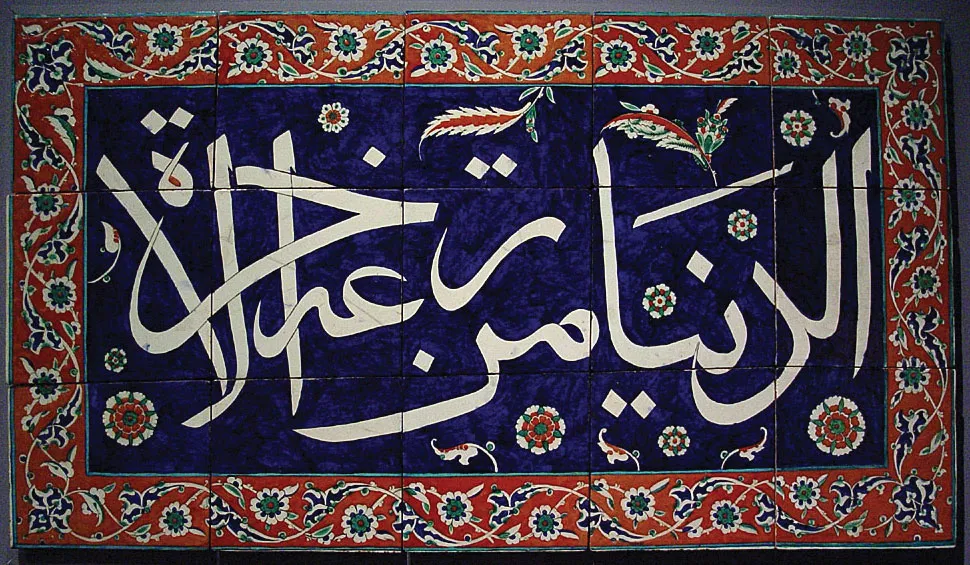
Thuluth

Kufic

Square Kufic
Muqarnas
Honey comb like architectural structure, interlocking geometric cells, without an actual structural function.
Pendentives
The transition between the circular dome and the square room, built in Byzantine architecture, with Hagia Sophia being one of the first.
Dome
The top half of a spherical shape, usually used for the roof of a structure.
Sunni
The largest sect of Islam, follow the sunnah, the teachings and practices of Muhammad, and believe the caliph should be elected rather than ancestry.
Shia
Second largest sect in Islam, they believe that Ali, the cousin and son-in-law of prophet Muhammad, and his descendants are the rightful successors to the Prophet
Ottoman
A major Islamic empire 1299-1922 known for monumental mosque architecture,blending Byzantine and Islamic styles e.g Suleymaniye mosque and the Blue Mosque.
Safavid
A Persian empire (1501–1736) that made Shi’a Islam the state religion and developed a rich artistic and architectural heritage in Iran.
Mughal
A Muslim dynasty that ruled India (1526–1857), blending Persian, Indian, and Islamic cultures and building landmarks like the Taj Mahal.
Umayyad
The first great Muslim dynasty after the Rashidun Caliphs, known for expanding the Islamic empire from Spain to India. Dome of Rock built under the Umayyads.
Byzantine
Byzantine empire 330-1453, its capital was Constantinople founded by Emperor Constantine, it was a Christian theocracy, Greek was the official language, Empire’s art and architecture heavily influenced early Islamic art especially in domes, mosaics and central plan buildings; Builders of the Hagia Sofia
Normans
The Normans ruled Sicily 12th centuries. They were Christian rulers but ruled over a multi religious population. They created a unique blend of Islamic, Byzantine & Latin art and architecture seen in monuments like Cappella Palatina.
Fatimid
Egyptian-North African dynasty, based in Cairo; adherents of Shia Islam; archiecture characterized by stone carving, Kufic inscriptions, and plain exteriors.
Ayyubid
Transitional style between Fatimid and Mamluk, with fortress-like mosques
Arabic
A semitic language spoken by people from regions in the Middle East and Northern Africa. Language of the Qur’an.
Turkish
Language of Turkey and Ottoman Empire. Written in Arabic script until the 1920s. Today written in Latin script.
Persian
Also known as Farsi; language of Iran, written in Arabic script. Court language of the Ottomans and Mughals.
Urdu
Indic language; Written in Arabic script, official language of Pakistan and widely used in India. Related to Hindi, but has many loan words from Persian and Arabic.
Topography
Where a building is located in its context and relationship to natural and manmade structures around it.
Ornament
Detail & Embellishment; A piece of architecture that was created solely for the purpose of decoration.
Scale
Size of the building/other architectural creation in reference to another (often to oneself)
Routes
Pathways for a specific purpose within a building/architectural creation
Pietra Dura
Method of inlaying colored stones in order to make a picture or design. Used at the Taj Mahal.
Haft Rangi
Means “seven colors”; highly decorative glazed tiles used to adorn the exteriors and interiors of both secular and religious buildings. Developed under Shah Abbas and used in the Masij-i Imam in Isfahan
Shah
“King” In Persian
Sultan
The main ruler or leader of a Muslim state, in this class, used for the rulers of the Ottoman empire
Mosaic
A picture or pattern produced by arranging together small colored pieces of hard material, such as stone, tile, or glass. Used in Hagia Sofia and Dome of the Rock
Ceramic
Pots and other articles made from clay hardened by heat; this material is used as ornament embedded into the foundation of buildings as well.
Iznik Tiles
A type of ceramic tile with floral designs developed under the Ottomans. They were used to decorate the interior of mosques, private homes, and mausoleums
Iwan
An Iwan is a vaulted hall open on one side, originating from Persian architecture. Seen in the Safavid Masjid-i Imam in Isfahan. (Portal)
People of the Book
People of the monotheistic religions: Jews, Christians, and Muslims.
Early Muslim Modern Empires
Also known as gunpowder empires: Ottoman Empire, Turkey(1299-1922); Safavid Empire, Iran (1501-1735 ); Mughal Empire, India( 1526-1857)
Mehmed II (The Conqueror)
Mehmed II (The Conqueror) was the Ottoman sultan who took over Constantinople in 1453 from the Byzantines
Suleyman the Magnificent
A sultan of the Ottoman Empire (1520-1566) who expanded the empire to its largest territorial extent and strengthened its political and cultural power. Also known as the “Kanuni” – “the lawgiver”. Evidence that a ruler can be both powerful and just.
Sinan
Chief architect of the Ottoman Empire during the reign of Suleyman the magnificent who influenced the world of Islamic architecture with his style as well as built many buildings most famous of which is the Suleymanie Mosque
Devşirme system
A system that was used by the Ottoman Empire in which Christian boys from the Balkans were recruited, converted to Islam, and trained to serve in the military. Mimar Sinan was brought to istanbul through this system.
Shah 'Abbas
Ruler of the Safavid Empire in Persia (1588-1629) who made the state powerful, stable, and culturally rich. Commissioned the Masjid-i Imam in Isfahan, Iran.
Roger II
King of Sicily (1130-1154) who made the most advanced and multicultural kingdom in medieval Europe. Commissioned the Cappella Palatina
Justinian
Byzantine emperor (527-565 CE). Commissioned the Hagia Sophia in Istanbu
Bilateral Symmetry
This symmetry is seen all around Taj Mahal; its left and right sides are perfect mirror images of each other along a central axis
Jummah Prayer
Weekly Friday prayer for Muslims
Tawhid
Unity of God, expressed visually through symmetry and repetitio
Madrasa
A religious school for studying the Qur’an, Hadith, and other Islamic sciences
 Note
Note  Flashcards (76)