Fund of Evol Exam 2
 Call Kai
 Learn
Learn Practice Test
 Spaced Repetition
 Match
Match Flashcards
 Knowt Play
1/94

There's no tags or description
Looks like no tags are added yet.
Name | Mastery | Learn | Test | Matching | Spaced | Call with Kai |
|---|
No analytics yet
Send a link to your students to track their progress
95 Terms
ortholog
homologous genes seperated by a speciation event
gene recruitment
the co-option of a particular gene or network for a totally different function as a result of a mutation
transcription factor
a protien that binds to a sequence of DNA and turns it on or off like a switch
gene control regions
upstream sections of DNA that include the promoter region as well as other regulatory sequences that influence the transcription of DNA.
anisogamy
fushion of two disimilar gametes (egg and sperm)
male biased operational sex ratio
more males and females prepared to mate
antagonistic coevolution
ducks (females can control male sperm not intragender)
How have bdelloid rotifers been able to avoid the disadvantages of parthenogenetic reproduction?
horizontal gene tranfer and incorporating forbien DNA fragments
Muller’s ratchet
mutations accumulate irreversibly in the asexual populations, causing their populations to die out quickly.
quantitative genetics
the study of continuos phenotypic traits and their underlying evolutionary mechanisms
phenotypic variance
stattical distrinution of traits on a radient in a population. made up of
Environemntal variance
phenotypic variance
genetic variance
phenotypic variation bell curve
polygenic basis for the trait
phenotypic variance equation
Vp = Ve + Vg
heretibility (H²)
the protoprtion of the totatl phenotypic variation of a trait thar is attributed to genetic varience
H²
Vg/Vp
Vg
Va = addititve variance
Vd = varience due to dominace effects on alleles
Vi = varience due to epistatic interaction effects on alleles
What component of genetic variance is used in narrow heritiblity
Va (addtitve varience)
h² (narrow heritibilty)
Va / Vp
A trait can be acted on only if it is
Heritable
Has a strong selection differential
stabilizing selection
selects for mean trait
directional selection
select trait in one extreme
disruptive selection
selects for traits on both extremes
selection differential (S)
S = the difference in means of reproducing population and total population
S = mean(repro) - mean(pop)
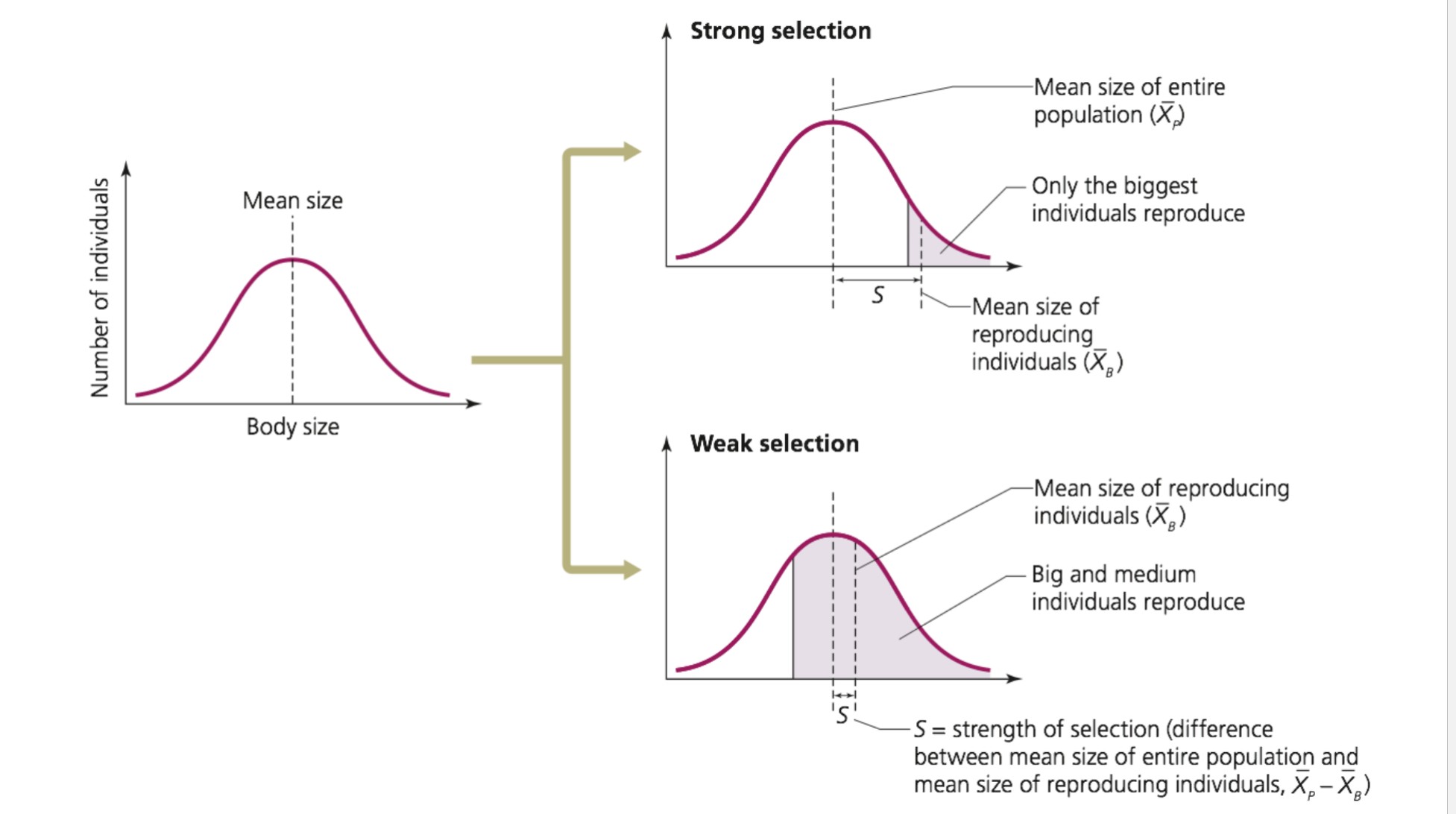
R = h² x S (heritibility equation)
h²= 0 = no response
h²= 0<h²<1 = response of h² x S
h² = 1 = respose of selection differential
linkage equilibrium
an allele at one locus is independent of any other allele at a second locus
ex. different chromosomes or far apart on the same chromosome
what could cause linkage equilibrium
genetic drift
linkage dsequilibrium
a statistical state where an allele at one locus is non randomly associated with the prescence or absence of another allele at a different location
has different degree depending on distance
True or False: linkage disquilibrium needs a physical linkage?
False
what does linkage disquilibrium indicate
there is a new allele (all new alleles are in this state) and can tell us if a gene was under positice selection
selective sweep
under strong positive selection an allele can reach fixation extremely fast, causing it to remain in linkage disequilibrium
super genes
sets of alleles that increase fitness so much when present ALL TOGETHER that they resist equilibrium
norm of reaction
the variety of different phenotypic states that can be produced by a single genotype under different environmental conditions
what is norm of reaction used for
to estimate the phenotypic presentation of a species under certain environmental conditions and vice versa
does selection effect phenotypic plasticity?
yes! when Vgxe (genetic interaction with the environment) > 0
when is plasticity good?
when environement is frequent and predictable
study: finches with various peak sizes. after drought little birds were NOT fit. in times of heavy rain they got a BOOST in fitness
concept: selection varies over time
study: coat color in field mice. dark mice in 2 different areas but one had Agouti gene mutations and the others were dark by a different mechanism
concept: multiple evolutionary pathways exsist to solve the same problem
study: gall size in flies are usually medium because if too small the wasps eat the babies but if too big the birds eat the babies
concept: humns drive evolutionary change
study: Intentional - coevolution in dogs
Unintentional - antibiotic resistance
concept: organisms respond to multiple selection pressures at once
antagonistic pleitropy
a gene is beneficial in early life or under some condition but is detrimental later on
molecular characters
nucleotides, amino acids, proteins, alleles
molecular character states
A, T, G, C
homoplasy is more common in which type of data?
molecular
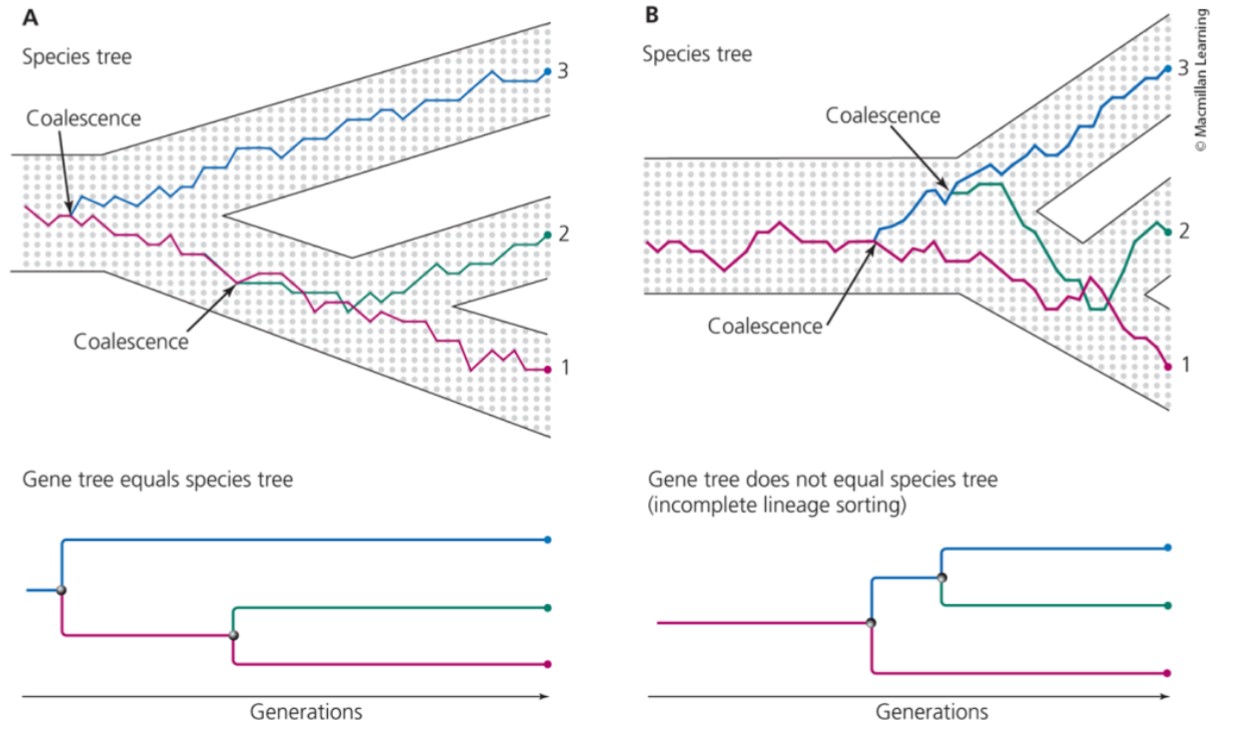
coalescence
the process in which the geneology of any pair of homologous alleles merges in a common ancestor
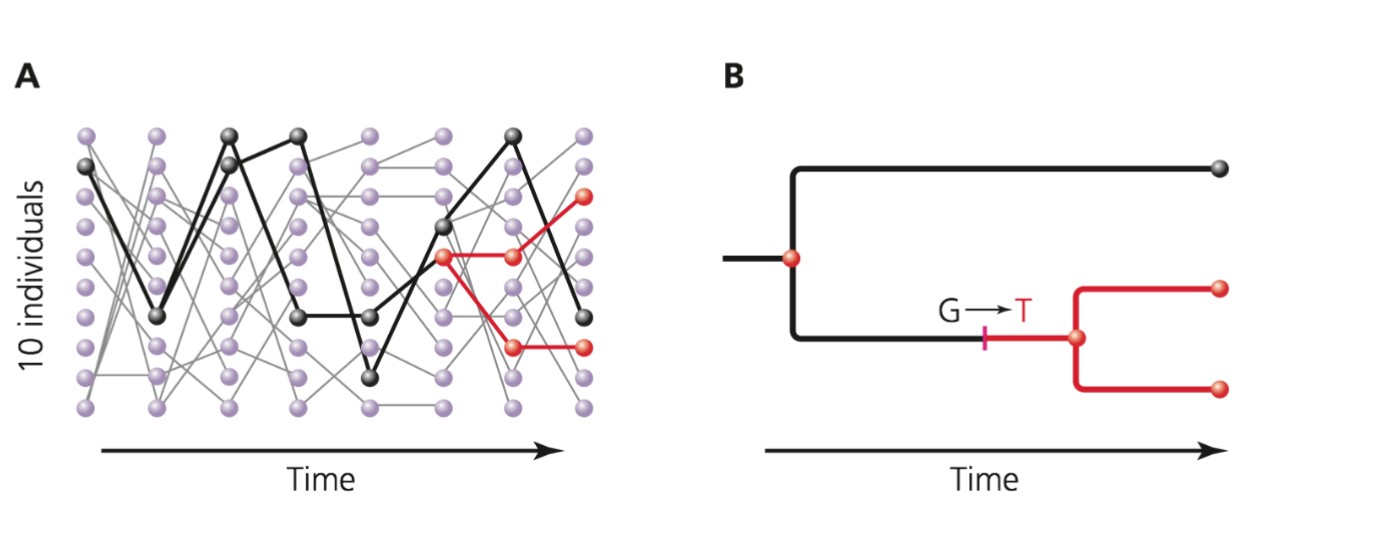
incomplete lineage sorting
when gene trees do not match species trees
introgression
the transfer of genetic material from one species to the gene pool of a different species (similar to horizontal gene transfer).
ex. human hace Neanderthal DNA despite not being hybrids
how to combat incomplete lineage sortage?
include more loci
methods for picking most likely tree from genetic data
Maximum parsimony (no model)
Maximum likleihood (model)
Bayesian method (model)
neutral theory of molecular evolution
neutral mechanisms become fixed in lineages at a regular rate
synonymous (silent) mutations
so not alter amino acid sequence if the protein CANNOT be selected for
nonsynonymous
alters the amino acid sequences of the protein and CAN be selected for
dN
rate of nonsynonymous subsititutions
dS
rate of synonymous substitutions
dN = dS (dN/dS = 1)
accept the neutral theory (null hypothesis)
dN > dS (dN/dS > 1)
positive selection
dN < dS (dN/dS < 1)
purifying selection
maximum likelihood
statistical method that involves adjusting branch lengths to what is most likely in a particular data set
bayesian method
applies prior knowledge to Bate’s original probalility model
genetic hitchhiking
strongly selected alleles are frequently found in a poopulation surrounded by the same set of alleles at neighboring locations
gene control region
an upstream section of DNA that includes a promotor region (to influence transcription)
repressor
a protein that binds to a sequence of DNA or RNA and inhibits expression
transcription factor
a protein that binds to specific DNA sequences and acts like light switch
promiscuois protiens
carry more than one function
gene recruitment
The co-option of a particular gene or network for a totally different function as the result of a mutation
gene duplication
gene dupolicates and that duplication can be tinkered with without harming organism
results in paralogs
paralogs
a homologous gene that arises by gene duplication
regulatory networks
Systems of interacting genes, transcription factors, promotors, RNA and other molecules that function like biological circuits. A few of these start a cascade of increasing development.
developmental control genes
control the expression of other genes
development
the genotype/phenotype map in multicelluar organisms
cells → communication between cells → cells send and reciveve positional info → info used to change cell fate/function
Hox genes
developmental genes that specify the anterior-postierior location of body segments in animals
encode proteins that regulate transcription
complex adaptations
Phenotypes are considered complex when they are influenced by many environmental and genetic factors, and when multiple components must be expressed together for the trait to function.
ex. eye
can proteins adopt new functions?
Yes! By changing time, place, and amount of protein production
deep homology
when developoment and growth of specific traits in diferent lineages develops due to underlying mechanisms from a common ancestor
contraints on evolution
laws of physics
antagonistic pleitropy
evolutionary history
disadvantages of sex
disease, cost of finding a mate, reduced relatedness
advantages of sex
genetic novelty, clearance of deleterious mutations, enhanced adaptation, faster evolution (v.s. parasites)
isogamy
gametes are identical
anisogamy
mutliple types of gametes: one is large and immobile, one is small and mobile
key facotor in sexual strategies
parental investment
Biased operational sex ratio
The ratio of sexually receptive males to females at one time
Male biased operational sex ratio
More males than females, most females will mate but very few males will
Female biased operational sex ratio
More females than males
intersexual selection
competition between individuals of the same sex compete against EACH OTHER for access to the other sex
intrasexual selection
competition between sexs in which one sex chooses mates from the other
monogomous breeding systems
mutual choice, slower evolutionary changes, limited or no sexual dimorphism
darwinian demon (chad of the animal)
Maximize all aspects of fitness simultaneously with no contraints
begins reproducing immediatley
produce infinite offspring
live forever
darwinian dolt (cuck of the animal)
Risk at every turn
delayed maturation
only reproduce one offsprinf
reproduces asexually
natural selection wants
to maximize offspring making it to maturity
senescence
age related decline of physical function and living ability. caused by prioritization of survivorship and reproduction in earlier life
trade-offs
Investment in early reproduction often reduces reproduction late in life
mammal parental care
90% female
fish parental care
70% male
bird parental care
90% biparental
amphibian parental care
50-50 male only female only
Trivers-Willard Hypothesis
females produce female offspring when resources are low and male when resources are abundant

