Module 7- Trematodes AKA Flukes
 Call Kai
 Learn
Learn Practice Test
 Spaced Repetition
 Match
Match Flashcards
 Knowt Play
1/39

There's no tags or description
Looks like no tags are added yet.
Name | Mastery | Learn | Test | Matching | Spaced | Call with Kai |
|---|
No analytics yet
Send a link to your students to track their progress
40 Terms
Trematode’s Phylum
Platyhelminthes (Flatworm)
Class name
Trematode (Flukes)
What species is always the first IH host?
Snails
What type of lifecycle do Trematodes (Flukes) have?
Indirect
Trematodes/ Flukes transmission type?
Ingestion is most common
Skin Penetration possible in some
What type of reproduction do trematodes have?
Sexual and Asexual
What type of reproduction happens in the DH (definitive host) ?
Sexual
What type of reproduction happens in the IH?
Asexual reproduction (leads to dramatically increasing numbers)
How many immature stages do trematodes have?
5
Five immature stages
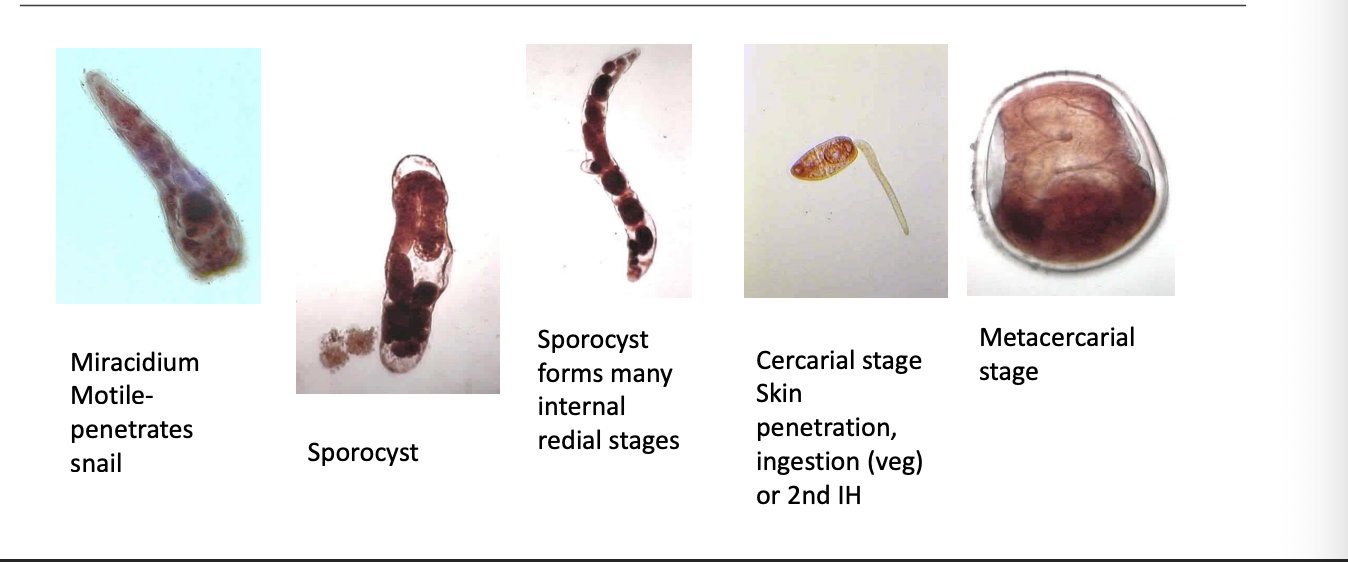
What are the 6 stages of trematodes lifecycle
Adult fluke pass eggs into the external environment within the hosts feces
When egg contacts water it will hatch and produce a motile stage called miracidium
The miracidium is covered with tiny hairs called cilia. Movement of the cilia allows the miracidium to seek out an aquatic snail (1st IH) and penetrate the skin of the snail and develop to the next stage (Sporocyst)
Sporocyst is a sack in which the next stage, the redia develops
. Many redia develop within one sporocyst. Within each redia many cercariae develop.
The cercarial stage often has a tail and will emerge from the snail and will do one of the following 3 paths…
List the 3 paths Cercaria can take?
1. Directly penetrates DH – heads to its preferred site in DH and develops to adult
2. Attaches to vegetation, loses its tail, secretes thick cyst wall around itself, and develops to metacercaria – in DH juvenile fluke released and migrates to predilection site and develops to adult
3. Loses tail, penetrates second IH, secretes thick cyst wall around itself, develops to metacercaria – second IH with metacercaria ingested - after ingestion juvenile fluke released and migrates to predilection site, develops to adult
What type of species do monogenic flukes usually parasitize?
Fish, amphibians and reptiles
What species do digenetic trematodes usually effect?
Wild and domestic animals and humans
What are the 2 sucker’s functions at the anterior end of flukes?
Used for attachment
Used as a mouth
What are the two subclasses of trematodes?
Monogenic
Digenetic
Monogenetic flukes usually ecto or endo parasites?
Ectoparasites mainly on fish
Digenetic trematodes usually endo or ecto parasites?
Endoparasites
Difference between cercaria and metacercaria?
Cercaria- larval form of trematode
Metacercaria- One of the three pathways a cercaria can turn into. Cercaria can develop into a metacercaria in the second intermediate host
What characteristic ovum do digenetic flukes have that is almost unique to their subclass?
Operculated egg- looks like a door on one side (pole) of the egg
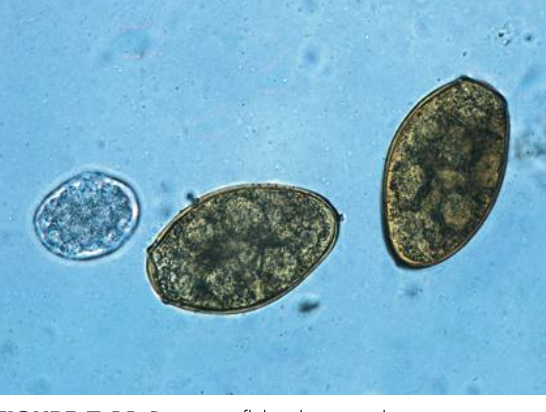
Operculum
Door or cap at one end, or pole, of the trematode egg
Hermaphroditic
Simultaneously possessing both male and female reproductive organs
Sporocyst
Developmental stage after penetration of the miracidium into a
snail (first intermediate host)
Operculum
Door or cap at one end, or pole, of the trematode egg
Monogenetic trematodes
Ectoparasites of fish, amphibians, and reptiles
Metacercaria
Encysted stage in the life cycle of the trematode usually found on
vegetation or within the second intermediate host
Cercaria
Stage that follows the redia; stage that emerges from the second
intermediate host
Miracidium
Motile stage emerging from the operculated fluke egg
Acetabulum
Ventral sucker that is used as a holdfast organ of attachment for
digenetic flukes
Redia
Stage that develops on the inside of the sporocyst
Nanophyetus salmincola
Salmon-poisoning fluke of dogs
Heterobilharzia americana
Canine schistosomes (blood flukes)
Fasciola hepatica
Liver fluke of cattle
Dicrocoelium dendriticum
The lancet fluke of ruminants
Paramphistomum and Cotylophoron
Rumen flukes
Black spot
Melanin deposition in response to the presence of
metacercariae
Swimmer’s itch
Schistosome cercarial dermatitis
Fascioloides magna
Liver fluke of white-tailed deer
Platynosomum fastosum
Liver fluke of white-tailed deer
Paragonimus kellicotti
Lung fluke of dogs and cats

