MCB 2210 L 13: Protein Targeting: Nucleus Part 2
 Studied by 0 people
 Call Kai
 Learn
Learn Practice Test
 Spaced Repetition
 Match
Match Flashcards
 Knowt Play
1/15

There's no tags or description
Looks like no tags are added yet.
Name | Mastery | Learn | Test | Matching | Spaced | Call with Kai |
|---|
No analytics yet
Send a link to your students to track their progress
16 Terms
What protein allow the Nuclear Localization Signal (NLS) and the Nuclear Export Signal (NS) to be recognized? + 2 types + protein that regulates process
Karyopherins = family of transport proteins that move molecules in/out of nucleus THROUGH nuclear pore complex
Importin = nuclear import receptors = help proteins into nucleus
Exportin = nuclear export receptors = help proteins out of nucleus
Ran = small G-protein that regulates both processes
Importin & exportin = of same gene family (related sequences = of same gene family)
Function similar BUT opposite directions
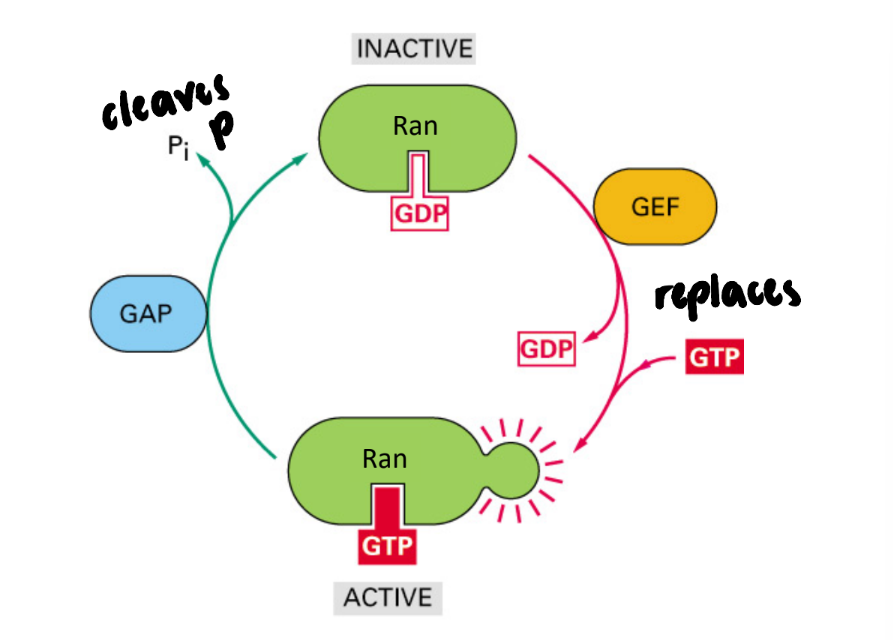
Describe G protein cycle
Ran + GDP = INACTIVE
GEF replaces GDP for GTP
Ran + GTP = ACTIVE
GAP cleaves phosphate group
GTP → GDP
Returns Ran to inactive state
What are 2 types of RAN regulator proteins used to control nuclear transport? How do they work together to regulate nuclear transport? What drives transport?
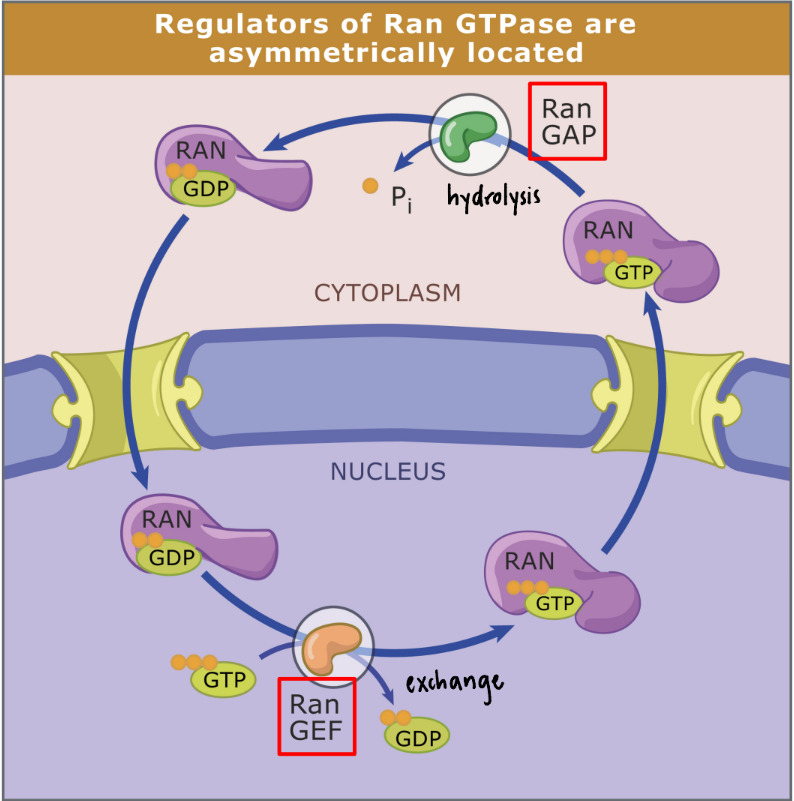
RanGAP = enzyme that turns Ran OFF
Located exclusively in cytoplasm
Cleaves Pi off of GTP → GDP
Ran-GDP = ONLY in cytoplasm
RanGEF = enzyme that turns Ran ON
Located exclusively in nucleus (bound to chromatin)
Exchanges GDP ↔ GTP
Ran-GTP = ONLY in nucleus
RanGAP & RanGEF = nuclear/cytoplasmic switch to import/export proteins to drive directional transport
Asymmetrically located → proteins “segregated” into nucleus & cytoplasm
GTP → hydrolyzed by GAP (GTP → GDP) = energy needed for transport
Anentropic process = create order by forcing molecules into nucleus (opposite entropy)
Used to reset the passive transport of molecules through Nuclear Pore Complex (NPC)
Importin + molecule → NPC into nucleus
Importin + Ran-GTP → LETS GO of molecule in nucleus
Importin + Ran-GTP → OUT to cytoplasm
RanGAP → Ran-GTP → Ran-GDP + Pi
Ran Δ shape → lets go of importin & grab new molecules
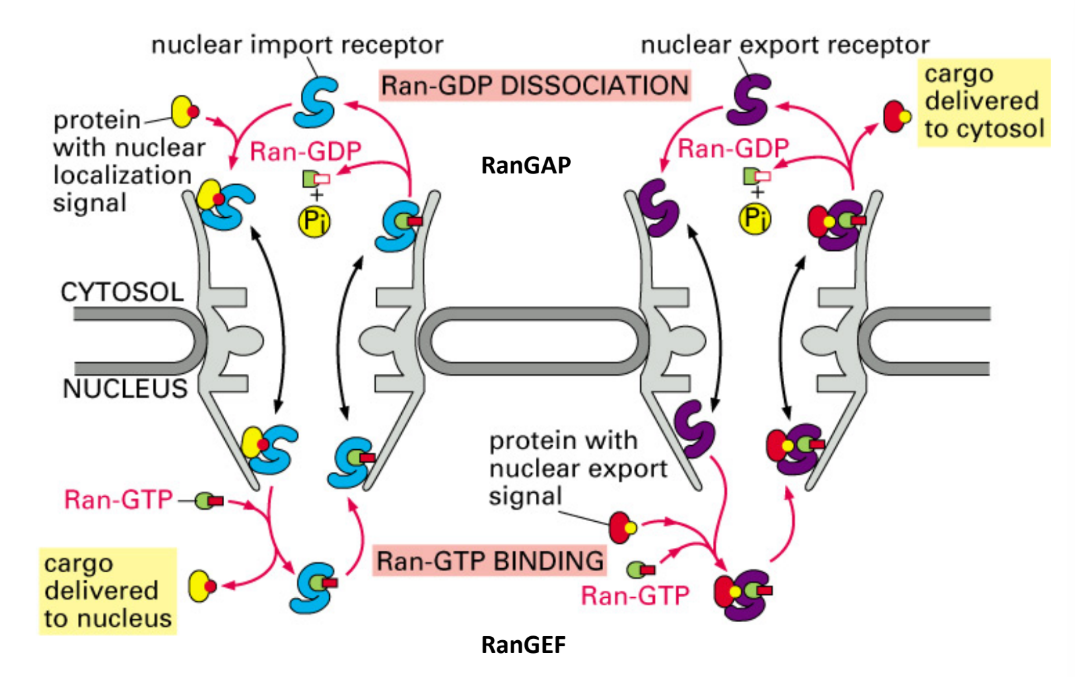
Describe the Nuclear Import Cycle pathway
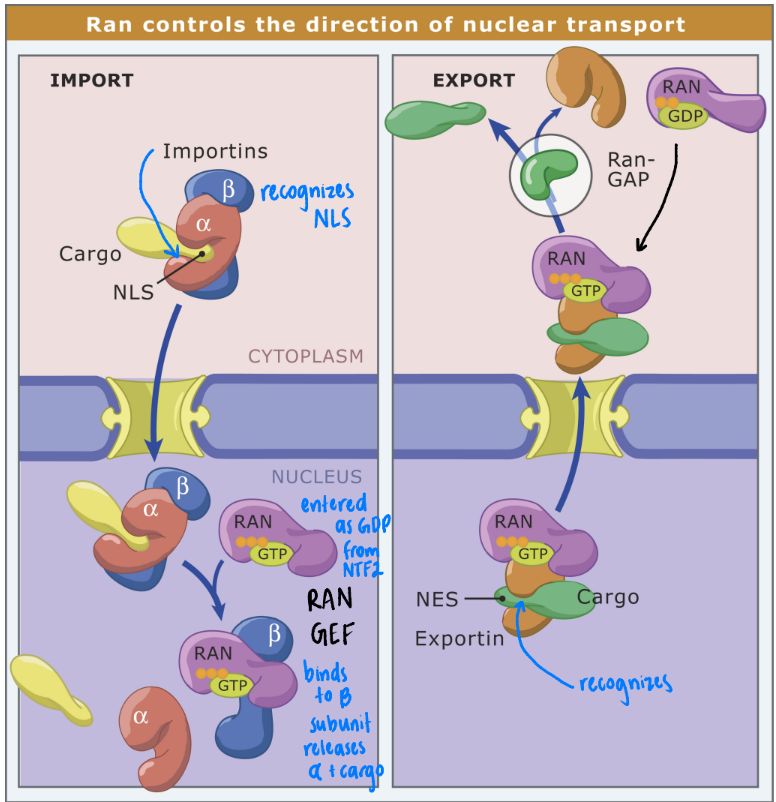
Importin = nuclear import receptor → recognizes Nuclear Localization Signal (NLS) → binds to cargo molecule to be imported
Importin + cargo binds to Nuclear Pore
Importin + cargo transported through pore into nucleus
Importin + cargo encounter Ran-GTP in nucleus
Importin + cargo bounded to by Ran-GTP → cargo released
Importin + Ran-GTP → cytoplasm
Importin + Ran-GTP encounter RanGAP → Ran-GTP → Ran-GDP
Importin - Ran-GDP (released)
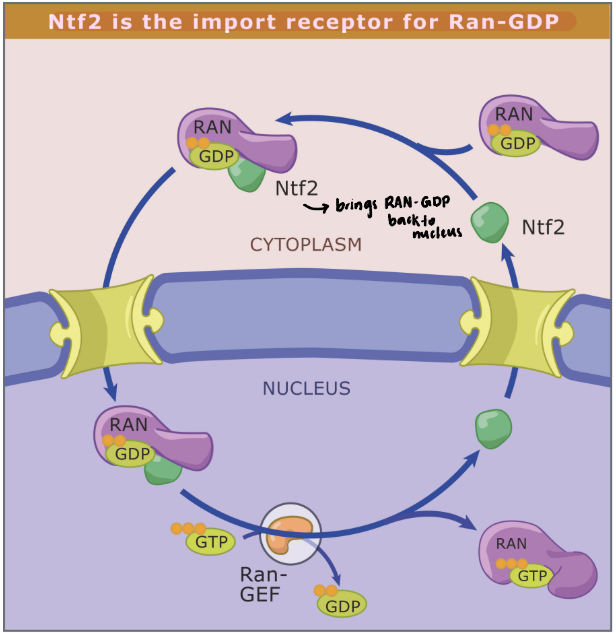
Ran-GDP → nucleus by NTF2 (specific import receptor)
Nuclear Transport Factor 2 = cytosolic protein → imports Ran-GDP from cytoplasm → nucleus
Describe the Nuclear Export Cycle Pathway
Exportin = nuclear export receptor → recognizes Nuclear Export Signal (NES) + cargo molecule
Exportin + cargo (tripartite complex) bounded by Ran-GTP → ACTIVATES export
Exportin + cargo (tripartite complex) encounters cytoplasmic RanGAP
RanGTP → RanGDP
Exportin + cargo (tripartite complex) + RanGDP → DISSOCIATE
Cargo = delivered
Exportin returns to nucleus
Ran-GDP → nucleus by NTF2 (specific import receptor)
Nuclear Transport Factor 2 = cytosolic protein → imports Ran-GDP from cytoplasm → nucleus
What does Ran use to be selectively reimported into nucleus and why?
Ran uses Nuclear Transport Factor 2 (NTF2) for Ran-GDP to be brough through nuclear pore complex (NPC)
DOES NOT HAVE Nuclear Localization Signal nor Nuclear Export Signal
Describe the 4 different pathways that allow different components of nuclear transport are recycled
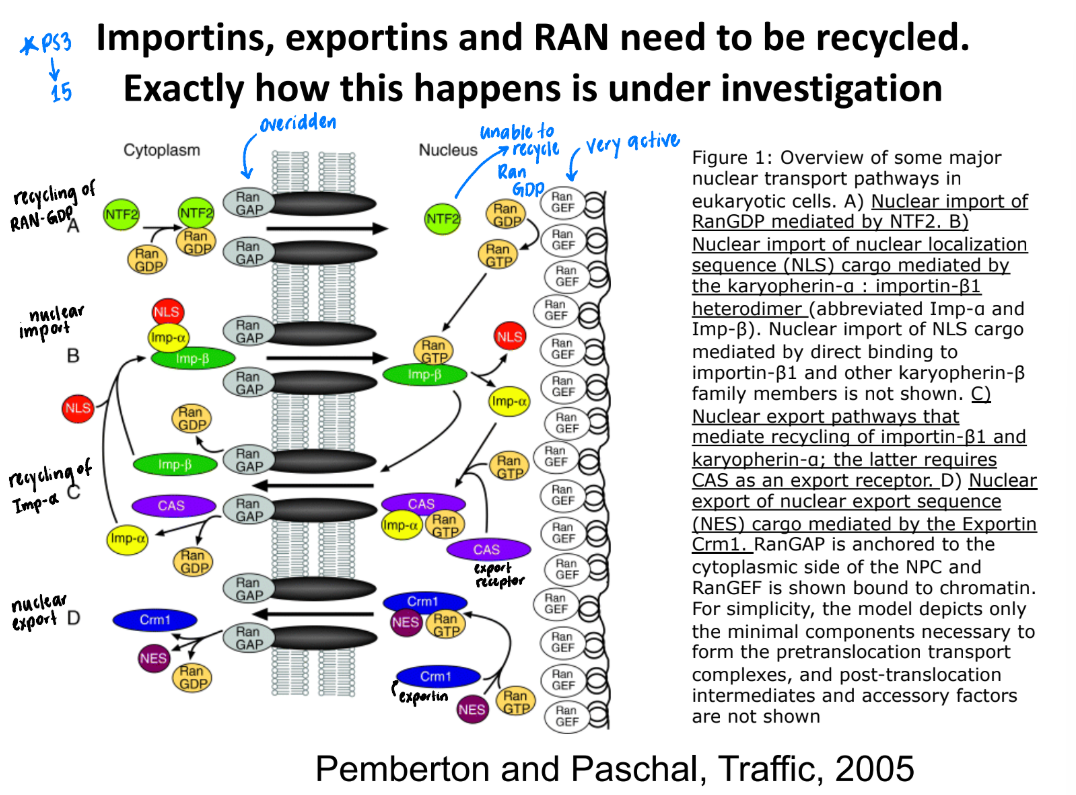
Recycling of Ran-GDP
PROBLEM: Ran = constantly exported to cytoplasm
SOLUTION: Ran-GDP returned to nucleus by NTF2 → Ran-GEF converts Ran-GDP → Ran-GTP (active)
Nuclear Import = protein → nucleus (from cytoplasm)
Cargo = protein w/ Nuclear Localization Sequence (NLS)
Importin + NLS of cargo → protein through pore → nucleus
Importin + cargo bound by Ran-GTP → cargo released in nucleus
Recycling of Importin-α
CAS (specialized export receptor) → binds to Important + Ran-GTP
Nucleus → cytoplasm → Ran-GTP hydrolyzed → Ran-GDP → Importin = released
Nuclear Export = protein → cytoplasm (out of nucleus)
Cargo = protein w/ Nuclear Export Sequence (NES)
Exportin + NES of cargo + Ran-GTP → cytoplasm
Ran-GAP breaks down Ran-GTP → complex dissociates → cargo released in cytoplasm
What is required for transport through nuclear pore complex (NPC)?
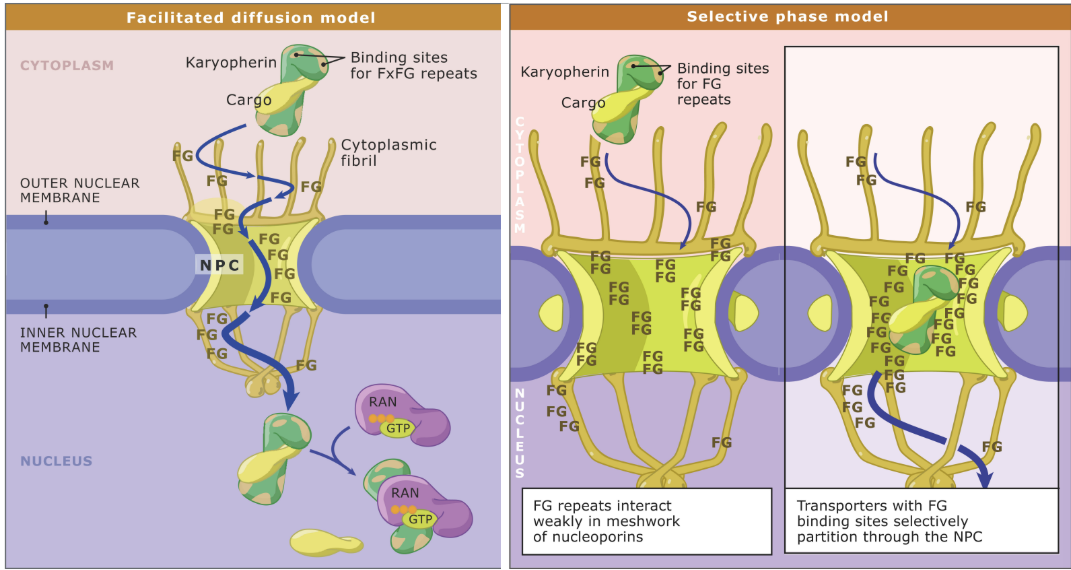
Phenylalanine-glycine (FG) repeats found in nucleoporins = form mesh-like barrier inside nuclear pore complex (NPC)
Barrier = selective gate for transporting molecules in & out of nucleus
Mechanism = UNKNOWN
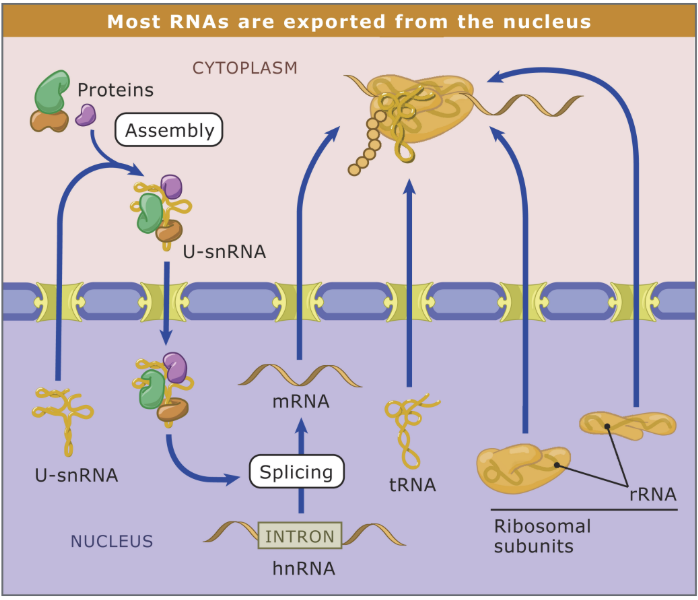
How are the majority of RNA species (including ribonuclear proteins) exported from nucleus?
Nuclear pores
Interact w/ exportins to get through
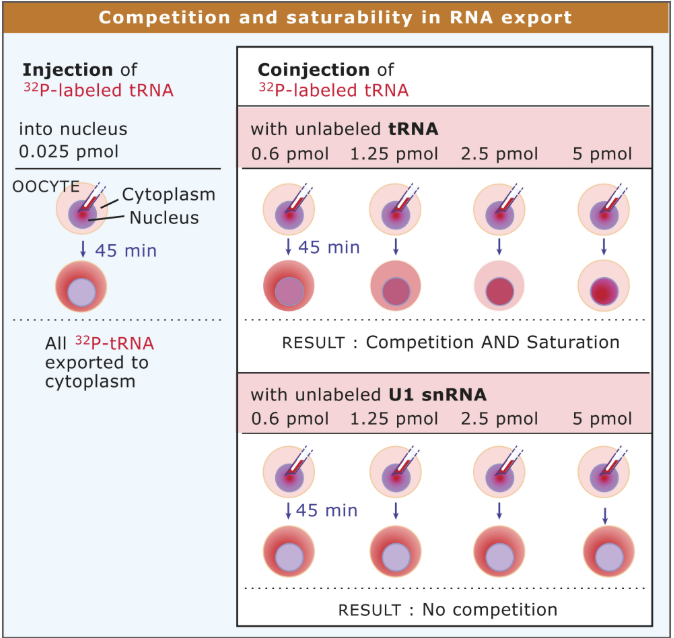
What is the relationship between types of exportins & types of RNAs?
Experiments demonstrate that there are different types of exportins for different kinds of RNAs
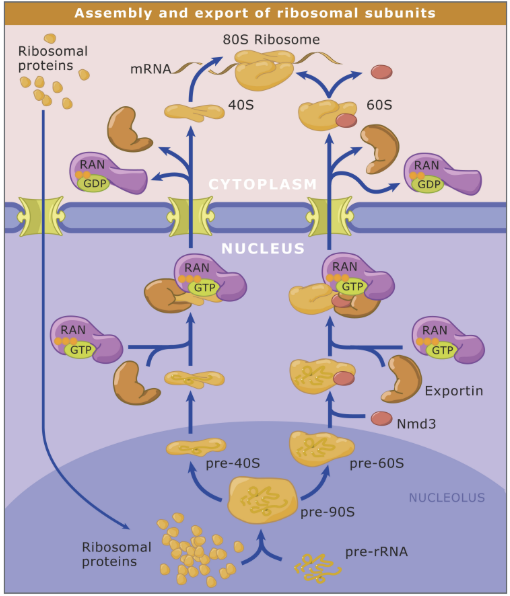
How is a ribosomal subunits formed in the nucleus?
Ribosomal proteins → nucleolus through NPC
Ribosomal proteins + pre-rRNA
Eventually bind to Ran-GTP → brought to cytoplasm through NPC
Ran-GTP → Ran-GDP → subunits formed
How is transport of proteins across nuclear envelope regulated?
Protein + targeting signal ≠ always moving through pore
May be bound to other structure = immobilized
Signal may be buried in protein (wrong conformation)
Signal may be concealed by another protein
Upstream signal (hormone/chemical Δ) → Δ conformation → expose signal → allow protein to be imported
What are the 2 examples of nuclear transport regulation?
NF-AT and T-Cells
Steroid hormones + Nuclear Hormone Receptor
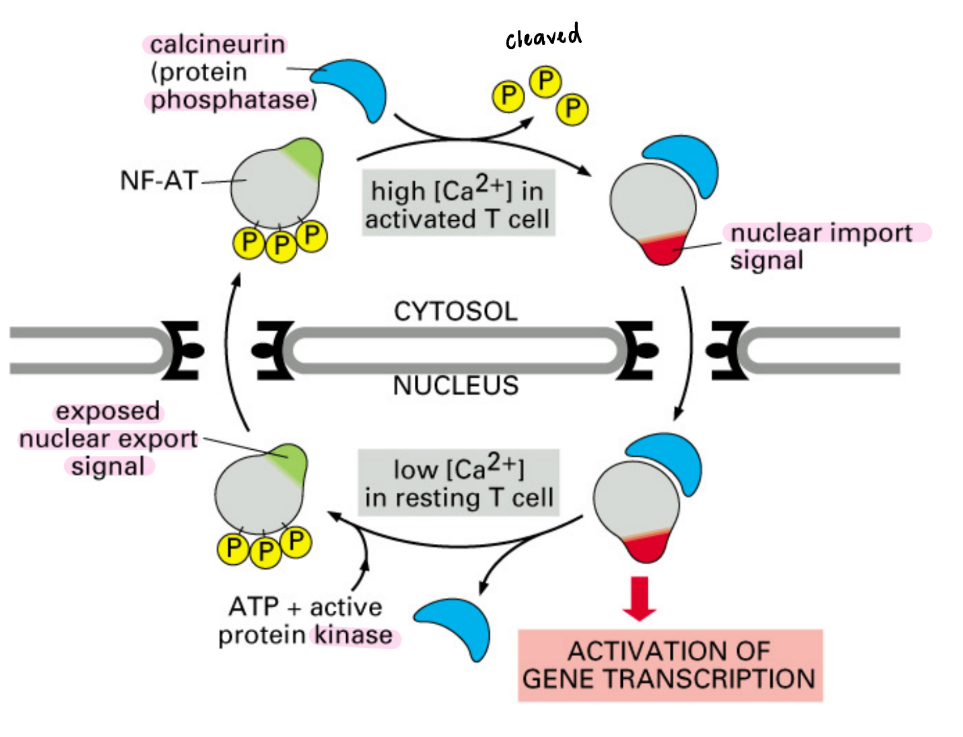
Explain the transcription factor import is regulated in T-Cell Activation (T-cells + NF-AT)
ON
NF-AT in cytoplasm of resting T-cell = phosphorylated → hides NLS
NF-AT = family of five transcription factors = regulates gene expression
Signaling → Ca2+ levels INCREASE
Calcineurin (Ca2+ dependent phosphatase) binds to NF-AT
NF-AT - Phosphate → NLS = EXPOSED
Importin recognizes NLS → carries NF-AT → nucleus
Transcription = ON
OFF
Ca2+ levels DECREASE → Calcineurin RELEASES NF-AT
NF-AT + Phosphate → NLS = hidden, NES = EXPOSED
Exportin recognizes NES → kicks NF-AT back to cytoplasm
Ensure immune response = off
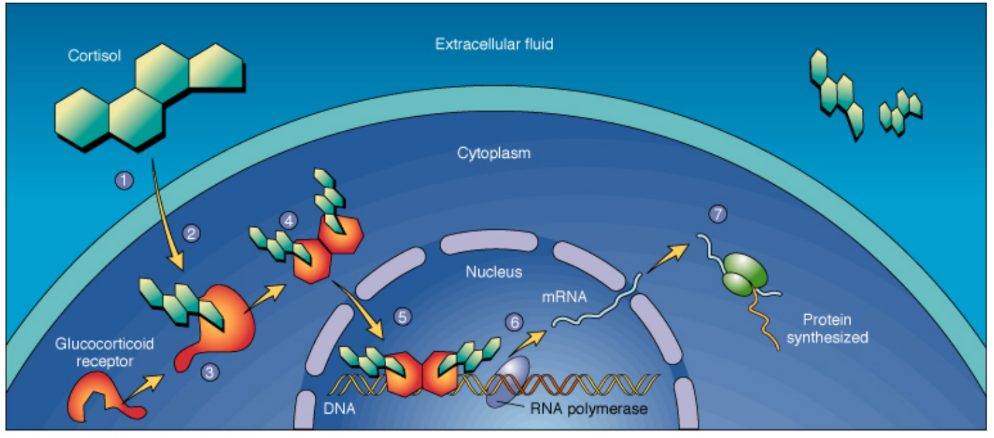
How do steroid hormones affect gene expression?
Steroid hormones = nonpolar → diffuse through membrane
Hormone binds to Nuclear Hormone Receptor in cytoplasm
Δ conformation of Nuclear Hormone Receptor → expose/activate NLS (import signal)
Importin grabs hormone-receptor complex → imported to nucleus
Describe how nuclear proteins are re-recruited to the nucleus during mitosis
Nuclear membrane & lamina break down
Nuclear pore complexes (NPCs) break down into subcomplexes
Mitotic spindle forms
Chromosomes segregate (karyokinesis) → nucleus reassembles around DNA
Nuclear proteins re-recruited to nucleus through NLS
Unclear how NPC reassembles
Cell membrane & cytoplasm divides (Cytokinesis)