Enterobacterales
 Studied by 0 people
 Call Kai
 Learn
Learn Practice Test
 Spaced Repetition
 Match
Match Flashcards
 Knowt Play
1/196

There's no tags or description
Looks like no tags are added yet.
Name | Mastery | Learn | Test | Matching | Spaced | Call with Kai |
|---|
No analytics yet
Send a link to your students to track their progress
197 Terms
serotyping is mostly used in classifiying
E. coli, klebsiella, shigella, and salmonella
O (somatic) antigen
found in the outer cell wall (part of LPS)
heats stable endotoxin
k (envelope) antigen
makes up the capsule
heat liable (must heat to get to k antigen)
H (flagellar) antigen
only in motile organisms
heat liable
used to serotype salmonella
gram negative bacilli and coccobacilli
found naturally in the environment and GI tract of most mammals
enterobacterales
frequent pathogens (strict or opportunistic)
seen in bed sores
enterobacterales
ferments glucose
oxidase negative (except Plesiomonas)
reduce nitrate to nitrite
most are motile
enterobacterales
principle of oxidase test
cytochrome oxidase present in an organism will oxidize the oxidase reagent (tetramethyl-para-phenylenediamine dihydrochloride) in the prescence of oxygen and form colored compound indophenol
positive vs negative result for oxidase test
positive: purple
negative: no color
enterobacterales are _______________ for the oxidase test with the exception of plesiomonas
negative
isolation of enterobacterales proteus on BAP exhibits
swarming (but doesn’t have to)
isolation of klebsiella pneumoniae on BAP is
mucoid
isolation of e. coli on BAP may be
beta hemolytic
for a stool culture we’ll use what media to culture
XLD or HE to visualize carbohydrate fermentation and H2S production
to enhance the recovery of salmonella and shigella what media do we use
enrichment broth which will inhibit gram-positive organisms
for early identification of E. coli what media do we use
tergitol 7 which is selectice and differential
MacConkey agar (MAC) inhibits
gram-positive organisms
gram negative lactose fermenters appear
pink
gram negative lactose-nonfermenters appear
clear/colorless
what media contains ferric ammonium citrate
hektoen (HE) and xylose-lysine-deoxycholate(XLD) which allows for visualization of H2S production
hektoen inhibits
gram positive organisms
xylose-lysine-deoxycholate inhibits
gram positive organisms
if hektoen is alkaline it’ll stay ___________ and if there’s a change in acidity the color will change to ___________________
green, yellow-salmon
what does shigella do on xylose-lysine-deoxycholate (XLD)
this bacteria doesn’t ferment sugars in the media so it’ll keep the media red (because it’s not fermenting, no pH change occurs)
what does salmonella do on xylose-lysine-deoxycholate (XLD)
this bacteria ferments xylose but not lactose and sucrose and decarboxylases lysine (removes a carboxyl group) so it’ll keep the media red (fermentation makes it acidic but decarboxylase turns it back to alkaline)
organisms that ferment xylose, lactose, and/or sucrose do what to xylose-lysine-deoxycholate
cause it to turn yellow from being acidic
for triple sugar agar (TSI) the indicator phenol red is _______________ in acidic environments and ______________ in alkaline environments
yellow, red
if only glucose is fermented on triple sugar iron agar (TSI) then the tube shows
K/A (red, alkaline/yellow, acidic)
if glucose and lactose and/or sucrose fermented on triple sugar iron agar (TSI) then the tube shows
A/(A) (yellow, acidic/yellow, acidic with gas produced)
if H2S is produced on triple sugar iron agar (TSI) it will
react with iron salts causing blackening in media
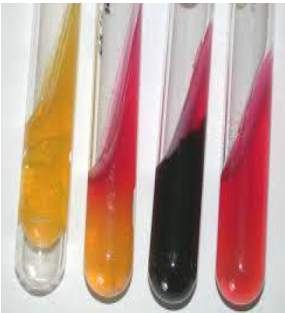
tube 1 shows
A/(A) (yellow, acidic/yellow, acidic with gas production)
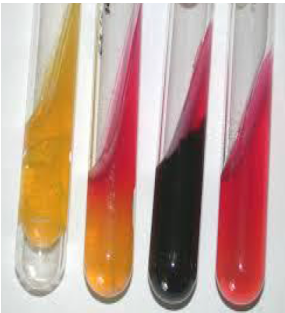
tube 2 shows
K/A (red, alkaline/yellow acidic)
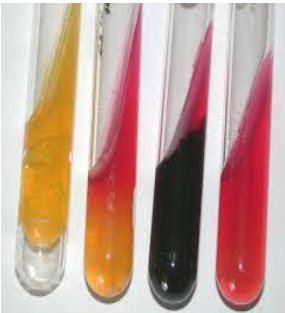
tube 3 shows
K/A (red, alkaline/yellow, acidic with H2S production)
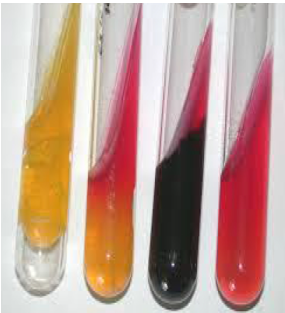
tube 4 shows
K/K (red, alkaline/red, alkaline)
for the triple sugar iron agar (TSI) what special step do you have to do with the lid
leave it lose to allow oxygen in
to test for H2S production you need
a source of sulfer
an H2S indicator (iron salt)
testing for H2S production is useful in differentiating
salmonella (+) and shigella (-)
principle of motility test
semisolid media with a small amount of agar allows motile bacteria to grow out from the line of inoculation
positive vs negative motility
positive: diffuse growth extending from stab line
negative: growth only at line of inoculation
positive vs negative result for tube indole
positive: red
negative: yellow/clear
__________ reagent is recommended for enteribacterales for tube indole
kovac’s
__________ reagent is recommended for nonfermenters for tube indole
ehrlich’s
principle for tube indole
tryptophanase converts tryptophan to indole which reacts with kovac’s or ehrlichs reagent to form a red product
principle for rapid indole
tryptophanase converts tryptophan to indole which reacts with DMACA to form a blue green color
methyl red test is used to
see if organisms is undergoing mixed acid fermentation (converts glucose into various stable acids)
methyl red indicator is __________ in acidic pH if they’re producing stable acids
red
for the voges-proskauer a positive result is
a pink red color
citrate test principle
if organism can use citrate then ammonium hydroxide will be formed which is visualized by a blue color
positive vs negative result for citrate test
positive: blue
negative: green
positive vs negative result for ONPG test
positive: yellow
negative: clear
positive vs negative decarboxylase test
positive: red-purple
nagative: orange-yellow
for a decarboxylase test we are testing for
the enzymatic removal of carboxyl group from specific amino acids
principle of decarboxylase test
if amino acid can be decarboxylated, alkaline amines build up and increase the pH which gives off a red-purple color
for the decarboxylase test alkaline is ____________ and acidic is ______________
purple-red, orange-yellow
deaminase positive vs negative results
positibe: dark green
negative: no color change
principle of deaminase test
enzymatic removal of amino group results in a color compound with addition of ferric chloride
phenylalanine deamination turns what color
green
tryptophan deamination turns what color
brown
urease test positive vs negative
positive: pink (alkaline)
negative: yellow (acidic)
principle of urease test
urease splits urea into NH3, CO2, and water leading to an alkaline environment which causes a shift to pink color
what bacteria have rapid urease production
proteus and providentia
what bacteria have slow urease production
klebsiella and some enerobacter
what bacteria is a frequent isolate in clinical lab
escherichia coli
normal flora of lower gastrointestinal tract
shows flat pink colonies on MAC
indole positive
escherichia coli
infections include UTIs, appendicitis, peritonitis, wound infections, pneumonia, sepsis (usually because a UTI causes bacteria to get into bloodstream), neonatal meningitis (labor process), and gastrointestinal syndromes
escherichia coli
citrate negative
indole positive
pink on MAC
A/A on TS1 tube
escherichia coli
causes traveler’s diarrhea
enterotoxigenic escherichia coli
most important escherichia coli strain
shiga toxin-producing escherichia coli
shiga toxin producing escherichia coli is also known as
verotoxigenic escherichia coli (VTEC) or enterohemmorrhagic escherichia coli (EHEC)
produces shiga toxin 1 and 2
this strain causes bloody diarrhea and hemolytic uremic syndrome (HUS)
enterohemorrhagic escherichia coli
most associated with the strain O157:H7 which is sorbitol negative
shiga toxin-producing escherichia coli
has longer incubation
acquired from contaminated food/water or from person to person (fecal to oral route)
S/S: abdominal cramps, diarrhea that turns bloody, low grade fever, and 6% of people develop HUS
shiga toxin-producing escherichia coli
treatment for escherichia coli
oral rehydration
not normal flora, always a pathogen
most communicable of bacterial diarrheas (low dose infective)
under 100 organisms can cause an infection
self-limiting, treat with hydration
shigella
S/S: abdominal cramps, fever and pain
causes watery diarrhea for 3 days which is followed by a dysenteric phase that causes tool to contain mucous and red and white blood cells due to an endotoxin
shigella
four serogroups of shigella
shigella dysenteriae, flexneri, boydii, and sonnei
produces a neuroteoxin (more severe)
shigella dysenteriae
most frequent worldwide (most common worldwide)
shigella flexner
most common in the US (spread through daycares commonly)
shigella sonnei
nonmotile
non-lactose fermenter
biochemically inert (doesn’t do much biochemically)
K/A
shigella
two species of salmonella
salmonella enterica and bongori
motile
non-lactose fermenter
H2S positive
citrate positive
indole negative
urease negative
deaminase negative
K/A with H2S
salmonella
many animals carry what bacteria
nontyphoid salmonella
S/S: vomiting, diarrhea, fever, chils after ingestion of oraganism
can be a carrier
not normal flora, always pathogenic
salmonella
serotyping on this bacteria is generally done by state health labs
salmonella
most cases are associated with travel outside of the US
S/S: high sustained fever, stomach pain, constipation or diarrhea, malaise
diagnosis made by blood culture
treat with antibiotics
salmonella serotype typhi
LDC positive and ONPG negative
salmonella
does shigella ferment lactose
no, it’s clear on MAC
found in soil, fresh water, and animals
infection caused by contaminated food or water or occuational hazard
self-limiting gastroenteritis (particularly in kids)
plesiomonas shigelloides
oxidase positive
ferments glucose
non-lactose fermenter
plesiomonas shigelloides
found in soil, water, plants, but also the GI tract and upper respiratory tract
common in hospitalized patients
klebsiella
klebsiella pneumoniae ssp. pneumoniae is indole
negative
klebsiella oxytoca is indole
positive
primary bacterual pneumonia
typically in immunocompromised, elderly, and newborns
spreads person-person or contaminated equipment
klebsiella pneumoniae ssp. pneumoniae
has a prominent capsule
suspect if isolate is mucoid, large, and colonies have diffused red pigment on MAC
klebsiella pneumoniae ssp. pneumoniae
nonmotile
pink, mucoid on MAC
urease positive
produce large amounts of gas in TSI
klebsiella
found in soil, water, and the GI tract
causes UTIs, respiratory tract infections, and wound infections
enterobacter
motile
urease variable
citrate positive
lactose fermenter
indole negative
A/A
enterobacter
yellow pigment seen on BAP
ubiquitous environmental organisms, survive in dry environments
biochemically similar to enterobacter
cronobacter sakazakii
infections are associated with powdered infant formula
causes bacteremia, septicemia, meningitis, and necrotizing colitis in newborns
cronobacter sakazakii
 Note
Note  Flashcards (27)