Chapter 10
 Call Kai
 Learn
Learn Practice Test
 Spaced Repetition
 Match
Match Flashcards
 Knowt Play
1/47

Earn XP
Description and Tags
Name | Mastery | Learn | Test | Matching | Spaced | Call with Kai | Chat |
|---|
No analytics yet
Send a link to your students to track their progress
48 Terms
Why is the sun important?
The radiant energy from the sun is the source of all energy on earth
Who discovered that heat is energy and how did he prove it?
James joule discovered it and proved it using the “joule device”
What is the joule device?
A device in which a weight falls, a stick spins, which paddles the water and causes it to heat up
What is mechanical energy equivalent to?
Heat energy
What is the unit for energy called?
Joule
Define heat capacity
The amount of heat energy(J) required to raise the temperature of 1g of a substance by 1°C
Why does water take a lot of time to heat up?
Because it requires a lot of heat energy, meaning it has a high specific heat capacity, specifically 4.19 J/g °c
What happens to the environment of cities that are near large bodies of water? ex) Vancouver
They experience little variation in temperature
Why does Vancouver experience little variation in temperature compared to Lethbridge?
Since Vancouver is next to the ocean and water has a high specific heat capacity compared to land, the ocean is able to absorb and/or release heat.
The ocean will absorb heat in the summer to keep Vancouver cool and release lots of hat energy in the winter to keep Vancouver warmer.
Heating curve of water: What formula is used to calculate ice, water, and gas?
Q = mc△T
Heating curve of water: What is the heat of fusion?
The energy required for water to go from solid <~> liquid at 0°C
How much moles are in heat of fusion in KJ/mol?
6.01 KJ/mol
Heating curve of water: What is the heat of vaporization?
The energy required for water to go from liquid <~> gas at 100°C
How much moles are in heat of vaporization in KJ/mol?
40.66 KJ/mol
What are the 3 types of systems?
Open system, closed system, isolated system
What is an open system?
Allows the exchange of energy and matter with its surroundings, ex) trees
What is a closed system?
Allows only energy to be exchanged, ex) earth
What is a isolated system(theoretical)?
Allows neither matter nor energy to be exchanged
What is the biosphere?
A thin layer, made up of 3 parts, surrounding earth
What are the 3 parts that make up the biosphere?
The atmosphere, lithosphere, and hydrosphere
What is the atmosphere?
A mixture of gasses, mostly nitrogen, that widely extends above earth’s surface
What are the 2 lower layers the atmosphere is concentrated in?
The troposphere(humans are here) and stratosphere
What is the lithosphere?
The top layered of earth’s crust, includes above sea level and the ocean floor
What is the hydrosphere?
All the water on earth’s surface, meaning it can be found in oceans, lakes, streams, etc
What is the cycle formed by the hydrosphere?
It is the hydrologic cycle which is created since earth’s surface is 70% water
Define climate
The temperature, precipitation, pressure, etc, over a period of time
Define weather
The temperature, precipitation, pressure, etc, in a specific area at a specific time
What is radiation budget?
The needed balance of the sun’s energy in order for humans not to be “cooked,” what goes in must come out
Solar E. input = terrestrial E. output = Net radiation budget
What is albedo?
The extent that a surface can reflect light
What has a high albedo?
The colour white which is able to reflect light
What has a low albedo?
The colour black which absorbs light
What does the melting of glaciers do to the albedo of the earth?
When glaciers melt, the albedo of Earth’s surface decreases which makes it easier for sunlight to be absorbed, causing Earth to become warmer and more glaciers to melt
What is the angle of inclination and how does it affect earth?
It is the tilt of the earth and determines our seasons and the length of our days
What is latitude?
A way to tell how far north or south a place is from the equator(the middle line of the earth) and goes up or down 90°
What does it mean if the equator is hotter?
More direct sun rays
What are others factors relating solar energy and the earth?
Cloud cover, closeness to a large body of water, and earth’s radiation budget and albedo
Memorize this image
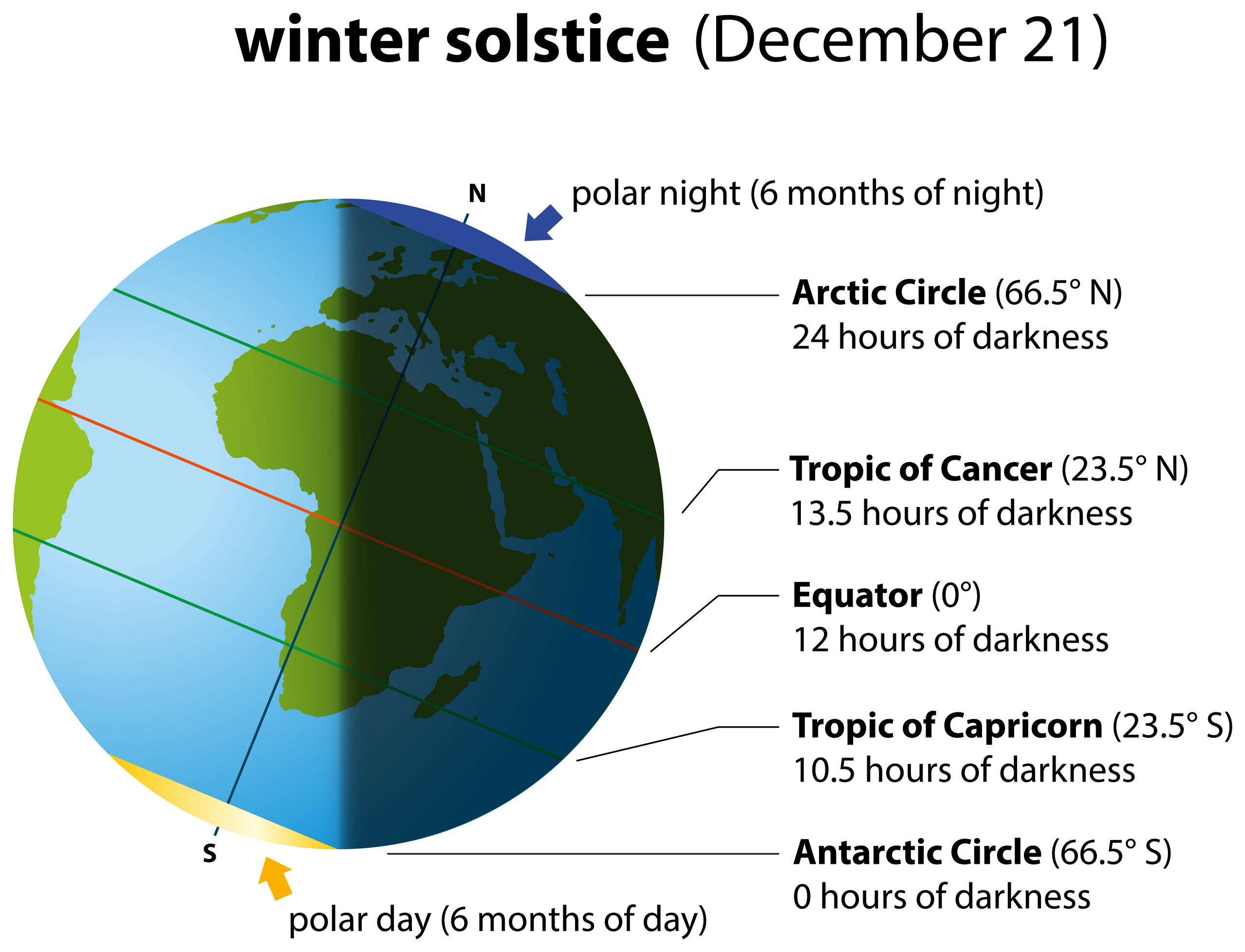
What would happen if the earth wasn’t tilted?
No change of seasons, every day would be 12h long, depending on your location, the latitude of the sun would be the same
What are the 3 thermal energy transfers?
Conduction, convection, and radiation
What is conduction?
Transfer of heat by touch
What is convection?
Transfer of heat through movement. Hot air rises, cold air falls
What is radiation?
Transfer of heat through waves
What is convection currents?
The flow of heat energy from hot to cool regions and transferred by mass motion of molecules
Convection currents: What does ocean currents do?
Affects costal weather and global climate due to wind, thermal energy, and earth’s rotation
Convection currents: What does global wind currents do?
Affects weather and climate, hot air rises, cool air sinks
Convection currents: What are jet streams?
Currents of extremely fast moving air which form boundaries of cold and warm air and moves from west to east
Convection currents: What is the Coriolis effect?
This is the results from earth’s rotation on air and ocean currents which then results in jet streams
Convection currents: What is the Elnino effect?
A temperature change in wind and ocean convection currents