Psychology - research methods
 Call Kai
 Learn
Learn Practice Test
 Spaced Repetition
 Match
Match Flashcards
 Knowt Play
1/85

Earn XP
Description and Tags
Name | Mastery | Learn | Test | Matching | Spaced | Call with Kai | Chat |
|---|
No analytics yet
Send a link to your students to track their progress
86 Terms
What is the aim of the experiment
A general statement about what the researcher intends to investigate; the purpose of the study
e.g. to investigate whether drinking energy drinks makes people more talkative
Define the experimental method
involves manipulating one variable to determine if these changes cause changes in another variable. this method relies on high levels of control to test a hypothesis
What is a hypothesis
A clear, precise, testable statement that is made at the start of the study that clearly states the relationship between variables to be investigated.
e.g. drinking an energy drink causes people to become more talkative
What are the two types of hypothesis
Directional
states the direction of the difference or relationship
include words like more or less, higher or lower, faster or slower etc
e.g. people who drink water are less talkative than those who drink an energy drink
used when the findings of previous research suggest a particular outcome
Non-directional
simply states that there is a difference between conditions or groups of people - nature of difference is not specified (does not state the direction)
e.g. people who drink an energy drink differ in terms of talkativeness compared with people who don’t drink energy drinks
used when there is no previous research or findings from earlier studies are contradictory
What variable does the researcher manipulate in an experiment
Independent variable
Measures the effect of this change on the dependent variable
Define operationalisation
Clearly defining variables in terms of how they can be measured
What is an operational hypothesis
Clearly defines what the variables of interest are and how the different variables are related to each other
e.g. the group that drinks an energy drink will be chattier than the group that drinks water —> after drinking 300ml of energy drink participants say more words in the next five minutes than the participants who drink 300ml of water
What is a independent variable
An aspect of the research situation that is manipulated by the researcher, or that changes naturally
What is a dependent variable
The variable in the experimental situation that is measured by the researcher, and should be caused by the independent variable
What is an extraneous variable
Any variable other than the IV, that might potentially interfere with the DV if it is not controlled
participant variables - any individual differences between participants that may affect the DV
situational variables - features of the experimental situation that may affect the DV
What is a confounding variable
Any variable other than the IV that may HAVE affected the DV so that we can not be sure of the true source of the changes to the DV - these have not been controlled and are found after the study (a systematic error)
What are demand characteristics
Any cue from the researcher or from the research situation that may be interpreted by participants as revealing the purpose of the investigation. This may lead to the participant changing their behaviour within the research situation
What are investigator effects
Any effect of the researchers behaviour (conscious or unconscious) on the research outcome (the DV). This may include everything from the design of the study, to the selection of, and interaction with, the participants during the process
What is randomisation
The use of chance in order to control the effects of bias when designing materials and deciding the order of conditions. Steps we can take to minimise the effect of EV’s and CV’s on the DV
What is standardisation
Using exactly the same, formalised procedures and instructions for all participants in a research study
What is internal validity
How much do the findings of the dependent variable have to do with the independent variable and not other factors
did you participants respond to demand characteristics and act the way that people expected them to
e.g. CBT helps reduce depression - however this may be the client-patient relationship and not the CBT itself (lack of internal validity)
What is external validity
All about whether our results can be generalised beyond the study e.g. other settings, other populations of people or even other eras in time
population validity - can the results be generalised to the general population
ecological validity - whether or not the environment in which the research was conducted in can be generalised to real life
There is a lack of mundane realism when the task that the participants are asked to perform is not something that would be asked of them during every day life so the truth of the findings is limited
What is temporal validity
The idea that the findings of a study or concepts of a particular theory hold true over time
e.g. Asch’s research on conformity was originally tested in a very conformist time in American history so lacks temporal validity
What are the two tests for testing validity
face validity - when an independent expert looks at the measures being used and assesses whether it will measure what it has set out to measure
concurrent validity - comparing the new procedure with a similar procedure that has been done before where validity has already been established (if the scores correlate as a strong positive correlation [+0.8] then the test is probably valid)
How can we improve validity
Experimental research
using a control group gives the experimenter something to compare the changes in the dependent variable due to the effects of the independent variable
procedures may be standardised to minimise effects of participant and investigator effects
use of single blind trials and double blind trials reduce demand characteristics
Observations
observations with minimal input from observer increases validity - better if observer is covert
ensure that behavioural categories are not too broad, not overlapping or ambiguous to increase validity
Questionnaires
many questionnaires include a lie scale within questions - may consist of repetitions of the same or closely similar items to check for consistency of responses (reduces effects of social desirability bias)
ensure all responses are anonymous
Qualitative methods
can be seen as more valid than quantitative methods, because depth and details associated with case studies and interviews better reflects the participants reality
validity is further enhanced by triangulation - the use of a number of different sources as evidence e.g. data from interviews with family, friends, personal diaries, observations etc.
What is reliability
if a measure can be repeated and the same result is found, the that measure is reliable
What is the difference between validity and reliability
reliability - The extent to which the results can be reproduced when the research is repeated under the same conditions.
validity - The extent to which the results really measure what they are supposed to measure.
How do we assess reliability
1st measure
external reliability - produce same results each time test is carried out
test-retest method - do the same test with the same participants again at a different time (enough time to prevent pps remembering og answers but not so much time that results would be affected by a change in attitude/opinion/ability)
correlation between two sets of scores (+0.8 = high correlation co-efficient = reliable)
2nd measure
inter-observer reliability - relevant to observational research, more than one person has seen the behaviours and believe there is a consistency on what was seen. may use behavioural categories to ensure they are looking at the same behaviours
can be used with content analysis and interviews
(content analysis is a research tool used to determine the presence of certain words, themes or concepts within some qualitative data)
(content analysis is a research tool used to determine the presence of certain words, themes or concepts within some qualitative data)
What is internal reliability
describes the internal consistency of a measure, such as whether the different questions in a questionnaire are all measuring the same construct
this type of reliability refers to the extent to which a measure is consistent within itself
if a test has people scoring really high on one part but not on the other then it has low internal consistency
How can we improve reliability
Questionnaires
should be measured with test-retest method and then data compared
correlation coefficient needs to be +0.8 to be reliable
Interviews
best way is to use same interviewer each time
each interviewer has to be trained in order to avoid asking leading or ambiguous questions
easier done in structured interviews due to fixed questions whereas unstructured are less likely to be reliable
Experiments
lab experiments more reliable due to controls over other variables due to standardised procedure
reliability may be affected if people are tested under even slightly different conditions
Observations
improved by operationalising behavioral categories - making sure they are measurable and self-evident
categories should not overlap
What is experimental design
The different ways in which the testing of participants can be organised in relation to the experimental conditions
Describe the independent group design
when two separate groups of participants experience two different conditions of the experiment
e.g. one group drinks water and the other drinks an energy drink
strength - order effects are not a problem
weakness - the participants who occupy the different groups are not the same - individual differences
Describe the repeated measures design
all participants experience both conditions of the experiment
e.g. each participant experiences condition A (the energy drink condition - experimental condition) and then later, condition B (the water condition - control condition)
strength - participant variables are controlled and fewer participants needed
weakness - order effect arise because repeating two tasks could create boredom or fatigue so may cause deterioration in performance on the second task, so it matters what order the tasks are in
Describe the matched pairs design
participants are together on a variable or variables relevant to the experiment
e.g. participants in a memory study may be matched on their IQ
strength - order effects and demand characteristics are less of a problem
weakness - matching may be time consuming and expensive (especially is a pre-test is needed) so this is less economical than other designs
Describe the laboratory experiment
conducted in highly controlled environments - not always a lab
strength - high control over extraneous variables, replication is more possible due to the high level of control
limitations - experiments may lack generalisability - lab environment is artificial and not like everyday life (low external validity), participants are usually aware they are being tested and therefore there are demand characteristics
Describe field experiments
the IV is manipulated in a natural, more everyday setting
strength - higher mundane realism - more genuine, authentic behaviour, high external validity as participants may be unaware they are being studied
limitation - loss of control of extraneous variables, ethical issues - participants being unaware means they cannot consent
Describe natural experiments
when the researcher takes advantage of a pre-existing independent variable - natural as the variable would have changed even if the experimenter was not interested
strength - high external validity - involve study of real-life issues and problems as they happen (e.g. effects of a natural disaster on stress levels), provide opportunity for research that may not otherwise be undertaken for practical or ethical reasons
limitations - a naturally occurring event may only happen very rarely - may limit scope for generalising findings, participants may not be randomly allocated so researcher is less sure whether the IV affected the DV
Describe quasi experiments
have an IV that is based on an existing difference between people e.g. age or gender - no one has manipulated this variable, it simply exists
e.g. if anxiety levels of phobic and non-phobic patients were compared, the IV of having a phobia would not have come about through any experimental manipulation
strength - controlled conditions (like lab experiment)
limitation - confounding variables due to inability to randomly allocate participants to conditions
What is the difference between objectivity and subjectivity
Objectivity
facts rather than opinion
true for everyone
dispassionate
Subjectivity
opinion rather than fact
not universal
emotive
Describe the empirical method
objectivity = base of empirical method
empirical methods emphasise the importance of data collection based on direct, sensory experience
e.g. experimental method and observational method
a theory cannot claim to be scientific unless it has been empirically tested and verified
What is replicability
findings must be shown to be repeatable across a number of different contexts and circumstances - allows us to see the extent to which findings can be generalised
replication has an important role in determining the validity of a finding
What is falsifiability
Genuine scientific theories should hold themselves up for hypothesis testing and the possibility of being proven false
Karl Popper drew a line between ‘good science’ in which theories are constantly challenged and ‘pseudosciences’ which couldn’t be falsified e.g. astrology
Define paradigm and paradigm shift
Paradigm = a clear, distinct concept accepted by most people in a scientific field e.g. evolution or the planets orbit the sun
Paradigm shift = when there is too much contradictory evidence to ignore so a group of researchers begin to question the accepted paradigm e.g. it used to be accepted that the sun revolves around the earth
What types of sampling is there
random sample - list of members is obtained, all names on list are assigned a number, sample generated through use of a lottery method
systematic sample - every nth member of the target population is selected
stratified sample - researcher identifies the different strata that make up a population, proportions are worked out for the sample to be representative, participants to make up each stratum are selected using random sampling
opportunity sample - taking anyone who is willing and available
volunteer sample - participants selecting themselves to be part of the sample
What is an evaluation for each type of sampling
random
strength - free from researcher bias
weakness - difficult and time consuming
systematic
strength - avoids researcher bias
weakness - greater risk of data manipulation
stratified
strength - avoids researcher bias, produces representative sample - generalisation of findings is possible
weakness - cannot reflect all the ways people are different - complete representation is not possible
opportunity
strength - convenient, saves time and effort
weakness - unrepresentative of target population, researcher bias
volunteer
strength - easy, minimal input from researcher, less time consuming
weakness - volunteer bias, may attract a certain ‘profile’ of person
What are ethical issues
these arise when a conflict exists between the rights of the participants in research studies and the goals of the research to produce authentic, valid and worthwhile data
What are the four ethical issues
Informed consent
participants need to know what they are getting themselves into
they should be told: the aims, the procedure, their rights, what their data will be used for and by whom
Deception
deliberately misleading or withholding information from a participant at any stage of a study
if a participant has not received adequate info about the study they cannot have said to be given informed consent
Protection from harm
participants should NEVER be placed at any more risk than they would in their every day lived - should be protected from physical and psychological harm at all times
psychological harm includes: being embarrassed, made to feel inadequate, being placed under undue stress or put under pressure
Privacy and confidentiality
participants have the right to control info about themselves - right of privacy
if this right is breached then confidentiality must be protected
confidentiality is the participants right, under the Data Protection Act, to have any personal data protected
privacy clause extends to the place the experiment is carried out in, so that institutions or geographical locations are not named
What are alternative ways of getting consent
presumptive consent - researchers ask a similar group of people to the participants and if they agree the study is acceptable then consent from the actual participants is presumed
prior general consent - participants consent to being in a number of studies including one that will involve deception
retrospective consent - participants give consent during debriefing
Describe how to deal with deception and protection from harm - debriefing
at end of study participants should be given a full debrief
here they should be made aware of the true aims of the study and given any details that were withheld from them
they should be given reassurance they their data will be protected and that they have the right to withhold their data if they wish
if a participant is concerned about their behaviour or responses to an investigation, they should be made aware that their behaviour was typical or normal
in the case that a participant feels they have been subject to harm, counselling should be made available to them
What is done to deal with informed consent
participants should be issued with a consent letter or form detailing all relevant information
needs to be signed and dated
under 16’s must have parental consent
What is the BPS Code of Ethics
a quasi-legal document produced by the British Psychological Society that instructs psychologists in the UK about dealing with participants. it is built around 4 major principles: respect, competence, responsibility and integrity
What is a pilot study and why is it used
A small scale version of an investigation that takes place before the real investigation is conducted. The aim is to check that procedures, materials, measuring scales etc, work and allow the researcher to make any changes or modifications if necessary
What
Trial run
Smaller number of participants
In self report experiments
In observations
Why
Allow for adjustments to be made to the experiment
Could save money, time, resources, energy etc
Ensures that the actual experiment is not wasted
Ensures that the experiment is getting a true set of results
Allows for control of extraneous and confounding variables
What is a single blind procedure
participants are not told the aim of the research at the beginning of the study
attempts to control for the confounding effects of demand characteristics
What is a double blind procedure
neither the participant nor the researcher who conducts the study is aware of the aims of the investigation
What are control groups used for
comparison - if the change in behaviour of the experimental group is significantly greater than that of the control group, the researcher can conclude that the cause of this effect was the independent variable
What is participant observation
The researcher takes part in the investigation as a member whose behaviour he/she is watching and recording e.g. Lorenz and his geese
strength - researcher can experience the situation as the participants do - increased insight & increased validity of findings
researcher may lose objectivity - ‘going native’
What is non-participant observation
The researcher remains outside of the group whose behaviour he/she is watching e.g. Bobo doll study
strength - allows researcher to maintain an objective psychological distance from their participants
weakness - researcher may lose valuable insight to be gained if they were actually taking part in it
What is covert observation
observations in which participants are unaware they are the focus of the study
behaviour is observed in secret
behaviour must be public and happening anyway if the observation is to be ethical
strength - no problem of participant reactivity, behaviour will be natural, increases validity of data
weakness - ethics may be questioned
What is overt observation
when participants are aware their behaviour is being observed and have given their informed consent before
strength - ethically acceptable (given informed consent)
weakness - knowledge they are being observed may act as an influence on their behaviour (observer effects and participant reactivity become an issue)
What are controlled observations
high control over extraneous variables
systematic, using a standardised procedure
objective, using a quantitative coding system
participants know they are under observation
e.g. Ainsworth Strange Situation, Asch’s Line study
strength - control over EV’s, increased reliability and credibility, high internal validity
weakness - participants know they are being watched, demand characteristics lowers the internal validity
weakness - often artificial tasks and stimuli, limited application, findings are not generalisable, lower external and ecological validity
What are naturalistic observations
field studies
looks at spontaneous behaviour
carried out in a natural environment
participants are not aware of observation
e.g. Rutter’s Romanian Orphanage study
strength - participants are not aware of observation, low chance of demand characteristics, high ecological validity
strength - tasks often have more real life application, easier to generalise findings, higher external validity
weakness - low control over extraneous variables, low degree of control, low internal validity
What is structured observation
the researcher used various ‘systems’ to organise observations
e.g. a sampling technique or behavioural category
observations can be quantified at the end
strength - quantitative data, observer bias is less likely
weakness - not much depth or detail
What is unstructured observation
every instance of a behaviour is recorded in as much detail as possible - useful if behaviours you are interested in do not occur very often, are small in scale and involve few participants
researcher observes and records as much detail as they can
no system to follow
strength - lots of depth and detail, qualitative data
weakness - risk of observer bias, only used in small scale studies
What are the two types of sampling methods
event sampling - a target behaviour is established then the researcher records this event every time it occurs, counting the number of times a behaviour occurs
time sampling - a target individual or group is first established then the researcher records their behaviour in a fixed time frame for example every 60 seconds
What is the AO3 for time sampling
strength - reduces number of observations
strength - more structured and systematic
weakness - may be unrepresentative
weakness - researcher may miss important details
weakness - may not reflect whole behaviour
What is the AO3 for event sampling
strength - may record infrequent behaviour
strength - researcher could pick up on behaviours that do not occur at regular intervals - such behaviours may be missed in time sampling
weakness - complex behaviours oversimplified
weakness - if event is too complex, important details may not be recorded
What is inter-observer reliability and how is it achieved
observers should be trained to establish inter-observer reliability to ensure the observers are consistent in their judgments and that the data they record is the same or similar
e.g. on a scale of 1-10 some may observe behaviour they consider a 4 whereas someone else considers it a 6
achieved by familiarising themselves with the behavioural categories, running a pilot study, comparing data and finally recording and analysing data and inter-observer reliability is calculated
Evaluate inter-observer reliability
Strengths
data more objective and unbiased - results more credible
two observers means two opinions
results more valid if they agree
Weaknesses
observers have to be trained - time and money
two observers may be easy to agree but there may be more than two
more observers = more disagreements
What is quantitative data and evaluate
data expressed numerically e.g. the amount of words people were able to accurately recall in a memory test
Strength
more objective and less open to bias
easier to analyse than qualitative
Weakness
lacks detail
may not represent real feelings
What is qualitative data and evaluate
data expressed in words
thoughts, feelings and opinions
the transcript of an interview, diary notes from a counselling session etc
Strengths
more subjective so rich in detail
higher external validity that quantitative
Weaknesses
hard to analyse
the interpretation is often subjective and may be open to researcher biasW
What is primary data and evaluate
original data that is collected specifically for the purpose of the investigation by the researcher themselves
Strengths
fit for purpose
authentic and less likely to be misinterpreted or used for the wrong reason
Weaknesses
time consuming to collect
can be expensive and requires a lot of effort
What is secondary data and evaluate
data that has been collected by someone else, that already exists before the investigation has been planned
has usually already been subjected to statistical testing and the significance is already known
Strengths
inexpensive
less effort required on the researchers part
Weaknesses
much variation to the quality and accuracy of data
can be outdated or incomplete
could be somewhat irrelevant to the field of study
What are behavioural categories
a breakdown of the target behaviours - these should be precisely defined and made observable and measurable
e.g. target behaviour ‘affection’ may be broken down into categories such as hugging, kissing, smiling, holding hands etc.
strength - more structured and objective data collection
weakness - categories may be ambiguous
What are questionnaires and evaluate
a set of written questions designed to collect information
can discover what people think or feel
always predetermined (structured)
can provide qualitative or quantitative data
strength -
cost effective and quick to distribute
gather large amounts of data because they can be distributed to large numbers of people
data is straightforward to analyse
respondents may feel comfortable to reveal personal info
reduces experimenter bias
limitations -
responses may not always be truthful (social desirability bias - give answers that make themselves look better)
can take time to design
sample can be biased due to who is willing to fill it out
What do you need for a good questionnaire
clarity - do not use double negatives or double barreled questions
bias - do not use leading questions which makes one answer seem more attractive than the other
analysis - questions need to be written so they are easy to analyse
What are the three types of interview
Structured - pre-determined questions, no deviation from og questions
Pros
easily repeated
different people can be compared due to standardised questions
answers easier to evaluate
Cons
interviewer bias
comparability difficult if interviewer behaves differently or different interviewer
Unstructured - new questions developed during course, interviewer may begin with general aims but subsequent questions develop on the basis of the answers that are given
Pros
more detailed info
Cons
requires interviewer with more skill - more expensive
questions may lack objectivity
interviewer bias
Semi-structured - falls between the two, list of questions that must be asked but interviewer is able to ask follow up questions based on responses
Define correlation
A mathematical technique in which a researcher investigates an association between two variables, called co-variables
plotted on scattergrams
What is the difference between correlations and experiments
correlation - researcher looks for associations among naturally occurring variables - no maniuplation
experiments - IV is manipulated and the effect on the DV is measured
Evaluate correlations
Strength
useful as a starting point for further research
relatively quick and economical to carry out
Weaknesses
can only tell us how variables are related, not why
there may be a third variable that is not taken into consideration
vulnerable to misuse - media could present a correlation as a fact when it is not
What is a correlation coefficient and what is it for
a numerical value between -1 and +1
shows us the strength and direction of the relationship between 2 variables
we get it from calculating a statistical test of correlation e.g. Spearman’s rho or Pearsons r
What is ordinal data
ranked data - ordered in some way
does not have equal intervals between each unit
lacks precision
based on subjective opinions rather than objective means
e.g. asking everyone on a scale of 1-10 how much they like pizza
uses Spearman’s rho
What is interval data
based on numerical scales that have units of equal, precisely defined size
can only get interval data from ‘public scales of measurement’ e.g. rulers, thermometers etc.
uses Pearson’s r
What is probability
a measure of the likelihood that a particular event will occur, where 0 indicates statistical impossibility and 1 indicates statistical certainty
What is significance
a statistical term that tells us how sure we are that a difference or correlation exists, it indicates that the association between two or more variables is strong enough for us to accept the alternative (experimental) hypothesis and reject the null hypothesis
Alternative vs null hypothesis
Alternative = directional or non-directional hypothesis that the researcher has stated e.g. age affects mathematical ability
Null hypothesis = states there is no significant difference between specified populations, any observed difference being due to sampling or experimental error e.g. age has no effect on mathematical ability
What is the significance level
the point at which the researcher can claim to have discovered a significant difference or correlation in the data
usual level for psych is 0.05 (5%) P<0.05 - means that the probability that the result occured by chance is equal to or less that 5%
some may use <0.01 for things like drug trials that can’t be repeated
the lower the p value, the more statistically significant the result is
What is the sign test and when do we use it
a calculation used to determine whether a difference is statistically significant
used when:
looking for a difference rather than association
experiment would’ve used repeated measures design
nominal data
What is the Rule of R
if the statistical tests name has an R in it, then the calculated value must be equal to or moRe than the critical value
calculated value > critical value for test to be significant
if it doesnt, then it has to be less than or equal to
What are type 1 and type 2 errors
Type 1
a ‘false positive’
you reject the null hypothesis and accept the alternative hypothesis but you shouldn’t have done
results were caused by random variables
more likely to make this error if the significance level is too high
Type 2
a ‘false negative’
you have kept the null hypothesis and rejected the alternative hypothesis but you should have kept the alternative hypothesis
more likely to make this error if the significance level is too low
How would you choose a statistical test
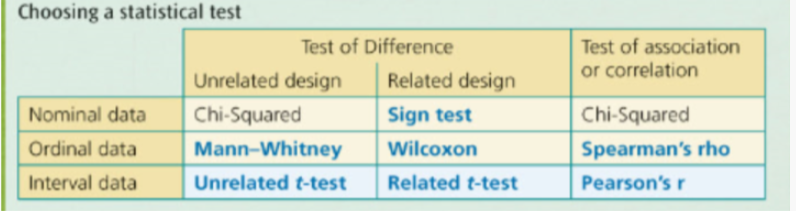 URR Carrots Should Come Mashed With Swede Under Roast Potatoes NOI
What is standard deviation
a more sophisticated measure of dispersion
the score tells us how far scores deviate from the mean
the larger the standard deviation, the greater the dispersion or spread withing a set of data