Bio 3rd Exam
 Call Kai
 Learn
Learn Practice Test
 Spaced Repetition
 Match
Match Flashcards
 Knowt Play
1/126

There's no tags or description
Looks like no tags are added yet.
Name | Mastery | Learn | Test | Matching | Spaced | Call with Kai |
|---|
No analytics yet
Send a link to your students to track their progress
127 Terms
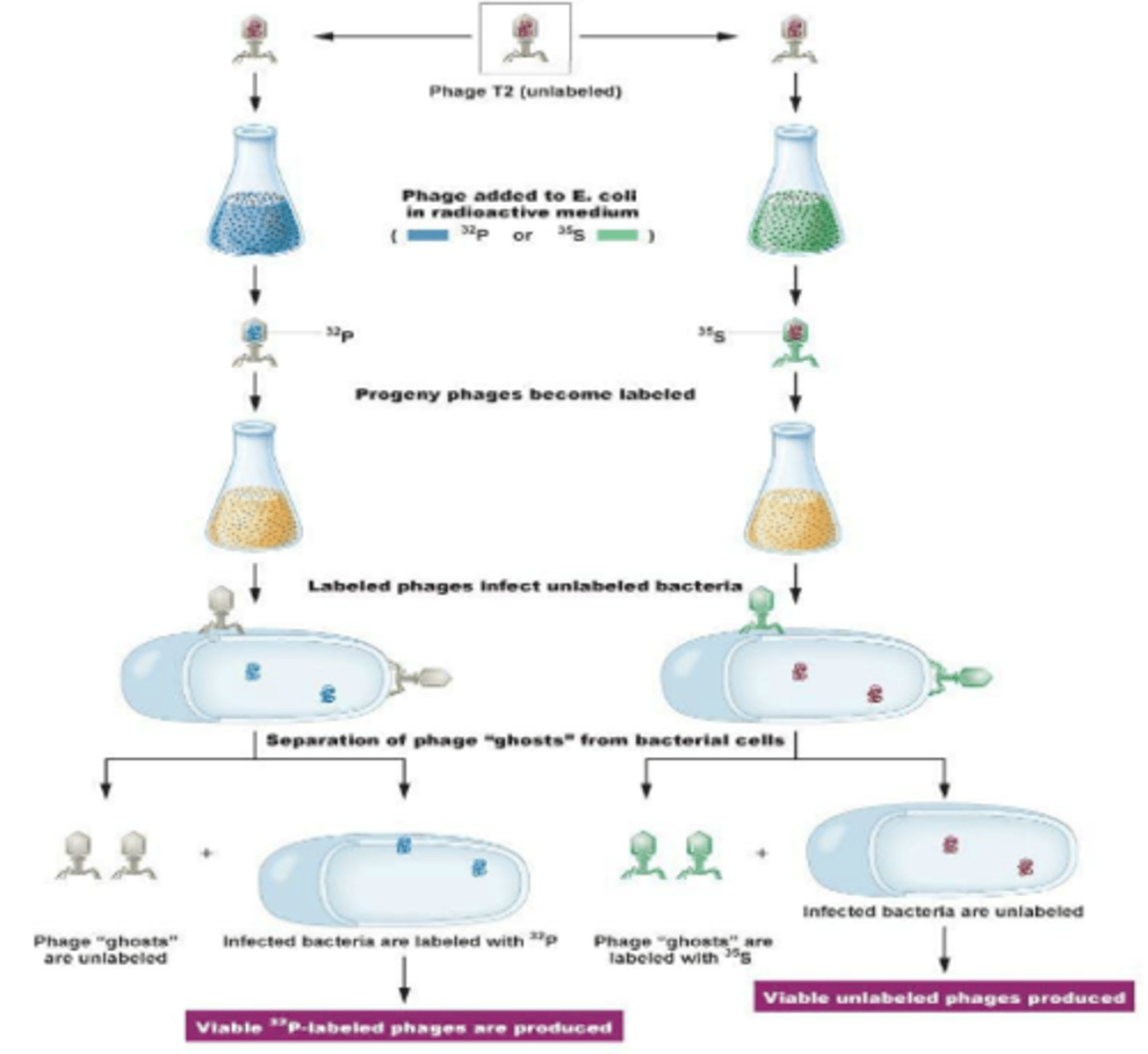
Hershey and Chase Experiment (1952)
The experiment demonstrated that DNA, not protein, was the genetic material encoding characteristics of a cell.
Describe the structure of DNA
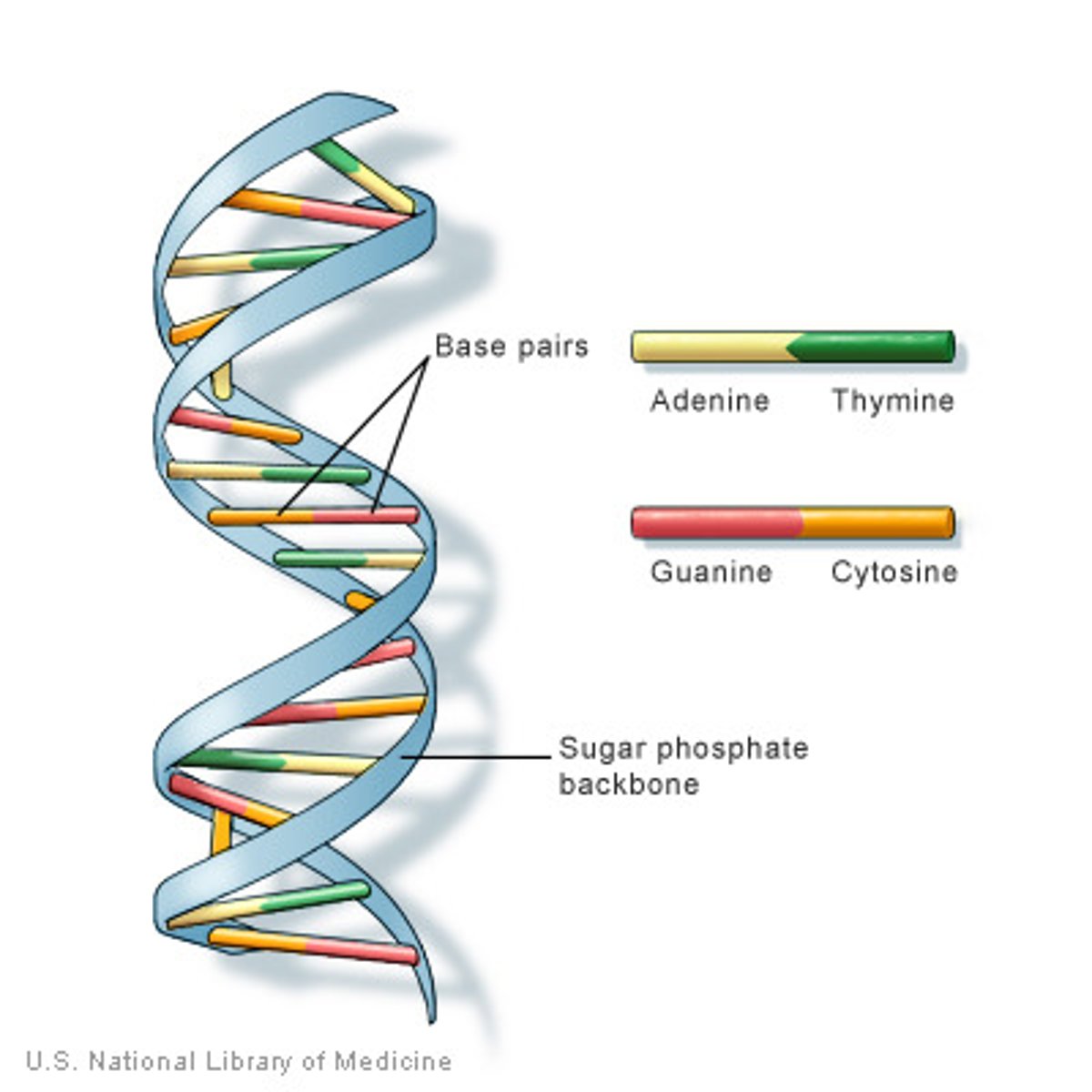
- Double-stranded
-Helical shape
-Has a sugar (deoxyribose)-phosphate backbone
-Contains the nitrogen bases Adenine, Guanine, Cytosine, Thymine
-Strands are held together by hydrogen bonds
Nucleotide
A unit of DNA or RNA consisting of a nitrogen base, deoxyribose or ribose sugar, and a phosphate.
Describe the structure of RNA
-Single-stranded
-Contains the nitrogen bases URACIL, adenine, guanine, and cytosine.
-has a ribose sugar-phosphate backbone
What are the 3 types of RNA?
Messenger RNA (mRNA)
Ribosomal RNA (rRNA)
Transfer RNA (tRNA)
mRNA
Messenger RNA; carries the genetic information from DNA to the ribosomes
rRNA
Ribosomal RNA; along with proteins, makes up the ribosomes.
Ribosome
A complex made of RNA and proteins that serves as platform or physical site where proteins are made.
tRNA
Transfer RNA; transfers amino acids to ribosomes for protein synthesis.
Steps of Transcription
1. Initiation
2. Elongation
3. Termination
RNA Polymerase
Enzyme in transcription that separates the hydrogen bonds in DNA and builds a complementary strand of RNA from the exposed DNA.
What nitrogen base substitutes for thymine in RNA
Uracil
Introns
Sequences in DNA that do not code for anything.
Exons
Sequences in DNA that code for proteins
What happens during mRNA processing?
-A 7-methylguanosine "cap" is added to the 5' end
-poly-A tail is added to the 3' end of the strand.
-Introns are cut out of the strand and exons are spliced together
Initiation step of transcription
RNA polymerase binds to the promoter region of DNA. The hydrogen bonds break in DNA and allow the strands to open up.
Elongation step of transcription
RNA polymerase reads the exposed DNA strands and builds a mRNA strand.
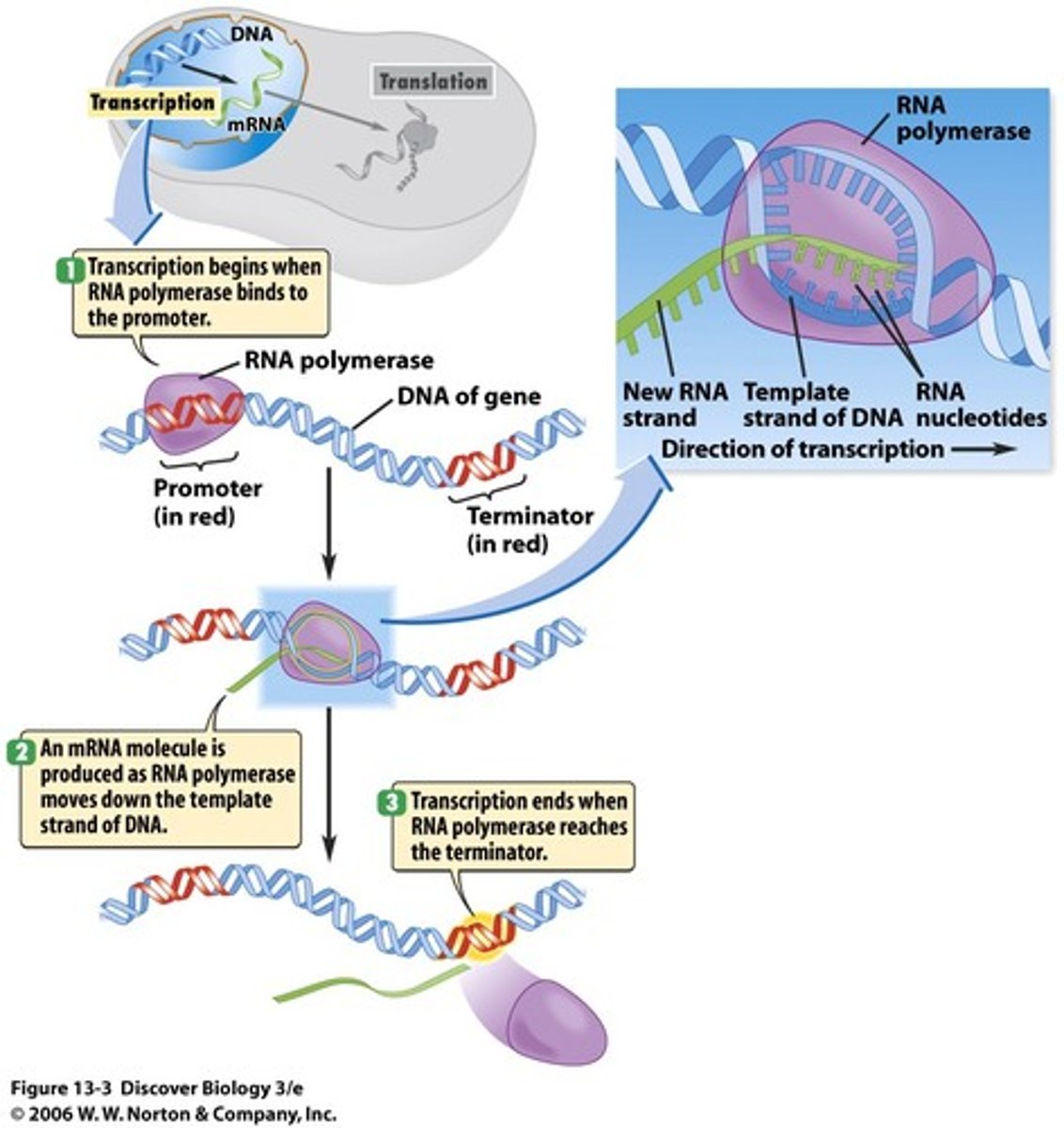
Termination step of transcription
RNA polymerase reaches a "stop" sequence in the DNA molecule and finishes building the new RNA strand.
Where does translation occur in the cell?
on a ribosome in the cytoplasm of the cell.
Where does transcription take place in the cell?
in the nucleus
Codon
A sequence of 3 nitrogen bases in DNA that code for an amino acid.
Steps of translation
-Initiation
-Elongation
-Termination
Initiation step of Translation
mRNA binds to a ribosome, which reads the mRNA 3 bases at a time
Elongation step of Translation
tRNA carries an amino acid to the ribosome, which matches the codons in the DNA to the complementary anticodon of the tRNA
Termination step of Translation
Once the ribosome reaches a stop codon, the protein is completed and released from the ribosome.
Operon
A cluster of structural and regulatory genes that act as a unit.
Gene
A specific sequence of DNA that controls the expression of one or more traits, such as blood type.
Gene expression
The process by which DNA is used to make proteins that determine specific traits.
Promoter
A portion of DNA that acts as a "starting line" for transcription.
Operator
A portion of the DNA that acts as a site for a repressor protein to bind. Acts as a switch that turns on/off transcription.
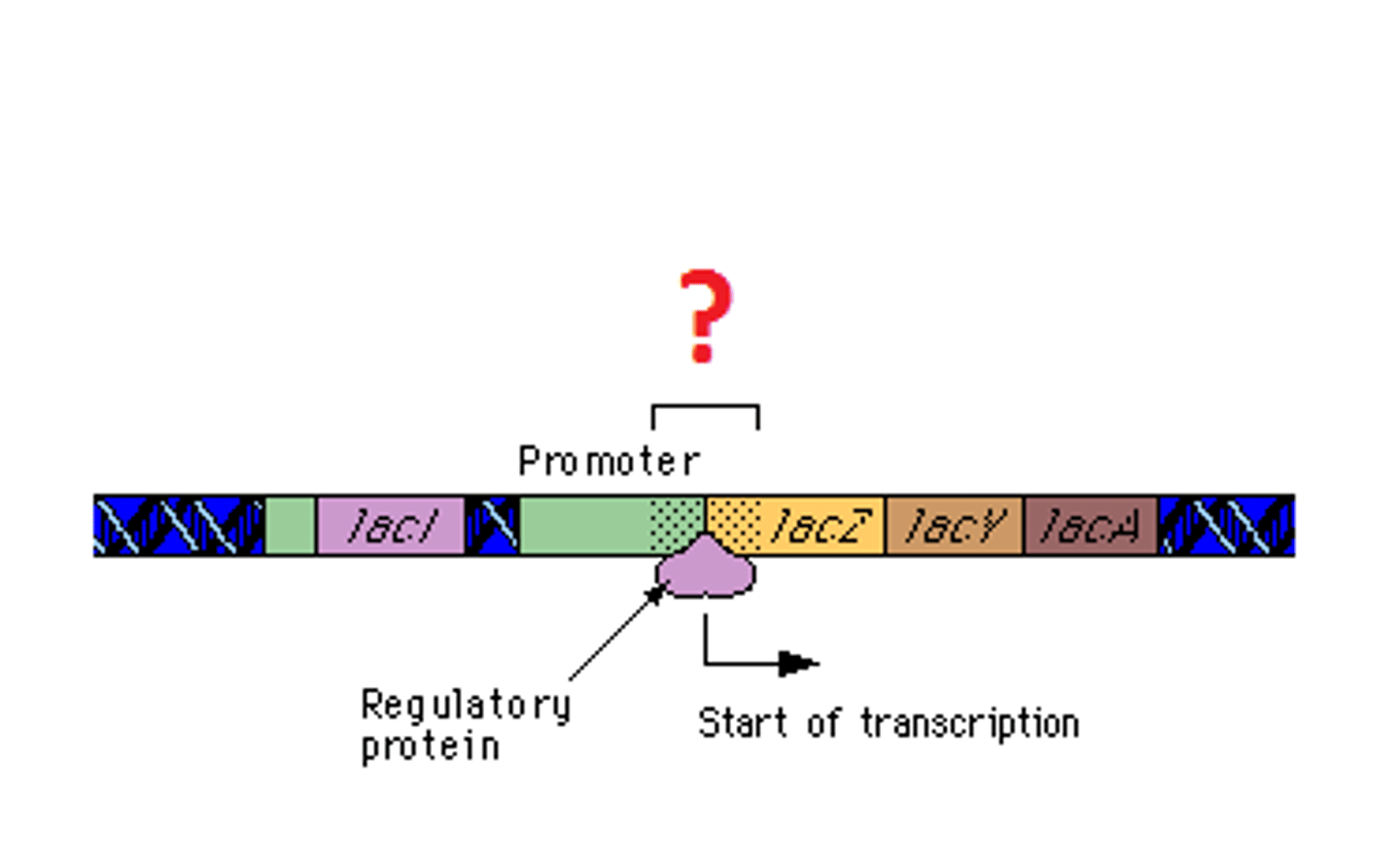
Repressor Protein
When attached to the operator portion, can prevent transcription by acting as a "roadblock" to RNA polymerase.
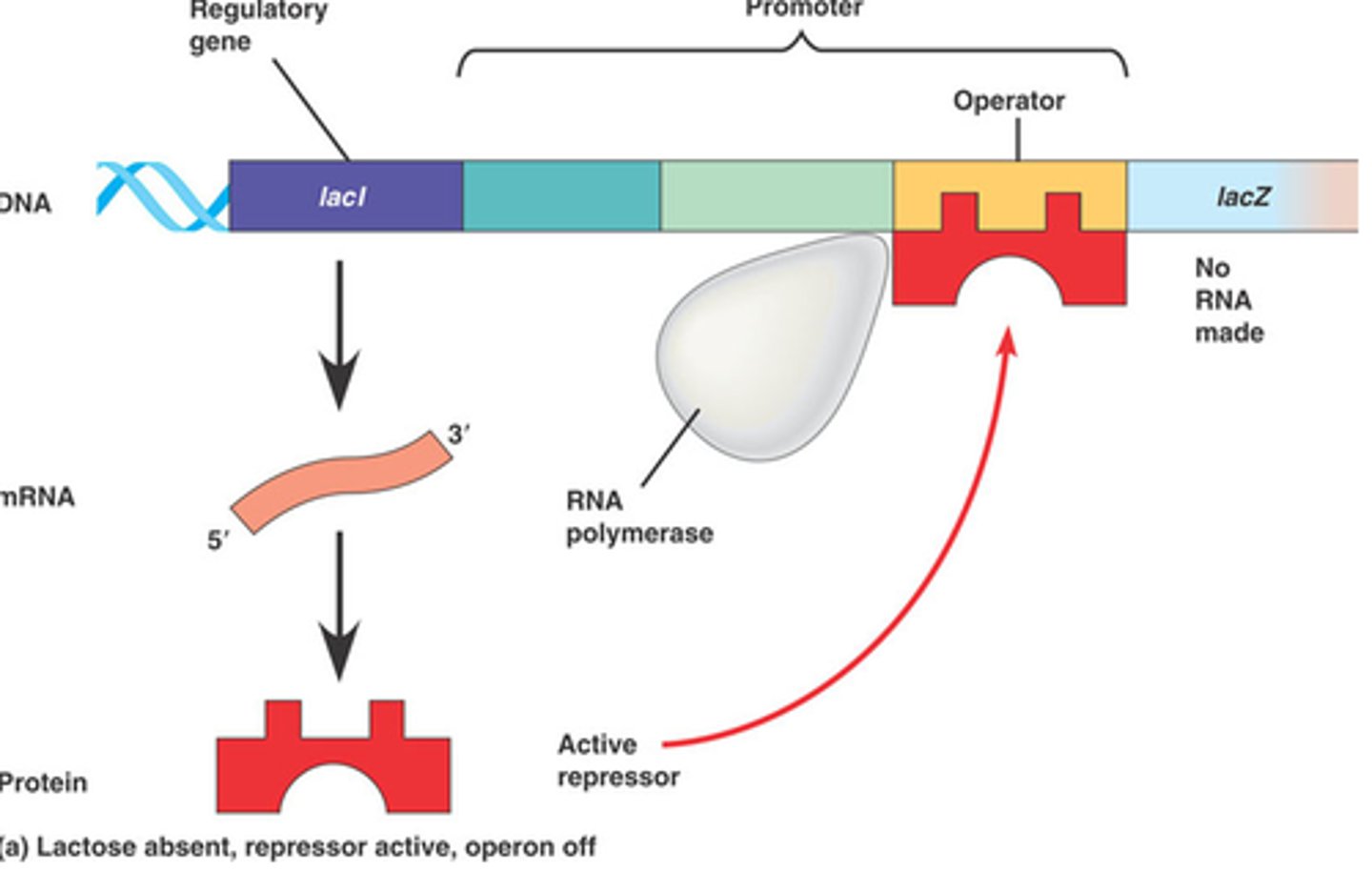
Gene expression in Prokaryotes
Prokaryotes have operons, clusters of genes, that can be "turned off" when they are not needed.
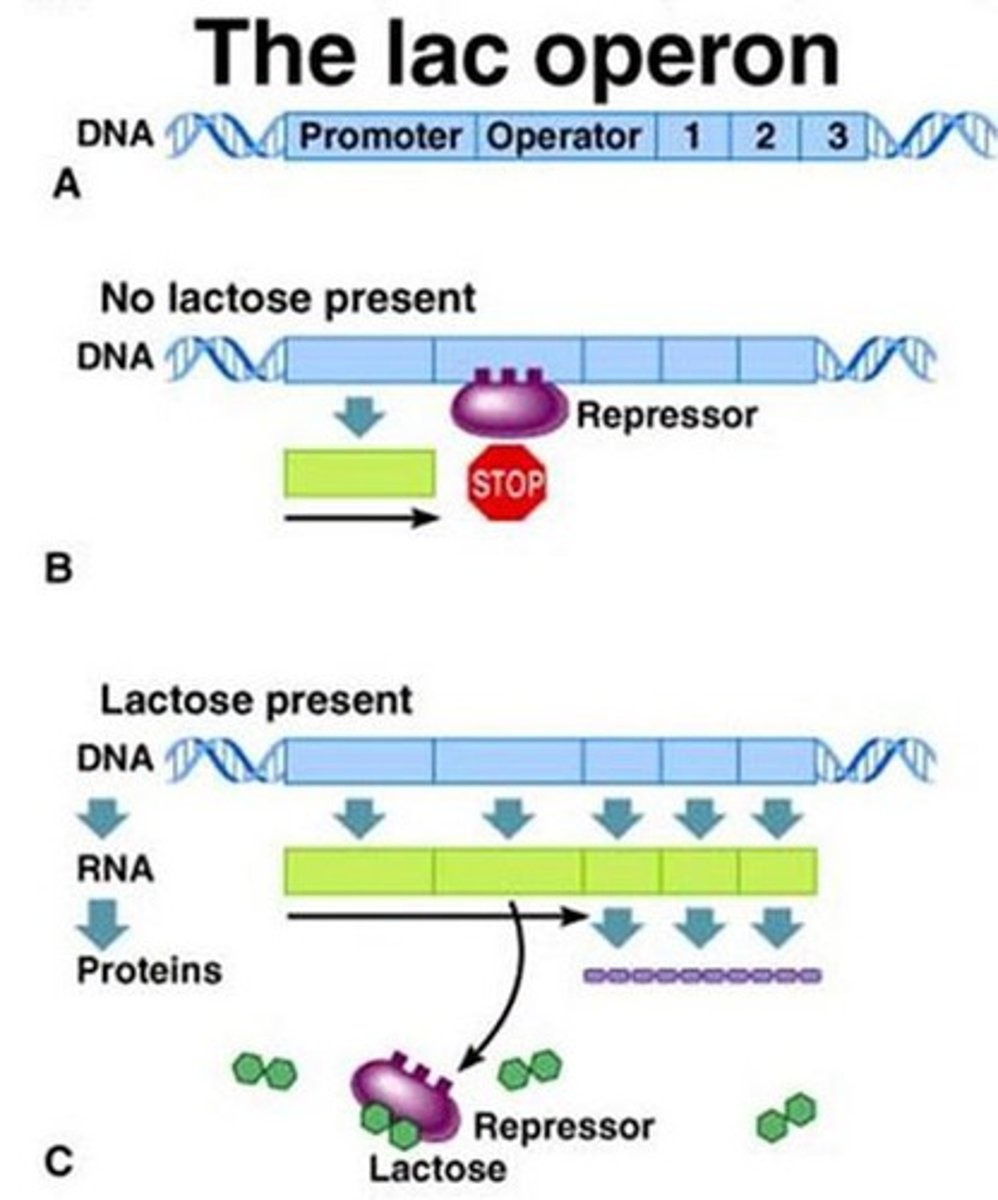
Lac Operon
-Present in E. coli
-Controls bacterial cells' ability to use lactose as energy
-When lactose is present, it binds to a repressor protein. Repressor detaches from the operator region of the gene and allows to use lactose.
Gene Expression in Eukaryotes
More complex than prokaryotes due to specialized cell genes.
-Five levels of gene control:
DNA availability/transcription factors
mRNA processing mRNA exit from nucleus
RNA degradation
Protein processing and degradation
How does DNA availability affect gene control?
Genes that are not used are packaged tightly until needed, preventing transcription.
How does mRNA processing affect gene control?
After transcription, mRNA can be rearranged during processing, producing different proteins from the same DNA information.
How does RNA degradation affect gene control?
The cell can control how many times mRNA is reused before it is broken down based on need for proteins.
How does protein processing and degradation affect gene control?
-Proteins that are needed only occasionally may be "turned off" and saved for later use.
-Proteins needed for single use may be broken down shortly after use.
Gene mutation
A change in the sequence of bases within a gene.
-Not always harmful.
Causes of mutations
-Errors in replication; happens rarely
-Mutagens
-Viruses
Why are errors in replication rare?
DNA polymerase proofreads strands and corrects errors in DNA
Mutagen
Environmental influences such as UV radiation and chemicals
Types of Gene Mutations
-Point mutations
-Frameshift mutations
Point mutation
Type of mutation in which one nucleotide is substituted for another.
Examples:
silent mutations, nonsense mutations missense mutations
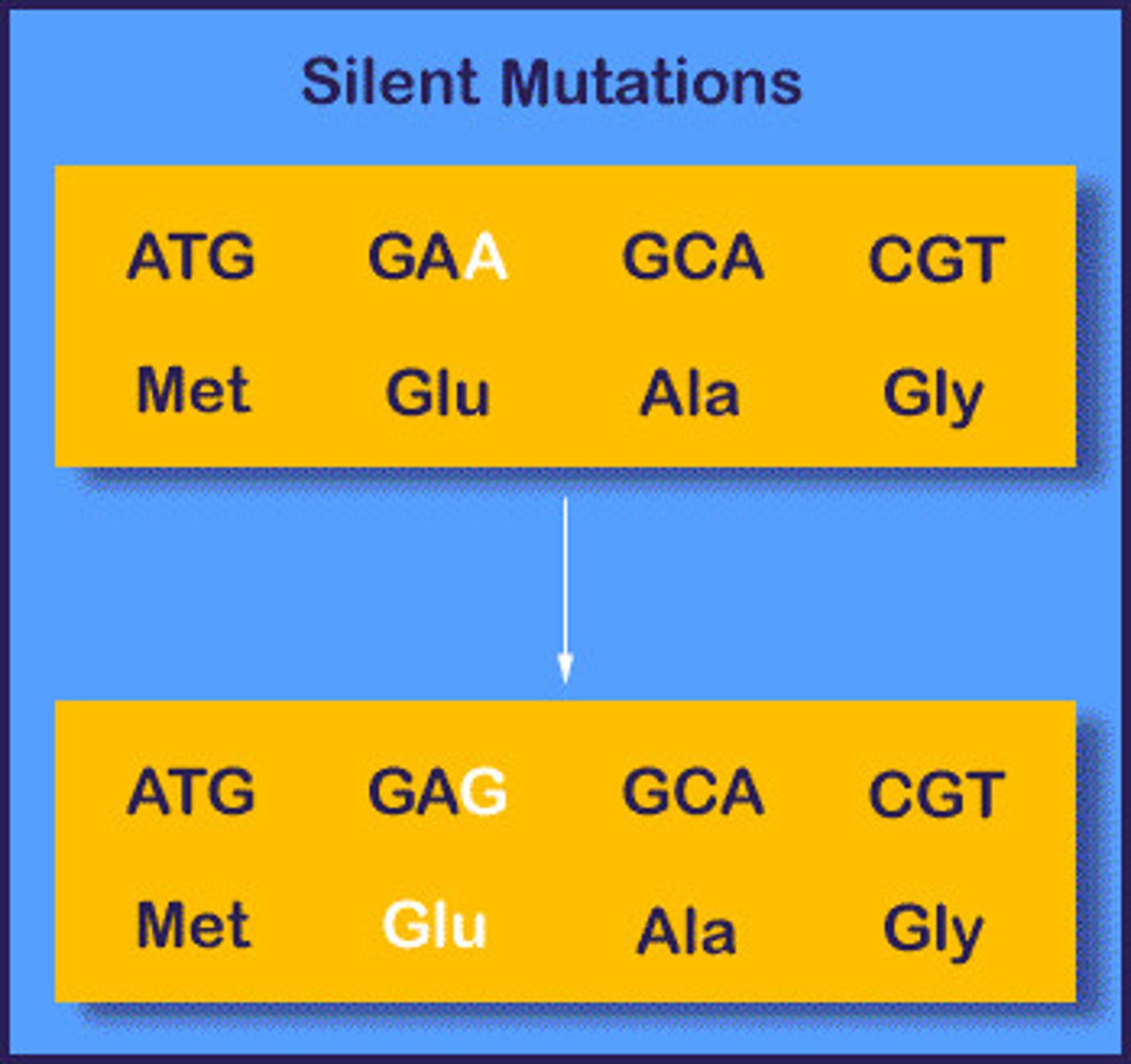
Silent Mutations
Point mutation that does not result in the production of a different protein; harmless
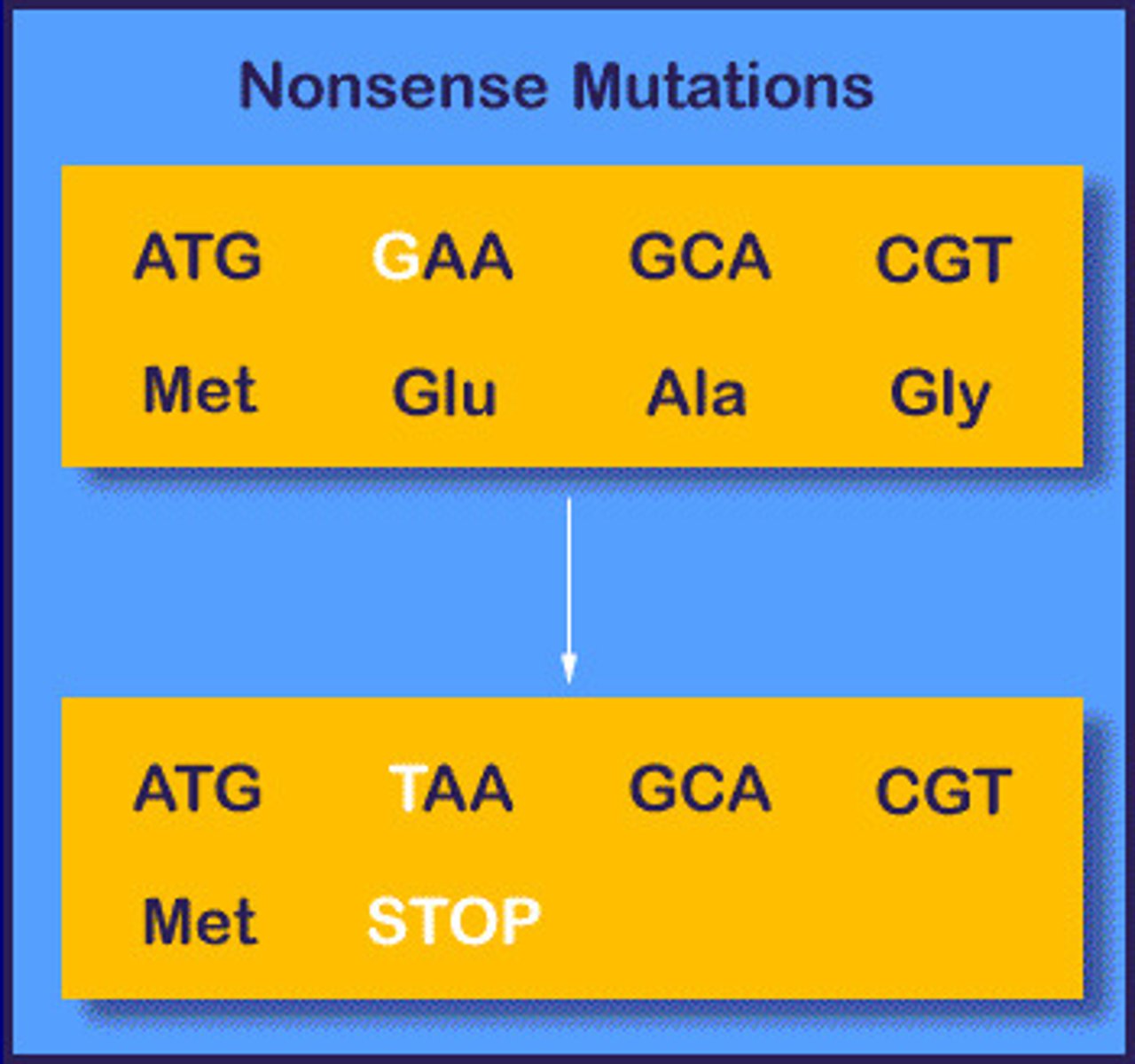
Nonsense Mutations
Result in a "STOP" codon
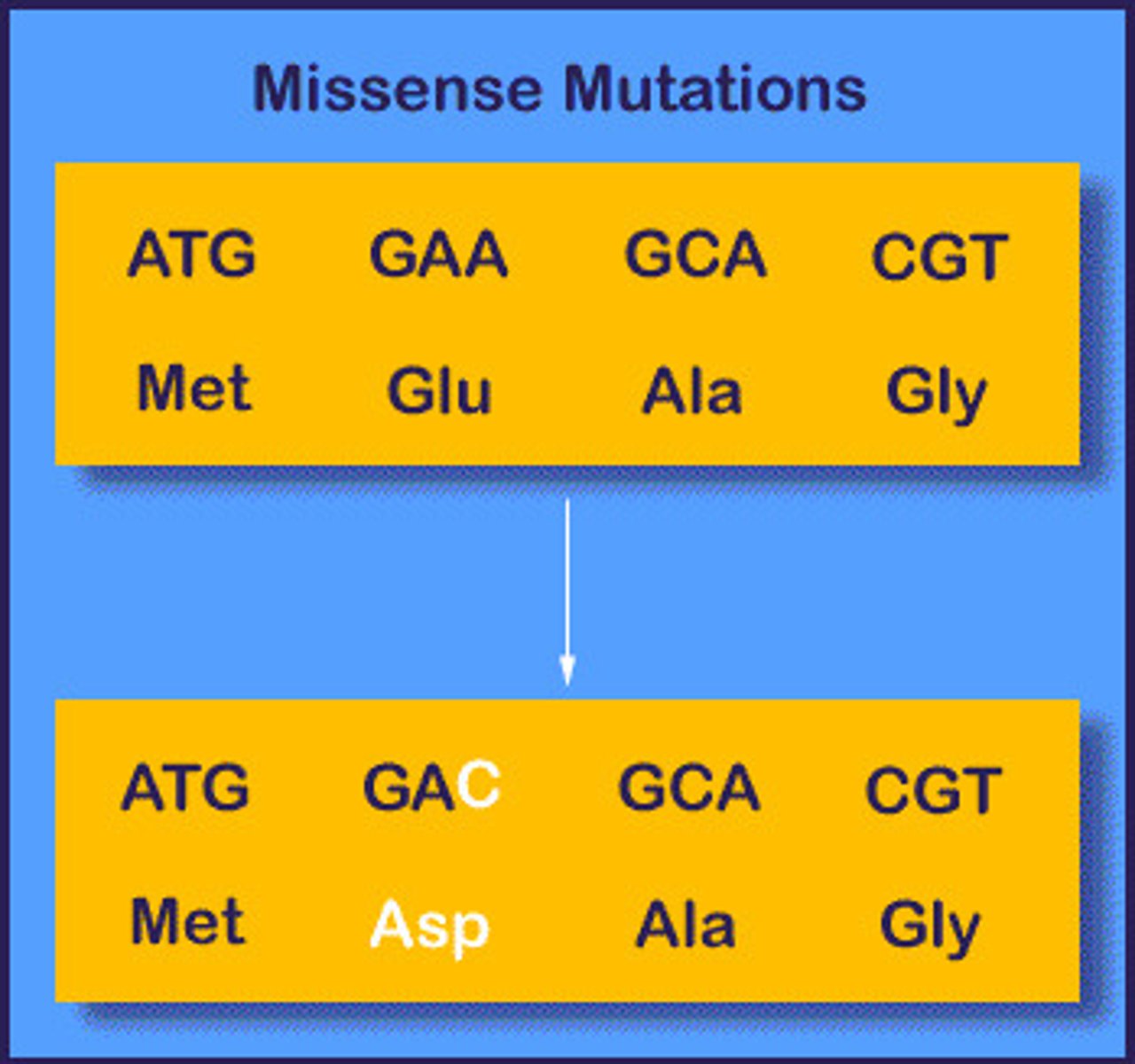
Missense Mutations
Result in a change in the amino acid made, which may change the protein made.
Frameshift Mutation
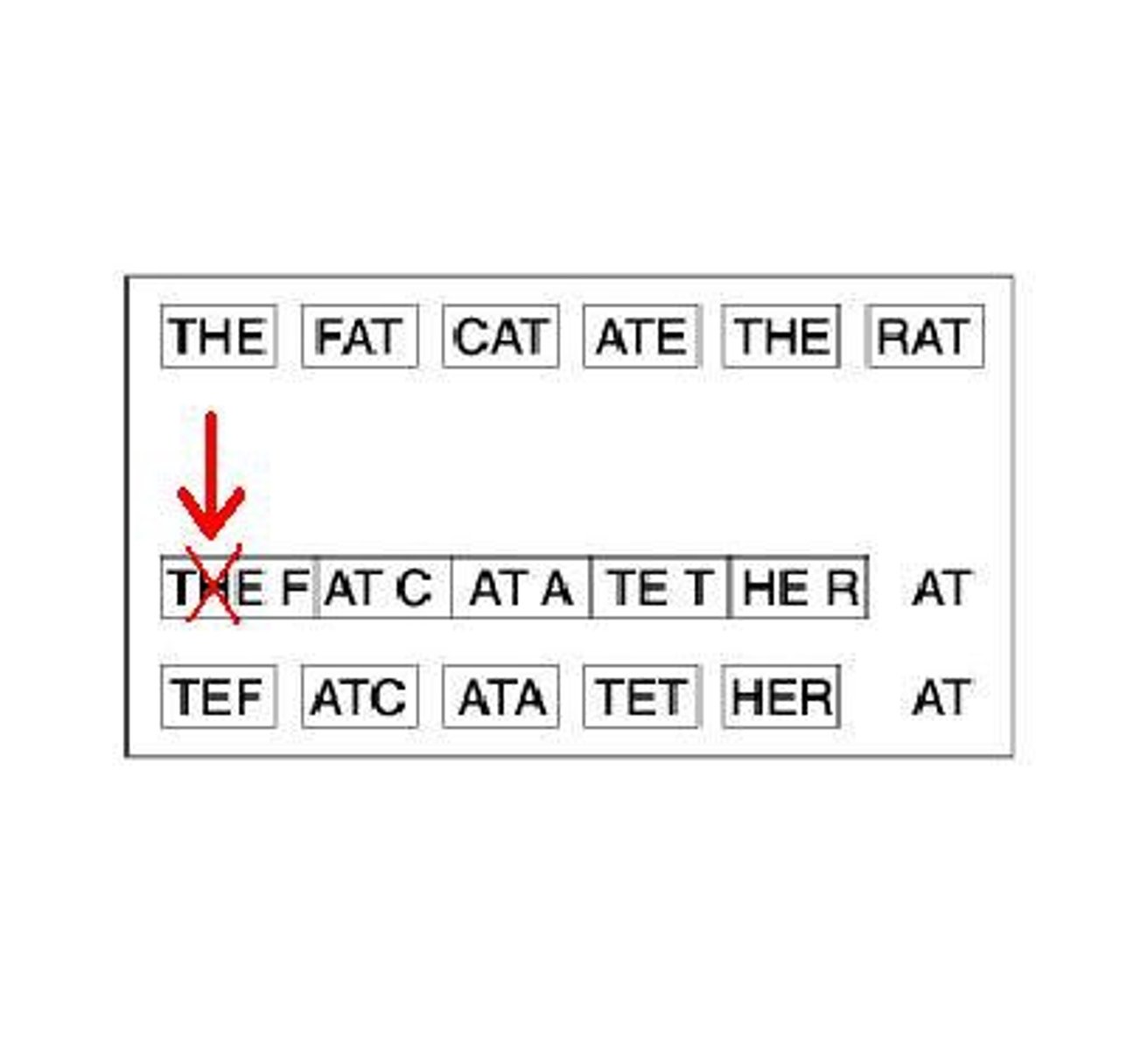
-Mutation in which one or more nucleotides are inserted or deleted
-Results in a different sequence of RNA, which will code for the wrong amino acids
Cancer
Uncontrolled cell division caused by changes in DNA
Characteristics of Cancer
-Many different variations
-Improper cell cycle regulation
-Loss of normal cell shape
-Loss of contact inhibition
-Shortened telomeres due to inability to produce telomerase.
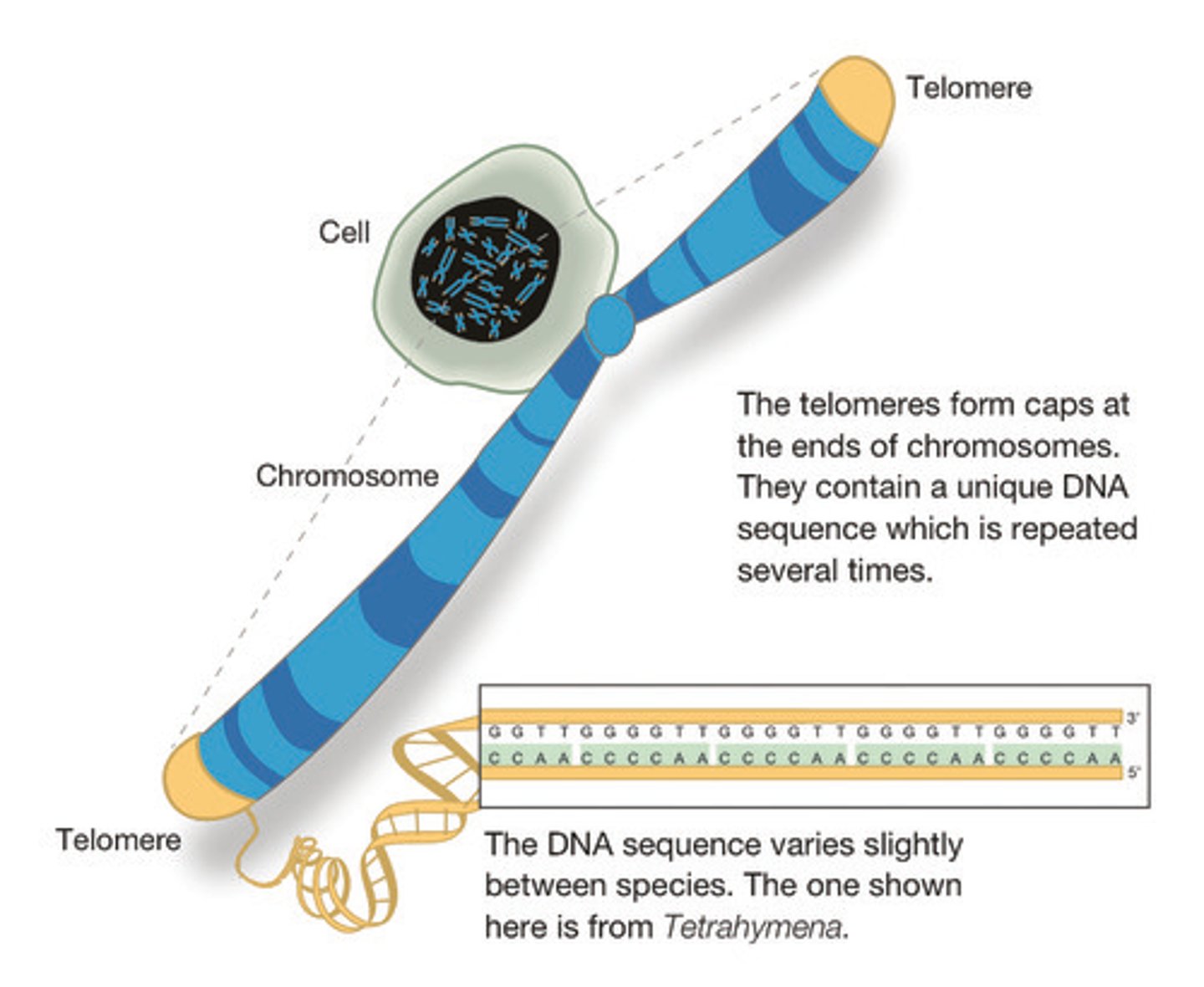
Telomere
Nucleotide sequences as the ends of chromosomes that function like a protective cap for DNA.
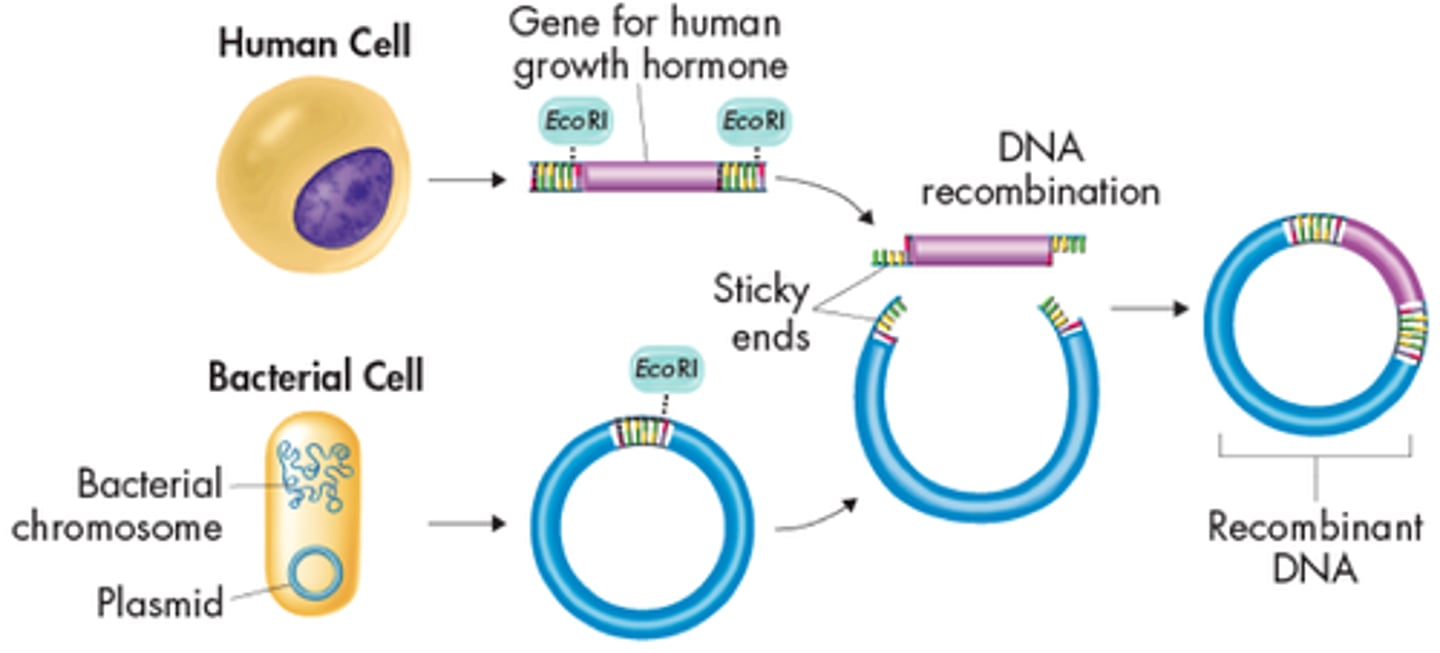
Steps to forming recombinant DNA
1. Cut the desired DNA by restriction sites
2. Amplify the genes copies by PCR
3. Insert the genes into the vectors.
4. Transfer the vectors into a host organism
5. Obtaining the products of recombinant genes
Polymerase Chain Reaction (PCR)
Process that can make billions of copies of a specific DNA region by using Taq polymerase, specific primers, and as exposure to varying temperatures.
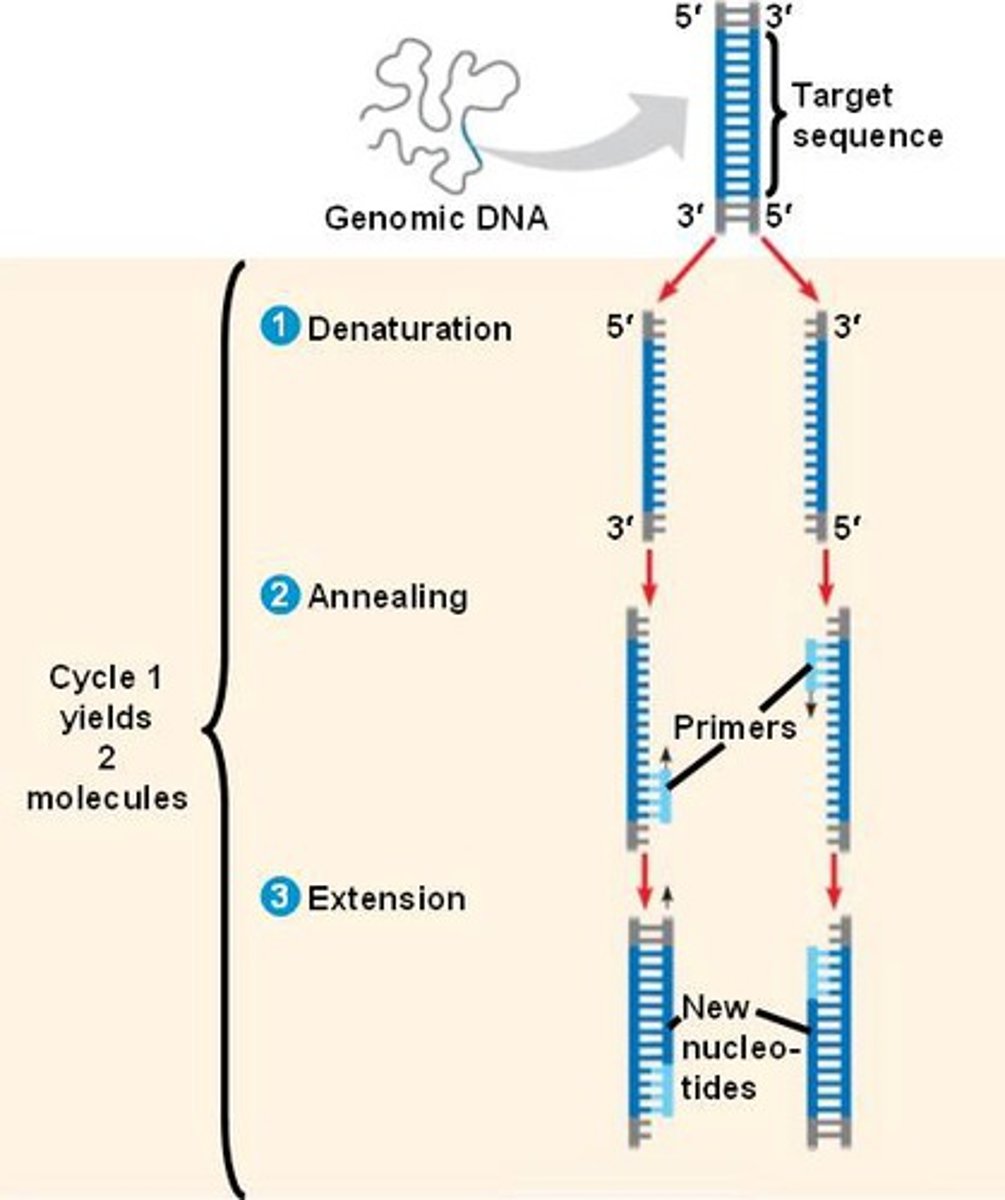
How is PCR useful in forensics cases?
PCR can be used to amplify samples of genetic material found at crime scenes, which can be analyzed for genetic markers. The markers can be compared to the DNA samples of suspects.
Human Genome Project
(1990-2003) An international collaborative effort to sequence and map all the genes in the human genome. As a result, scientists are able to identify genetic markers for diseases and develop gene therapies.
In DNA, Adenine always binds with ....
Thymine
In DNA, Guanine always binds with.....
Cytosine
What is the complementary DNA sequence to the following:
ATTGCGA
TAACGCT
What is the complementary RNA sequence to the following:
TAGATTC
AUCUAAG
Why do unicellular organisms divide?
Reproduce
Why is cell division important in multicellular organisms?
Supply of replacement cells
What type of division do multicellular organisms use...
...for growth and repair?
Mitosis
To produce sex cells?
Meiosis
Sex cells contain ___________ the DNA as other body cells.
Half
What is fertilization?
When two gametes combine and the zygote inherits DNA from both
What is the name of the cell produced by fertilization?
Zygote
What type of cells are produced by meiosis?
Sex cells (gametes)
What is apoptosis?
programmed cell death
What is DNA replication?
The making of two identical copies of DNA starting with one copy.
Why must DNA be replicated before a cell divides?
So each daughter cell receives identical DNA.
Helicase
unwind the DNA
Binding proteins
hold strands apart
Primase
Adds short RNA primers
DNA polymerase
Builds new DNA strands (adds to 3' end, 5'→3')
Ligase
Joins DNA fragments on lagging strand
Topoisomerase
Relieves twisting/tension in DNA
What does it mean that DNA replication is semiconservative?
Each DNA molecule has one parental strand and one newly made strand.
What is the role of RNA primers in DNA replication?
They provide a starting point for DNA polymerase.
What is the difference between the leading and lagging strand?
Leading: continuous synthesis
Lagging: discontinuous synthesis (opposite direction of helicase)
What are Okazaki fragments?
Short lengths of single-stranded DNA made on the lagging strand.
Okazaki fragments are found on the _____________________ strand of DNA.
Lagging strand
Where on the DNA does replication begin?
At origins of replication.
Which organisms divide by binary fission?
Prokaryotes
Is binary fission a sexual or asexual process?
asexual
List the main steps of binary fission:
DNA is replicated
DNA attaches to cell membrane
Cell membrane grows and separates DNA
Cell splits into two identical cells
Why is binary fission considered asexual?
Because it produces two identical cells.
Eukaryotic cells do not divide by binary fission. They divide by
mitosis.
What is the form of DNA when the cell is not dividing?
Chromatin
Replicated chromosomes condense before eukaryotic cell division. What is the term for this condensed, visible DNA?
Chromosomes
DNA wraps around ___________________ proteins, forming bead-like structures called ________________________.
histone, nucleosomes
Those bead-like structures cluster together into
Chromatin.
Why is DNA packaging important before cell division?
So DNA stays tightly packed and does not get lost or damaged during division.
For Animals: Meiosis of a germ cell produces...
Gametes
For Plants & Fungi: Meiosis produces...
Spores
Haploid cells only have__ chromosomes.
23
What trait spreads quicker through a sexually reproducing population?
An Adaptive trait
Sexual reproduction generates new combinations of___
traits
Homologous is what?
Pairs of matching chromosomes (1 moms, 1 dads)
What are Gametes?
Sex cells (sperm and egg)
Crossing over only happens in?
Meiosis 1 (Prophase 1)

