Circular Geometry

0.0(0)
Studied by 0 people
call kaiCall Kai
Locked
learnLearn
examPractice Test
spaced repetitionSpaced Repetition
heart puzzleMatch
flashcardsFlashcards
GameKnowt Play
Card Sorting

1/46

flashcard set

Earn XP

Description and Tags

Last updated 11:36 AM on 9/14/26
Name
Mastery
Learn
Test
Matching
Spaced
Call with Kai
Chat

No analytics yet

Send a link to your students to track their progress

47 Terms

1
New cards
<p>In circle K with <span style="font-family: KaTeX_Main, &quot;Times New Roman&quot;, serif; line-height: 1.2; font-size: 1.21em;"><em>m</em>∠<em>JKL</em>=82∘</span> and <span style="font-family: KaTeX_Main, &quot;Times New Roman&quot;, serif; line-height: 1.2; font-size: 1.21em;"><em>JK</em>=7</span>, find the area of sector JKL. Round to the nearest hundredth</p>

In circle K with mJKL=82∘ and JK=7, find the area of sector JKL. Round to the nearest hundredth

35.06 units2

<p><span>35.06 units<sup>2</sup></span></p>
2
New cards
<p>In circle R with <span style="font-family: KaTeX_Main, &quot;Times New Roman&quot;, serif; line-height: 1.2; font-size: 1.21em;"><em>m</em>∠<em>QRS</em>=156∘</span> and <span style="font-family: KaTeX_Main, &quot;Times New Roman&quot;, serif; line-height: 1.2; font-size: 1.21em;"><em>QR</em>=10</span>, find the area of sector QRS. Round to the nearest hundredth.</p>

In circle R with mQRS=156∘ and QR=10, find the area of sector QRS. Round to the nearest hundredth.

136.14 units2

<p><span>136.14 units<sup>2</sup></span></p>
3
New cards
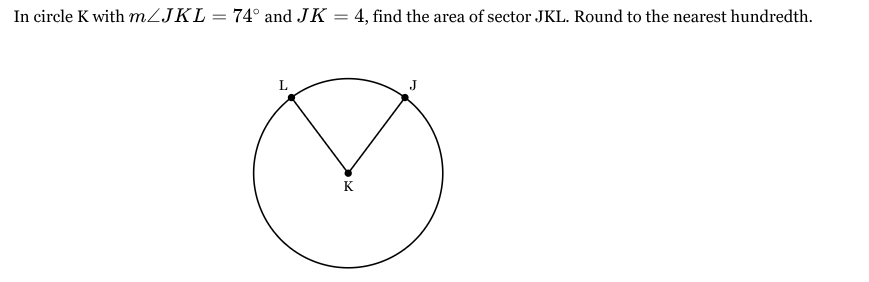
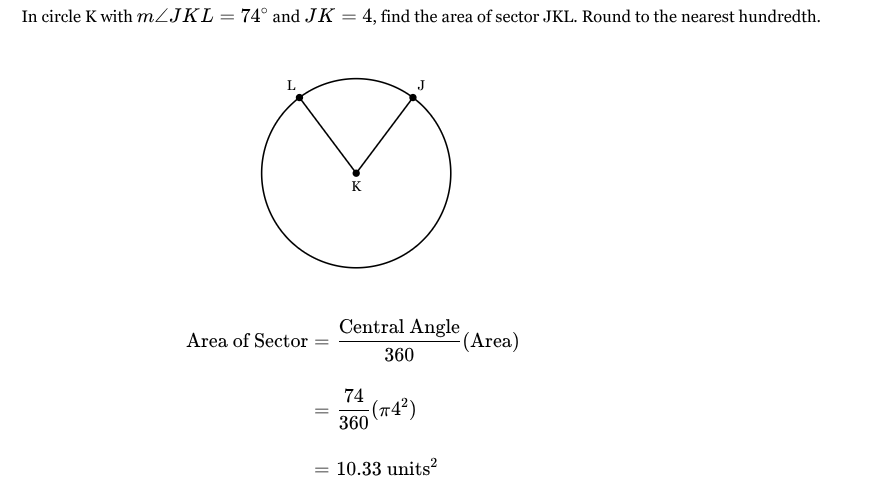
<p>In circle K with <span style="font-family: KaTeX_Main, &quot;Times New Roman&quot;, serif; line-height: 1.2; font-size: 1.21em;"><em>m</em>∠<em>JKL</em>=74∘</span> and <span style="font-family: KaTeX_Main, &quot;Times New Roman&quot;, serif; line-height: 1.2; font-size: 1.21em;"><em>JK</em>=4</span>, find the area of sector JKL. Round to the nearest hundredth.</p>

In circle K with mJKL=74∘ and JK=4, find the area of sector JKL. Round to the nearest hundredth.

10.33 units2
<p><span>10.33&nbsp;units<sup>2</sup></span></p>
4
New cards
<p>In circle <span style="font-family: KaTeX_Main, &quot;Times New Roman&quot;, serif; line-height: 1.2; font-size: 1.21em;"><em>T</em></span>, <span style="font-family: KaTeX_Main, &quot;Times New Roman&quot;, serif; line-height: 1.2; font-size: 1.21em;"><em>TU</em>=9</span> and m<span style="font-family: KaTeX_Main, &quot;Times New Roman&quot;, serif; line-height: 1.2; font-size: 1.21em;">∠<em>UTV</em>=160∘</span>. Find the area of shaded sector. Express your answer as a fraction times <span style="font-family: KaTeX_Main, &quot;Times New Roman&quot;, serif; line-height: 1.2; font-size: 1.21em;"><em>π</em></span>.</p>

In circle T, TU=9 and mUTV=160∘. Find the area of shaded sector. Express your answer as a fraction times π.

36π

<p><span>36<em>π</em></span></p>
5
New cards
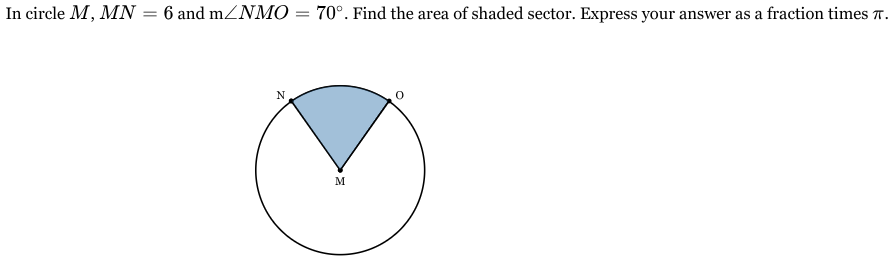
<p>In circle <span style="font-family: KaTeX_Main, &quot;Times New Roman&quot;, serif; line-height: 1.2; font-size: 1.21em;"><em>M</em></span>, <span style="font-family: KaTeX_Main, &quot;Times New Roman&quot;, serif; line-height: 1.2; font-size: 1.21em;"><em>MN</em>=6</span> and m<span style="font-family: KaTeX_Main, &quot;Times New Roman&quot;, serif; line-height: 1.2; font-size: 1.21em;">∠<em>NMO</em>=70∘</span>. Find the area of shaded sector. Express your answer as a fraction times <span style="font-family: KaTeX_Main, &quot;Times New Roman&quot;, serif; line-height: 1.2; font-size: 1.21em;"><em>π</em></span>.</p>

In circle M, MN=6 and mNMO=70∘. Find the area of shaded sector. Express your answer as a fraction times π.

7π

<p><span>7<em>π</em></span></p>
6
New cards
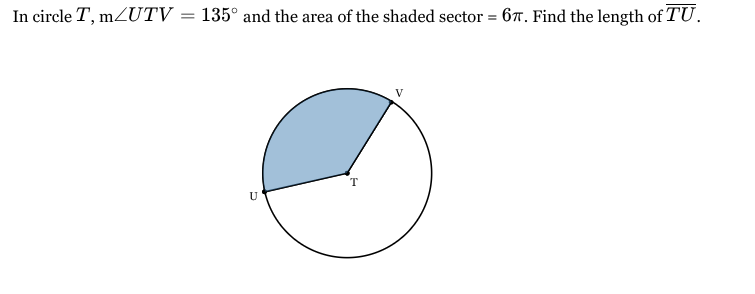
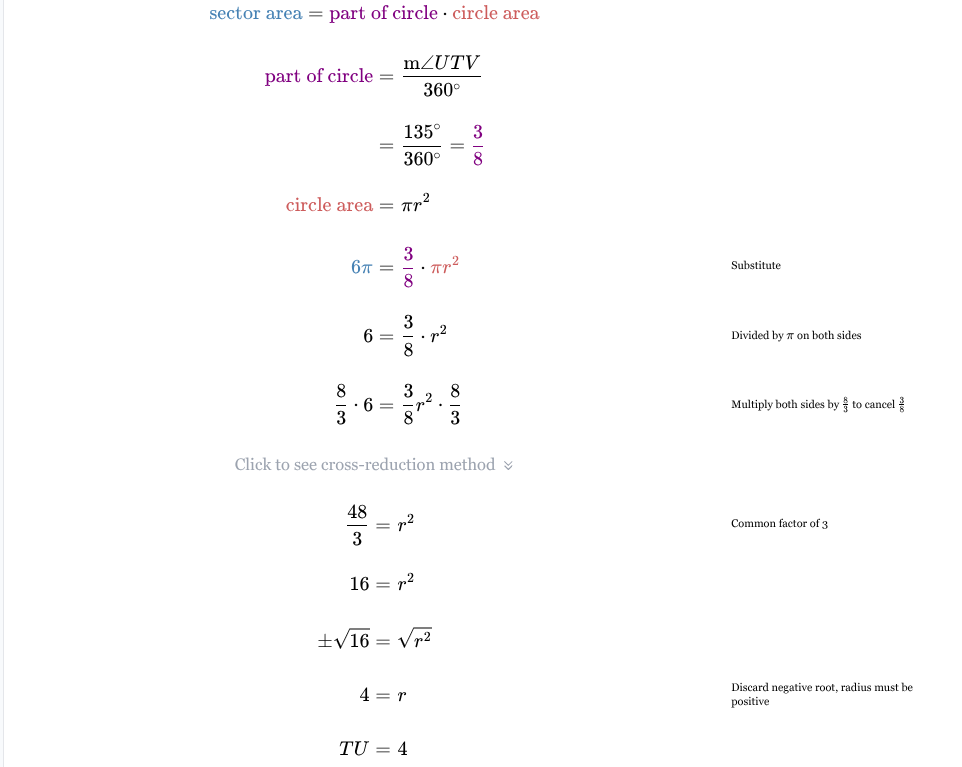
<p>In circle <span style="font-family: KaTeX_Main, &quot;Times New Roman&quot;, serif; line-height: 1.2; font-size: 1.21em;"><em>T</em></span>, m<span style="font-family: KaTeX_Main, &quot;Times New Roman&quot;, serif; line-height: 1.2; font-size: 1.21em;">∠<em>UTV</em>=135∘</span> and the area of the shaded sector = <span style="font-family: KaTeX_Main, &quot;Times New Roman&quot;, serif; line-height: 1.2; font-size: 1.21em;">6<em>π</em></span>. Find the length of <span style="font-family: KaTeX_Main, &quot;Times New Roman&quot;, serif; line-height: 1.2; font-size: 1.21em;"><em>TU</em></span>.</p><p>TU = ___</p>

In circle T, mUTV=135∘ and the area of the shaded sector = 6π. Find the length of TU.

TU = ___

TU = 4
<p><span>TU = 4</span></p>
7
New cards
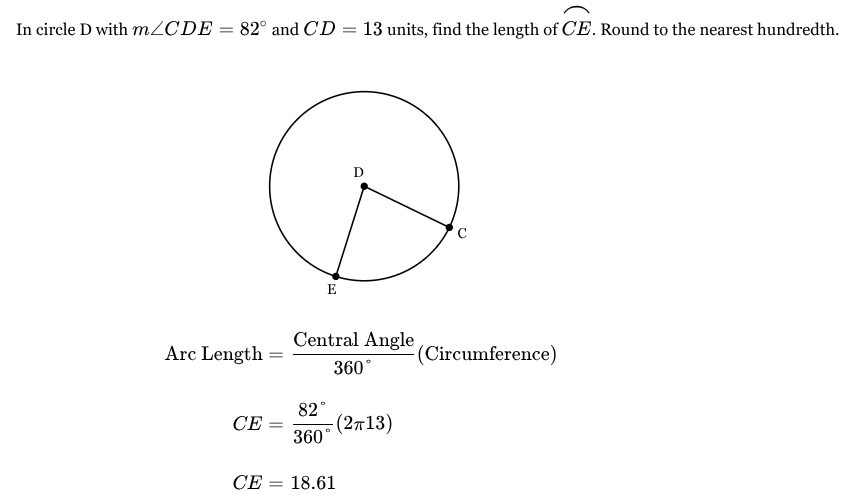
<p>In circle D with <span style="font-family: KaTeX_Main, &quot;Times New Roman&quot;, serif; line-height: 1.2; font-size: 1.21em;"><em>m</em>∠<em>CDE</em>=82∘</span> and <span style="font-family: KaTeX_Main, &quot;Times New Roman&quot;, serif; line-height: 1.2; font-size: 1.21em;"><em>CD</em>=13</span> units, find the length of <span style="font-family: KaTeX_Main, &quot;Times New Roman&quot;, serif; line-height: 1.2; font-size: 1.21em;"><em>CE</em>⌢</span>. Round to the nearest hundredth.</p>

In circle D with mCDE=82∘ and CD=13 units, find the length of CE. Round to the nearest hundredth.

CE = 18.61
<p><span style="font-family: KaTeX_Main, &quot;Times New Roman&quot;, serif; line-height: 1.2; font-size: 1.21em;"><em>CE </em>= 18.61</span></p>
8
New cards
<p>In circle P with <span style="font-family: KaTeX_Main, &quot;Times New Roman&quot;, serif; line-height: 1.2; font-size: 1.21em;"><em>m</em>∠<em>NPQ</em>=96∘</span> and <span style="font-family: KaTeX_Main, &quot;Times New Roman&quot;, serif; line-height: 1.2; font-size: 1.21em;"><em>NP</em>=3</span> units, find the length of <span style="font-family: KaTeX_Main, &quot;Times New Roman&quot;, serif; line-height: 1.2; font-size: 1.21em;"><em>NQ</em>⌢​</span>. Round to the nearest hundredth.</p>

In circle P with mNPQ=96∘ and NP=3 units, find the length of NQ⌢​. Round to the nearest hundredth.

NQ = 5.03

<p><span style="font-family: KaTeX_Main, &quot;Times New Roman&quot;, serif; line-height: 1.2; font-size: 1.21em;"><em>NQ </em>= 5.03</span></p>
9
New cards
<p>In circle F with <span style="font-family: KaTeX_Main, &quot;Times New Roman&quot;, serif; line-height: 1.2; font-size: 1.21em;"><em>m</em>∠<em>EFG</em>=46∘</span> and <span style="font-family: KaTeX_Main, &quot;Times New Roman&quot;, serif; line-height: 1.2; font-size: 1.21em;"><em>EF</em>=8</span> units, find the length of <span style="font-family: KaTeX_Main, &quot;Times New Roman&quot;, serif; line-height: 1.2; font-size: 1.21em;"><em>EG</em>⌢</span>. Round to the nearest hundredth.</p>

In circle F with mEFG=46∘ and EF=8 units, find the length of EG. Round to the nearest hundredth.

EG = 6.42

<p><span style="font-family: KaTeX_Main, &quot;Times New Roman&quot;, serif; line-height: 1.2; font-size: 1.21em;"><em>EG </em>= 6.42</span></p>
10
New cards
<p>In circle P with <span style="font-family: KaTeX_Main, &quot;Times New Roman&quot;, serif; line-height: 1.2; font-size: 1.21em;"><em>m</em>∠<em>NPQ</em>=96∘</span> and <span style="font-family: KaTeX_Main, &quot;Times New Roman&quot;, serif; line-height: 1.2; font-size: 1.21em;"><em>NP</em>=19</span> units, find the length of <span style="font-family: KaTeX_Main, &quot;Times New Roman&quot;, serif; line-height: 1.2; font-size: 1.21em;"><em>NQ</em>⌢​</span>. Round to the nearest hundredth.</p>

In circle P with mNPQ=96∘ and NP=19 units, find the length of NQ⌢​. Round to the nearest hundredth.

NQ = 31.83

<p><span style="font-family: KaTeX_Main, &quot;Times New Roman&quot;, serif; line-height: 1.2; font-size: 1.21em;"><em>NQ </em>= 31.83</span></p>
11
New cards
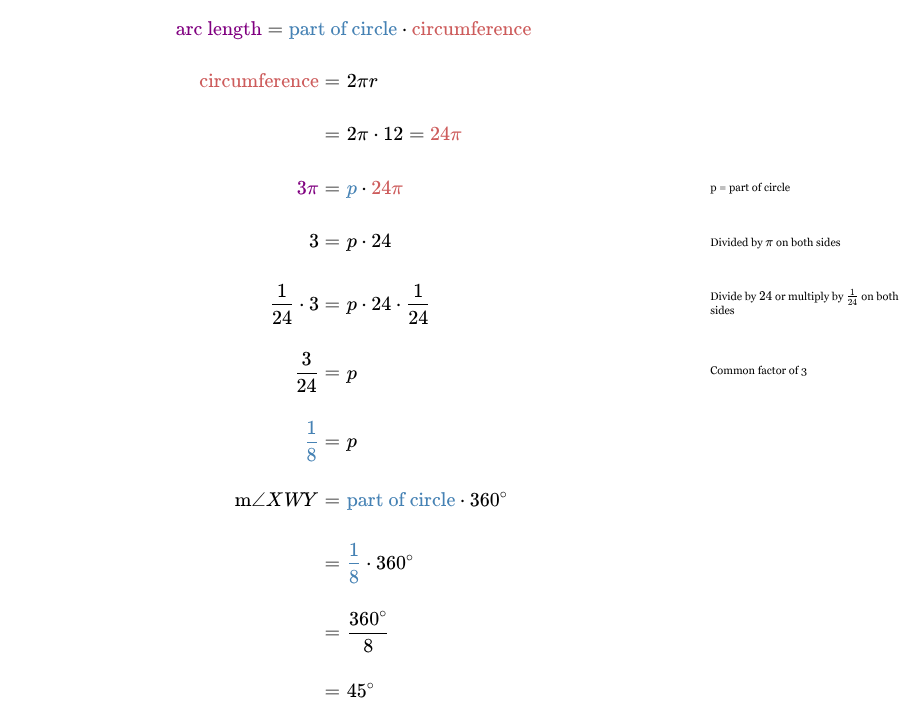
<p>In circle <span style="font-family: KaTeX_Main, &quot;Times New Roman&quot;, serif; line-height: 1.2; font-size: 1.21em;"><em>W</em></span>, <span style="font-family: KaTeX_Main, &quot;Times New Roman&quot;, serif; line-height: 1.2; font-size: 1.21em;"><em>WX</em>=12</span> and the length of <span style="font-family: KaTeX_Main, &quot;Times New Roman&quot;, serif; line-height: 1.2; font-size: 1.21em;"><em>XY</em>⌢=3<em>π</em></span>. Find m<span style="font-family: KaTeX_Main, &quot;Times New Roman&quot;, serif; line-height: 1.2; font-size: 1.21em;">∠<em>XWY</em></span>.</p>

In circle W, WX=12 and the length of XY⌢=3π. Find mXWY.

m∠XWY=45∘

<p><span>m∠XWY=45∘</span></p>
12
New cards
<p>In circle <span style="font-family: KaTeX_Main, &quot;Times New Roman&quot;, serif; line-height: 1.2; font-size: 1.21em;"><em>A</em></span>, <span style="font-family: KaTeX_Main, &quot;Times New Roman&quot;, serif; line-height: 1.2; font-size: 1.21em;"><em>AB</em>=5</span> and m<span style="font-family: KaTeX_Main, &quot;Times New Roman&quot;, serif; line-height: 1.2; font-size: 1.21em;">∠<em>BAC</em>=144∘</span>. Find the length of <span style="font-family: KaTeX_Main, &quot;Times New Roman&quot;, serif; line-height: 1.2; font-size: 1.21em;"><em>BC</em>⌢</span>. Express your answer as a fraction times <span style="font-family: KaTeX_Main, &quot;Times New Roman&quot;, serif; line-height: 1.2; font-size: 1.21em;"><em>π</em></span> (in simplest form).</p>

In circle A, AB=5 and mBAC=144∘. Find the length of BC. Express your answer as a fraction times π (in simplest form).

Length of BC⌢=4π

<p><span>Length&nbsp;of&nbsp;BC⌢=4π</span></p>
13
New cards
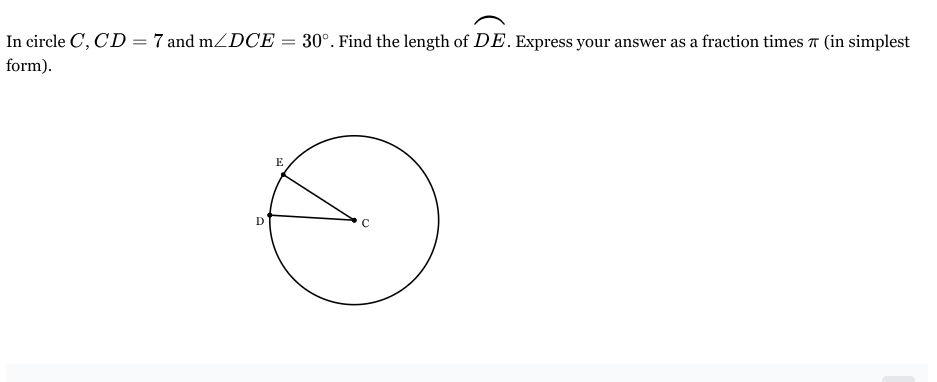
<p>In circle <span style="font-family: KaTeX_Main, &quot;Times New Roman&quot;, serif; line-height: 1.2; font-size: 1.21em;"><em>C</em></span>, <span style="font-family: KaTeX_Main, &quot;Times New Roman&quot;, serif; line-height: 1.2; font-size: 1.21em;"><em>CD</em>=7</span> and m<span style="font-family: KaTeX_Main, &quot;Times New Roman&quot;, serif; line-height: 1.2; font-size: 1.21em;">∠<em>DCE</em>=30∘</span>. Find the length of <span style="font-family: KaTeX_Main, &quot;Times New Roman&quot;, serif; line-height: 1.2; font-size: 1.21em;"><em>DE</em>⌢</span>. Express your answer as a fraction times <span style="font-family: KaTeX_Main, &quot;Times New Roman&quot;, serif; line-height: 1.2; font-size: 1.21em;"><em>π</em></span> (in simplest form).</p>

In circle C, CD=7 and mDCE=30∘. Find the length of DE. Express your answer as a fraction times π (in simplest form).

Length of DE⌢=(7π/6)​

<p><span>Length&nbsp;of&nbsp;DE⌢=(7π/6)​</span></p>
14
New cards
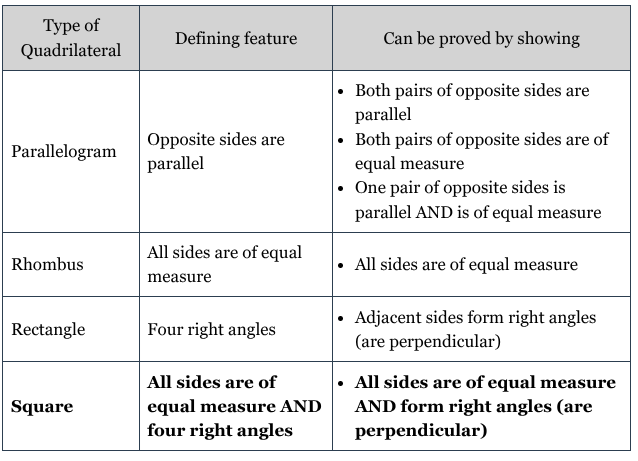
<p>The points <span style="font-family: KaTeX_Main, &quot;Times New Roman&quot;, serif; line-height: 1.2; font-size: 1.21em;"><em>L</em>(5,−9),<em>M</em>(6,−5),<em>N</em>(2,−4)</span>, and <span style="font-family: KaTeX_Main, &quot;Times New Roman&quot;, serif; line-height: 1.2; font-size: 1.21em;"><em>O</em>(1,−8)</span> form quadrilateral LMNO. FIll in the blanks in the image.</p>

The points L(5,−9),M(6,−5),N(2,−4), and O(1,−8) form quadrilateral LMNO. FIll in the blanks in the image.

I will prove that Quadrilateral LMNO is a square by demonstrating that all sides are of equal measure AND adjacent sides are perpendicular.

To prove all sides are equal:
LM= 17​MN= 17​NO= 17​OL= 17​

All sides are of equal measure.

To prove adjacent sides are perpendicular:
slope of LM= 4,  slope of MN= −1/4​,  slope of NO= 4,  slope of OL= −1/4

The slope of any pair of adjacent sides are negative reciprocals. That being the case, those sides are perpendicular.

Therefore, as a result of these two things taken together, the quadrilateral is a square.

<p><span>I will prove that Quadrilateral LMNO is a square by demonstrating that </span><span style="color: steelblue;">all sides are of equal measure AND adjacent sides are perpendicular</span><span>.</span><br><br><span>To prove all sides are equal:</span><br><span style="font-family: KaTeX_Main, &quot;Times New Roman&quot;, serif; line-height: 1.2; font-size: 1.21em;"><em>LM</em></span><span>= </span>√<span style="font-family: KaTeX_Main, &quot;Times New Roman&quot;, serif; line-height: 1.2; font-size: 1.21em; color: steelblue;">17​</span><span>,&nbsp; </span><span style="font-family: KaTeX_Main, &quot;Times New Roman&quot;, serif; line-height: 1.2; font-size: 1.21em;"><em>MN</em></span><span>= </span>√<span style="font-family: KaTeX_Main, &quot;Times New Roman&quot;, serif; line-height: 1.2; font-size: 1.21em; color: steelblue;">17​</span><span>,&nbsp; </span><span style="font-family: KaTeX_Main, &quot;Times New Roman&quot;, serif; line-height: 1.2; font-size: 1.21em;"><em>NO</em></span><span>= </span>√<span style="font-family: KaTeX_Main, &quot;Times New Roman&quot;, serif; line-height: 1.2; font-size: 1.21em; color: steelblue;">17​</span><span>,&nbsp; </span><span style="font-family: KaTeX_Main, &quot;Times New Roman&quot;, serif; line-height: 1.2; font-size: 1.21em;"><em>OL</em></span><span>= </span>√<span style="font-family: KaTeX_Main, &quot;Times New Roman&quot;, serif; line-height: 1.2; font-size: 1.21em; color: steelblue;">17​</span><br><br><span style="color: steelblue;">All</span><span> sides are of </span><span style="color: steelblue;">equal</span><span> measure.</span><br><br><span>To prove adjacent sides are perpendicular:</span><br><span>slope of </span><span style="font-family: KaTeX_Main, &quot;Times New Roman&quot;, serif; line-height: 1.2; font-size: 1.21em;"><em>LM</em></span><span>= </span><span style="font-family: KaTeX_Main, &quot;Times New Roman&quot;, serif; line-height: 1.2; font-size: 1.21em; color: steelblue;">4</span><span>,&nbsp; slope of </span><span style="font-family: KaTeX_Main, &quot;Times New Roman&quot;, serif; line-height: 1.2; font-size: 1.21em;"><em>MN</em></span><span>= </span><span style="font-family: KaTeX_Main, &quot;Times New Roman&quot;, serif; line-height: 1.2; font-size: 1.21em; color: steelblue;">−1/4​</span><span>,&nbsp; slope of </span><span style="font-family: KaTeX_Main, &quot;Times New Roman&quot;, serif; line-height: 1.2; font-size: 1.21em;"><em>NO</em></span><span>= </span><span style="font-family: KaTeX_Main, &quot;Times New Roman&quot;, serif; line-height: 1.2; font-size: 1.21em; color: steelblue;">4</span><span>,&nbsp; slope of </span><span style="font-family: KaTeX_Main, &quot;Times New Roman&quot;, serif; line-height: 1.2; font-size: 1.21em;"><em>OL</em></span><span>= </span><span style="font-family: KaTeX_Main, &quot;Times New Roman&quot;, serif; line-height: 1.2; font-size: 1.21em; color: steelblue;">−1/4</span><br><br><span>The slope of any pair of </span><span style="color: steelblue;">adjacent</span><span> sides are </span><span style="color: steelblue;">negative reciprocals</span><span>. That being the case, those sides are </span><span style="color: steelblue;">perpendicular</span><span>.</span><br><br><span>Therefore, as a result of these two things taken together, the quadrilateral is a </span><span style="color: steelblue;">square</span><span>.</span></p>
15
New cards
<p>The points <span style="font-family: KaTeX_Main, &quot;Times New Roman&quot;, serif; line-height: 1.2; font-size: 1.21em;"><em>B</em>(1,4),<em>C</em>(−5,5),<em>D</em>(−6,−1)</span>, and <span style="font-family: KaTeX_Main, &quot;Times New Roman&quot;, serif; line-height: 1.2; font-size: 1.21em;"><em>E</em>(0,−2)</span> form quadrilateral BCDE. FIll in the blanks in the image</p>

The points B(1,4),C(−5,5),D(−6,−1), and E(0,−2) form quadrilateral BCDE. FIll in the blanks in the image

I will prove that Quadrilateral BCDE is a square by demonstrating that all sides are of equal measure AND adjacent sides are perpendicular.

To prove all sides are equal:
BC= 37​CD= 37​DE= 37​EB= 37​

All sides are of equal measure.

To prove adjacent sides are perpendicular:
slope of BC= −1/6,  slope of CD= 6,  slope of DE= −1/6​,  slope of EB= 6

The slope of any pair of adjacent sides are negative reciprocals. That being the case, those sides are perpendicular.

Therefore, as a result of these two things taken together, the quadrilateral is a square.
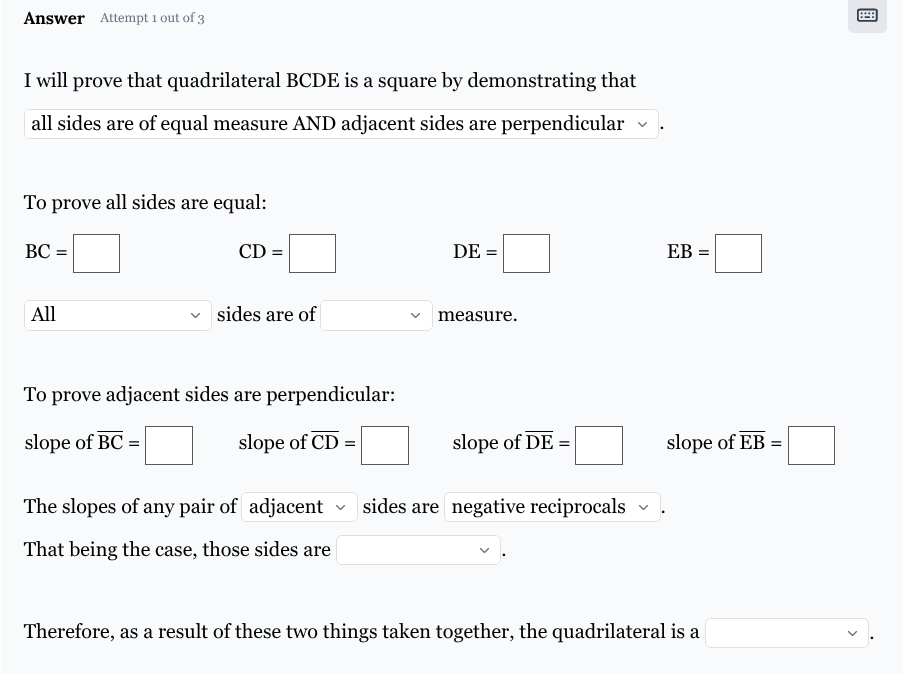
<p><span>I will prove that Quadrilateral BCDE is a square by demonstrating that </span><span style="color: steelblue;">all sides are of equal measure AND adjacent sides are perpendicular</span><span>.</span><br><br><span>To prove all sides are equal:</span><br><span style="font-family: KaTeX_Main, &quot;Times New Roman&quot;, serif; line-height: 1.2; font-size: 1.21em;"><em>BC</em></span><span>= </span>√<span style="font-family: KaTeX_Main, &quot;Times New Roman&quot;, serif; line-height: 1.2; font-size: 1.21em; color: steelblue;">37​</span><span>,&nbsp; </span><span style="font-family: KaTeX_Main, &quot;Times New Roman&quot;, serif; line-height: 1.2; font-size: 1.21em;"><em>CD</em></span><span>= </span>√<span style="font-family: KaTeX_Main, &quot;Times New Roman&quot;, serif; line-height: 1.2; font-size: 1.21em; color: steelblue;">37​</span><span>,&nbsp; </span><span style="font-family: KaTeX_Main, &quot;Times New Roman&quot;, serif; line-height: 1.2; font-size: 1.21em;"><em>DE</em></span><span>= </span>√<span style="font-family: KaTeX_Main, &quot;Times New Roman&quot;, serif; line-height: 1.2; font-size: 1.21em; color: steelblue;">37​</span><span>,&nbsp; </span><span style="font-family: KaTeX_Main, &quot;Times New Roman&quot;, serif; line-height: 1.2; font-size: 1.21em;"><em>EB</em></span><span>= </span>√<span style="font-family: KaTeX_Main, &quot;Times New Roman&quot;, serif; line-height: 1.2; font-size: 1.21em; color: steelblue;">37​</span><br><br><span style="color: steelblue;">All</span><span> sides are of </span><span style="color: steelblue;">equal</span><span> measure.</span><br><br><span>To prove adjacent sides are perpendicular:</span><br><span>slope of </span><span style="font-family: KaTeX_Main, &quot;Times New Roman&quot;, serif; line-height: 1.2; font-size: 1.21em;"><em>BC</em></span><span>= </span><span style="font-family: KaTeX_Main, &quot;Times New Roman&quot;, serif; line-height: 1.2; font-size: 1.21em; color: steelblue;">−1/6</span><span>,&nbsp; slope of </span><span style="font-family: KaTeX_Main, &quot;Times New Roman&quot;, serif; line-height: 1.2; font-size: 1.21em;"><em>CD</em></span><span>= </span><span style="font-family: KaTeX_Main, &quot;Times New Roman&quot;, serif; line-height: 1.2; font-size: 1.21em; color: steelblue;">6</span><span>,&nbsp; slope of </span><span style="font-family: KaTeX_Main, &quot;Times New Roman&quot;, serif; line-height: 1.2; font-size: 1.21em;"><em>DE</em></span><span>= </span><span style="font-family: KaTeX_Main, &quot;Times New Roman&quot;, serif; line-height: 1.2; font-size: 1.21em; color: steelblue;">−1/6​</span><span>,&nbsp; slope of </span><span style="font-family: KaTeX_Main, &quot;Times New Roman&quot;, serif; line-height: 1.2; font-size: 1.21em;"><em>EB</em></span><span>= </span><span style="font-family: KaTeX_Main, &quot;Times New Roman&quot;, serif; line-height: 1.2; font-size: 1.21em; color: steelblue;">6</span><br><br><span>The slope of any pair of </span><span style="color: steelblue;">adjacent</span><span> sides are </span><span style="color: steelblue;">negative reciprocals</span><span>. That being the case, those sides are </span><span style="color: steelblue;">perpendicular</span><span>.</span><br><br><span>Therefore, as a result of these two things taken together, the quadrilateral is a </span><span style="color: steelblue;">square</span><span>.</span></p>
16
New cards
<p>The points <span style="font-family: KaTeX_Main, &quot;Times New Roman&quot;, serif; line-height: 1.2; font-size: 1.21em;"><em>D</em>(9,8),<em>E</em>(0,6),<em>F</em>(−7,0)</span>, and <span style="font-family: KaTeX_Main, &quot;Times New Roman&quot;, serif; line-height: 1.2; font-size: 1.21em;"><em>G</em>(2,2)</span> form quadrilateral DEFG. Fill in the blanks</p>

The points D(9,8),E(0,6),F(−7,0), and G(2,2) form quadrilateral DEFG. Fill in the blanks

I will prove that Quadrilateral DEFG is a rhombus by demonstrating that all sides are of equal measure.

DE= 85​EF= 85​FG= 85​GD= 85​

All sides are of equal measure.
Therefore the quadrilateral is a rhombus.
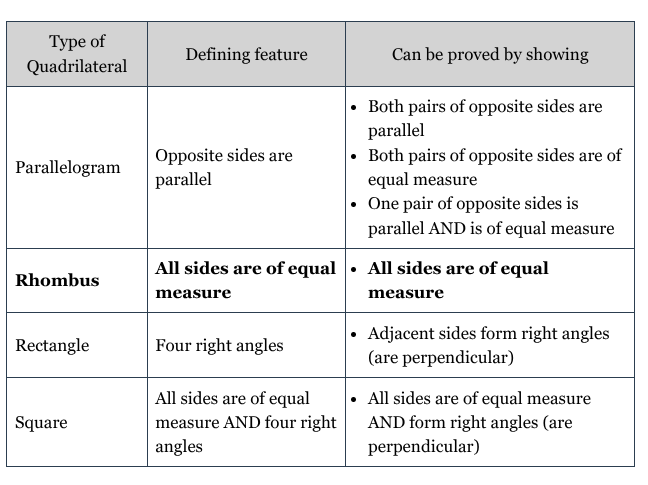
<p><span>I will prove that Quadrilateral DEFG is a rhombus by demonstrating that </span><span style="color: steelblue;">all sides are of equal measure</span><span>.</span><br><br><span style="font-family: KaTeX_Main, &quot;Times New Roman&quot;, serif; line-height: 1.2; font-size: 1.21em;"><em>DE</em></span><span>= </span>√<span style="font-family: KaTeX_Main, &quot;Times New Roman&quot;, serif; line-height: 1.2; font-size: 1.21em; color: steelblue;">85​</span><span>,&nbsp; </span><span style="font-family: KaTeX_Main, &quot;Times New Roman&quot;, serif; line-height: 1.2; font-size: 1.21em;"><em>EF</em></span><span>= </span>√<span style="font-family: KaTeX_Main, &quot;Times New Roman&quot;, serif; line-height: 1.2; font-size: 1.21em; color: steelblue;">85​</span><span>,&nbsp; </span><span style="font-family: KaTeX_Main, &quot;Times New Roman&quot;, serif; line-height: 1.2; font-size: 1.21em;"><em>FG</em></span><span>= </span>√<span style="font-family: KaTeX_Main, &quot;Times New Roman&quot;, serif; line-height: 1.2; font-size: 1.21em; color: steelblue;">85​</span><span>,&nbsp; </span><span style="font-family: KaTeX_Main, &quot;Times New Roman&quot;, serif; line-height: 1.2; font-size: 1.21em;"><em>GD</em></span><span>= </span>√<span style="font-family: KaTeX_Main, &quot;Times New Roman&quot;, serif; line-height: 1.2; font-size: 1.21em; color: steelblue;">85​</span><br><br><span style="color: steelblue;">All</span><span> sides are of </span><span style="color: steelblue;">equal</span><span> measure.</span><br><span>Therefore the quadrilateral is a </span><span style="color: steelblue;">rhombus</span><span>.</span></p>
17
New cards

Given V(6,−8),W(8,2),X(−6,5), and Y(x,10). Find x such that VW XY.

x=−5

<p><span>x=−5</span></p>
18
New cards

Given J(9,3),K(3,−6),L(5,4), and M(1,y). Find y such that JKLM.

y = -2

<p>y = -2</p>
19
New cards

Given S(0,6),T(−3,−9),U(2,−9), and V(−3,y). Find y such that STUV.

y = −8

<p><span>y = −8</span></p>
20
New cards
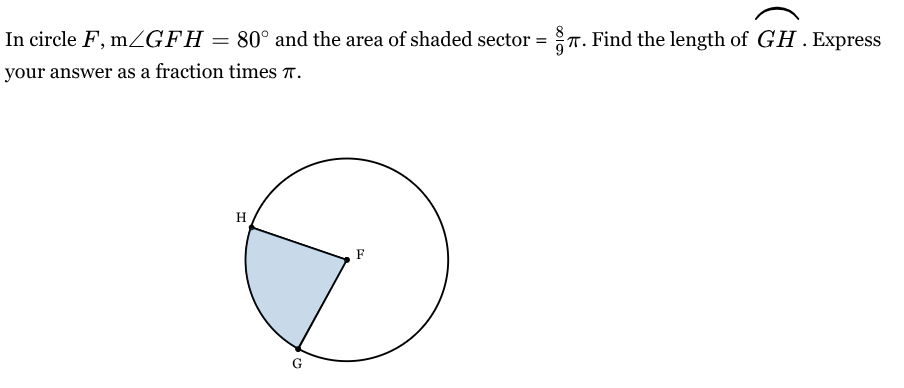
<p>In circle <span style="font-family: KaTeX_Main, &quot;Times New Roman&quot;, serif; line-height: 1.2; font-size: 1.21em;"><em>F</em></span>, m<span style="font-family: KaTeX_Main, &quot;Times New Roman&quot;, serif; line-height: 1.2; font-size: 1.21em;">∠<em>GFH</em>=80∘</span> and the area of shaded sector = <span style="font-family: KaTeX_Main, &quot;Times New Roman&quot;, serif; line-height: 1.2; font-size: 1.21em;">(8/9)​<em>π</em></span>. Find the length of <span style="font-family: KaTeX_Main, &quot;Times New Roman&quot;, serif; line-height: 1.2; font-size: 1.21em;"><em>GH</em>⌢</span>. Express your answer as a fraction times <span style="font-family: KaTeX_Main, &quot;Times New Roman&quot;, serif; line-height: 1.2; font-size: 1.21em;"><em>π</em></span>.</p>

In circle F, mGFH=80∘ and the area of shaded sector = (8/9)​π. Find the length of GH. Express your answer as a fraction times π.

(8/9)​π

<p><span>(8/9)​<em>π</em></span></p>
21
New cards
<p>In circle <span style="font-family: KaTeX_Main, &quot;Times New Roman&quot;, serif; line-height: 1.2; font-size: 1.21em;"><em>T</em></span>, <span style="font-family: KaTeX_Main, &quot;Times New Roman&quot;, serif; line-height: 1.2; font-size: 1.21em;"><em>TU</em>=10</span> and the area of shaded sector = <span style="font-family: KaTeX_Main, &quot;Times New Roman&quot;, serif; line-height: 1.2; font-size: 1.21em;">40<em>π</em></span>. Find the length of <span style="font-family: KaTeX_Main, &quot;Times New Roman&quot;, serif; line-height: 1.2; font-size: 1.21em;"><em>UWV</em>⌢</span>. Express your answer as a fraction times <span style="font-family: KaTeX_Main, &quot;Times New Roman&quot;, serif; line-height: 1.2; font-size: 1.21em;"><em>π</em></span>.</p>

In circle T, TU=10 and the area of shaded sector = 40π. Find the length of UWV. Express your answer as a fraction times π.

12π
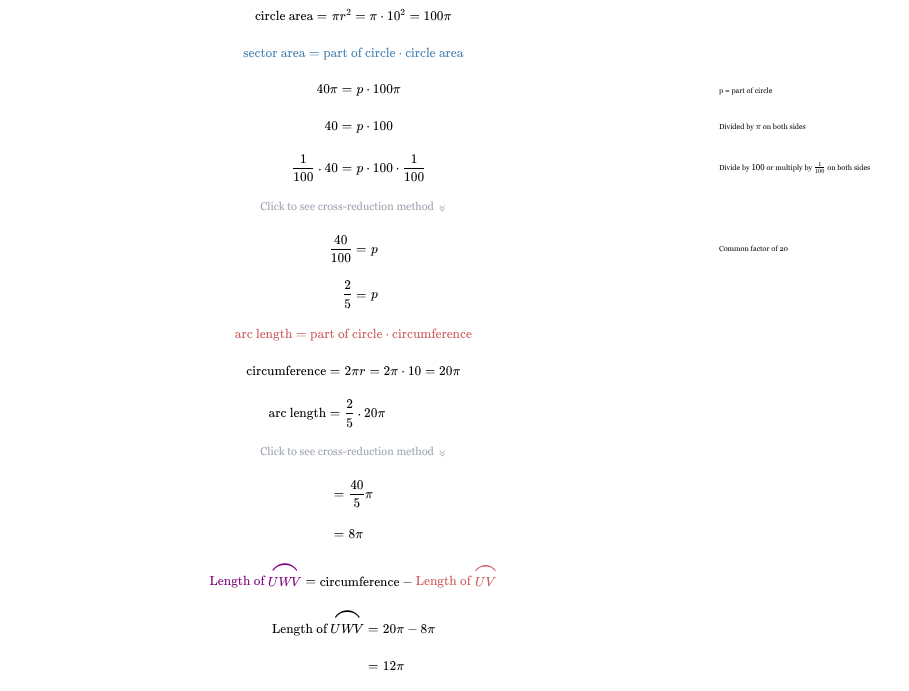
<p><span>12<em>π</em></span></p>
22
New cards
<p>In circle <span style="font-family: KaTeX_Main, &quot;Times New Roman&quot;, serif; line-height: 1.2; font-size: 1.21em;"><em>H</em></span>, <span style="font-family: KaTeX_Main, &quot;Times New Roman&quot;, serif; line-height: 1.2; font-size: 1.21em;"><em>HI</em>=4</span> and the length of <span style="font-family: KaTeX_Main, &quot;Times New Roman&quot;, serif; line-height: 1.2; font-size: 1.21em;"><em>IJ</em>⌢=(8/9)​<em>π</em></span>. Find the area shaded below. Express your answer as a fraction times <span style="font-family: KaTeX_Main, &quot;Times New Roman&quot;, serif; line-height: 1.2; font-size: 1.21em;"><em>π</em></span>.</p>

In circle H, HI=4 and the length of IJ⌢=(8/9)​π. Find the area shaded below. Express your answer as a fraction times π.

(16/9)​π

<p><span>(16/9)​<em>π</em></span></p>
23
New cards

Find the center and radius of the circle represented by the equation below.

x2+y2+2x+8y−19= 0

Center: (−1,−4)  Radius: 6

<p><span>Center:&nbsp;(−1,−4)&nbsp;&nbsp;Radius:&nbsp;</span><span style="color: crimson;">6</span></p>
24
New cards

Find the center and radius of the circle represented by the equation below.

x2+y2−6x−10y+9=0

Center: (3,5)  Radius: 5

<p><span>Center:&nbsp;(3,5)&nbsp;&nbsp;Radius:&nbsp;</span><span style="color: crimson;">5</span></p>
25
New cards

Find the center and radius of the circle represented by the equation below.

x2+y2+16x+4y+43=0

Center: (−8,−2)  Radius: 5

<p><span>Center:&nbsp;(−8,−2)&nbsp;&nbsp;Radius:&nbsp;</span><span style="color: crimson;">5</span></p>
26
New cards

Find the center and radius of the circle represented by the equation below.

x2+y2+18x−16y+120=0

Center: (−9,8)  Radius: 5

<p><span>Center:&nbsp;(−9,8)&nbsp;&nbsp;Radius:&nbsp;</span><span style="color: crimson;">5</span></p>
27
New cards

Find the center and radius of the circle represented by the equation below.

x2+y2−10x+6y−47=0

Center: (5,−3)  Radius: 9
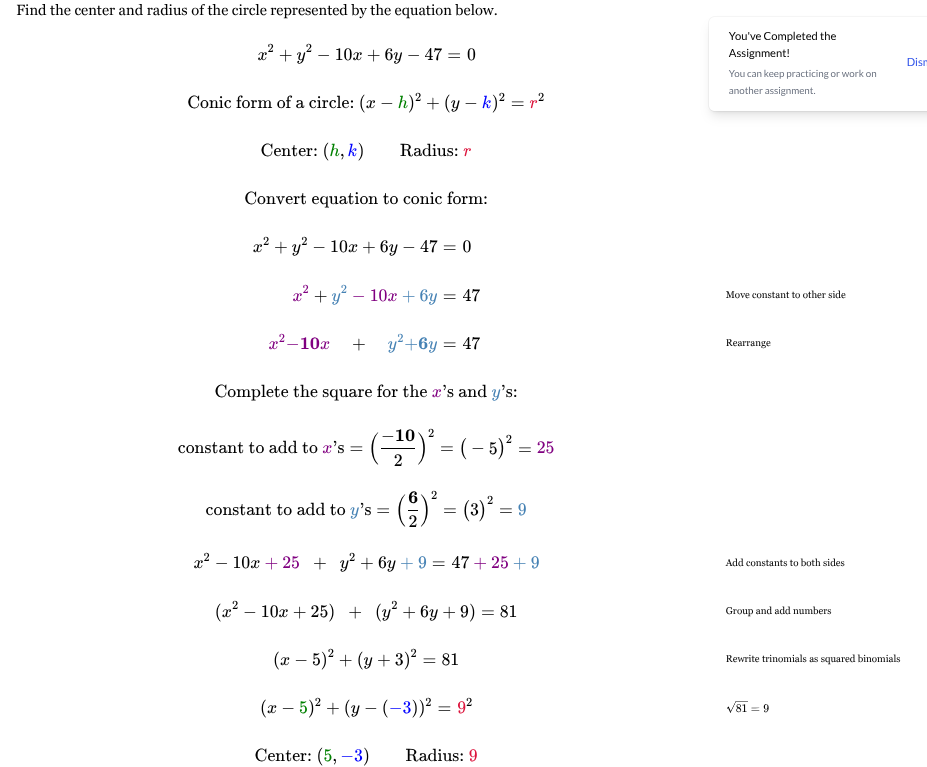
<p><span>Center:&nbsp;(5,−3)&nbsp;&nbsp;Radius:&nbsp;</span><span style="color: crimson;">9</span></p>
28
New cards
<p>If <span style="font-family: KaTeX_Main, &quot;Times New Roman&quot;, serif; line-height: 1.2; font-size: 1.21em;">m<em>MH</em>⌢=56∘</span> and <span style="font-family: KaTeX_Main, &quot;Times New Roman&quot;, serif; line-height: 1.2; font-size: 1.21em;">m<em>QJ</em>⌢​=164∘</span>, find <span style="font-family: KaTeX_Main, &quot;Times New Roman&quot;, serif; line-height: 1.2; font-size: 1.21em;">m∠<em>I</em></span>.</p>

If mMH⌢=56∘ and mQJ⌢​=164∘, find m∠I.

m∠I=54∘

<p><span>m∠I=54∘</span></p>
29
New cards
<p>If <span style="font-family: KaTeX_Main, &quot;Times New Roman&quot;, serif; line-height: 1.2; font-size: 1.21em;">m<em>IU</em>⌢=125∘</span> and <span style="font-family: KaTeX_Main, &quot;Times New Roman&quot;, serif; line-height: 1.2; font-size: 1.21em;">m<em>LF</em>⌢=147∘</span>, find <span style="font-family: KaTeX_Main, &quot;Times New Roman&quot;, serif; line-height: 1.2; font-size: 1.21em;">m∠<em>LJF</em></span>.</p>

If mIU⌢=125∘ and mLF⌢=147∘, find m∠LJF.

m∠LJF=136∘

<p><span>m∠LJF=136∘</span></p>
30
New cards
<p>If <span style="font-family: KaTeX_Main, &quot;Times New Roman&quot;, serif; line-height: 1.2; font-size: 1.21em;">m<em>GH</em>⌢=43∘</span> and <span style="font-family: KaTeX_Main, &quot;Times New Roman&quot;, serif; line-height: 1.2; font-size: 1.21em;">m<em>RK</em>⌢=63∘</span>, find <span style="font-family: KaTeX_Main, &quot;Times New Roman&quot;, serif; line-height: 1.2; font-size: 1.21em;">m∠<em>RDK</em></span>.</p>

If mGH⌢=43∘ and mRK⌢=63∘, find m∠RDK.

m∠RDK=53∘

<p><span style="font-family: KaTeX_Main, &quot;Times New Roman&quot;, serif; line-height: 1.2; font-size: 1.21em;">m∠<em>RDK</em>=53∘</span></p>
31
New cards
<p>If <span style="font-family: KaTeX_Main, &quot;Times New Roman&quot;, serif; line-height: 1.2; font-size: 1.21em;">m<em>PD</em>⌢=180∘</span> and <span style="font-family: KaTeX_Main, &quot;Times New Roman&quot;, serif; line-height: 1.2; font-size: 1.21em;">m∠<em>Q</em>=58∘</span>, find <span style="font-family: KaTeX_Main, &quot;Times New Roman&quot;, serif; line-height: 1.2; font-size: 1.21em;">m<em>LW</em>⌢</span>.</p>

If mPD⌢=180∘ and m∠Q=58∘, find mLW.

64 = x

<p><span style="font-family: KaTeX_Main, &quot;Times New Roman&quot;, serif; line-height: 1.2; font-size: 1.21em; color: crimson;">64 </span><span style="font-family: KaTeX_Main, &quot;Times New Roman&quot;, serif; line-height: 1.2; font-size: 1.21em;">= </span><span style="font-family: KaTeX_Main, &quot;Times New Roman&quot;, serif; line-height: 1.2; font-size: 1.21em; color: crimson;"><em>x</em></span></p>
32
New cards
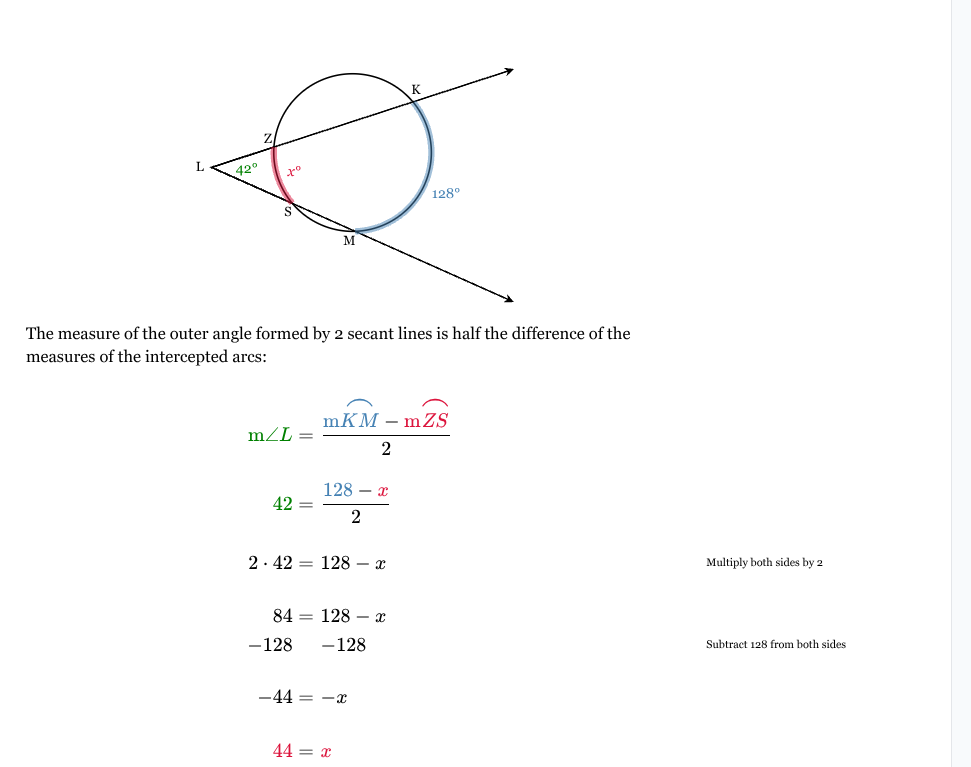
<p>If <span style="font-family: KaTeX_Main, &quot;Times New Roman&quot;, serif; line-height: 1.2; font-size: 1.21em;">m<em>KM</em>⌢=128∘</span> and <span style="font-family: KaTeX_Main, &quot;Times New Roman&quot;, serif; line-height: 1.2; font-size: 1.21em;">m∠<em>L</em>=42∘</span>, find <span style="font-family: KaTeX_Main, &quot;Times New Roman&quot;, serif; line-height: 1.2; font-size: 1.21em;">m<em>ZS</em>⌢</span>.</p>

If mKM⌢=128∘ and m∠L=42∘, find mZS.

mZS⌢=44∘

<p><span>mZS⌢=44∘</span></p>
33
New cards
<h3 id="5520c10e-4b39-4ddc-8f6a-63cbbf2ce6b9" data-toc-id="5520c10e-4b39-4ddc-8f6a-63cbbf2ce6b9" collapsed="true" seolevelmigrated="true"><span style="font-family: KaTeX_Main, &quot;Times New Roman&quot;, serif; line-height: 1.2; font-size: 1.21em;"><strong><em>MU</em></strong></span><strong> is tangent to circle </strong><span style="font-family: KaTeX_Main, &quot;Times New Roman&quot;, serif; line-height: 1.2; font-size: 1.21em;"><strong><em>O</em></strong></span><strong> at point </strong><span style="font-family: KaTeX_Main, &quot;Times New Roman&quot;, serif; line-height: 1.2; font-size: 1.21em;"><strong><em>G</em></strong></span><strong>. </strong><span style="font-family: KaTeX_Main, &quot;Times New Roman&quot;, serif; line-height: 1.2; font-size: 1.21em;"><strong><em>GA</em></strong></span><strong> is the circle's diameter. Find </strong><span style="font-family: KaTeX_Main, &quot;Times New Roman&quot;, serif; line-height: 1.2; font-size: 1.21em;"><strong>m∠<em>MGA</em></strong></span><strong>.</strong></h3><p></p>

MU is tangent to circle O at point G. GA is the circle's diameter. Find m∠MGA.


m∠MGA=90∘

<p><span>m∠MGA=90∘</span></p>
34
New cards
<p>Given the circle below with secants <span style="font-family: KaTeX_Main, &quot;Times New Roman&quot;, serif; line-height: 1.2; font-size: 1.21em;"><em>GHI</em></span> and <span style="font-family: KaTeX_Main, &quot;Times New Roman&quot;, serif; line-height: 1.2; font-size: 1.21em;"><em>KJI</em></span>, find the length of <span style="font-family: KaTeX_Main, &quot;Times New Roman&quot;, serif; line-height: 1.2; font-size: 1.21em;"><em>GH</em></span>. Round to the nearest tenth if necessary.</p>

Given the circle below with secants GHI and KJI, find the length of GH. Round to the nearest tenth if necessary.

x ≈ 35.9

<p><span style="font-family: KaTeX_Main, &quot;Times New Roman&quot;, serif; line-height: 1.2; font-size: 1.21em;"><em>x </em>≈ 35.9</span></p>
35
New cards
<p>Given the circle below with secant <span style="font-family: KaTeX_Main, &quot;Times New Roman&quot;, serif; line-height: 1.2; font-size: 1.21em;"><em>LKJ</em></span> and tangent <span style="font-family: KaTeX_Main, &quot;Times New Roman&quot;, serif; line-height: 1.2; font-size: 1.21em;"><em>IJ</em></span>, find the length of <span style="font-family: KaTeX_Main, &quot;Times New Roman&quot;, serif; line-height: 1.2; font-size: 1.21em;"><em>IJ</em></span>. Round to the nearest tenth if necessary.</p>

Given the circle below with secant LKJ and tangent IJ, find the length of IJ. Round to the nearest tenth if necessary.

x ≈ 19.2
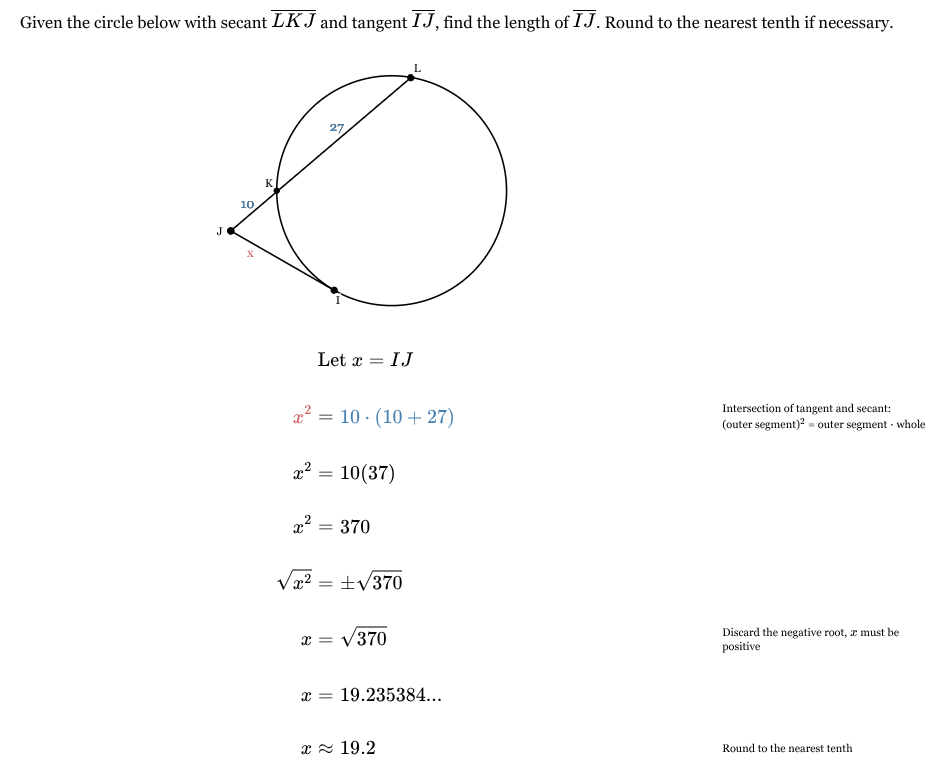
<p><span style="font-family: KaTeX_Main, &quot;Times New Roman&quot;, serif; line-height: 1.2; font-size: 1.21em;"><em>x </em>≈ 19.2</span></p>
36
New cards
<p>Given the circle below with secant <span style="font-family: KaTeX_Main, &quot;Times New Roman&quot;, serif; line-height: 1.2; font-size: 1.21em;"><em>NML</em></span> and tangent <span style="font-family: KaTeX_Main, &quot;Times New Roman&quot;, serif; line-height: 1.2; font-size: 1.21em;"><em>KL</em></span>, find the length of <span style="font-family: KaTeX_Main, &quot;Times New Roman&quot;, serif; line-height: 1.2; font-size: 1.21em;"><em>NM</em></span>. Round to the nearest tenth if necessary.</p>

Given the circle below with secant NML and tangent KL, find the length of NM. Round to the nearest tenth if necessary.

x ≈ 14.8
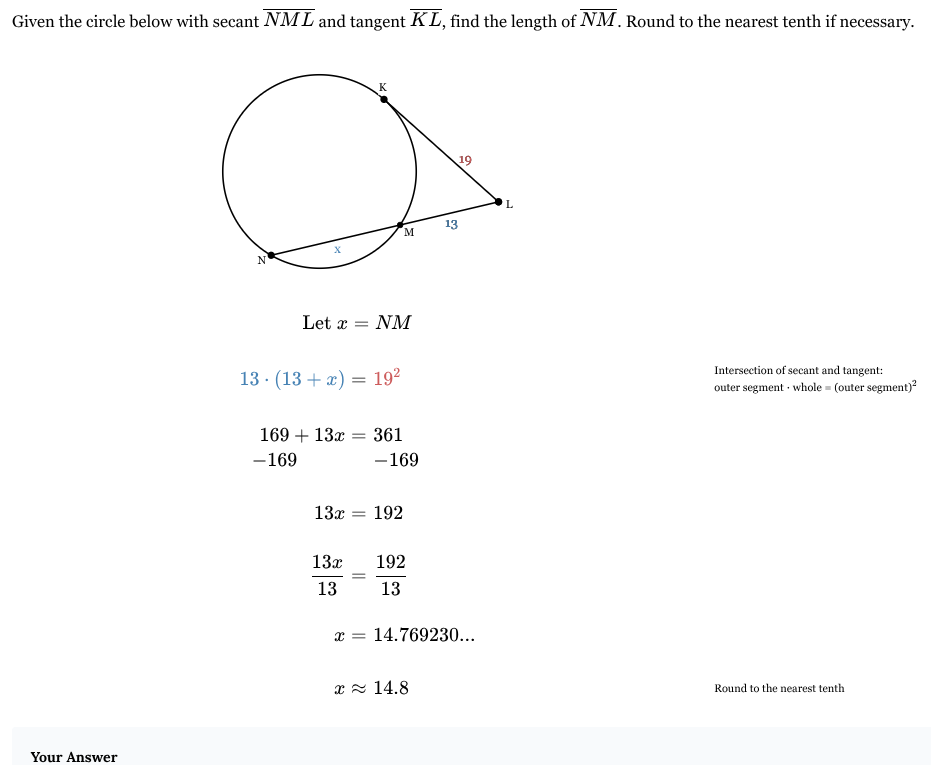
<p><span style="font-family: KaTeX_Main, &quot;Times New Roman&quot;, serif; line-height: 1.2; font-size: 1.21em;"><em>x </em>≈ 14.8</span></p>
37
New cards
<p>Given the circle below with secants <span style="font-family: KaTeX_Main, &quot;Times New Roman&quot;, serif; line-height: 1.2; font-size: 1.21em;"><em>EFG</em></span> and <span style="font-family: KaTeX_Main, &quot;Times New Roman&quot;, serif; line-height: 1.2; font-size: 1.21em;"><em>IHG</em></span>. If <span style="font-family: KaTeX_Main, &quot;Times New Roman&quot;, serif; line-height: 1.2; font-size: 1.21em;"><em>FG</em>=13,<em>HG</em>=12</span> and <span style="font-family: KaTeX_Main, &quot;Times New Roman&quot;, serif; line-height: 1.2; font-size: 1.21em;"><em>EF</em></span> is <span style="font-family: KaTeX_Main, &quot;Times New Roman&quot;, serif; line-height: 1.2; font-size: 1.21em;">3</span> less than <span style="font-family: KaTeX_Main, &quot;Times New Roman&quot;, serif; line-height: 1.2; font-size: 1.21em;"><em>IH</em></span>, find the length of <span style="font-family: KaTeX_Main, &quot;Times New Roman&quot;, serif; line-height: 1.2; font-size: 1.21em;"><em>IH</em></span>. Round to the nearest tenth if necessary.</p>

Given the circle below with secants EFG and IHG. If FG=13,HG=12 and EF is 3 less than IH, find the length of IH. Round to the nearest tenth if necessary.

x = 14
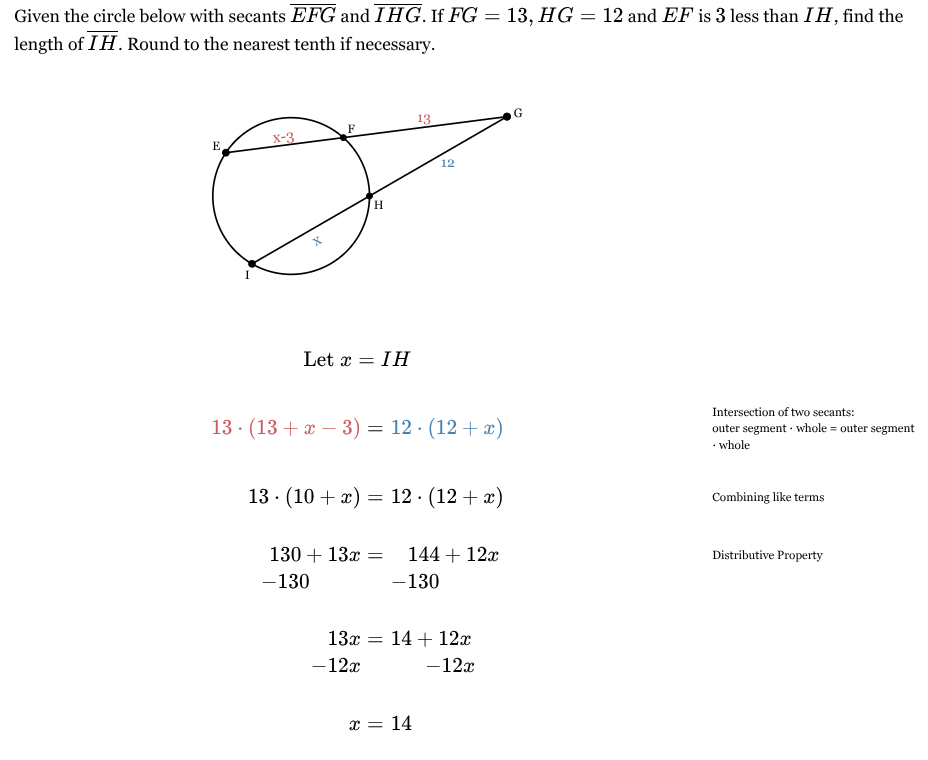
<p><span style="font-family: KaTeX_Main, &quot;Times New Roman&quot;, serif; line-height: 1.2; font-size: 1.21em;"><em>x </em>= 14</span></p>
38
New cards
<p>Given the circle below with secants <span style="font-family: KaTeX_Main, &quot;Times New Roman&quot;, serif; line-height: 1.2; font-size: 1.21em;"><em>PQR</em>​</span> and <span style="font-family: KaTeX_Main, &quot;Times New Roman&quot;, serif; line-height: 1.2; font-size: 1.21em;"><em>TSR</em></span>. If <span style="font-family: KaTeX_Main, &quot;Times New Roman&quot;, serif; line-height: 1.2; font-size: 1.21em;"><em>QR</em>=25,<em>SR</em>=22</span> and <span style="font-family: KaTeX_Main, &quot;Times New Roman&quot;, serif; line-height: 1.2; font-size: 1.21em;"><em>TS</em></span> is <span style="font-family: KaTeX_Main, &quot;Times New Roman&quot;, serif; line-height: 1.2; font-size: 1.21em;">8</span> more than <span style="font-family: KaTeX_Main, &quot;Times New Roman&quot;, serif; line-height: 1.2; font-size: 1.21em;"><em>PQ</em></span>, find the length of <span style="font-family: KaTeX_Main, &quot;Times New Roman&quot;, serif; line-height: 1.2; font-size: 1.21em;"><em>TS</em></span>. Round to the nearest tenth if necessary.</p>

Given the circle below with secants PQR and TSR. If QR=25,SR=22 and TS is 8 more than PQ, find the length of TS. Round to the nearest tenth if necessary.

19.7

<p><span>19.7</span></p>
39
New cards

Given the circle below with secants VWX and ZYX. If YX=23,ZY=25 and WX=22, find the length of VW. Round to the nearest tenth if necessary.

x = 28.2

<p><span style="font-family: KaTeX_Main, &quot;Times New Roman&quot;, serif; line-height: 1.2; font-size: 1.21em;"><em>x </em>= 28.2</span></p>
40
New cards
<p>Given the circle below with tangent <span style="font-family: KaTeX_Main, &quot;Times New Roman&quot;, serif; line-height: 1.2; font-size: 1.21em;"><em>WX</em></span> and secant <span style="font-family: KaTeX_Main, &quot;Times New Roman&quot;, serif; line-height: 1.2; font-size: 1.21em;"><em>ZYX</em></span>. If <span style="font-family: KaTeX_Main, &quot;Times New Roman&quot;, serif; line-height: 1.2; font-size: 1.21em;"><em>WX</em>=36</span> and <span style="font-family: KaTeX_Main, &quot;Times New Roman&quot;, serif; line-height: 1.2; font-size: 1.21em;"><em>ZX</em>=50</span>, find the length of <span style="font-family: KaTeX_Main, &quot;Times New Roman&quot;, serif; line-height: 1.2; font-size: 1.21em;"><em>YX</em></span>. Round to the nearest tenth if necessary.</p>

Given the circle below with tangent WX and secant ZYX. If WX=36 and ZX=50, find the length of YX. Round to the nearest tenth if necessary.

x = 25.9

<p><span style="font-family: KaTeX_Main, &quot;Times New Roman&quot;, serif; line-height: 1.2; font-size: 1.21em;"><em>x </em>= 25.9</span></p>
41
New cards
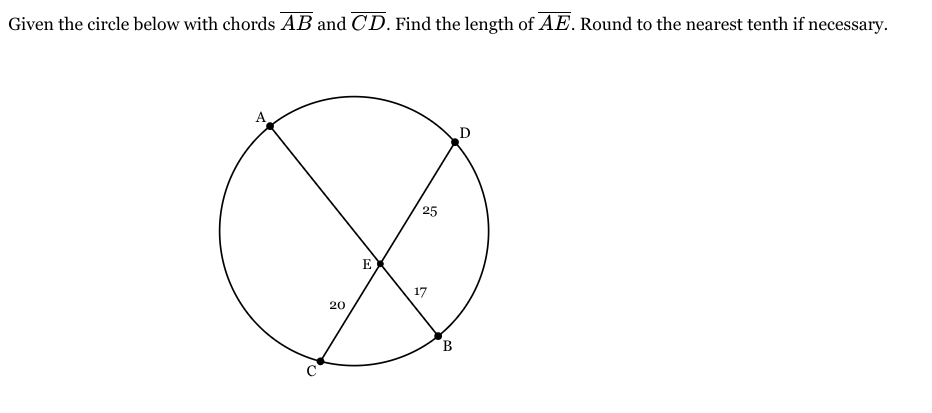
<p>Given the circle below with chords <span style="font-family: KaTeX_Main, &quot;Times New Roman&quot;, serif; line-height: 1.2; font-size: 1.21em;"><em>AB</em></span> and <span style="font-family: KaTeX_Main, &quot;Times New Roman&quot;, serif; line-height: 1.2; font-size: 1.21em;"><em>CD</em></span>. Find the length of <span style="font-family: KaTeX_Main, &quot;Times New Roman&quot;, serif; line-height: 1.2; font-size: 1.21em;"><em>AE</em></span>. Round to the nearest tenth if necessary.</p>

Given the circle below with chords AB and CD. Find the length of AE. Round to the nearest tenth if necessary.

x ≈ 29.4

<p><span style="font-family: KaTeX_Main, &quot;Times New Roman&quot;, serif; line-height: 1.2; font-size: 1.21em;"><em>x </em>≈ 29.4</span></p>
42
New cards
<p>Given the circle below with chords <span style="font-family: KaTeX_Main, &quot;Times New Roman&quot;, serif; line-height: 1.2; font-size: 1.21em;"><em>NO</em></span> and <span style="font-family: KaTeX_Main, &quot;Times New Roman&quot;, serif; line-height: 1.2; font-size: 1.21em;"><em>PQ</em>​</span>. Find the length of <span style="font-family: KaTeX_Main, &quot;Times New Roman&quot;, serif; line-height: 1.2; font-size: 1.21em;"><em>QR</em>​</span>. Round to the nearest tenth if necessary.</p>

Given the circle below with chords NO and PQ. Find the length of QR. Round to the nearest tenth if necessary.

x = 46.5

<p><span style="font-family: KaTeX_Main, &quot;Times New Roman&quot;, serif; line-height: 1.2; font-size: 1.21em;"><em>x </em>= 46.5</span></p>
43
New cards
<p>Given the circle below with chords <span style="font-family: KaTeX_Main, &quot;Times New Roman&quot;, serif; line-height: 1.2; font-size: 1.21em;"><em>UV</em></span> and <span style="font-family: KaTeX_Main, &quot;Times New Roman&quot;, serif; line-height: 1.2; font-size: 1.21em;"><em>WX</em></span>. Find the length of <span style="font-family: KaTeX_Main, &quot;Times New Roman&quot;, serif; line-height: 1.2; font-size: 1.21em;"><em>UY</em></span>. Round to the nearest tenth if necessary.</p>

Given the circle below with chords UV and WX. Find the length of UY. Round to the nearest tenth if necessary.

x ≈ 15.9
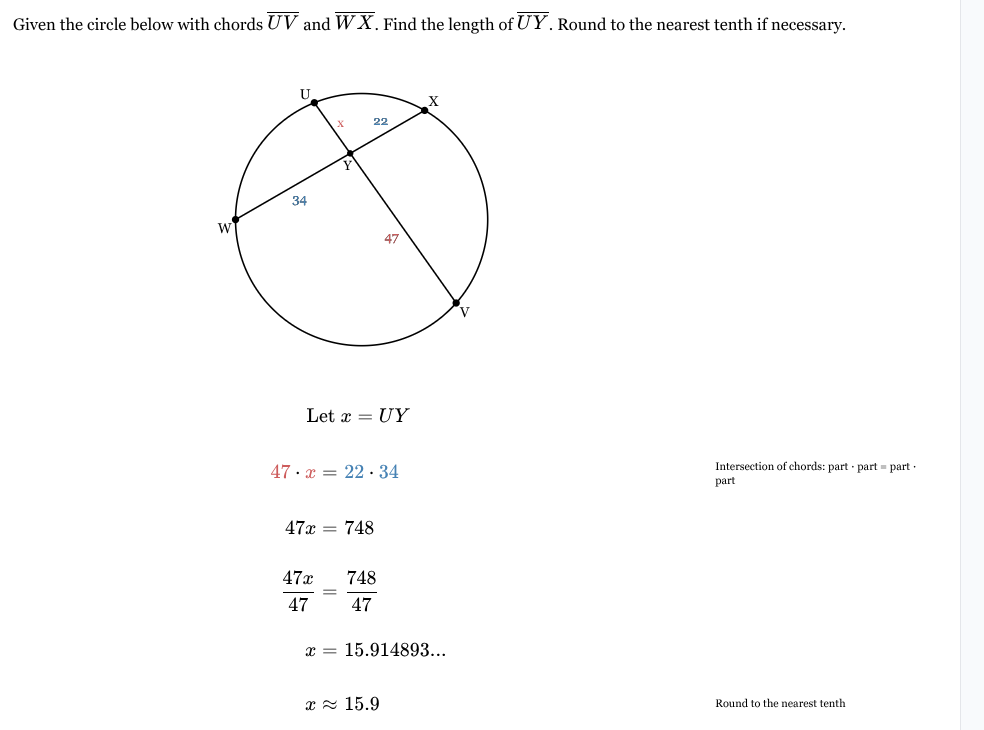
<p><span style="font-family: KaTeX_Main, &quot;Times New Roman&quot;, serif; line-height: 1.2; font-size: 1.21em;"><em>x </em>≈ 15.9</span></p>
44
New cards
45
New cards
46
New cards
47
New cards