Sleep, dreams and consciousness
 Call Kai
 Learn
Learn Practice Test
 Spaced Repetition
 Match
Match Flashcards
 Knowt Play
1/30

There's no tags or description
Looks like no tags are added yet.
Name | Mastery | Learn | Test | Matching | Spaced | Call with Kai |
|---|
No analytics yet
Send a link to your students to track their progress
31 Terms
What is the behavioural definition of sleep?
a condition that typically recurs for several hours every night characterised by:
immobility
reduced response to sensory stimuli
rapidly reversable
What is the main way to help record sleep?
electroencephaly
characterise brain state by using elecrtodes to record electrical activity of brain
What is needed to best accurately describe sleep state?
polysomnograph
containing EEG, EOG, EMG
need brain, eyes and muscle tone
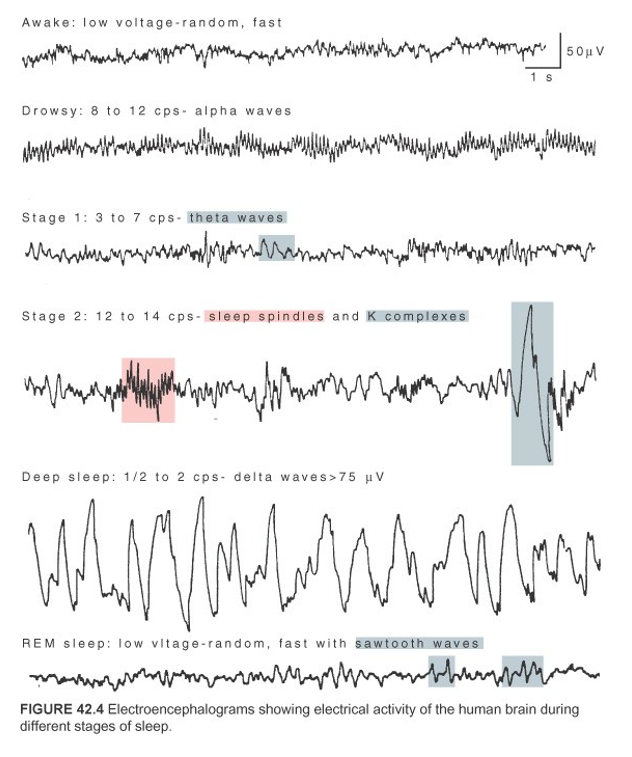
What are brain waves like as go into sleep through stages?
Do we have intrinsic circadian rhythm?
yes
if mouse put in complete darkness they still have very similar sleep wake cycle
not quite 24 hours (around 23)
something in nervous system regulates
What is the circadian pacemaker?
suprachiasmatic nucleus
What did Siffre (1975) show?
absence of external cues significantly altered his circadian rhythm
When he returned from an underground stay with no clocks or light, he believed the date to be a month earlier than it was.
This suggests that his 24-hour sleep-wake cycle was increased by the lack of external cues, making him believe one day was longer than it was, and leading to his thinking that fewer days had passed.
What did Duffy et al. (2001) find?
‘morning people’ prefer to rise and go to bed early (about 6 am and 10 pm) whereas ‘evening people’ prefer to wake and go to bed later (about 10 am and 1 am).
This demonstrates that there may be innate individual differences in circadian rhythms, which suggests that researchers should focus on these differences during investigations.
How can we see the effect of the SCN?
lesions and transplants - a level study look
What did Morgan (1955) show?
bred hamsters so that they had circadian rhythms of 20 hours rather than 24
SCN neurons from these abnormal hamsters were transplanted into the brains of normal hamsters
subsequently displayed the same abnormal circadian rhythm of 20 hours,
showing that the transplanted SCN had imposed its pattern onto the hamsters
What did Skene and Arendt (2007) suggest tho?
claimed that the majority of blind people who still have some light perception have normal circadian rhythms whereas those without any light perception show abnormal circadian rhythms
this demonstrates the importance of exogenous zeitgebers as a biological mechanism and their impact on biological circadian rhythms
supports role of melanopsin
What are the molecular mechanisms of the circadian rhythm?
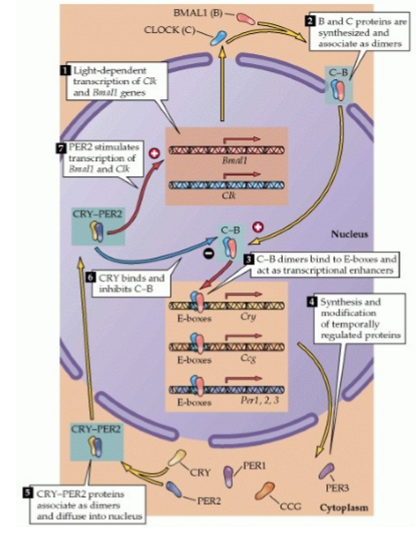
What is photopic entrainment of the circadian rhythm?
add the brain arousal bits that outline the levels of different neurotransmitters at different points of sleep
Role of melatonin?
When light hits the retina, it signals the brain's internal clock (the suprachiasmatic nucleus, or SCN) to halt melatonin production
As evening approaches and sunlight fades, the SCN allows the pineal gland to start releasing the hormone.
peeks at 4am to keep asleep
Why do we go to sleep?
sleep pressure and circadian rhythm
homeostatic drive regulates need for sleep
slow wave activity increases in proportion to duration of wakefulness in day then progressively decreases during sleep
What did Purves et al show?
effect of sleep deprivation in rats
rotating platform so one rat sleeps the other can’t
rat dies
haven’t controlled for stress
What did Everson et al (1989) do?
when rats were prevented from sleeping consistently, it was found that, although their food intake increased, their weight decreased and they died after around a month
before death, their ability to regulate body temperature and metabolic needs was impaired and they developed conditions like stomach ulcers and internal haemorrhages
shows how important sleep must be in lots of different functions and necessary for survival if lack of it can even lead to death
study didn’t control for the stress of being hit by the glass to wake them up however which could have impacted some of the results seen
Who spent 264 hours awake and how did it impact him?
Randy Gardner 1963
slurred speech, hallucinations, delusions and more
after one week though back to normal
but years later reported debilitating insomnia
What are possible effects of sleep deprivation in humans?
fatigue
irritability
impaired memory
hallucinations
tremor
Suggested functions for REM sleep and vivid dreaming?
memory consolidation and transfer
unlearning of ‘parasitic’ memory traces
reinforcement of innate behaviours
maybe rehearsal draws out patterns
What did Karni et al (1994) do?
training participants to identify the orientation of lines in their peripheral field presented for a small amount of time
saw that with repeated practice, participants got better and improved in their identification more between evening and morning
when deprived of REM sleep however their learning did not improve but when deprived of non-REM sleep, their performance was enhanced
double dissociation suggests that specifically the REM section of sleep is involved in consolidating information learnt through the day, forming memories and improving performance.
INTERPRET
Perceptual learning-the improvement of perceptual skills through practice-is a type of human learning that may serve as a paradigm for the acquisition and retention of procedural knowledge
Why can we assume that memory and cognitive abilities is not all REM sleep though?
lots of different animals eg dolphins have little to no REM sleep
still capable of forming memories and other cog functions
Do all animals have REM sleep?
no - humans and some others do
What effect does selective REM sleep deprivation have?
little or no obvious effect on behaviour
impair memory performance but these interventions also affect non REM sleep
MAO inhibtors cause littel or no REM yet show no obvious memory impairement after months or years
What did Huber et al (2004) suggest?
What is slow oscillation sleep suggested to be involved in?
potentiating memory
What did Tononi and Cirelli (2003) suggest?
While awake, synapses are strengthened through long term potentiation due to learning and new experiences and it is proposed that during slow wave oscillation sleep, synaptic consolidation and downscaling takes place, increasing the signal to noise ratio
Where does evidence for this come from?
Vyazovskiy et al (2008)
Molecular and electrophysiological evidence for this comes from evoked cortical responses from stimulation within a rat’s cortex as well as measuring of proteins associated with synaptic strength, in which periods of sleep were associated with a net decrease of cortical synapse strength
What did Marshall et al (2006) do?
Declarative learning
Giving word list for example
Non declarative
Eg motor task
Kept in lab while go to sleep
Strap electrode
When enter slow wave
Apply transcranial to see if improve
Boosted
No improvement in non but improvements in declarative
Involved in consolidating, optimise retrieval
Is evidence for memory and consolidation stronger in REM or nonREM sleep?
non REM
(REM more controversial)
perhaps REM is more for non-declarative kinda stuff??