Chapter 11(not yet finished, half way done)
 Call Kai
 Learn
Learn Practice Test
 Spaced Repetition
 Match
Match Flashcards
 Knowt Play
1/90

There's no tags or description
Looks like no tags are added yet.
Name | Mastery | Learn | Test | Matching | Spaced | Call with Kai |
|---|
No analytics yet
Send a link to your students to track their progress
91 Terms
a so-called “third force”
The humanistic approach (sometimes, perhaps incorrectly, referred to as existential or phenomenological psychology) paints a very different picture of our species.
The third force in American psychology caught on rapidly with a large number of psychotherapists and personality theorists.
The emphasis on individuality and personal expression in the 1960s (which gave rise to the counterculture movement personified by Jim Morrison) provided fertile soil for the growth of humanistic psychology. The election of prominent humanistic psychologist Abraham Maslow to president of the American Psychological Association in 1967 symbolized the acceptance of the humanistic approach as a legitimate alternative perspective.
Humanistic psychology never did overthrow psychoanalysis or behaviorism, but it did manage to make a niche for itself among the major approaches to understanding human personality. Although not as popular as it once was, there remains an active community of humanistic psychologists and a large number of psychotherapists who identify with this perspective.
Although humanistic psychology evolved from many sources, its roots lie primarily in two areas:
existential philosophy, which is decidedly European in flavor, and the work of some American psychologists, most notably Carl Rogers and Abraham Maslow.
The list of prominent existential psychologists includes
udwig Binswanger, Medard Boss, Viktor Frankl, R. D. Laing, and Rollo May.
Existential psychotherapy frequently focuses on what?
existential anxiety
existential anxiety
the feelings of dread and panic that follow the realization that there is no meaning to one’s life. Therapy often emphasizes the freedom to choose and develop a lifestyle that reduces feelings of emptiness, anxiety, and boredom.
Carl Rogers
Carl Rogers found his early efforts as a psychotherapist were largely unsuccessful. He started to question his ability to understand his clients’ problems and wondered whether he really could help people overcome their problems. “It began to occur to me,” Rogers reflected many years later, “that unless I had a need to demonstrate my own cleverness … I would do better to rely upon the client for direction” (1967, p. 359).
Abraham Maslow
The turning point for Abraham Maslow came while watching a World War II parade. Although the parade was supposed to promote American patriotism and the war effort, it made Maslow aware of the scope of society’s problems and just how little psychology had contributed to bettering the human condition. He became determined “to prove that human beings are capable of something grander than war and prejudice and hatred” (as cited in Hall, 1968, p. 55).
a big drawback to humanistic ppoaach?
unlike psychoanalysis, there is no single authority we can point to as the definitive spokesperson for the humanistic perspective and no clearly agreed-upon definition of what constitutes a humanistic personality theory. Nonetheless, we can identify some elements that are central to the humanistic approach.
Key Elements of the Humanistic Approach
The problem of having no agreed-upon definition for humanistic psychology became obvious in the 1960s and early 1970s when it seemed nearly everyone identified himself or herself as “humanistic” in an effort to capitalize on the popularity of the approach at that time. As a result, humanistic psychology sometimes was associated with faddish therapies that promised to solve problems and provide the key to happiness for the price of a paperback book. Although no clear criteria exist for identifying which approaches to psychotherapy fall into the humanistic category, it is safe to say that the following four elements are central to the general viewpoint to which we apply the “humanistic” label:
an emphasis on personal responsibility,
(2)
an emphasis on the “here and now,”
(3)
a focus on the experience of the individual, and
(4)
an emphasis on personal growth.
Personal Responsibility
Although we may try to deny it, we are ultimately responsible for what happens to us. This idea, borrowed from existential philosophers, is central to the humanistic approach.
commonly use the phrase “I have to.” We say, “I have to go to class,” “I have to meet some friends,” “I have to take care of my children,” and so forth. But the truth is that we don’t have to do any of these things. Within limits, there is practically nothing we have to do. Rather, humanistic psychologists argue virtually all our behaviors represent personal choices. People choose to remain in relationships; they do not have to. We choose to act passively; we could decide to act forcefully. We choose to go to work, call our friends, leave a party, or send a Christmas present. We do not have to do any of these things. The price we pay for making some of these choices can be steep, but they are choices nonetheless.
Unlike the Freudian or behavioral descriptions of people at the mercy of forces they cannot control, humanistic psychologists see people as active shapers of their own lives, with freedom to change limited only by physical constraints
Clients working with humanistic psychotherapists are often encouraged to accept that they have the power to do or to be whatever they desire. However, this power can be a two-edged sword. When speaking in the abstract, nearly everyone agrees that freedom of choice is a good thing. But when applied at a personal level, accepting that our fate is in our own hands is often quite frightening. Taking responsibility means no more blaming others for your problems and no more feeling sorry for yourself. If things are going to change, it is up to you to do the changing.
The Here and Now
According to the humanistic perspective, we can’t become fully functioning individuals until we learn to live our lives as they happen. Some reflection on the past or future can be helpful, but most people spend far too much time thinking about events that have already happened or planning those that might. Time spent on these activities is time lost, for you can live life fully only if you live it in the here and now.
Think about the last time you walked to a class or to a scheduled meeting. Perhaps you spent the time thinking about what you did last weekend or ruminating over an embarrassing incident. Maybe you rehearsed something you wanted to say to someone or thought about how nice it would be just to get through this week. A humanistic psychologist might say that what you really did was to lose 10 minutes. You failed to experience fully the 10 minutes that life handed you. You could have enjoyed the fresh air, appreciated the blue sky, or learned something from observing or talking with other people.
A popular poster reminds us, “Today Is the First Day of the Rest of Your Life.” This phrase could well have been coined by a humanistic psychologist. The humanistic view maintains that we need not be victims of our past. Certainly, our past experiences shape and influence who we are and how we behave. But these experiences should not dictate what we can become. People do not need to remain shy and unassertive just because they “have always been that way.” You do not have to remain in an unhappy relationship simply because you don’t know what else to do. Your past has guided you to where you are today, but it is not an anchor.
The Experience of the Individual
No one knows you better than yourself. This observation is a cornerstone of humanistic psychology. Humanistic psychologists argue that it’s absurd for therapists to listen to clients, decide what the clients’ problems are, and force clients to accept the therapist’s interpretation of what should be changed and how it should be changed. Instead, humanistic therapists seek to understand what their clients are experiencing and try to provide a therapeutic atmosphere that allows clients to help themselves.
People sometimes find this view of the therapist’s role a bit puzzling. Aren’t clients turning to therapy because they need help understanding and solving their problems? The answer is that, whereas some people may not understand the source of their difficulties at the moment, the therapist also has no access to this information. During the course of successful therapy, clients come to understand themselves and develop an appropriate strategy for dealing with their problems. You might have had a similar experience when facing a personal issue. Well-meaning friends may have provided plenty of advice, but it was only when you considered that advice and came to a decision on your own that you were able to resolve the problem.
Personal Growth
“"“Whether one calls it a growth tendency, a drive toward self-actualization, or a forward-moving directional tendency, it is the mainspring of life.”
According to the humanistic approach, we are all motivated to progress toward some ultimately satisfying state of being. Carl Rogers referred to this state as becoming a fully functioning individual. Abraham Maslow (1970) used the term self-actualization. A person becomes self-actualized when he or she becomes “more what one idiosyncratically is, to become everything that one is capable of becoming” (p. 46).
This growth process is assumed to be the natural manner of human development. That is, we progress toward this satisfying state unless life’s difficulties prevent us from doing so. When obstacles block our personal growth, humanistic psychotherapy can be helpful. However, the therapist does not put clients back on track. Only the client can do that. Rather, the therapist creates a therapeutic atmosphere that allows clients to overcome their problems and continue growing. Rogers describes this ever-unfolding of one’s self as a “process of becoming.”
Suppose tomorrow you inherited several million dollars, settled down with someone who will admire and love you always, and were promised a long and healthy life. Would you be happy?
Most likely, your answer is yes, or perhaps even, “Are you kidding?” No doubt having all these things is better than not having them. But a humanistic psychologist would probably predict that your happiness is short-lived. That’s because there is more to life than simply taking care of all our immediate needs. Happiness also requires that that we grow in a positive direction.
After she does not earn a passing grade in her chemistry class, Toya tells her parents that the teacher was totally incomprehensible, that the material made no sense, and that the textbook was too difficult. Which response would her parents give her that would mirror one of the critical components of the humanistic approach?
“There are probably some unconscious barriers that are preventing you from succeeding in your class.”
“The university favors men in science classes, which is why women fail them at a disproportionate rate.”
“It is important for you to accept responsibility for your own actions, whether you succeed or fail.”
“The environment of the course made it impossible for you to succeed, so we’ll look for a better, more supportive setting.”
“It is important for you to accept responsibility for your own actions, whether you succeed or fail.”
Which cliché that you might find on an Internet meme or an inspirational poster would be reflective of a key component of the humanistic model?
“Don’t sacrifice today just thinking about tomorrow.”
“God will provide as long as you have faith.”
“Freedom is an illusions.”
“You can’t move forward until you reconcile your past.”
Don’t sacrifice today just thinking about tomorrow.”
Fully functioning is to blank 1 as self-actualization is to blank 2.
Alfred Adler; Erik Erikson
Abraham Maslow; Carl Rogers
Erik Erikson; Alfred Adler
Carl Rogers; Abraham Maslow
Carl Rogers; Abraham Maslow
what was Carl Rogers big controbutions to humanistic psy? why is he so important?
Humanistic psychology could ask for no better example of how to live life fully than the career of Carl Rogers.
pioneered humanistic psychotherapy. He was the
first to popularize a “person-centered” approach to treating clients
early advocate of using groups as a form of therapy
eventually expanded his ideas from his work with clients into a general theory of personality (Rogers, 1961).
Late in his career, Rogers applied the humanistic approach to social issues such as education and world peace.
t or f Rogers maintained that each of us naturally strives to reach an optimal sense of satisfaction with our lives. He called people who reach this goal fully functioning
t
fully functioning
A psychologically healthy individual who is able to enjoy life as completely as possible.
What are fully functioning people like?
Fully functioning people are open to new experiences. Rather than falling into familiar patterns, they look to see what life will throw their way. Related to this, fully functioning people try to live each moment as it comes. The idea is to experience life, not just pass through.
Fully functioning individuals also learn to trust their feelings. If something feels right, they’re likely to try it. They are sensitive to the needs of others, but they aren’t overly concerned with meeting the standards society sets for them. If a fully functioning woman wants to cut her hair or quit her job, she probably won’t stop herself just because others might not approve. It’s not that fully functioning people are rebellious. They may follow the traditional path of college, job, marriage, and family, but only if each of these choices is consistent with their own interests, values, and needs.
Unlike some depictions of them, fully functioning people aren’t simply mellow folks who take everything in stride. On the contrary, they experience emotions—both positive and negative—more deeply and more intensely than most people. Fully functioning people accept and express their anger. To do otherwise would be to cut themselves off from some of their feelings. Because of these intense emotions, Rogers maintained that fully functioning people lead richer lives than most of us
If we all have an innate desire to be fully functioning individuals, why is there so much unhappiness in the world? Why doesn’t everyone get the maximum enjoyment out of life?
the world is full of disappointments and difficulties, all of which are potential sources of anxiety. Becoming a fully functioning person doesn’t eliminate all our problems. But it does mean we acknowledge and deal with these problems directly rather than rely on psychological defenses to avoid them.
Rogers maintained that anxiety often results from encountering information that is inconsistent with the way we think of ourselves:
You may believe that you are a good tennis player, a kind person, a good student, or a pleasant conversationalist, but occasionally you receive information that contradicts this self-concept. For example, suppose you think of yourself as the kind of person everybody likes, but one day you overhear someone say what a jerk he thinks you are. How do you react? If you were fully functioning, you would accept the information. You might acknowledge to yourself that, although you are a fine person, not everyone is going to find you pleasant and wonderful. Unfortunately, most of us are not capable of such a well-adjusted reaction. For those of us who fall short of being fully functioning, hearing information that threatens our self-concept leads to anxiety. And if that information is excessively threatening, the anxiety will be difficult to manage.
subception.
This is where Rogers’ theory takes on a slight Freudian flavor. Rogers proposed that we initially process this threatening information at a level somewhere below consciousness, a process he called subception. As in Freud’s theory, we often rely on defenses to keep the information from entering awareness.
distortion
Rogers called our most common defense distortion. Returning to the example, you might convince yourself that the person who called you a jerk was in a bad mood or is just a rude person
denial
However, in more extreme cases, you might resort to outright denial. No, you might convince yourself, he wasn’t really talking about me but about someone else with a name that sounds like mine.
why is distortion and denial so bad?
People who think of themselves as undesirable also turn to distortion and denial when they encounter information to the contrary. If they hear that someone is attracted to them, they might tell themselves the admirer is just being polite or perhaps is scheming to get something from them. We also use defenses when making observations about ourselves. Each of us on occasion acts in ways that fall short of our personal standards. Perhaps you have cheated a friend out of money or said some hurtful things to a loved one. Rather than acknowledge your shortcomings and trying to learn from your mistake, you may have distorted the situation (“She often overreacts to innocent comments”) or denied the facts (“I didn’t know the money was his”).
Distortion and denial often succeed in the short run by reducing anxiety. But this relief comes at a price. Each use takes us further and further away from experiencing life fully. In severe cases, people replace reality with fantasy. A man may think of himself as the world’s most desirable bachelor when in fact there are no objective reasons to draw this conclusion. A student with poor grades might convince herself that she is a genius whose ideas are simply too sophisticated for her instructors to appreciate. However, at some point, the gap between self-concept and reality may become so large that even our defenses are inadequate. In this case, people experience what Rogers called a state of disorganization. The protective barrier against threatening information collapses, and the result is extreme anxiety.
disorganization
However, at some point, the gap between self-concept and reality may become so large that even our defenses are inadequate. In this case, people experience what Rogers called a state of disorganization. The protective barrier against threatening information collapses, and the result is extreme anxiety.
Why is it so difficult to face facts and incorporate relevant information as we develop a sense of who we are?
Rogers’ answer is that most of us grow up in an atmosphere of conditional positive regard.
conditional positive regard
Acceptance and respect for people either only when they act as we desire
As children, our parents and caregivers provide love and support. However, they rarely do this unconditionally. Rather, most parents communicate affection for their children as long as the children do what is expected of them. When parents disapprove of their children’s behavior, they withhold their admiration and love. The children get the message that they are loved but only when they do what their parents want. The positive regard children need and want is conditional upon their behavior.
As a result of this conditioned esteem, children learn to accept only the parts of themselves their parents deem appropriate. They deny or distort their weaknesses and faults and become less and less aware of who they really are. Unfortunately, this process continues when the child becomes an adult. We often incorporate into our self-concept only those characteristics that are likely to win the approval of significant people in our lives. Instead of acknowledging and expressing aspects of ourselves that others might not approve of, we simply deny that we possess these unflattering characteristics. And as we lose touch with our real self, we become less and less fully functioning.
unconditional positive regard
Acceptance and respect for people either regardless of their behavior (unconditional).
When we experience unconditional positive regard, we know we will be accepted and loved no matter what we say or do. Rogers advised parents to communicate to their children that although they don’t approve of a specific behavior, they will always love and accept the child. Under these conditions, children no longer feel a need to deny thoughts and feelings that might lead their parents to withdrawal affection. They are free to incorporate faults and weaknesses into their self-concepts and thereby are better able to experience life.
Fortunately, parents are not the only source of unconditional positive regard, and growing up in a family without this acceptance does not condemn a person to a less-than-full life. Adult relationships with friends and romantic partners can also be based on unconditional positive regard. Perhaps you are fortunate enough to have a close friend in whom you can confide anything without fear of losing that friendship. Psychologists can also create an atmosphere of unconditional positive regard during psychotherapy. In fact, Rogers maintained that this type of accepting environment is a requirement for effective treatment. We’ll examine more of Rogers’ ideas about psychotherapy later in this chapter.
This pioneer of the humanistic model believed in a “person-centered” approach to treatment, and also advocated the value of group therapy.
Carl Rogers
Abraham Maslow
Alfred Adler
Carl Jung
Carl Rogers
In which way did the theory of Carl Rogers bear a resemblance to that of Sigmund Freud?
He argued that dreams offered us a rich view into what is going on deep in our psyche.
He noted that as we grow through childhood, we go through stages of personality development.
He did feel that we use defense mechanisms to keep unpleasant information below the level of consciousness.
He felt that the relationships that we have with our opposite-sex parent can take on a pseudosexual tone during middle childhood.
He did feel that we use defense mechanisms to keep unpleasant information below the level of consciousness.
Ryan is very proud of his son, Shane; however, sometimes he makes Shane feel as if he is very disappointed. Recently, Ryan made Shane feel like a failure because he struck out three times during a little league baseball game. Shen felt that his father is only proud of him when he is successful at various activities. Which is it that Ryan is displaying twards his son?
obstructed flow.
conditional positive regard.
peak experiences.
self-actualization.
conditional positive regard.
who said “Freud supplied to us the sick half of psychology,” he wrote, “and we must now fill it out with the healthy half”?
Abraham Maslow
Abraham Maslow spent most of his career filling in the gaps he found in other approaches to personality. At a time when the field was largely concerned with psychological disorders, Maslow wondered what psychology could do for the happy, healthy side of personality.
Maslow replaced Freud’s pessimistic and dismal view of human nature with an optimistic and uplifting portrayal. In addition, although he acknowledged the existence of unconscious motives, Maslow focused his work on conscious aspects of personality.
Maslow described two types of motives.
Deficiency motives and growth needs
Deficiency motives
Deficiency motives result from a lack of some needed object. Basic needs such as hunger and thirst fall into this category. Once we obtain the needed object, deficiency motives are satisfied and, for a period of time, stop directing our behavior. In contrast, growth needs are not satisfied simply by finding the object we desire. Rather, growth needs are satisfied by expressing the motive, such as unselfishly giving love to another person and taking steps to develop your unique potential. Satisfying a growth need may even lead to an increase in, rather than a satiation of, motivation.
growth needs
In contrast, growth needs are not satisfied simply by finding the object we desire. Rather, growth needs are satisfied by expressing the motive, such as unselfishly giving love to another person and taking steps to develop your unique potential. Satisfying a growth need may even lead to an increase in, rather than a satiation of, motivation.
Maslow identified five basic categories of needs—both deficiency and growth—and placed them in his well-known hierarchy of needs.
In Maslow’s theory, the order in which human needs demand attention.
As shown in Figure 11.1, he arranged the five kinds of needs in order of prominence. That is, some needs demand our attention more than others. Although there are exceptions, we typically attend to needs at the lower levels before turning to higher level needs. If you are hungry, your attention will be focused on obtaining food. Until this need is met, you won’t be very concerned about making new friends or developing a romantic relationship. Of course, once satisfied, the lower need may return, causing you to divert your attention again. But over the course of a lifetime, most of us generally progress up the hierarchy. Let’s go through that hierarchy one step at a time.
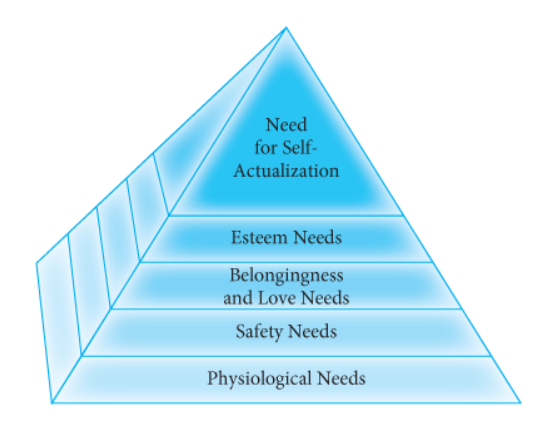
Physiological Needs
Physiological needs, including hunger, thirst, air, and sleep, are the most demanding in that they typically must be satisfied before we can move to higher level needs. In many places today—and throughout much of human history—too many people’s lives are focused on meeting these basic needs. Finding enough food and water for survival takes priority over concerns like gaining the respect of peers or developing your potential as an artist.
Safety Needs
When physiological needs are met, we become increasingly motivated by our safety needs. These include the need for security, stability, protection, structure, order, and freedom from fear or chaos. These needs are likely to dominate our thoughts and actions when the future is unpredictable or when living in an area where political or social order is unstable. People motivated by safety needs may become obsessed about saving money for an uncertain future. They might settle for a job with a lot of security rather than pursue a more interesting but less certain career or an unhappy marriage if the arrangement provides stability and a sense of security.
Belongingness and Love Needs
For most middle-class American adults, the need for food and water and the need for security and stability are fairly well satisfied. Most have jobs, homes, and food on the table. But satisfaction of these lower level needs does not guarantee happiness. Soon the need for friendship and love is likely to make itself known.
Although some adults remain slaves to their safety needs and devote most of their energy to their careers, others find their job unsatisfying if it requires them to sacrifice time spent with friends and loved ones.
D-love vs B llove
D love is like hunger, is based on a deficiency. We need this love to satisfy the emptiness we experience without it. It is a selfish love, concerned with taking, not giving. But it is a necessary step in the development of the second type of love.
B-love is a nonpossessive, unselfish love based on a growth need rather than a deficiency. B-love is not satisfied once a relationship is established. Rather, B-love is experienced and grows as a result of being in the relationship.
Esteem Needs
Although poets and songwriters might disagree, there is more to life than love. Satisfying our belongingness and love needs is likely to direct our attention to the esteem needs. Maslow divided these needs into two basic types: the need to perceive oneself as competent and achieving and the need for admiration and respect. These two needs often go hand-in-hand. It is difficult for others to admire you if you don’t feel good about yourself, and knowing that you have earned the respect of people who are important to you most likely will contribute to your sense of personal esteem.
Need for Self-Actualization
A state of personal growth in which people fulfill their true potential.
Nearly every culture has a story about someone who, by virtue of a magic lamp or contact with a supernatural being, receives everything he or she wishes. But inevitably, the lucky individual discovers that acquiring wealth, love, and power is not enough to guarantee happiness. As Maslow explained, when all our lower level needs are satisfied, a new source of discontent often surfaces. We turn our attention inward and ask ourselves what we want out of life, where our lives are headed, and what we want to accomplish. The need for self-actualization is satisfied when we identify our true self and reach our full potential. “A musician must make music,” Maslow wrote. “An artist must paint, a poet must write, if he is to be ultimately at peace with himself. What a man can be, he must be. He must be true to his own nature” (1970, p. 46).
Misconceptions About Maslow’s Need Hierarchy
Maslow was quick to acknowledge that the five-level hierarchy is an oversimplification.
People first encountering Maslow’s need hierarchy sometimes assume that lower needs must be satisfied 100% before we turn to higher needs. But that was never Maslow’s intent.
Maslow estimated that for the average person in our culture, 85% of physiological needs, 70% of safety needs, 50% of belongingness and love needs, 40% of esteem needs, and 10% of self-actualization needs are satisfied.
Another oversimplification of Maslow’s theory is that any given behavior is motivated by a single need. Maslow maintained that most behavior is the result of multiple motivations.
example of sexual activity. It is easy to see that physiological needs are satisfied through sexual behavior. But that behavior can also be motivated by a desire to express affection, a need to feel masterful and competent, or a desire to act masculine or feminine.
“Self-actualizing individuals have more free will than average people.”
Abraham Maslow
As a rule, psychologists are focused on understanding and helping people resolve psychological and social problems. But Maslow’s research took him in the opposite direction. why?
Instead of studying people who suffer from traumatic experiences or psychological disorders, Maslow turned his attention to psychologically healthy individuals. By learning what self-actualized people are like, he reasoned, we can better understand how individuals reach their true potential. Maslow identified and interviewed people he knew who appeared to have satisfied their need for self-actualization. He also turned to records and documents to learn about historic figures who seemed to have lived a self-actualized life. That list included Thomas Jefferson, Albert Einstein, Eleanor Roosevelt, and Albert Schweitzer. By his own admission, Maslow’s methods were far from scientifically rigorous. Rather than using statistical analyses, he relied on what he called “holistic analysis.” He considered all the information he collected about an individual and arrived at his own general impressions of that person. From these impressions, he created a list of characteristics common to psychologically healthy people.
What are self-actualized people like?
Not surprisingly, they sound a lot like the fully functioning individuals Rogers described. To begin, self-actualized people tend to accept themselves for what they are. They admit to personal weaknesses, and they work to improve themselves where they can. But they don’t spend a lot of time worrying about things they might have done. They aren’t perfect, but they respect and feel good about themselves for what they are.
how do self actualised people dress?
Psychologically healthy people are also less restricted by cultural norms and customs than the average person. They express their thoughts and desires in a way that suits them, regardless of whether society approves. Self-actualized people often dress differently, live differently, and spend their free time differently than the typical citizen. It’s not that they’re insensitive to or unaware of social rules and societal expectations. On the contrary, Maslow described them as very perceptive. They understand how they are “supposed” to act; they simply feel little need to structure their lives like everyone else’s.
Maslow was surprised to find that every psychologically healthy person he studied was in some way quite creative. But not all expressed their creativity through traditional outlets like poetry or art.
Rather, they often exhibited novel approaches to in the way approached routine tasks, what Maslow called self-actualizing creativity. A self-actualized teacher might develop innovative ways to communicate ideas to students. A self-actualized businessperson might think of clever new approaches to improve sales.
People are often surprised to learn that self-actualized individuals have relatively few friends.
However, the friendships they do have are deep and rewarding. Self-actualized people also have a “philosophical, unhostile” sense of humor. They poke fun at the human condition and at themselves but do not make fun of specific individuals or groups. Self-actualized people also have a strong need for solitude, as we’ll explore in the next chapter.
Perhaps the most intriguing characteristic Maslow discovered in psychologically healthy people is the tendency to have peak experiences. Do all expirience this?
no, not all self-actualized people have peak experiences.
peak experiences.
During a peak experience, time and place are transcended. Anxieties and fears are replaced by a sense of unity with the universe and a momentary feeling of power and wonder. However, peak experiences are different for each person. Maslow likened them to “a visit to a personally defined Heaven.” Above all else, they are growth experiences. Often problems that concerned people before a peak experience no longer seem as important afterward.
“nonpeakers” vs “peakers”
Maslow found that:
“nonpeakers”- “the social world improvers, the politicians, the workers of society, the reformers, the crusaders.
“peakers”-tend to be less conventional. They are “more likely to write the poetry, the music, the philosophies, and the religions” (1970, p. 165).
Cody has been mowing the lawn for the last 2 hours and it is over 100 degrees Fahrenheit outside. He is now very dehydrated and goes inside to have several glasses of water before continuing his work. Abraham Maslow would say that Cody is currently experiencing a(n) ____ motive.
deficiency
approach
avoidance
growth
deficiency
In a terrible car accident, Velma has landed her vehicle in a pond and it is sinking to the bottom. Velma is trying to stay calm but knows that in just a few minutes, there will not be any air left inside, so she is going to have to get out and swim for the surface. According to Abraham Maslow’s theory, Velma is about to have a very big problem at the________ level of the hierarchy of needs.
first
second
third
fourth
first.
If you refer to Figure 11.1, you’ll find that the first (or bottom) level of the hierarchy refers to physiological needs. Velma needs air. Physiological needs do not get much more basic than that!
According to Maslow, the need for _______ (which is the fourth level of his hierarchy of needs) can be divided into two basic processes. They include the need to perceive oneself as competent and the need to have the admiration and respect of others.
belongingness
esteem
love
self-actualization
esteem
What makes people happy?
This question threads its way through much of the writings of the humanistic personality theorists. Of course, most of us point to family and friends as important sources of happiness. But what sorts of activities make us happy? That is, to increase our sense of well-being and happiness, how should we spend our time? Psychologist Mihaly Csikszentmihalyi (pronounced Chick-Sent-Me-High) has one suggestion. He maintains that opportunities for happiness lie all around us in many of the everyday, routine activities that fill our lives.
Can people structure the events in their daily lives in a way that promotes a sense of personal fulfillment and self-worth?
One starting point for answering this question is simply to ask people to describe the activities that make them happy. That’s what Csikszentmihalyi did. Try it yourself. Think of a time when you felt alive and totally engaged in an activity, when what you were doing was more than pleasurable, but truly enjoyable. When Csikszentmihalyi asked people to identify an experience that fits this description, he found a wide variety of answers (Csikszentmihalyi, 1990, 1999; Csikszentmihalyi & Csikszentmihalyi, 1988). Some people talked about mountain climbing, others about playing tennis, and others about performing surgery. But when he asked people to describe the experience in their own words, he found they used surprisingly similar terms.
Csikszentmihalyi’s participants talked about becoming so involved in what they were doing that nothing else seemed to matter. Whether it was climbing a mountain or performing surgery, the activity demanded all their attention. Although each step seemed to flow automatically to the next, the task was almost always challenging and demanded full concentration. Reaching their goal provided participants with a sense of mastery, but the real pleasure came from the process rather than the achievement.
optimal experience
A state of happiness and satisfaction characterized by absorption in a challenging and personally rewarding task. Because people typically describe a feeling of being caught up in a natural, almost effortless movement from one step to the next, psychologists sometimes refers to the experience as flow.
Optimal experiences described
Optimal experiences are intensely enjoyable, but they usually are not restful, relaxing moments. On the contrary, most flow experiences are quite demanding. “The best moments usually occur when a person’s body or mind is stretched to its limits in a voluntary effort to accomplish something difficult and worthwhile,” Csikszentmihalyi explained. “Optimal experience is thus something that we make happen” (1990, p. 3).
describe the flow
Interestingly, people of all ages and cultures tend to describe the flow experience in similar terms. After examining thousands of descriptions of people’s most satisfying and enjoyable moments, Csikszentmihalyi (1990) identified eight characteristics that make up the flow experience (Table 11.1). Not every flow experience contains each of these eight, but any flow experience you can think of probably includes many of these components.
The Activity Is Challenging and Requires Skill.
One’s Attention Is Completely Absorbed by the Activity.
The Activity Has Clear Goals.
There Is Clear Feedback.
One Can Concentrate Only on the Task at Hand.
One Achieves a Sense of Personal Control.
One Loses Self-Consciousness.
One Loses a Sense of Time.
Finding Happiness in Everyday Activities
In a perfect world, we all could enjoy life to its fullest by doing what we wanted when we wanted and filling our lives with one flow activity after another. But reality does not grant such luxury. Most of us face a seemingly endless series of demands, with free time an increasingly rare commodity. This observation raises an important question: When are people more likely to experience flow—at work or during leisure hours? Most of us believe that our leisure hours are far happier than time on the job. In fact, people often point to long working hours as a source of unhappiness
However, research suggests the opposite. Certainly, people often have flow-like experiences when engaging in recreational activities like playing a musical instrument or competing in sports (Stein, Kimiecik, Daniels, & Jackson, 1995). But flow experiences are far more likely to happen when people are at work than during off-hours (Csikszentmihalyi & LeFevre, 1989). A challenging job creates numerous opportunities to experience a sense of mastery and accomplishment (Keller & Bless, 2008). Moreover, finding happiness in our work is not limited to glamorous professions or even to paid positions. Mowing the lawn or making dinner can be a source of happiness, if we look at these chores as challenges and take pride and satisfaction in a job well done. Rather than thinking of every job as something we have to do or something others expect us to do, we can approach daily tasks by asking what we can get out of them.
This advice also applies to students
High school students are most content when they face academic assignments that are challenging but still within their power to accomplish (Moneta & Csikszentmihalyi, 1996). Researchers in one study identified students who were motivated to work hard because they found learning the material to be fascinating and satisfying (Wong & Csikszentmihalyi, 1991). Interestingly, these students’ grades were not particularly high. But they did take more advanced courses than grade-driven students, probably because they wanted to learn more about the subjects they found most interesting. Intrinsically motivated undergraduates in another study were more likely to lose track of time and to report that study time passed more quickly than did students who were less interested in the learning experience (Conti, 2001).
In summary, Csikszentmihalyi’s prescription for happiness contains many of the elements traditionally embraced by humanistic personality psychology:
Flow experiences require us to live in the present and to get the most out of our lives in the here and now. Achieving the goal is not the point. Rather, it is the struggle and experience along the way that provide the enjoyment. Moreover, happiness comes from taking control of our own lives rather than caving in to conventional standards or demands from others. In the flow state, people are intensely in touch with their experiences and often feel a sense of personal mastery. Like the peak experiences Maslow described, flow experiences are occasions for personal growth.
Psychologist Mihaly Csikszentmihalyi has done extensive study of happiness and positivity and has concluded that opportunities for happiness
lie all around us in everyday activities.
come infrequently, and that most people miss or ignore them.
can only be found when our most basic needs have been satisfied.
are strongly correlated with financial security.
lie all around us in everyday activities.
What makes people happy? This question threads its way through much of the writings of the humanistic personality theorists. Of course, most of us point to family and friends as important sources of happiness. But what sorts of activities make us happy? That is, to increase our sense of well-being and happiness, how should we spend our time? Psychologist Mihaly Csikszentmihalyi has one suggestion. He maintains that opportunities for happiness lie all around us in many of the everyday, routine activities that fill our lives.
While playing his violin, Greg closes his eyes and lets his fingers glide over the strings. He knows the music so well that he does not have to look at it, and when he just loses himself in these moments, he feels that the music is speaking to his soul. Csikszentmihalyi refers to an experience such as this as
an optimal experience.
flow.
self-actualization.
transcendent.
an optimal experience.
Csikszentmihalyi refers to these kinds of moments as optimal experience. Because people typically describe a feeling of being caught up in a natural, almost effortless movement from one step to the next, psychologists sometimes refer to the experience as flow. Optimal experiences are intensely enjoyable, but they usually are not restful, relaxing moments. On the contrary, most flow experiences are quite demanding.
A martial arts instructor is asked by a student, “when will I earn my black belt?” The sensei smiles at the student’s impatience and cryptically responds, “focus not on the destination but rather on the journey.” The student nods and walks away scratching his head, not understanding that the wise teacher was encouraging him to focus on the experience of
self-actualization.\
flow.
a peak experience.
conditional positive regard.
flow.
person-centered therapy.
the therapist provides an atmosphere within which clients are able to help themselves.
t or f According to Rogers, a therapist cannot possibly understand clients as well as clients understand themselves. He also maintained that clients, rather than the therapist, are responsible for changing themselves.
t
After successful Rogerian therapy, ….
clients should be more open to personal experience, more able to accept all aspects of themselves, and, therefore, less likely to use defenses when encountering information that threatens their self-concept. In short, they should be more fully functioning and happier people.
Therapists must first create the proper relationship with their clients. The most important rule here is to be open and genuine
Therapists should be themselves rather than play the role of therapist they were taught in graduate school. This means being honest with clients, even if that includes being very frank (but not cruel) at times. Rogers believed clients can always tell when a therapist isn’t being genuine with them, and the mistrust that comes from this perception can doom a therapeutic relationship.
Unconditional positive regard and therapy:
Unconditional positive regard does not mean therapists must approve of everything clients say and do. Indeed, in the safe atmosphere provided by the therapist, clients may disclose some disturbing information about themselves. But because therapists accept clients with positive regard despite these faults and weaknesses, clients learn to acknowledge—and eventually change—these aspects of themselves.
Rogerian therapist helps clients listen to what they are saying
Part of this process is simply giving clients the opportunity to put their feelings into words. By translating vague feelings into precise words, clients come to understand their feelings. Clients listen to own their words and examine their thoughts, perhaps for the first time.
One technique a therapist can use to further this process is to restate what the client says.
Some people mistakenly think this means the therapist simply repeats the client’s words verbatim. But as the following excerpt demonstrates, the goal is to help clients explore their thoughts and feelings by directing their attention to what they are saying. Therapists never tell clients what the client really means to say. Instead, therapists restate what they believe they are hearing. However, these restatements are only suggestions for the client to agree with or reject.
Carl Rogers was the founder of person-centered therapy, which differed in important ways from the psychotherapy systems that had come before. Which was a main principle of this therapy approach?
The client is capable of helping him- or herself, and the therapist’s job is to facilitate this process.
Unconscious determinants of behavior are regarded as unknowable, and thus therapeutic attempts to uncover them are regarded as fruitless.
Other therapies had focused almost exclusively on the use of reinforcement, while person-centered models introduced the importance of punishment.
Person-centered models focused on cognitive restructuring so that clients could some to have a more accurate perception and interpretation of the world around them.
The client is capable of helping him- or herself, and the therapist’s job is to facilitate this process.
Arguably the most important part of person-centered therapy is the
level of training of the clinician.
relationship between the client and therapist.
ability of the client to overcome defensiveness and resistance tendencies.
frequency of the therapy sessions.
relationship between the client and therapist.
Dr. Pelfrey’s therapy client has just asked her a question to which the honest answer could be hurtful. She does not want to be mean, and worries that if she is honest, it could damage the relationship with her client. How would Carl Rogers advise Dr. Pelfrey to respond to this question?
He would tell her to dodge the question so that she was not dishonest but also didn’t hurt the client’s feelings.
He’d suggest that she respond by countering with a question of her own as a means of deflection.
Rogers would argue that being dishonest in this situation is necessary and ethical, as it preserves the therapeutic bond.
Rogers would advise her to be honest and firm, without being unnecessary harsh or cruel.
Rogers would advise her to be honest and firm, without being unnecessary harsh or cruel.
Therapists must first create the proper relationship with their clients. The most important rule here is to be open and genuine. Therapists should be themselves rather than play the role of therapist they were taught in graduate school. This means being honest with clients, even if that includes being very frank (but not cruel) at times. Rogers believed clients can always tell when a therapist isn’t being genuine with them, and the mistrust that comes from this perception can doom a therapeutic relationship.
Assessment: The Q-Sort Technique
Too often therapy is declared a success simply because the therapist and client feel there has been improvement. However, without empirical evidence of therapeutic change, Rogers argued, psychologists are in danger of fooling themselves.
Q-Sort
An assessment procedure in which test takers distribute personal descriptions along a continuum.
1/1 on this page
The basic procedure was developed several decades ago (Stephenson, 1953) and has been used to assess a wide variety of psychological concepts, including parent–child attachment (Tarabulsky et al., 2008), defense mechanisms (Davidson & MacGregor, 1996), temperament (Buckley, Klein, Durbin, Hayden, & Moerk, 2002), and strength of romantic relationships (Bengston & Grotevant, 1999). Rogers saw that the procedure also fit nicely with his approach to psychotherapy and quickly adopted it.
The California Q-Sort
s a good example of a Q-Sort procedure used by many humanistic therapists. The materials for this test consist of a deck of 100 cards. A self-descriptive phrase is printed on each card, such as “is a talkative individual,” “seeks reassurance from others,” or “has high aspiration level for self.”
If you were a client about to begin counseling with a Rogerian therapist, you might be instructed to read the cards and sort them into categories. On the first sort, you would be asked to place the cards into nine categories according to how much you believe the description on the card applies to you. The nine categories represent points on a normal distribution ( Figure 11.2), with the categories on the extreme ends representing characteristics most descriptive of you (Category 9) and least descriptive of you (Category 1
A key difference between the Q-Sort and other assessment procedures is that the Q-Sort sets limits on how many cards can be placed in each category. Indecisive test takers are forced, for example, to select only a few cards that are most descriptive of them. When all the cards are sorted, you have a neatly arranged profile of your self-concept.
this time you would distribute the cards according to your “ideal” self. Thus, if “is a talkative individual” does not describe you very well, but you want to become more talkative, you would move this card to a higher category than you used during the first sort. After you have laid out descriptions of your “real” and “ideal” selves, you and the therapist can compare the two profiles.
The Q-Sort technique fits very nicely with Rogers’ theory for several reasons.
Consistent with Rogers’ assumption that clients know themselves best, clients are allowed to describe themselves however they please. Of course, a therapist will not always agree with a client’s placement of the cards. A client might describe herself as socially aware, polite, and sensitive to the needs of others when a perceptive therapist sees right away that her crude insensitivity may be part of her problem. The task for the therapist in this case is to help the client come to see herself in a more realistic light.
Other studies find that real and ideal self correlations increase as clients move through client-centered psychotherapy (Butler, 1968). To illustrate how the Q-Sort can be used to track therapeutic progress, let’s look at one of Rogers’ clients
his 40-year-old woman came to Rogers with problems that included an unhappy marriage and guilt about her daughter’s psychological problems. The woman attended 40 therapy sessions over the course of 5 1/2 months and returned a few months later for some additional sessions. She completed the real and ideal self Q-Sorts at the beginning and at various stages during her treatment. She also completed the Q-Sort at two follow-up sessions, 7 and 12 months after her therapy. The correlations among the various Q-Sorts are presented in
Several important changes in the way the woman viewed her real self and her ideal self occurred during her treatment. The similarity between the two sorts increased significantly over the course of the therapy and continued to grow even after she discontinued the sessions. At the beginning of her treatment, her real and ideal self Q-Sorts were quite discrepant, correlating at only .21. In other words, when she first entered Carl Rogers’ office, she did not see herself at all as the kind of person she wanted to be. However, as therapy progressed, the two descriptions became more and more alike. In particular, the client changed the way she viewed herself. We can tell this from the low correlation (.30) between the way she described herself at the beginning of the therapy and the way she described herself at the end. By exploring her feelings in these person-centered sessions, the client came to see herself in very different and presumably more accurate terms.
Dr. Garcia is working with a client, Dennis, to help him figure out some relationship problems that he has been having. Dr. Garcia asks Dennis to take a deck of cards that has various self-descriptive terms on them, and to arrange them into piles ranging from “doesn’t describe me at all” all the way up to “describes me completely.” When he is done there will be such such piles. This assessment technique is called a(n)
Repertory grid.
MMPI-2.
California Personality Inventory
Q-sort.
Q-sort.
For what reason does the assessment technique noted in this section of the chapter fit so well with Rogers’s theory of client-centered therapy?
It is based on the principle that the client is the expert on the client’s life.
It allows the client to “give up control” to the therapist so that positive growth can be achieved.
It recognizes the importance of assessing biological functions as first step toward psychological progress.
It focuses on studying a person’s “whole” experience rather than breaking their experiences down into “pieces.”
It is based on the principle that the client is the expert on the client’s life.
The Q-Sort technique fits very nicely with Rogers’ theory for several reasons. Consistent with Rogers’ assumption that clients know themselves best, clients are allowed to describe themselves however they please. Of course, a therapist will not always agree with a client’s placement of the cards.
The assessment technique associated with person-centered therapy helps to gauge the similarity between a client’s blank 1 self and his or her blank 2 self.
perceived; expressed
objective; subjective
real; ideal
past; future
real; ideal
Strengths and crticism
humanists’ positive approach offers a welcome alternative
emphasis on the healthy side of personality.
positive psychology
Many therapists embrace Rogers’ suggestion to make their clients the center of therapy.
empathy, positive regard for clients, giving clients responsibility for change, and self-disclosure by client and therapist.
not been limited to psychology and psychotherapy. Students in education, communication, and business
critcisms
11.8 pick up later

