Comm 150 Midterm
0.0(1)
Studied by 10 people Call Kai
 Learn
Learn Practice Test
 Spaced Repetition
 Match
Match Flashcards
 Knowt Play
Card Sorting
1/86

Earn XP
Description and Tags
Last updated 6:31 PM on 2/16/23
Name | Mastery | Learn | Test | Matching | Spaced | Call with Kai |
|---|
No analytics yet
Send a link to your students to track their progress
87 Terms
1
New cards
Garfinkel
**Rules (social norms) govern social contract**
* ex. cutting lines in the bathroom
* ex. cutting lines in the bathroom
2
New cards
Asch
**We can be peer pressured into lying if context calls for it**
* ex. abra lied on stage saying he was cured
* ex. abra lied on stage saying he was cured
3
New cards
Milgram
**We’ll disregard our morals if context (or authority) calls for it**
* obedience study discovered ordinary people are capable of evil
* obedience study discovered ordinary people are capable of evil
4
New cards
Sherif
**We’ll change our beliefs if pressured, even if they’re accurate**
* jurors will change their beliefs just to match the rest of the group
* jurors will change their beliefs just to match the rest of the group
5
New cards
Rosenthal & Jacobsen
**Traits are social**
* ex. teachers give kids special attention if they believe they’re gifted, in turn making them smarter (self-fulfilling prophecy)
* ex. teachers give kids special attention if they believe they’re gifted, in turn making them smarter (self-fulfilling prophecy)
6
New cards
Loftus
**Memory is social**
* convinced participants that they experienced a memory (trauma) that never happened
* family mentioned it to the subject, and after enough ensuring, they believed it too
* convinced participants that they experienced a memory (trauma) that never happened
* family mentioned it to the subject, and after enough ensuring, they believed it too
7
New cards
Sapir/Whorf
**Language shapes our worldview**
* Ability to send particular messages is constrained by language
* Unless you have a word for something, it doesn’t exist
* Contextual limits:
* ex. can’t swear in front of a child
* euphemism is a rebranded word that is more socially acceptable
* Ability to send particular messages is constrained by language
* Unless you have a word for something, it doesn’t exist
* Contextual limits:
* ex. can’t swear in front of a child
* euphemism is a rebranded word that is more socially acceptable
8
New cards
Hochschild
**Social context comes with emotion rules**
* ex. bride at a wedding is **expected** to **experience** joy
* The context **demands** that she **displays** this emotions, even if she woke up on the wrong side of the bed
\--------
* Believes that the second you clock in for work, you lose freedom
* autonomy now belongs to employer (take out trash)
* speech becomes company rhetoric
* **emotions are bought** by the workplace (can’t look sad if you’re a hostess/won’t get tipped)
* ex. bride at a wedding is **expected** to **experience** joy
* The context **demands** that she **displays** this emotions, even if she woke up on the wrong side of the bed
\--------
* Believes that the second you clock in for work, you lose freedom
* autonomy now belongs to employer (take out trash)
* speech becomes company rhetoric
* **emotions are bought** by the workplace (can’t look sad if you’re a hostess/won’t get tipped)
9
New cards
Chandra Russo
**Ritual protest as a form of solidarity witness**
* Migrant Trail Walk & Witness Against Torture
* Silent protest protocol
* Mobilizes emotions
* Works through recognizable traditions and symbols to introduce alternative logics (holding a cross or casket)
* Serves as an emotional and protective guise
* Silence is hard to counter-protest; it controls the mood of the message
* Migrant Trail Walk & Witness Against Torture
* Silent protest protocol
* Mobilizes emotions
* Works through recognizable traditions and symbols to introduce alternative logics (holding a cross or casket)
* Serves as an emotional and protective guise
* Silence is hard to counter-protest; it controls the mood of the message
10
New cards
Karl Marx
**Employers and employees have a power imbalanced relationship**
* He believes that **the want to work is innate** (ex. Hobbies are unpaid work), however capitalism has twisted us to no longer want to work a job
* He believes that **the want to work is innate** (ex. Hobbies are unpaid work), however capitalism has twisted us to no longer want to work a job
11
New cards
Kellerman
**All communication is strategic**
* Communication process
* all communication is goal directed and constraint-responsive
* constraint = social appropriateness, efficiency
* all communication **is adjusted** for these goals and constraints
* belonging, esteem, inclusion, etc
* Communication process
* all communication is goal directed and constraint-responsive
* constraint = social appropriateness, efficiency
* all communication **is adjusted** for these goals and constraints
* belonging, esteem, inclusion, etc
12
New cards
Heise
**Affect control theory**
* people act in a way that confirms the fundamental sentiments about self and others that are evoked by definitions of situations
* these impressions can change rapidly due to the social interaction
* *transient feelings*: feelings that manifest at any moment (measurable)
* influenced by perceiving events
* people act in a way that confirms the fundamental sentiments about self and others that are evoked by definitions of situations
* these impressions can change rapidly due to the social interaction
* *transient feelings*: feelings that manifest at any moment (measurable)
* influenced by perceiving events
13
New cards
Homophily: Inbreeding vs. Baseline
* **Inbreeding**: we gravitate towards people similar to us, and thus that becomes our surroundings
* **Baseline**: the amount of similarity we have between any given population
* **Baseline**: the amount of similarity we have between any given population
14
New cards
Homophily: Values vs. Status
* **Values**: Attitudes and beliefs
* **Status**: Ascribed or acquired
* ascribed: race, sex, ethnicity
* acquired: religion, job, education
* **Status**: Ascribed or acquired
* ascribed: race, sex, ethnicity
* acquired: religion, job, education
15
New cards
**Why are younger children more likely to show greater intellectual development?**
* younger children may have less of a reputation (of being a bad student, etc) and thus be more capable of intellectual growth
* teachers view younger children as more malleable
\----------
* correlated sampling "errors"- children in younger grades at this just happen to come from better families and circumstances than the older
* gradessampling "errors" in the teachers (the teachers of younger children are just better than teachers of the older children)
* teachers view younger children as more malleable
\----------
* correlated sampling "errors"- children in younger grades at this just happen to come from better families and circumstances than the older
* gradessampling "errors" in the teachers (the teachers of younger children are just better than teachers of the older children)
16
New cards
**homophily principle**
similarity breeds connection (contact between similar people occurs at a higher rate than among dissimilar people)
17
New cards
**causes of homophily**
geography, family, organizations, choice, influence
18
New cards
**when does homophily become more important to tie activation?**
during times of crisis
19
New cards
**what did** ***asch*** **find?**
group size influenced whether subjects conformed. The bigger the majority group (\# of confederates), the more people conformed, but only up to a certain point.
20
New cards
***Asch*** **Informational Conformity vs. Normative Conformity**
* **Informational**: the group must be right because they all agree
* **Normative**: the participant believed their own assessment but went with the group so as to not stand out
* **Normative**: the participant believed their own assessment but went with the group so as to not stand out
21
New cards
**when do we process information?**
when something changes, or is weird or unusual
22
New cards
**how does** ***mass media*** **affect what information we receive and think is important?**
the media wants to grab your attention because that's what they sell to advertisers (how they make $). the more unusual something is the more the audience will pay attention. so the mass media is more likely to present a warped view of the news
23
New cards
**who are the unique people that we interact with who are different from us?**
family, because it's forced
24
New cards
**what is the biggest force that constrains us?**
culture
25
New cards
**why is culture for a human like water for a fish?**
From the second you're born every part of your life is impacted by culture, which is why it's hard to see it
* Fish need water the same way humans need culture
* Fish need water the same way humans need culture
26
New cards
***garfinkel*****- how do you actually teach people about culture?**
the only way is to metaphorically take you out of it, show there's a rule/norm by breaking it
27
New cards
**what happens when people break norms?**
you get an emotional response, you get weirded out and scared
28
New cards
**breaching experiment**
break through norms/protocol
29
New cards
**how many people conformed in** ***asch's*** **study**
* 3/4
* 76%
* 76%
30
New cards
**how is communication goal directed and constraint responsive?**
People adjust their communicative behavior in response to situational, relational, and personal factors that constrain how appropriate and how efficient they are expected to be at particular times (i.e. saying vows fast at a shotgun wedding)
31
New cards
**despite communicative choices being intentional (i.e. not involuntary or uncontrollable)...**
they don't need to be consciously made and often aren't consciously made
32
New cards
**tacitly**
outside conscious awareness
33
New cards
**how is mindless behavior automated?**
it's familiar/ overlearned
34
New cards
**what is tacit/ implicit learning**
unconscious processing, an automatic and naturally occurring cognitive activity. knowledge is acquired implicitly, held tacitly, and used unconsciously
35
New cards
**how is language an example of tacit learning?**
Instructions to search consciously for a language's rule have been found to inhibit the learning of the language
36
New cards
**what is an example of how implicit/tacit knowledge is used?**
when persons implicitly learned, based on one friendly or unfriendly gesture in one interaction, that kind (or unkind) experimenters wear glasses, they implicitly used this knowledge to assess another's friendliness in a subsequent interaction
37
New cards
**how does social pressure relate to the** ***asch*** **experiments?**
when one confederate said the correct answer the number of non-confederates who said the wrong answer went down to 0
38
New cards
**Hannah** ***Arendt***
wrote a book called the Banality of Evil where she wrote that the idea that only bad people do bad things is false, any person can do evil things
39
New cards
***Milgram's*** **experiment**
designed an experiment where people were "given" electric shocks if they gave a wrong answer to a test. The experimenters were forcing the teachers to continue giving electric shocks even after hearing agonizing screams from the learner in the other room. (teaches us about morals)
40
New cards
**what was** ***milgram's*** **experiment testing**
obedience to authority and negative reinforcement
41
New cards
**what did** ***milgrams*** **experiment find**
americans will torture a stranger for no reason, 2/3 of teachers were ready to administer the highest voltage
42
New cards
**what does professor abra think about** ***milgram's*** **experiment?**
the fact that Milgram was saying "the experiment demands that you continue" shows that people don't want to stop the context, they aren't following the authority figure they're following the social context
43
New cards
***Sherif***
studied conformity through how well people perceived things that are hard to see (auto kinetic effect) (teaches us about beliefs)
44
New cards
**auto kinetic effect**
When people are seated in a darkened room and a stationary point of light is directed at the opposite wall, the light appears to move about in arbitrary directions.
45
New cards
**what did** ***sherif's*** **experiment find**
people were converging with what others were saying, the variation was getting smaller even though the factual answer was the light wasn't moving at all. Shows more powerful conformity and stronger effect because you're actually changing your opinion and then stating it, whereas in Asch you know what you believe to be true you just are afraid of stating it
46
New cards
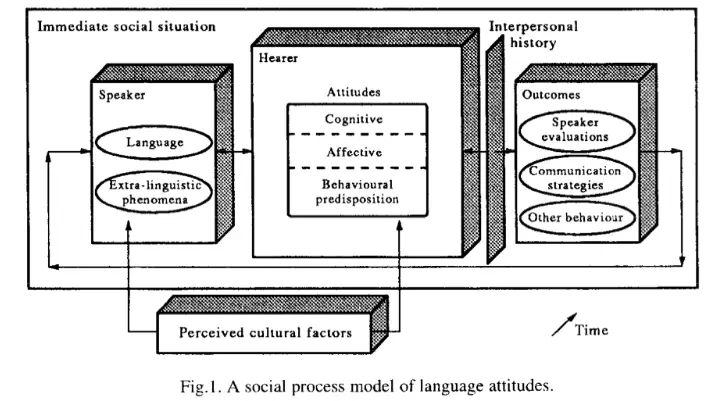
***Cargile***\*\*, Giles, Ryan, Bradac- **language attitudes**\*\*
Language (variation) influences perception
(Ex: american’s may thinks someone with a british accent is "refined")
(Ex: american’s may thinks someone with a british accent is "refined")
47
New cards
**How does the** ***speaker*** **impact the language attitudes process?**
A speaker's linguistic performance is determined by a number of perceived situational cues, including their perceptions of the hearer's physical and communicative attributes
* i.e. speaking loudly to a deaf person, slowly to a person you think is dumb
* i.e. speaking loudly to a deaf person, slowly to a person you think is dumb
48
New cards
**What is often the most important in determining** ***hearer's*** **language attitudes**
What a speaker is perceived to be and how they are perceived to sound and communicate
* i.e. perceieved ethnicity or reigonality of speaker, age of speaker
* i.e. perceieved ethnicity or reigonality of speaker, age of speaker
49
New cards
**ex. of different language behaviors leading to different language attitudes**
One official with a protection goal may see a criminal's non-standard accent and believe that they're a member of a particular social group whose members are cruel, remorseless, and undeserving of assistance. Another official with the rehabilitation goal may hear, at the same time, a criminal's slow speech rate and poor lexical diversity, allowing attributions to be made about the criminal's impoverished educational upbringing. The two officials' goals then lead to appropriate perceptions of the criminal based on the 'appropriate' language attitudes that they summoned in this situation.
50
New cards
**why are language attitudes cognitive? what is an example?**
language can trigger beliefs about the speaker and their group membership ex: language → group membership → speaker personality; British accent → British upper class → fancy, competent
51
New cards
**why are attitudes affective? and what is an example?**
they involve feelings toward an attitude object, ex: a passion for Irish poetry
52
New cards
**why are attitudes behavioral? and what is an example?**
they encourage certain actions, ex: if you believe members of a particular group to be cruel and their presence makes you feel hostile, you are predisposed to behave in a distant manner
53
New cards
**example of interpersonal history affecting language attitudes**
a man may think people who speak in a southern US accent are dumb but when his good friend who he thinks is intelligent speaks with such an accent he wouldn't act on this stereotype. Instead he'd make use of individuated information already provided by their interpersonal history
54
New cards
**example of social situation affecting language attitudes?**
attitudes towards a speaker's slow rate of speech would be different in the context of a nuclear physics lecture than during introductions at a cocktail party
55
New cards
***Rosenthal and Jacobson*** **experiment (Pygmalion in the Classroom)**
The purpose was to figure out what would ensue if teachers would react differently towards certain students if told that a select number of students were expected to learn more information and more quickly than the pupils in their class; studied self fulfilling prophecy
56
New cards
**what did rosenthal and jacobson find?**
Teachers produce low or high performing students, The teachers were more likely to interact with the students who had "high IQ" which led to those students doing better
Teachers communicated differently to students who weren't stars, they didn't help them get to the right answer because they believed them to be dumb
Teachers communicated differently to students who weren't stars, they didn't help them get to the right answer because they believed them to be dumb
57
New cards
***Loftus***
interested in memory and how it works, had people's parents recount stories to them that never happened and those people then told the story to the researcher because they thought it actually happened
58
New cards
**how does creating memories work?**
we store memories already missing a bunch of pieces and we fill it in so it's a coherent memory- it's an editable video
Everytime you call up a memory something has decayed so you insert something that makes sense for the context
The more often you call up the memory the less accurate it is because you don't store information about the edits you made
Everytime you call up a memory something has decayed so you insert something that makes sense for the context
The more often you call up the memory the less accurate it is because you don't store information about the edits you made
59
New cards
**why do we edit memories?**
we want to make sense of what we witnessed
60
New cards
**what are the three dimensions of response as stated in affect control theory**
evaluation (goodness versus badness) potency (powerfulness versus powerlessness) and activity (liveliness versus torpidity)
61
New cards
**What did** ***Heise*** **want to do with affect control theory**
he wanted to know if he could use math to predict how people make sense of situations that don't make sense and to see if he could use emotion to predict behavior
* ex: if people see a boyfriend beating a girlfriend they may not intervene but if they see a criminal beating a girlfriend they may intervene
* ex: if people see a boyfriend beating a girlfriend they may not intervene but if they see a criminal beating a girlfriend they may intervene
62
New cards
***Affect Control Theory*** **(ACT**)
people respond affectively (emotionally) to every social event. individuals maintain affective (emotional) meanings through their actions and interpretations of events.
63
New cards
**how have researchers used affect control theory to analyze institutional roles**
researchers have focused on certain social identities and then examined the kind of action people normally think that person would do
64
New cards
**ex. of affect control theory in medicine**
doctors should accommodate, remember, medicate, caution, reassure, console. A nurse should admire, stroke, obey, mother, and release a patient. A psychoanalyst should coddle, watch, observe, contemplate and psychoanalyze.
The doctor should charm, direct, discipline, and assist the nurse.
The nurse should treat, charm, inform, and engage with the doctor.
A patient's predicted acts toward the caregivers are to idolize, beg, avoid, hide from, appease, and forget
The doctor should charm, direct, discipline, and assist the nurse.
The nurse should treat, charm, inform, and engage with the doctor.
A patient's predicted acts toward the caregivers are to idolize, beg, avoid, hide from, appease, and forget
65
New cards
**what is one of the most powerful features of affect control theory?**
its ability to adjust predictions to take into account circumstances created by recent events (role creativity)
66
New cards
**what is an example of people using affect control theory to adjust predictions based on the circumstances?**
people expect a mother to entertain and sing to a baby but if the mother is responding to the baby interacting with her the mother will caress, kiss, welcome
67
New cards
**what did** ***loftus*** **have to say about sense of self**
people's sense of self is informed by their memories, but since these memories aren't accurate we have no way of knowing who we really are
68
New cards
***Sapir-Whorf*** **Hypothesis**
the idea that different languages create different ways of thinking
69
New cards
**strong version of sapir-whorf hypothesis example**
if i don't have the word for chair i don't know what it is. all i see is wood
70
New cards
**weak version of sapir-whorf hypothesis example**
having the word chair allows me to think about a chair differently than if i don't have the word. I still conceive of it as something people sit on but I don't have a word for it
71
New cards
**what is an example of context-constraining your ability to express yourself?**
you can't say bomb at an airport but you can when you're at home with friends or family
72
New cards
**stigmatized labels- euphemisms**
we take something that's stigmatized and make it socially palatable to talk about. it has a lifespan because euphemisms become stigmatized since it's describing the underlying thing. people think that by changing the word they've removed the underlying stigma but they haven't
73
New cards
**example of a euphemism**
homeless people becoming "unhoused people"
74
New cards
**how do cheerleaders and coaches try to impart emotional states onto the audience and players respectively?**
cheerleaders are ecstatic and perky because they want the audience to be excited and happy, the coaches are yelling and growling because they want the players to be intense and aggressive
75
New cards
**what is the haka and how was the france rugby team able to take control of the situation?**
a maori ritual done before rugby games that is meant to instill an emotional state in your opponent- fear and intimidation. the french team went hand in hand and stepped over the midline showing that they were coming for the other team
76
New cards
**how does the context of rugby change the aggression in pre game rituals?**
the culture of rugby is that everyone understands the intimidation tactics are for the field, once they leave that context they leave the beef behind
77
New cards
**what is an example of how emotions are social?**
you can turn them on and off fast, they're for other people (i.e. when hugging someone you don't smile while you're in the actual hug)
78
New cards
***Hochschild***
expert on emotion. she believed that social contexts contain emotion rules and that there are particular emotions that are acceptable or mandatory to experience and display
79
New cards
**what is an example of social contexts having "mandatory" emotions?**
a bride to be is supposed to display elation, joy, anticipation
80
New cards
**why did abra let his 6 year old watch the walking dead?**
Because children are only allowed to be happy they don't know how to regulate emotions, fear being the biggest one. This leads to issues in adulthood. Abra's kid could experience fear when there was no threat, so he could learn how to handle it
81
New cards
**what did hochschild discover about happiness and occupations**
there are a lot of occupations where the job is to display happiness and make other people feel happy. has nothing to do with being competent
82
New cards
**how did hochschild connect her ideas to capitalism**
* Marx believed that everyone who works is working with a gun to their head because they'll die without work.
* Hochschild believed you lose freedoms when you clock into work- you lose control over your body (have to clean up), your voice, and your emotions (when you work as a hostess and you're really tired you can't act that way, you have to be happy). You get excited when you get to clock out because you get your freedoms back. Essentially we rent our bodies out
* Hochschild believed you lose freedoms when you clock into work- you lose control over your body (have to clean up), your voice, and your emotions (when you work as a hostess and you're really tired you can't act that way, you have to be happy). You get excited when you get to clock out because you get your freedoms back. Essentially we rent our bodies out
83
New cards
**in many jobs emotions are...**
commodities (emotion is part of our purchases)
84
New cards
**what 3 elements impact which language attitudes become accessible and how they're used**
* goals (one officer with protection goal)
* hearer's mood
* expertise (schemas, stereotypes)
* hearer's mood
* expertise (schemas, stereotypes)
85
New cards
**3 processes involved with language attitudes**
* generation (of content)
* salience
* application (interpersonal history)
* salience
* application (interpersonal history)
86
New cards
**outcomes of language attitudes**
* speaker evaluations (competency, attractiveness)
* listeners communication strategies
* other behaviors (cooperation)
* listeners communication strategies
* other behaviors (cooperation)
87
New cards
Social Process Model of Attitudes
Explore top notes

Biology GCSE - Respiration, Breathing investigation and gas exchange in humans
Updated 1384d ago0.0(0)
Biology GCSE - Respiration, Breathing investigation and gas exchange in humans
Updated 1384d ago0.0(0)
