The Problem of Evil
 Studied by 0 people
 Call Kai
 Learn
Learn Practice Test
 Spaced Repetition
 Match
Match Flashcards
 Knowt Play
 Podcast
1/42

There's no tags or description
Looks like no tags are added yet.
Name | Mastery | Learn | Test | Matching | Spaced | Call with Kai |
|---|
No study sessions yet.
43 Terms
Logical problem of evil
Deductive
The existence of evil is logically incompatible with God’s benevolence/omnipotence/omniscience
If evil exists, God must lack power/goodness
Ganssie
‘Square circle’ objection
Believing that an all-loving, all-powerful God allows evil to exist in the world makes as much sense as a square circle
Inconsistent triad argument
Evidential problem of evil (Rowe)
Inductive
Type/amount/intensity of evil makes God’s existence unlikely
Even if some evil has purpose, extreme suffering in the world suggests no good God would permit it
Example for Rowe’s evidential problem of evil
Fawn in a fire - there is no good reason or moral lesson to be learned from a fawn painfully dying in a fire
Augustine (Inconsistent triad)
‘Either God cannot abolish evil, or He will not. If He cannot, He is not all-powerful, if we He will not He is not all-good’
JL Mackie
Problem of evil is a ‘logical problem’
Theists have to show their beliefs make sense
If God is omnipotent he must have power over ‘casual laws’ ie the laws of the universe - why then does God not stop evil if he has the power to?
Dawkins
Even with no humans, there is still suffering in the world
Questions whether evil outweighs good
Says religious believers struggle to defend goodness in the face of all the evil and suffering in the world
Taylor
Why do bad people benefit off good people’s suffering
How does this fit with God’s benevolence
Natural Evil
Caused by nature/natural world
Fall of the angels caused disharmony
Either: God created/allowed natural evil OR it’s the devil’s fault
Aquinas/Augustine: evil was not God’s intention, but a necessary part of good’s existence (privation of good)
Peter Vardy’s categorisation of natural evil
Animal suffering
Suffering caused by natural disasters
Pain resulting from disease
Pain resulting from poor design of the human body
Psychological illness
Moral Evil
Evil caused by humans
Usually with intention of causing harm
Easier for theists to explain as evil comes from humans, not God
BUT did God not know that we would abuse our free will?/ Why doesn’t he stop us?
Theodicy (in response to the problem of evil)
Tries to explain why God allows evil to exist while maintaining his goodness and omnipotence
Iraneus - Background
Interpreted creation story literally
Fall as a necessary stage in the development of humans towards perfection
Believed God allowed evil and suffering to happen as it has its place in the universe
Mixture of good and evil is so that humans can develop and choose a relationship with God
Developing towards perfection
Humans are created imperfectly because we are developing towards perfection
God’s creation is therefore imperfect
Free will
God gave humans free will to willingly develop into God’s ‘likeness’
This process of growth/development involves suffering
Tyler: ‘freedom requires the possibility of choosing good instead of evil’
God’s plan
God did not make a perfect world because evil plays an important part in his plan for humanity
Teleological/has a purpose
Turns us from human animals to God’s children
Problem of scale: some people do not grow from suffering
God is partly responsible for evil
His creation is not perfect
Part of his plan for humanity
Permits evil as a consequence
Soul-making
Evil has a purpose if we are to grow and develop into perfect human beings
5 strengths of Iraneus’ soul-making theodicy
Swinburne: because of evil and suffering humans are given the opportunity and responsibility to ‘grow in power, freedom and knowledge’, and make a difference to the imperfect world they live in.
Evil exists for a purpose - part of God’s ultimate plan to help us grow spiritually.
Rooted in Genesis 1:26 - Biblically coherent
God’s epistemic distance allows genuine, free moral choice, making humans’ development from ‘image’ to ‘likeness’ more meaningful
Concept of humans progressively improving fits with evolution
5 weaknesses of Iraneus’ soul-making theodicy
Universal salvation unjust - everyone going to heaven means people can do whatever they like in this life, not grow into the likeness of God, but still be saved
Extreme suffering - the Holocaust was not necessary to grow into God’s likeness
Vulnerable individuals - sometimes suffering does cause growth, but not in babies or people with learning difficulties. Or animals, who won’t be saved anyway
No spiritual growth - suffering can destroy people, make them lose their faith, make them bitter
Value of free will questioned - does free will justify such extreme pain?
Apokatastasis
Universal salvation
Augustine - background
Influenced by Plato
Disagreed with Plato in that P thought the world was created with imperfections
Took creation literally in terms of universe’s origins, but mythologically in its values and meaning
The universe is good
God is good
Made the universe ex nihilo and free from flaws
Aug
Evil is not a substance
Evil is an absence of God in human beings
The perversion of something good that already exists
e.g. sickness is a lack of good health
Privation of good
Doesn’t believe evil is a force opposed to God as it would detract from God’s omnipotence
Aug
The Fall
Evil came into the world when humans and angels first turned away from God
e.g. the Fall
All evil derives from moral choices
Aug
Free will (A)
God created everyone with free will
Through this he gave the possibility of actualising evil
Because we can choose our own path, we have the possibility of choosing evil
Aug
Soul-deciding
Because of free will we can decide our own fate through individual choices
Aug
Original sin
First sin of Adam and Eve passed onto all human beings
Aug
Natural evil as a punishment for moral evil
First sin destroyed natural order of things God created
‘All evil is either a sin or a punishment for sin’ - therefore God is right not to intervene and stop suffering
Aug
Redemption through Christ
God is still merciful and just
Planned for humanity’s redemption through Christ’s death and resurrection
If God was just, everyone would be punished in hell, but he sent his only Son to be the scapegoat for humanity’s sins
Aug
‘Evil comes from God’
God allows evil things to exist and allows free will
Didn’t believe anyone could be truly evil, because to be so meant they would have had to have goodness to start with
Aug
4 strengths of Augustine’s soul-deciding theodicy
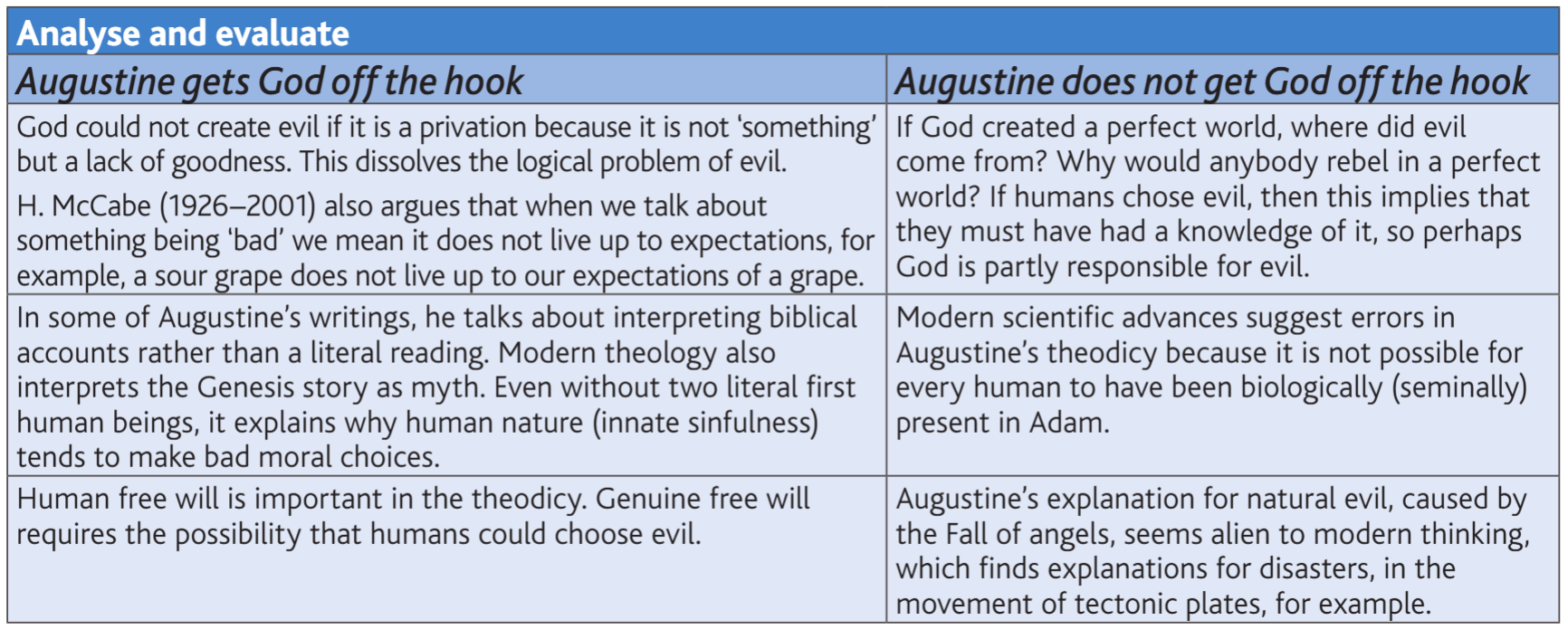
Free will clears God of any responsibility for evil - humans’ fault
Free will shows God’s love for humanity as we have been allowed the right to choose a relationship with him
Genesis: Augustine’s argument is consistent with Genesis
Evil is not a substance therefore it cannot be part of what God Himself created
5 weaknesses of Augustine’s soul-deciding theodicy
Schleiermacher - logical contradiction to say that a world that has been made perfectly can have evil in it. If everything depends on God for its existence then God must be involved with humanity - are we really free…??
Plantinga - for God to create humans with free will would be a logical contradiction. For humans to disobey God knowledge of good and evil must have existed before the Fall.
Inconsistent with evolution. Also, not everyone has the same DNA, so seminally present original sin argument is void.
‘Privation of good’ is insufficient - evil is a real entity through Satan (Tyler)
Existence of Hell is inconsistent with benevolent God. If created at the beginning of the earth, then God must have known that people would sin
Hick - distinguishing between ‘image’ and ‘likeness’ of God
Stage 1: spiritually immature - through struggle to survive, humans can develop into spiritually mature beings
The Fall is a result of immature humans who are only in God’s ‘image’
Stage 2: Grow into a relationship with God (in his ‘likeness’)
Hick - epistemic distance
We cannot truly know of God’s existence
If God revealed himself to us, we would follow his commands out of obedience to his authority, instead of because they are the right thing to do
We can only grow spiritually and morally if we have faith in God and still do good because we want to, rather then because God wants us to
Peter Vardy Epistemic distance example
The King falls in love with a peasant girl and forces her to marry him
She doesn’t love him and only agrees to marriage because of her obedience to him and her fear of authority
Similarly, we would obey God’s authority rather than loving what is good for its own sake, which is the morally superior move ∴ most conducive to soul-making.
Hick and Natural Evil
The world is a ‘vale of soul-making’ so the amount of evil is instrumental, it serves the purpose of developing character and could not occur in a pain-free paradise.
Evil is instrumentally good because it allows people to develop into the likeness of God
Pain is necessary because it teaches us what is valuable and dangerous
Hick suggests most parents develop their kids’ character by encouraging perseverance, independence and resilience
Similarly, the world is not paradise, but useful for soul-making
Hick: strengths
Influential among Christians who are faced with suffering
God has a plan and it will result in something in good
Are Augustine’s view of the origins of moral and natural evils enough to spare God from blame for suffering and evil in the world?
Possible solutions to the logical problem of evil
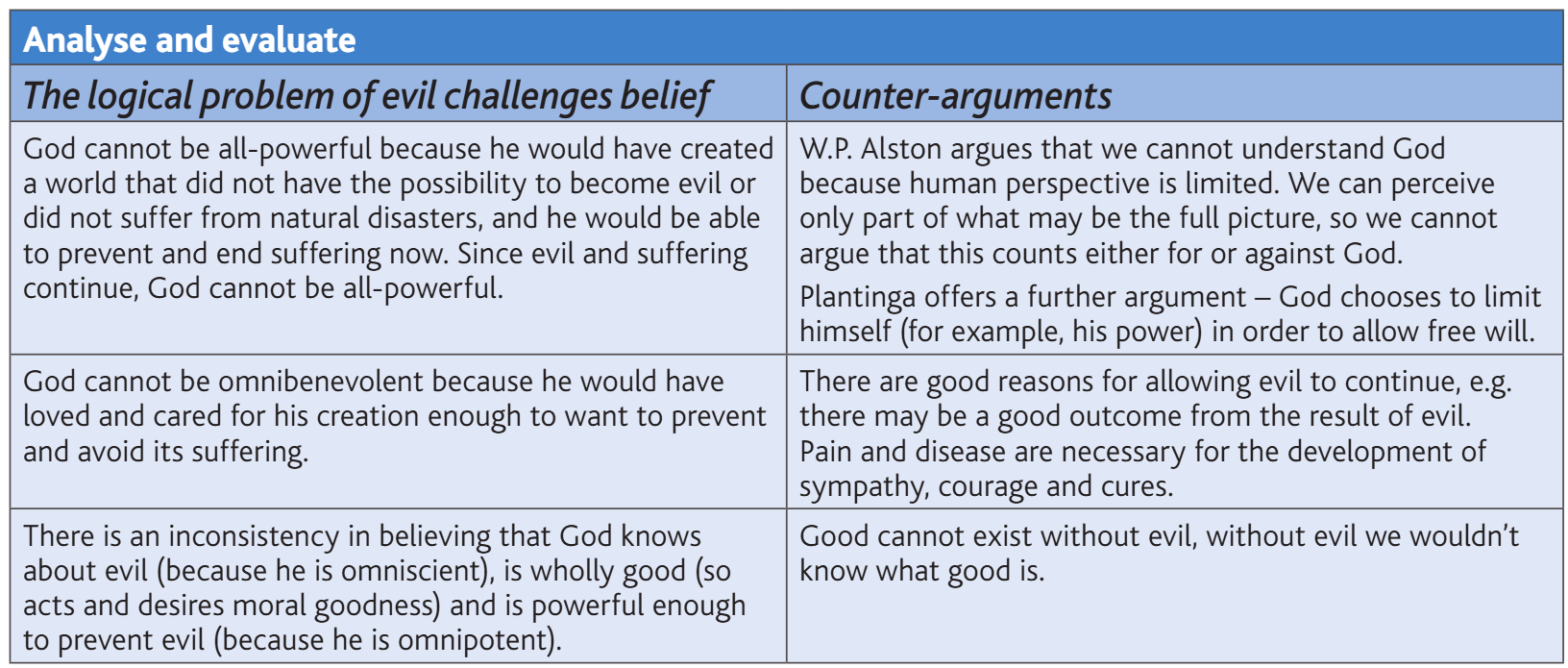
3 reasons that God is responsible for evil
Dostoyevsky: how dysteleological (meaningless) suffering could have any purpose - what kind of God would allow innocent suffering?
Logical problem of evil: highlights logical inconsistencies in the incoherent triad
Evidential problem of evil: highlights overwhelming amount of evil and suffering in the world. Even if some suffering is needed to warn us of dangers, is there too much?
3 reasons that God is not responsible for evil
Evil as the privation of good - God cannot create a lack of something and so cannot have created evil
God allows evil and suffering for a purpose but is not wholly to blame. Free will is valuable in that it allows humans to make choices
Swinburne argues God should not be made responsible for evil because free will is essential to being human
Privatio boni
Augustine: an absence of goodness
 Note
Note  Flashcards (34)