AP European History Units 8 and 9 - 20th Century Global Conflicts & Cold War and Contemporary Europe
 Call Kai
 Learn
Learn Practice Test
 Spaced Repetition
 Match
Match Flashcards
 Knowt Play
1/79

There's no tags or description
Looks like no tags are added yet.
Name | Mastery | Learn | Test | Matching | Spaced | Call with Kai |
|---|
No analytics yet
Send a link to your students to track their progress
80 Terms
Explain the causes and effects of World War I. (topic 8.2)
CAUSES:
- The assassination of Archduke Francis Ferdinand, heir to the Austrian throne, causing a confrontation between Austria and Serbia. This was an immediate cause. His assassination was caused by Pan-Slavic nationalism provoked by Austria's tension with Russia and the Serbs that erupted in conflict between Russia and Austria.
- Nationalism: Imperialist competition over colonial, industrial, and commercial interests intensified with the division of Europe into the Triple Alliance and the Triple Entente. Major European states believed in the importance of their allies and supported them even when they took foolish risks (like those to maintain national interest). National attitudes encouraged war as an accepted way to preserve the power of national states. Examples of this include Austrian opposition to a Serbian empire, Russia's desire to maintain its power to protect the Slavic peoples in the Balkans, and Germany's wanting to create a German Empire by acquiring parts of Russia and France.
- Internal Dissent: Ethnic groups desired the goal of nationhood. This can be exemplified by the Slavic minorities in the Balkans and Austrian Empire, the Irish in the British Empire, and the Poles in the Russian Empire. Socialist labor movements also became increasingly powerful and more commonly used strikes, even violent ones, to achieve their goals. This alarmed conservative leaders and statesmen.
- Militarism: Large mass armies after 1900 were growing by means such as mass conscription, which was adopted as a regular practice in most Western countries (except for Britain and the U.S.). Military leaders also gained more influence by quickly mobilizing millions of men and enormous quantities of supplies.
- Crises in the Balkans: The First and Second Balkan Wars that were between Balkan states in the Balkan League and the Ottoman Empire caused a disruption in the balance of power by giving Macedonia and Albania to the Balkan states (first Balkan War). The Second Balkan War saw the Balkan states fighting each other for control of Bulgaria. This was solved with the London Conference, which made the Albanian state an independent territory, destroying Serbia's desire for a united Serbian kingdom.
- Austria's ultimatum to Serbia in 1914 caused war between the two states. This war soon spread as Tsar Nicholas II of Russia ordered a partial mobilization of the Russian army against Austria.
To remember the main causes of WWI, remember MAIN (militarism, alliance systems, imperialism, nationalism)
Black Hand
Serbian nationalist/terrorist group responsible for the assassination of Austrian Archduke Franz Ferdinand in order to create a pan-Slavic kingdom which resulted in the start of World War I.
Blank Check Policy
this was a figurative blank check whereby the German Kaiser (Emperor William II/Kaiser Wilheim) (or king) indicated that Germany would support Austria-Hungary no matter what in the event of a war
Schlieffen Plan 1905
Germany's grand strategy for quickly winning the war against France in 1914. In the original plan, the crushing blows at France were to be followed by the release of troops for use against Russia and Germany's Eastern front. The plan, however, was not adequately implemented, and the war on the Western front became a long contest in place
Western Front of WWI
Trench Warfare, small land gains, and ended in a bloody stalemate. Germany vs. GB and France.
- It was trench warfare, little advance, barbed wire fences, machine guns, and mustard gas.
No Man's Land
A strip of land beween the trenches of opposing armies along the Western Front during WW1, which were very dangerous as soldiers crossing these lands made for easy targets to oppossing armies, which had access to the machine gun.
Central Powers of WWI
Germany, Ottoman Empire, Austria-Hungary, Bulgaria
- This alliance developed as Italy left the Triple Alliance to join the Triple Entente and the Ottoman Empire and Bulgaria decided to join WWI on the side of the Triple Alliance.
Allied Powers (WWI)
Britain, France, Russia, Italy, and the United States
- This alliance developed from the Triple Entente as Italy and the U.S. decided to join WWI on the side of Britain, France, and Russia. This alliance was against the Central Powers.
Events in World War I
1) Trench Warfare on the Western Front: Resulted from the failure of the Schlieffen Plan. There are trenches set up in by German, Austrian, British, and French, which are all divided by territory known as the No-Man's Land. The trench warfare battlefield saw the use of new military technology, namely, poison gas, barbed wire, tanks, and the machine gun.
2) Mobile Warfare on the Eastern Front
3) Bulgaria and the Ottoman Empire join the Triple Alliance and forms the Central Powers, while the United States, Japan, and Italy join the Triple Entente, which forms the Allied Powers.
4) Rebellions and internal dissent can be seen with the Easter Uprising in Ireland, in which the Irish sought to gain independence from the
5) Warfare on the Atlantic Front sees submarine warfare between the Germans and the British. This ultimately caused the United States to join Britain due to their sympathy for the British and rising American nationalism as German submarine warfare brought about the destruction of passenger liners, leading to American deaths. The Germans also sank American ships during their times of unrestricted submarine warfare.
How did the breakup of the Ottoman Empire cause crises that led to World War I? (8.2)
The breakup of the Ottoman Empire caused crises that led to World War I by causing crises in the Balkans that strengthened the tensions between Austria and Russia and Serbia. The breakup of the Ottoman Empire can be seen with the Crimean War, which displayed the weakness of the empire as it needed the assistance of France and Britain to be able to take on Russia, but the crises that happened within it that would pave the way for World War I, namely, the First and Second Balkan Wars. The First Balkan War further displayed the weakness of the Ottoman Empire, which caused its further loss of territory by having to give up Macedonia and Albania to the Balkan League, which consists of states that were once part of the Ottoman Empire. The Second Balkan War led to the London Conference, which angered Serbia and Russia by making Albania an independent state. Albania's separation from the Ottoman Empire would lead to further tensions between Austria and Russia and Serbia, which would provoke the use of the military to be seen in World War I.
What were the Balkan Wars and how did they contribute to the accumulation of World War I? (8.2)
How did imperialist rivalries and the breakdown of Bismarck's alliance system lead to war? (8.2)
Imperialist rivalries and the breakdown of Bismarck's alliance system led to war by establishing a distinct division of European countries through separated alliances and strengthening tensions between the two alliances. First of all, the breakdown of Bismarck's alliance system caused strong tensions between Russia and Germany and Austria, which led to the establishment of the Triple Alliance that includes Germany, Italy, and Austria along with the Triple Entente, which includes Russia, France, and Britain. The establishment of these two European alliances divided the European powers and created tensions between them. Imperialist rivalries, on the other hand, saw European competition for national power in Africa by means of pursuing commercial, colonial, and industrial interests. As a result, tensions became more prevalent between European countries as they sought to expand their colonial empires. This can be exemplified in the Fashoda Crisis, which saw diplomatic tensions between France and Britain as each country sought to connect their railroads to the other's, though it was met with the problem that where the railroads intersected was in Fashoda, an unclaimed territory. The French ended up giving Britain the territory in the Cordial Entente as they knew they could not defeat the British army and they needed a diplomatic ally.
Explain how new technology altered the conduct of World War I. (8.2)
New technology transformed terrestrial, naval, and aerobic warfare. Good new military technologies to remember include barbed wires, poison/mustard gas, tanks, machine guns, submarines, torpedoes, battleships like dreadnoughts, and planes that were used to spot enemy locations and to combat terrestrial soldiers by being mounted with a machine gun or dropping bombs (like the German zeppelins).
Explain the role of imperial colonies in World War I as a total war.
Fighting and military conflicts between the Allies and the Germans occurred within and outside of Europe. Despite the Social Darwinism and racism during the Imperial era, colonial troops from India and Africa were used since the war required a unprecedented amount of manpower and caused massive casualties, thus making all nations desperate for manpower. The long-term effects of the use of colonies in World War I include
Explain how the developments of World War I changed political and diplomatic interactions between and among nations. (8.2)
The developments of World War I changed political and diplomatic interactions between and among nations by sparking domestic dissent that gave rise to rebellions, the spread of the war caused global conflict, and the relations between Europe and its colonies and the United States changes as colonies increasingly demand independence and the U.S. emerges as a global power.
What were the major causes of the Russian Revolution? How did it influence the course of World War I? (8.3)
The major causes of the Russian Revolution include the incomplete industrialization of Russia, the centralized government of the Russian autocracy, food and land distribution, social inequality and privilege. These problems became worse and more noticeable during World War I. For example, the Russian army struggled a lot and saw many soldier deaths due to their industrialization that lacks the development that other countries underwent. Although the country started to rapidly industrialize in the late 19th century, Russia has still not completed its industrialization process, causing a lack of military technology, weapons, and food. Food and land distribution also became worse as a problem as food was unable to be distributed equally among the people due to Russia's lack of industrialization, while land distribution became worse as the higher classes had all of the land, which deprived the working class of land. The Russian autocracy also deprived of the Russian people freedom and rights as the tsar took power of the whole state, evident in that fact that they served as the military leader of the Russian army during wars. As the Russian government still followed the ways of the old regime, Russian society still had social inequality and privilege.
The Russian Revolution influenced the course of World War I as it caused Russian absence in the war on the side of the Allied Powers. This would force the Allied countries to fight for themselves against the Central Powers.
Explain the effects of the Russian Revolution, especially the prevalence of the Bolsheviks. (8.3)
The effects of the Russian Revolution included social, political, and economic changes.
SOCIAL CHANGES: Established a communist society, the abolishing of social inequality and privilege, universal suffrage, and a liberalized, socialist government, socialist reform.
The March Revolution saw the shift from an autocratic government to a provisional government, which was established by the Duma Assembly, initially established by Alexander II. The provisional government, however, saw opposition from the Petrograd Soviet, which consisted of the Bolsheviks. As the weakness of the provisional government became more visible, the Bolshevik Revolution saw the dissolution of the provisional government and shifted Russia towards a communist government and society. This new government was ruled by Lenin and under the Marxist-Leninist theory, which established a communist dictatorship.
POLITICAL CHANGES: The collapse of the autocracy in Russia as the form of government, the rise of a communist country, a policy of war communism, socialist policy.
ECONOMIC CHANGES: The establishment of a more free-market economy, which was enforced by Lenin through his New Economic Policy.
How does Leninism-Marxism differ from Marxism?
Marxism predicted a proletariat revolution to destroy the government and capitalism, while Lenin claimed that the government could transition directly to socialism under a party of professional revolutionaries. Marxism also predicted a temporary dictatorship of the proletariat after the collapse of the government, while Leninism established a permanent dictatorship in Russia of the Communist Party.
Marxist-Leninism
Communist theory as derived from the writings of Karl Marx, Vladimir Lenin, and their successors, which criticizes capitalism as a cause of class struggle, the exploitation of works, colonialism, and war.
- this calls for an overthrow of the state by an organized unit, but in the cities of industrialized countries.
- the belief that the peasants needed someone to lead a revolt to ultimately share everything
What terms of the Treaty of Versailles caused economic collapse and political problems for Weimar Germany? (8.4)
The Treaty of Versailles caused economic collapse and political problems as it was through this that Britain and France demanded huge reparations from the newly established Weimar Germany and thus much discontent and instability within the Weimar Republic. Through the Treaty of Versailles, Germany was demanded to pay reparations due to Britain and France blaming them for starting WWI with the War Guilt Clause. This caused much economic burden in Germany as it also suffered much economic damage from WWI itself, which led to problems such as superinflation of the German Mark (German currency), which made the German Mark virtually worthless. Germany's economy eventually became completely dependent on the United States as they were loaned much money from the Dawes Plan, which temporarily helped Weimar Germany recover economically. However, the Great Depression, which destroyed the U.S. economy, left Germany with no other country to depend on, thus causing an economic collapse for Germany as well. This exposed the weakness of democracy in being able to effectively solve large national problems, thus leading to political conflict as political parties such as the Communists and National Socialists (Nazis) competed for dominance over the Reichstag (German parliament). Additionally, much discontent was generated with the Weimar Republic as the people increasingly demanded a shift to more right-wing politics, a strong, centralized government. The National Socialists would soon rise to power and establish a totalitarian government in Germany.
Explain how and why the settlement of World War I failed to effectively resolve the political, economic, and diplomatic challenges of the early 20th century. (8.4)
The settlement of World War I failed to effectively resolve the political, economic, and diplomatic challenges of the early 20th century since different states on the victory side of WWI had different goals, which led to a weak, unstable alliance that failed to settle the rising tensions between European states and paved the way for further conflict. First of all, the United States' goal as a result of WWI contradicted the goals of France and Great Britain. President Wilson followed ways of idealism, in which he sought to create everlasting peace between the European nations and prevent future wars. For example, in his Fourteen Points, he addressed the idea of self-determination of nations, in which he claimed that a nation should have the right to establish their own country or government. Wilson's influence at the Paris Peace Conference would cause the creation of new nation-states, which include Poland, Czechoslovakia, Romania, Hungary, etc. Wilson's idealism, however, was challenged by France and Britain, who desired to punish Germany. They firstly accused Germany (and Austria) of starting World War I through the War Guilt Clause, which thus caused them to demand reparations from Germany. They also created a mandate system, in which Britain and France took control of nation-states as they believed they were not ready to be independent states, which caused an imperial imbalance of power in Europe. Germany was underwent demilitarization as their industries ceased production of military goods and were deprived of a strong military. The huge reparations demanded of Germany caused the collapse of the newly established Weimar Republic, thus causing domestic discontent and leading up to the totalitarian regime of Hitler, who would rearm Germany and attempt revenge on the Allied Powers in WWII. During the time of the Weimar Republic, the German economy also became very dependent on the American economy (Dawes Plan), and overproduction of military goods, domestic economic damage from WWI, and a fall in the American stock market all contributed to the Great Depression, which created much economic dislocation in European countries and exposed the weaknesses of political democracies, which led people to desire for more centralized governments. As a result, totalitarian and authoritarian regimes were established in Middle East nation-states, Italy, Germany, and Russia.
Fascism in depth...
DEFENITION: the totalitarian philosophy of government that glorifies the state and nations and assigns to the state control over every aspect of national life, including, social, economic, political, and cultural aspects.
- Fascism followed the ideas of nationalism (Mussolini's Fascist Italy and Hitler's Nazi Germany), despite religion or class differences, the people of a nation are of one nationality.
- Rejects liberalism, which denies the state in the name of the individual, while fascism reasserts the state's rights as expressing the real essence of the individual.
- Extremely right-wing (favored a very centralized government rather than a government largely uninvolved with social affairs)
- Anti-democratic
-Accepts the tenets of Social Darwinism
- The Fascists believed in the value of the individual as a member of the state, they were taught to believe, obey, and fight.
- Identification of Enemies of Scapegoats as a unifying cause: the people of a nation rallied into a unifying patriotic frenzy over the need to eliminate a perceived common threat or foe. This foe can be a racial, ethnic, religious minority, liberals, communists, etc. This can be seen with the Ottoman Empire (although it was not fascist) and the Armenian Genocide and also Nazi Germany and Aryan nationalism (which can be seen with the Night of Broken Glass).
- Religion and Government are intertwined: Fascist governments tend to use the most common religion in the nation to manipulate public opinion in their favor. They implemented religious rhetoric, symbolism, mythology, etc., into their policies. An example is Mussolini's appeal to the Catholic Church, which he supported and established as Italy's official religion. In exchange, the Catholic Church highly supporting Mussolini's regime.
Differences and similarities between communism and fascism
- Each kind of state is dominated by only one party, following ways of totalitarianism.
mass politics
reforms encouraged expansion of political democracy through voting rights formed and creation of mass political parties
(trotsky = russian jew, karl marx = socialist jew)
Explain the causes and effects of the global economic crisis in the 1920s and 1930s. (8.5)
The causes of the global economic crises during the 1920s and the 1930s include the failed peace settlement that was made as a result of the
What caused the Great Depression, and how did it affect European social classes? (8.5)
The Great Depression was a global economic crisis that destroyed the economies of European countries and the United States, which was caused by the weaknesses in international trade and monetary theories, and thus undermined Western democracies and gave rise to radical movements demanding reform from the government. In European social classes, the Great Depression caused a kind of reversal in roles between women and men, that is to say, women were the ones working for money, while the men could not find work due to mass unemployment caused by the Great Depression. For example, as industrial production plummeted, less workers were needed in factories, thus eliminating many workers. Women, on the other hand, were able to find low-paying jobs such as servants, house cleaners, or laundresses.
Extra concepts on Global Conflicts (8.5)
Different European Countries responded to the economic crises of the Great Depression in different ways.
- United States: Active governmental action/involvement in the economy by President Roosevelt, which was known as the New Deals. The New Deal initiated programs and social projects that would create jobs and decrease unemployment and it followed the Keynesian economics, which encouraged governmental spending in order to recover from economic crises.
- Great Britain: Lost many overseas markets to Japan and the United States. There were many parties who competed for political power, including the Conservatives and Labour Party, but each party took ineffective measures in solving the Great Depression. One example of their ineffective measures is the formation of the National Government, which imposed protective tariffs and traditional policies to solve the Great Depression, which was condemned by Keynes.
- France: Saw the political alliance of the Popular Front, a group of leftist parties in response to riots from the right-wing parties. Attempted to impose the French New Deal but ended up being as ineffective as Britain.
- Germany: Gave rise to internal dissent that eventually led to the dissolution of the Weimar Republic and the rise of the National Socialist (Nazi) Party under Hitler. Under the Weimar Republic, Germany was dependent on the American economy and saw the hyperinflation of the Germany mark. Hitler remilitarized Germany by creating a lot more jobs in military industries, which eventually pulled Germany out of the Great Depression.
Explain the factors that led to the development of fascist and totalitarian regimes in the aftermath of World War I. (8.6)
The factors that led to the development of fascist and totalitarian regimes in the aftermath of World War I include the rise of communism, the distrust in democracy, and economic instability. Fascist and totalitarian rulers sought to control all social, political, economic, and cultural aspects of their countries and focused on the state as a whole, which showed their focuses on nationalism. In promoting their cause, Fascists used propaganda including radios, propaganda ministers, architecture, and cults of personality. They also greatly used terror and other extremist policies to enforce their goals for their countries. This can be seen through Hitler's terror against Jews, as demonstrated in the Night of Broken Glass. Fascists also feared the rise of communism and wanted to eliminate it, which led to Hitler's goal to destroy the Soviet Union and its communism in WWII. Mussolini and Hitler came to power in their respective countries by manipulating the discontent of the people in regard to the weakness of democracies and economic instability, which caused the people to desire a strong, centralized state, giving Hitler and Mussolini the ability to establish totalitarian regimes in their nations.
The establishment of totalitarian regimes can also be seen with Stalin's rise to power in the Soviet Union, who established extreme policies and was very sensitive to internal opposition. He sought to move in a rapid pace in advancing and industrializing Russia due to his fears of Russia being destroyed in war due to the country being far behind other countries in terms of industrialization. Therefore, he established his Five Year Plans, which focused on creating a heavy industry rapidly in Russia, making Russia one of the greatest industrial producers during the time. He also made use of terror through his secret police force and gulags (concentration camps) to eliminate internal dissent. He also eliminated Lenin's Marxist focus on spreading communism internationally through the Comintern, which he replaced with the policies of Cominform and Socialism in One Country. This shows Stalin skipping steps to achieve a communist, Marxist state just as Lenin did with his New Economic Policy.
Authoritarian regimes also rose in Eastern European states, including Romania, Poland, and Hungary. Totalitarianism also spread to Spain, which led to the Spanish Civil War, in which the Spanish Popular Front (group of leftist parties, different from the FRENCH Popular Front) united against right-wing parties, who were led by Franco in the war. Hitler and Mussolini supported Franco's forces, which made the Spanish Civil War a testing ground for WWII. This to say, Hitler and Mussolini (and Stalin) noticed that Western democracies would not take action against totalitarian regimes, which led to Hitler's ruthless expansion throughout Europe under the belief that Western European countries would not face them in war.
Explain Hitler's and Mussolini's policies and foreign policy.
Explain Lenin's and Stalin's policies/governments respectively and compare and contrast them.
How did Mussolini, Hitler, and Franco each rise to power? (8.6)
What were the effects of Stalin's economic modernization programs in the Soviet Union? Explain the consequences of Stalin's economic policies and totalitarian rule in the Soviet Union. (8.6)
How did totalitarian governments control their populations? (8.6)
In what ways were totalitarian governments of the twentieth century like the absolutist governments of the seventeenth and eighteenth centuries? (8.6)
Explain how and why various political and ideological factors resulted in the catastrophe of World War II. (8.7)
Why were Great Britain and France reluctant to confront Fascist aggression during the 1930s? (8.7)
Great Britain and France were reluctant to confront Fascist aggression during the 1930s because they were still struggling with the economic harm of the Great Depression and the struggles that World War I brought forth. For this reason, Great Britain and France ultimately followed a policy of appeasement, that is to say, they tried to appease Hitler and the dissatisfied Germany by not interfering with their campaigns and allowing them to violate the terms of the Paris Peace Conference. For example, the Munich Conference gave Czechoslovakia to Germany and Hitler's not kept promise of not pursuing any more military expansion. Great Britain soon started to face the Nazi Army in military combat in WWII under Winston Churchill's leadership and Chamberlain's leaving of office as prime minister as a result of the French surrendering to Germany (due to Hitler's successful Blitzkrieg).
Explain the causes and effects of World War II. (8.8)
CAUSES:
1) Great Depression
2) Treaty of Versailles (War Guilt Clause, Reparations, German disarmament/demilitarization, territorial losses from Germany, failure of the League of Nations)
3) The emergence of fascism and totalitarianism (Hitler's Nazi Germany; built-up military, alliances, Nazi imperialism)
4) Diplomatic Revolution - Germany's alliance with Italy and Japan
5) German aggression in the East and Japanese aggression in the Pacific.
What impact did the concept of total war have on the lives of Europeans on the home front in both the Allied countries and the Axis powers? (8.8)
How were women both affected by and participants in the war? (8.8)
Explain how technology and innovation affected the course of World War II and the 20th century. (topic 8.8)
What did Germany mean by a "new racial order," and how did they attempt to bring it about? (8.9)
Explain how and why cultural and national identities were affected by war and the rise of fascist/totalitarian powers in the period from 1914 to the present. (topic 8.9)
What was the Interwar period? Explain the developing mass culture, mass leisure, and new art movements during this time. Also explain the Lost Generation and the Roaring Twenties. (8.10)
What were the effects of the peace conferences held by the Allied Powers at the end of WWII (Tehran Conference, Yalta Conference, and Potsdam Conference). How were these "peace" conferences similar and different to the Paris Peace Conference held at the end of WWI? What were the goals at these conferences?
Explain the new science and physics that emerged during the time period of post-WWI to post-WWII. How did the science that emerged contradict the principles or ideas that were laid in the past by past scientists (e.g. Newton, John Dalton)?
(From Collegeboard Course and Exam Description)
Translation: Ambition, militarism, war. This is Fascism. Unite to Destroy it.
SAQ Prompt: Refer to the image given for the following questions...
A) Describe the historical situation in Spain reflected in the poster.
B) Describe one way in which the psoter reflects broader historical developments in Europe.
C) Explain one way in which the artist's political affiliation influenced the view expressed in the poster.
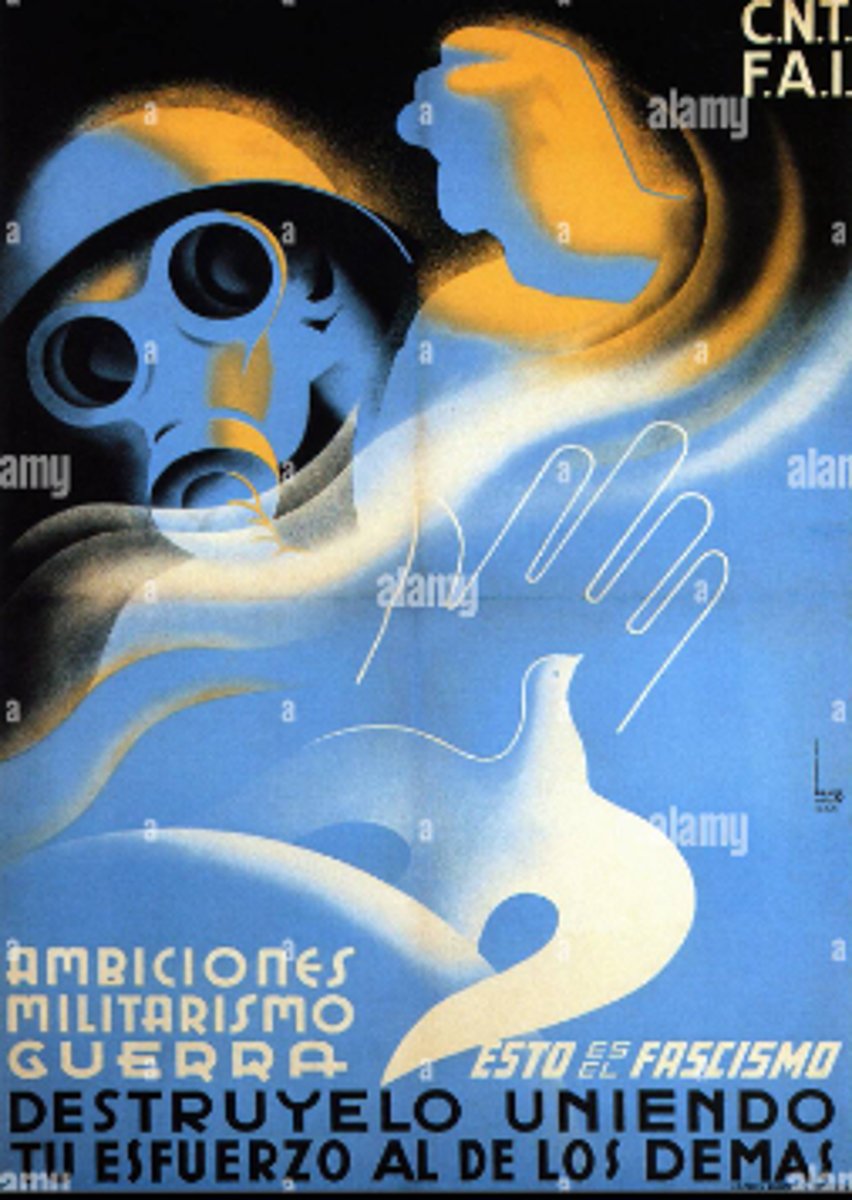
(From Collegeboard 2018 Exam)
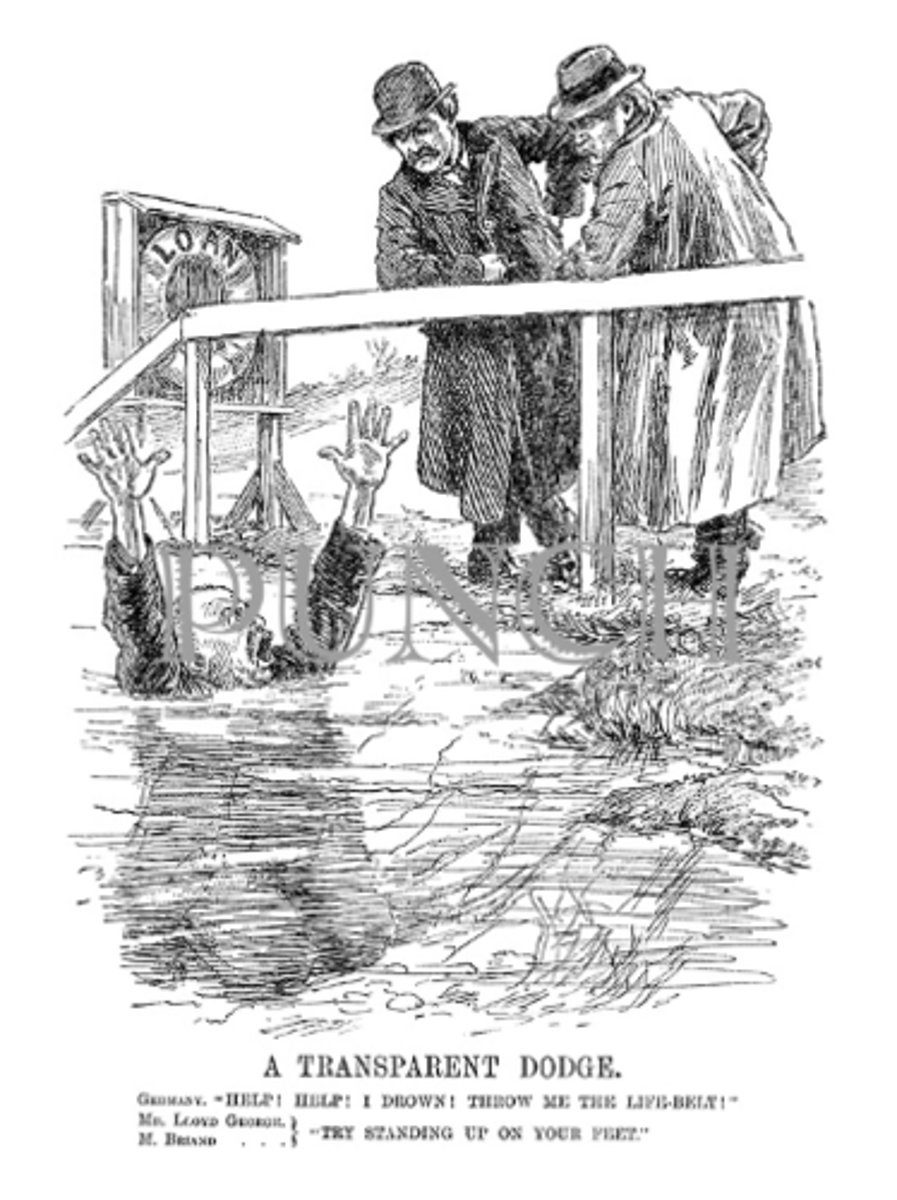
The following shows a political cartoon depicting the postwar situation between Germany and France and Great Britain. This was drawn by a British artist.
SAQ Prompt: Refer to the image given for the following questions...
A) Explain one cause for the historical situation shown.
B) Explain one effect of the historical situation shown.
C) Account for how the countries are shown and explain the artist's view of the situation.
LEQ Prompt: Explain the differences and similarities between Nazi Germany and Soviet Russia. (8.6 & 8.8)
Contextualization:
Soviet Russia - World War I, Pan-Slavism, Russian Revolution, Russian Civil War, tensions with Austria
Nazi Germany - World War I, the abdication of Kaiser Wilheim, Bismarck's alliance system
Thesis: Nazi Germany and Soviet Russia share political, social, and economic similarities of governmental centralization of power and strict policies to enforce social order, enforcement of a program of industrialization and armament, and political goals of territorial expansion. The differences, on the other hand, include the forms of government Russia and Germany had.
Body Paragraph 1: Governmental centralization of power and political goals of territorial expansion are similar between Nazi Germany and Soviet Russia.
- Russia: Five year plans, totalitarianism, kulags, secret police, great purges, collectivization of agriculture
Germany: remilitarization and rearmament, Holocaust, brownshirts, Night of Broken Glass, totalitarianism
Body Paragraph 2: Political goals of territorial expansion:
- Nazi Germany: Polish Campaign of 1939, living space policy, Nazi-Soviet Nonaggression Pact
- Russia: Comintern, Cominform
Body Paragraph 3: The governmental goals of the two countries were different.
Russia - Communism under Lenin and Stalin, the establishment of the Petrograd Soviet, New Economic policy, collectivization
Germany - Fascism, beliefs in the superiority of Aryan race,
Explain the post-WWII societies of the Soviet Union and Eastern Europe.
The living conditions in Eastern Europe, including the Soviet Union, have seen much devastation and wreckage, which include economic dislocation through the destruction of buildings, roads, and industries, and social problems that included poor working and living conditions of Soviet laborers in agriculture and industry as labor shortages persisted.
In the Soviet Union, Stalin, in reforming the Soviet economy, industry, and agriculture, reused his method of acquiring development capital from Soviet labor in industry and agriculture. In doing such labor, Soviet laborers lived poorly as they had poor pay, poor housing, and few consumer goods, and as many Soviet men were killed in WWII with the Nazi invasion of the Soviet Union, much of the work burden lay on the Soviet women. Postwar economic recovery, however, was rapid as the Soviet Union was able to elevate its industrial production to above prewar levels as new power plants, canals, giant factories, industries, and oil fields were built and established. At the cost of this rapid economic recovery, however, there was much worker discontent as housing shortages became prevalent and failure to invest in new technologies led to a downfall of the industrial economy in the 1970s. The Soviet citizens also had to live with Stalin’s policies of forced labor and terror as his morbid suspicions caused constant repression characteristic of his regime, which can be demonstrated through the government decree that all literary and scientific works must fit the political needs of the Soviet Union.
Under Khrushchev, however, the Soviet Union saw new political reforms and policies through his program of de-Stalinization, which aimed to get rid of the administrative violence, mass repression, and terror policies of Stalin. Khrushchev, in his de-Stalinization program, permitted a degree of intellectual freedom, ended Stalins’ program of forced labor camps, reduced the powers of the secret police force, and closed some prison camps. In maintaining the regime, however, Khrushchev deemphasized his de-Stalinization campaign later. In regard to his economic policies, he emphasized a more light industry and consumer goods, which were not very successful as he harmed industrial and agricultural growth and thus the Soviet economy. Khrushchev was successful to a pretty small extent in his policies as he had many foreign policy failures, which led to retirement. True power of a Soviet leader would only be seen until the rise of Brezhnev.
Eastern Europe, on the other hand, were bound to the relations they had with the Soviet Union and saw limited reform and repression, which gave rise to new nationalisms that brought instability and social upheaval. Some Eastern European countries such as East Germany, Bulgaria, and Romania, saw the establishment of communist governments. In Albain and Yugoslavia, however, there was Communist resistance as they deviated from Stalinism and adhered more closely to Marxist-Leninism. Since Eastern European satellite states followed a policy of Stalinization, including an emphasis on heavy industry and collective agriculture, Khrushchev’s denunciation of Stalin led to reforms in the Polish Communist Party and the Hungarian Revolt directed at communism in general, which led to Hungarian leader Imry Nagy to declare free elections, which then led to an invasion of Hungary by the Red Army.
Explain the postwar societies of Western Europe (France, Great Britain, West Germany, and the United States)
In general, Western European nations, after WWII, though they faced the same issues as Eastern Europe of needing to rebuild their economies and their governments, did very well, especially in light of the Marshall Plan and Truman Doctrine. Western European countries were able to receive tons of money for new equipment and raw materials, which caused larger industrial outputs above prewar levels and dramatic decreases in unemployment rates, allowing for dramatic economic growth and prosperity in Western Europe.
FRANCE:
Postwar France saw the domination of Charles de Gaulle, who became the president of the Fifth French Republic and sought to reestablish the greatness of the French nation. French society saw internal division as the French people became divided over the problem of decolonization, which can be demonstrated by the war for Algerian independence, in which French intellectuals and church leaders opposed war as the French army invaded Algeria to put down the crisis, thus almost paving the way for civil war in France. Under de Gaulle, the French president had the ability to choose the prime minister, dissolve parliament, and supervise both defense and foreign policy. He believed that the greatness of France lay in its participation in the nuclear arms race, leading France to explode its first nuclear bomb during de Gaulle's presidency. Under Gaulle, France became a major industrial producer and exporter, though it still faced problems like the nationalization of traditional industries.
GREAT BRITAIN:
WWII left Great Britain with massive economic problems and the Labour Party defeated Churchill's Conservative Party in elections with its promised far-reaching reforms. The Labour Government, under prime minister Attlee, enacted reforms that led to the creation of a welfare state, that is to say, the government sought to promote the economic and social well-being of its citizens through principles like equal opportunity and equal distribution of wealth. In creating a welfare state, the Labour government nationalized the Bank of England, industries, and public utilities and enacted legislation that established social security and nationalized medical insurance. The creation of a welfare state caused Britain to reduce foreign expenses, which saw decolonization as the British Empire was broken apart and the reduction of military aid to Greece and Turkey.
WEST GERMANY:
As a result of Western Europe's fear of the spreading of Soviet communism during the Cold War, The United States, Britain, and France united their Western German occupation zones, which became known as the Federal Republic of Germany. They also allowed the emergence of political parties, which included the Social Democrats, Christian Democrats, and the Free Democrats, who were able to play greater roles in their zones without Western European interference. The Federal Republic was formed under the leadership of Konrad Adenauer, who sought to reconcile Germany with France. The fear of South Korea falling to communism in the Korean War led to the rearmament of West Germany and made it also become a member of the NATO alliance. Under Adenauer's chancellorship, West Germany saw the resurgence of the West German economy, which was thoroughly aided by the Marshall Plan, culminating in the idea of an "economic miracle." As a result, the West German gross national product exceeded that of postwar Germany (both East and West), wages increased significantly, unemployment rates plummeted, and guest workers were imported from Italy, Spain, Greece, Turkey, and Yugoslavia to work for the German industry.
Nazi leaders were also tried and condemned for war crimes in the Nuremberg Trials, which sought the de-Nazification of Germany.
UNITED STATES:
The main political developments that took place in North America between 1945 and 1965 include the involvement of the United States in the Cold War through proxy wars, the establishment of a welfare state, and political reforms that sought to abolish racial discrimination and segregation. During the Cold War, the United States and the Soviet Union engaged in political and ideological conflict through proxy wars, which caused the United States to participate in proxy wars against Communist factions such as the Korean War and the Vietnam War. Under the presidency of Lyndon B. Johnson, North America saw the continuation as he followed a mandate to pursue what he called the Great Society, which sought to continue the program of the New Deal to build upon the welfare state in the U.S. ushered in by the New Deal. Johnson also showed interest in equal rights for African Americans, which is demonstrated through his political reforms that decreased racial segregation such as the Civil Rights Act of 1964, which ended discrimination in the workplace and all public areas. Along with the Civil Rights Movement, Johnson also faced bitter social unrest from opposition to the Vietnam War and as radical movements for civil rights rose, the United States became bitterly divided between whites and African Americans.
Explain how economic developments resulted in economic, political, and cultural change in the period after World War II. (topic 9.2)
Operation Barbarossa (1941)
German invasion of Russia. This caused a two front war for Germany and led to their downfall.
-Hitler's idea to destroy the Soviet Union and achieve his goal of Lebensraum; successful at first but failed to capture the key cities
Marshall Plan
- explain the context, causes, and effects.
This was a massive aid package sponsored by the US and meant to strengthen democratic governments; Under this, the US funneled food and economic support to Europe to help countries rebuild; Millions of dollars in American aid helped war-shattered Europe recover rapidly
NATO (North Atlantic Treaty Organization)
- explain context, causes and effects
A 1949 defense alliance initiated by the US, Canada, and 10 Western European nations
- CONTEXT: As tensions between the United States and the Soviet Union grew as they became increasingly divided in terms of ideology and government, the Cold War saw the two nations competing for dominating influence and the survival of their respective nations. The United States sought to protect Western Europe from the Soviet communist influence and in doing so, the U.S. established the NATO alliance with Western European countries like Britain, France, and West Germany, in which the countries formed a military alliance and agreed to help one another when faced with the threat of communism. This response to Soviet aggression led to the Soviet Union to act by establishing the systems that united Eastern European countries under the Soviet Union's leadership to create a Soviet Bloc that would create a buffer zone between the West and East. These systems included the economic alliance of COMECON, the military alliance of the Warsaw Pact, and the unity of communist governments through the Cominform, in which Stalin sought to coordinate communist governments' actions and to revive the Communist International (Comintern established by Lenin).
Warsaw Pact (1955)
- explain context, causes and effects
Soviet Union formed this in 1955. It included the Soviet Union and seven of its satellites (countries alligned with them) in Eastern Europe. This was also a defensive alliance, promising mutual military cooperation.
Nikita Khrushchev (1894-1971)
- explain context, beliefs, significance
Premier of the Soviet Union from 1958 to 1964. He was a Communist Party official who emerged from the power struggle after Stalin's death in 1953 to lead the USSR. As Soviet premier, he notably renounced Stalin's brutality in 1956, the same year that he crushed a pro-Western uprising in Hungary. In 1958, he issued an ultimatum for Western evacuation
People of Berlin, from which he backed down a year later. He defended Soviet-style economic planning in the Kitchen Debate with American Vice President Richard Nixon in 1959, and attempted to send missiles to Cuba in 1962 but backed down when confronted by John F. Kennedy during the Cuban Missile Crisis.
Ho Chi Minh
- Explain context, beliefs, and significance. What was his role in the Vietnam War?
1950s and 60s; communist leader of North Vietnam; used geurilla warfare to fight anti-comunist, American-funded attacks under the Truman Doctrine; brilliant strategy drew out war and made it unwinnable
To what extent was Khrushchev effective in delivering or carrying out his program of Destalinization? What were the causes and effects of this program?
In what ways did the United States and the Soviet Union clash in conflict with one another?
In the Cold War, waging proxy wars was a primary way the United States and the Soviet Union clashed in conflict. Explain and know each of the following proxy wars:
- Korean War, Vietnam War, Yom Kippur War
KEY CONCEPT: Despite efforts to maintain international cooperation through the newly created United Nations, deep-seated tensions between the USSR and the West led to the division of Europe, which was referred to in the West as the Iron Curtain.
Explain the causes, events, and effects of the Cold War in the period following World War II. What caused the division
Explain the economic and political consequences of the Cold War for Europe. How did the United States and the Soviet Union emerge as global superpowers following WWII and during the Cold War?
(topic 9.4 - Two Superpowers Emerge)
Explain the causes and effects of mass atrocities in the period following World War II to the present. Explain
(topic 9.5 - postwar nationalism, ethnic conflict, and atrocities)
During the period following World War II to the present, new nationalisms in Central and Eastern Europe led to nationalist violence and separatist movements and the World War II peace settlement caused ethnic cleansing of people in countries such as Germany.
Domino Theory (Cold War)
- Explain it, its causes, effects, and how it influenced the decisions of the United States during the Cold War.
the idea that if a nation falls under communist control, nearby nations will also fall under communist control
Context: During the postwar age that was ushered in after WWII was fought, Western and Eastern European countries saw much economic dislocation despite the United States' booming economy after the war. As a result, the United States sought to provide military and economic aid to Europe through the Marshall Plan and the Truman Doctrine.
Explain the process of decolonization that appeared after WWII and during the Cold War. What led to European countries like France and Great Britain to renounce its colonial claims, and what impact did it have on those countries?
- African National Congress, Apartheid, Nelson Mandela
Palestine Liberation Organization (PLO) and Yasir Arafat
Created in 1964, a loose union of Palestinian refugee groups opposed to Israel and united in the goal of gaining Palestinian home rule.
Detente
A policy of reducing Cold War tensions that was adopted by the United States during the presidency of Richard Nixon.
Berlin Blockade/Airlift
1948-1949
Stalin's attempt to block access to Berlin. Truman sent a huge airlift to Berlin with food, fuel, and equipment to stock the City with supplies.
-In 1948, Berlin was blocked off by the Soviet Union in order to strangle the Allied forces. In order to combat this, the United States began to airlift supplies into Berlin.
Stalinization vs. Destalinization
Under Khrushchev, the Soviet Union saw new political reforms and policies through his program of de-Stalinization, which aimed to get rid of the administrative violence, mass repression, and terror policies of Stalin. Khrushchev, in his de-Stalinization program, permitted a degree of intellectual freedom, ended Stalins’ program of forced labor camps, reduced the powers of the secret police force, and closing some prison camps. In maintaining the regime, however, Khrushchev deemphasized his de-Stalinization campaign later. In regard to his economic policies, he emphasized a more light industry and consumer goods, which were not very successful as he harmed industrial and agricultural growth and thus the Soviet economy. Khrushchev was successful to a pretty small extent in his policies as he had many foreign policy failures, which led to retirement. True power of a Soviet leader would only be seen until the rise of Brezhnev.
European Coal and Steel Community (ECSC)
The purpose of the European Coal and Steel Community was to create a common market for coal and steel products among the six nations by abolishing tariffs and other trade barriers. The six founding members were France, West Germany, Belgium, the Netherlands, Luxembourg, and Italy. As the trade bloc expanded, the ECSC eventually became known as the Common Market, which saw the elimination of customs barriers for the six nations and created a large free-trade area protected from the rest of the world by a common external tariff.
EEC/Common Market
European Economic Community which promoted free traded among member nations.
Hungarian Uprising (1956)
Eastern Europe, on the other hand, were bound to the relations they had with the Soviet Union and saw limited reform and repression, which gave rise to new nationalisms that brough instability and social upheaval. Some Eastern European countries such as East Germany, Blugaria, and Romania, saw the establishment of communist governments. In Albain and Yugoslavia, however, there was Communist resistance as they deviated from Stalinism and adhered more closely to Marxist-Leninism. Since Eastern European satellite states followed a policy of Stalinization, including an emphasis on heavy industry and collective agriculture, Khrushchev's denunciation of Stalin led to reforms in the Polish Communist Party and the Hungarian Revolt directed at communism in general, which led to Hungarian leader Imry Nagy to declare free elections, which then led to an invasion of Hungary by the Red Army.
Imre Nagy
Hungarian Communist Party leader who attempted to end association with the USSR which lead to the 1956 Hungarian revolt.
Prague Spring/Brezhnev Doctrine (1968)
Alexander Dubcek
Leader of Czechoslovakia who introduced liberal reforms and was ousted by the Soviets
Communist Party Secretary of Czechoslovakia; loosens strict rules; permits criticism of government; assures loyalty to USSR; gets kicked out
Konrad Adenauer
Chancellor of Germany in 1949; the former mayor of Cologne and a long-time anti-Nazi, who began his long highly successful democratic rule; West Germany had a majority of Christian Democrats; helped regain respect for Germany
Explain the course, causes, and effects of the revolts against Soviet control.
(Prague Spring, Hungarian Revolt)
Soviet Control from the mid-19th century sees a transition from Stalin to Khrushchev, Brezhnev, and then Gorbachev. Each of these Soviet leaders made important changes in the Soviet Union through their policies that had political, social, and economic consequences.
Explain the causes and effects of the end of the Cold War. Explain what factors led to the downfall of the Soviet Union in the late 20th century and its effects. (topic 9.7 - the fall of communism)
Explain how and why European culture changed from the period following World War II to the present. Explain the 20th-21st century culture, arts, and demographic trends. (topic 9.14)
Explain how women's roles and status developed and changed throughout the 20th and 21st centuries. (topic 9.8 - 20th Century Feminism)
Women continued to press for rights through feminist activism, governmental policy, and philosophy. After World War I, women gained the right to vote in countries such as Great Britain, the United States, Hungary, and Poland, and after World War II, women in France and Italy gained suffrage, which was done through feminist activism that led to governments to recognize women’s contribution in the war effort. In Second-Wave Feminism, women shifted their focus away from suffrage and more toward educational opportunities, professional careers, marriage laws, and other societal issues. In France, Simone de Beauvoir laid down the ideas for feminist ideals in her The Second Sex, which was a piece of existentialist work. In the Soviet Union, women largely gained rights through governmental policy, where they were viewed as equal to men. On the other hand, Western European countries saw feminist agitation that would lead to governmental reforms and allowed more liberalization of women through the new roles they could play in high political office and in legislative bodies in nations. For example, Margaret Thatcher became the first British prime minister and Mary Robinson became the president of Ireland. Alongside this, women’s developments in science and medicine allowed them more control over their bodies. For example, the birth control pill, developed largely through the efforts of Margaret Sanger, allowed women to decide if they wanted to have children or not, and alongside this, marriage laws were reformed so that women were able to call for divorces with their husbands, whereas in the past, only husbands could declare divorces, not women. Women were successful in pressing for rights to an above moderate extent, but not to a large extent as they still faced wage inequality in the workforce and were still favored by governments, especially those of Western nations, to stay at home and bear children.

