Public Key Infrastructure - CompTIA Security+ Sy0-701 - 1.4
 Call Kai
 Learn
Learn Practice Test
 Spaced Repetition
 Match
Match Flashcards
 Knowt Play
1/5

There's no tags or description
Looks like no tags are added yet.
Name | Mastery | Learn | Test | Matching | Spaced | Call with Kai |
|---|
No analytics yet
Send a link to your students to track their progress
6 Terms
Public Key Infrastructure (PKI)
• Policies, procedures, hardware, software, people
- Digital certificates: create, distribute, manage, store, revoke
• This is a big, big, endeavor
- Lots of planning
• Also refers to the binding of public keys to people
or devices
- The certificate authority
- It's all about trust
Symmetric encryption
-A single, shared key
-Encrypt with the key
-Decrypt with the same key
-If it gets out, you'll need another key
-Secret key algorithm
-A shared secret
-Doesn't scale very well
-Can be challenging to distribute
-Very fast to use
-Less overhead than asymmetric encryption
-Often combined with asymmetric encryption
Asymetric Encryption
Public key cryptography
- Two or more mathematically related keys
Private key
- Keep this private
Public key
- Seen and used by anyone
- Give it away
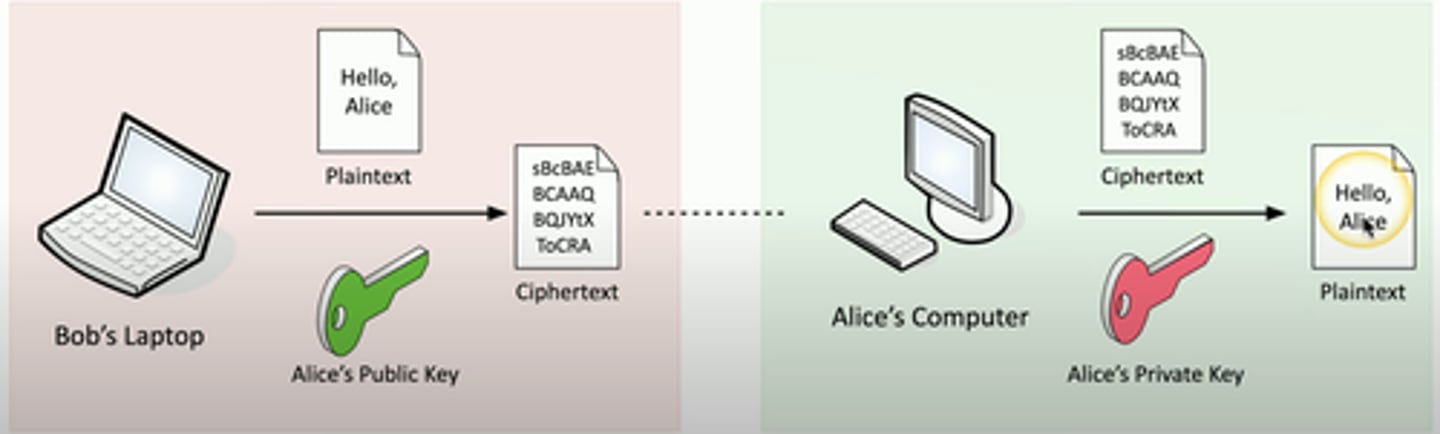
The private key is the only key that can decrypt data encrypted with the public key
- You can't derive the private key from the public key
The key pair
• Asymmetric encryption
- Public Key Cryptography
• Key generation
- Build both the public and private key at the same
time
- Lots of randomization
- Large prime numbers
- Lots and lots of math
• Everyone can have the public key
- Only Alice has the private key
Asymmetric Encryption
Key escrow
Someone else holds your decryption keys
- Your private keys are in the hands of a 3rd party
- This may be within your own organization
This can be a legitamate business organization
- A business might need access to employee info
- Government agencies need to decrypt partner data
Controversial?
- Of course
- But still may be required

