Nutrition Module 4 (4.1 & 4.2) Vitamins!
 Studied by 0 people
 Call with Kai
 Learn
Learn Practice Test
 Spaced Repetition
 Match
Match Flashcards
 Knowt Play
1/103

Earn XP
Description and Tags
Portage Learning - this set was meant to be shuffled
Name | Mastery | Learn | Test | Matching | Spaced | Call with Kai |
|---|
No analytics yet
Send a link to your students to track their progress
104 Terms
Break down the word, “vitamin,” into its two meanings
Vita = life
Amine = nitrogen containing
Are vitamins…
Inorganic or organic?
Energy-yielding?
Needed in large amounts in the body?
Organic
NOT energy-yielding
Needed in SMALL amounts
Which processes do vitamins assist with?
Digestion, absorption, metabolism, and body regulations
Can essential vitamins be synthesized in the human body?
the majority cannot, but Vitamin K, biotin, and Vitamin D can
What sources are the majority of essential vitamins found in?
plant and animal sources
Which vitamins are found in the human body? Where?
Vitamin K and biotin are both found in the gut flora in the intestine
Vitamin D is synthesized in the skin through sunlight
What is a precursor?
Substances in food or our body that have to be converted into an active form before they function as a vitamin.
Which vitamins are produced through precursors? How?
Vitamin A is produced after we consume food containing beta carotene
Vitamin B3 (Niacin) is produced when we consume foods containing Tryptophan
What are the two criteria in order for an organic compound to be considered a vitamin?
1) Enough of the compound must be consumed in diet to maintain health
2) Symptoms of deficiency occur in the absence of the compound
What are the two aspects that you should be looking for when you are purchasing a food or supplement?
Enriched and Fortified
Define Enrichment and give an example
The process of taking nutrients that were lost in the milling or processing of the food and adding them back to the final product.
Ex) All grain products are enriched due to the loss that occurs in the milling process.
Define Fortification and give an example
The process of supplementing a product with additional vitamins that would not normally be in that product.
Ex) Adding calcium and vitamin D to orange juice or vitamins to cereal.
Two classifications of Vitamins
Fat soluble (ADEK) and Water soluble (B&C)
Why are fat-soluble vitamins called this? Where are they stored in the body?
They are dependent on dietary fat for absorption.
Once absorbed, fat soluble vitamins are stored within the liver and adipose (fat) tissue.
What factors can lead to deficiency in fat-soluble vitamins?
Certain diseases, weight loss medications, and laxatives
Which two vitamins have the highest likelihood of becoming toxic?
Vitamin A and Vitamin D
What are two forms you can find Vitamin A in?
(1) preformed vitamin A (retinol or retinal), which comes from animal sources
(2) provitamin A carotenoids, which come from plants and are considered precursors — pigments found in plant sources that can be later be converted into vitamin A.
Where can you find Carotenoids? (This is where Vitamin A is from)
Yellow, orange, and red vegetables as well as antioxidants
What is an antioxidant?
Stop reactive substances (oxidants) from potentially causing damage to cells.
Which three major body parts is Vitamin A vital for improving?
Eyes, skin, and GI tract
If your patient has a Vitamin A deficiency, what can you assume about his vision?
He will be experiencing “night blindness,” a loss in adjusting his eyes from bright light to dim light.
He may also experience xeropthalmia, which is abnormal dryness.
Your patient is asking you about what she should consume to decrease the risks of macular degeneration. What vitamin would you recommend and which foods can it be found in?
Vitamin A, which can be found in fruits and veggies high in carotenoids
What does Vitamin A do for the GI tract?
Support the health of the epithelial cells, that act as barriers to bacteria and provide immunity
What are illnesses/diseases that can be avoided with proper Vitamin A intake?
Stunted growth, Infertility, cancer, and CVD
What are some sources of Preformed Vitamin A?
Liver, fish, fish oils, fortified milk, yogurt, and eggs
What are some sources of Provitamin A (carotenoids)?
Dark green leafy vegetables, such as spinach and kale, as well as yellow and orange fruits and vegetables, such as sweet potatoes, cantaloupe, and apricots)
You patient tells you she is concerned of future vision problems and has started a Vitamin A supplement. Would you recommend she continue or try a different method?
Healthy source of Vitamin A can come from food sources (i.e. fish, fortified milk, leafy greens, sweet potatoes)
What is the upper level for preformed vitamin A in adults? What could levels above this lead to?
The upper level for vitamin A is 3000 micrograms of preformed vitamin A per day for adults. Levels above this could lead to toxicity resulting in increased hip fracture, liver toxicity, and fetal malformations in pregnant women.
True or false: preformed vitamin A poses LESS effects when consumed in excess than provitamin A
FALSE, preformed has more effects than provitamin.
you will just get carotenodermia (orange/yellow skin) with too much provitamin
Vitamin D is not only a vitamin but also a _____.
hormone
What are the two forms of Vitamin D?
Ergocalciferol (D2) = a synthetic product used in supplements
Cholecalciferol (D3) = made by the human body.
Ten minutes of sun two to three times per week provides ______% of our vitamin D needs.
80-100
You practice in a northern climate where many patients have limited exposure to the sun in winter months. What sources of vitamin D would you recommend to them?
Fatty fish, fortified cereal, eggs, butter, fortified milk, and yogurt.
Explain the primary function of Vitamin D. What hormones and nutrients are important in this process?
The regulation of calcium levels and bone metabolism.
In conjunction with parathyroid hormone (PTH), vitamin D regulates absorption of calcium and phosphorus from the intestine and deposition of calcium in the bones.
What are other functions, besides bone metabolism, is Vitamin D important in?
Immune system, skin development, muscle health, and blood pressure control.
What skeletal problem will arise in a child who has inadequate Vitamin D levels? What about their posture would indicate this disease?
Rickets: poor mineralization of the bone due to inadequate calcium deposits
Characterized by bow legs.
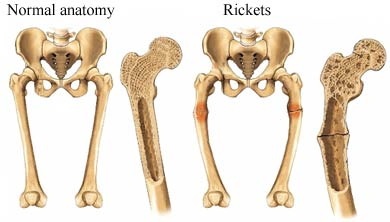
What are two skeletal problems that will arise in adults who has inadequate Vitamin D levels?
Osteomalacia: soft bones, break easily
Osteoporosis: bone mass decreases, bones are thin and become porous
What is recommended for supplementation of Vitamin D?
1000 IUs of Vitamin D daily
Your patient presents with weakness, loss of appetite, and confusion. After further testing, there is an excess loss of calcium in the urine and calcium deposits in the kidney and other organs.
Which Vitamin is the problem? Is this an excess or a deficiency?
This is an excess of Vitamin D, very toxic
What is Vitamin E’s main function?
Antioxidant
What threat does a free radical pose to the cells and which vitamins attack it?
Free radicals can alter a cell’s DNA, damage the membrane, and increase risk for cancer.
Vitamin A and especially Vitamin E fight against these.
Which vitamin is named “the love potion” and why?
Vitamin E due to its anti-aging properties
What are the two forms of Vitamin E?
in the body (alpha-tocopherol) or in plants (gamma-tocopherol).
What are major sources of Vitamin E?
oils, cereals, eggs, margarines, whole grains, and nuts
What happens when you have a Vitamin E deficiency?
Hemolysis and cellular breakdown
Who are most at risk for Vitamin E deficiency?
Pre-term infants, smokers, and those who suffer from fat malabsorption
Vitamin E levels above ___ mg/day could result in toxicity
1,000
Toxic levels of Vitamin E interfere with _____’s role in clotting and can lead to hemorrhagic responses.
Vitamin K
What is Vitamin K’s purpose in the body?
It is involved in coagulation
Name some foods that contain Vitamin K
oils, plants, fish and meats. Also in green leafy vegetables, green beans, soybean and canola oils, and liver.
Can our bodies synthesize Vitamin K?
Yes, small amounts of it in the intestinal tract
Why are infants injected with Vitamin K?
Because the intestinal tracts of infants do not have established gut flora and do not have adequate amounts of bacteria for Vitamin K synthesis
Your patient is on a blood-thinner. Which vitamin would you recommend she avoid?
Vitamin K
Why is Vitamin K toxicity rare?
It disappears from the body within 24 hours
Why are they called “water-soluble” vitamins? What are the two water-soluble vitamins?
Because they are absorbed into the bloodstream and easily dissolve in water.
Vitamins B&C
What is the likelihood of toxicity in water-soluble vitamins? What poses the risk?
Minimal likelihood, but supplements in large quantity typically pose the greatest risk.
What are some actions that destroy water-soluble vitamins?
Excessive cooking, improper handling, heat, light, and exposure to air can all destroy vitamins, and this is especially true for those that are water soluble
What are some methods to best preserve nutrients in freshly harvested vegetables?
Fruits and vegetables should be consumed soon after harvest for the greatest nutritional value.
To best preserve nutrients, store canned goods in a cool place, refrigerate foods in moisture-proof containers, and blanch vegetables prior to freezing.
Name the 8 B vitamins
Thiamin, riboflavin, niacin, pantothenic acid, biotin, vitamin B-6, folate, and vitamin B-12
What is the function of Vitamin B in metabolism?
To act as coenzymes in the metabolism of carbohydrates, protein, and fats.
Define coenzymes
Small molecules that bind to inactive enzymes and, once bound, cause the enzyme to become active
Following digestion of foods containing B vitamins, ____% is absorbed in the small intestine. This means that they have a ____ bioavailability.
50-90%
high
Define Bioavailability
The amount of a vitamin that is absorbed and available to the body
Do B vitamins pose any risk of having deficiency? Which populations have the highest risk?
Vitamin B does not pose a great risk of deficiency.
However, alcoholics tend to exhibit decreased absorption related to the abuse of alcohol, and elderly individuals who have a very poor diet
Name for Vitamin B-1
Thiamin
Name for Vitamin B-2
Riboflavin
Name for Vitamin B-3
Niacin
Name for Vitamin B-6
Pyridoxine
What is the main function of Thiamin (Vitamin B-1)?
What is another function and which organs does Vitamin B-1 help?
What are some sources of Vitamin B-1?
Thiamin is a coenzyme for the release of energy from carbohydrates.
Thiamin also works with enzymes to promote the metabolism of glucose—the major source of energy for the brain and nervous system.
Good food sources include pork, legumes, milk, orange juice, organ meats, and whole and enriched grains.
Explain beriberi. What does this mean, and which vitamin deficiency is this?
What are some symptoms?
Beriberi is a Thiamin deficiency, meaning “I can’t I can’t”. With little thiamin, glucose cannot be metabolized.
Symptoms include weakness, loss of appetite, irritability, poor arm and leg coordination, an enlarged heart, and severe edema.
What is a major function of Riboflavin (Vitamin B-2)?
What are some major sources of this vitamin?
Why do milk containers need to be opaque?
Riboflavin is a coenzyme used during energy metabolism that requires oxygen. It is necessary for certain vitamin and mineral metabolism, and it is a known antioxidant.
Sources of this vitamin include enriched grains, meat, eggs, and milk products.
Riboflavin is very sensitive to light, so milk containers are almost always opaque to prevent degradation
What is the name for riboflavin deficiency?
What are some symptoms?
Ariboflavinosis
Some symptoms include: glossitis (inflammation of the tongue), cheilosis (cracks around the mouth), sun sensitivity, and confusion
True or false: Often a riboflavin deficiency occurs in conjunction with other vitamin deficiencies.
TRUE
What is the function of Niacin (Vitamin B-3)?
How do our bodies make niacin?
What are some sources?
Niacin functions as either nicotinic acid or nicotinamide. Almost all cells use this coenzyme for the release of energy from carbohydrates, proteins, and fats.
Our bodies can also make niacin from tryptophan, an amino acid. Through this process, we synthesize approximately 50% of our body needs.
Meat, enriched breakfast cereals, poultry, fish, nuts, and peanuts are good sources.
Niacin Deficiency 4D’s Symptoms
dementia, diarrhea, dermatitis, and (eventually) death
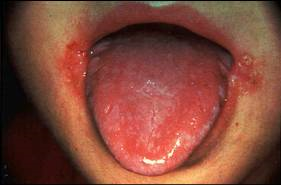
A patient present to the office with sever cracks around his mouth and inflamed tongue. What is this, and what could have caused this?
Cheilosis and Glossitis, caused by Riboflavin deficiency
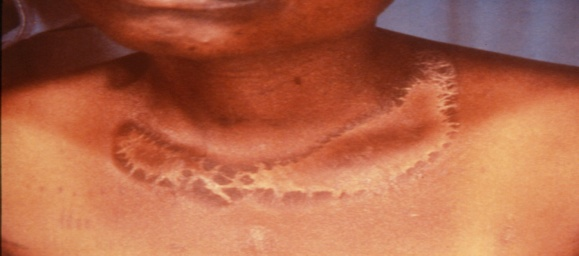
A patient presents with a patch of rough dry skin. What is this called, and what is this caused by?
Pellagra, caused by niacin deficiency
What is a hallmark of excess niacin intake?
Flushing = an increase in blood flow to the skin and headaches
What is Pantothenic Acid?
What is its function?
What are the sources of this?
A component of coenzyme A (CoA)
It is important in fatty acid production and the release of energy from the energy yielding nutrients.
Sources include chicken, pork, fish, egg yolks, yogurt, legumes, avocados, and sweet potatoes
List all of the functions that Biotins aids in.
What sources are rich in Biotin?
Biotin aids in the production of glucose and fatty acids, DNA synthesis, and amino acid metabolism.
Food sources include cauliflower, liver, peanuts, cheese, and egg yolks.
What is in egg whites that prevents the absorption of biotin? How can you get rid of this?
Avidin prevents the absorption of biotin. You can get rid of this when you cook the egg white.
What are the three chemical forms of Pyridoxine (Vit B-6)?
What sources can you find this in?
Pyridoxine, pyridoxal, and pyridoxamine
B-6 is found in both animal and plant sources but has a higher bioavailability in animal sources.
List some functions of Pyridoxine.
While B-6 is needed for carbohydrate, protein, and fat metabolism, it plays a key role in protein and amino acid (the building blocks of protein) metabolism. B-6 enables cells to make nonessential amino acids by removing the nitrogen group from certain amino acids.
Additionally, B-6 is important for the synthesis of white blood cells to support immune function, the synthesis of hemoglobin for red blood cells, and for neurotransmitter synthesis.
Why would a lack of Vit B-6 cause convulsions in a person?
As neurotransmitters allow nerve cells to communicate with each other, a lack of B-6 interferes with this communication and can lead to convulsions.
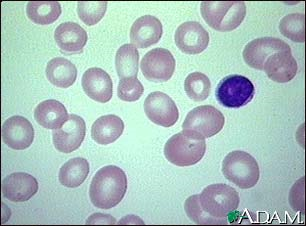
What is microcytic hypochromic anemia, and which deficiency causes this?
A deficiency of VIT B-6 can also decrease hemoglobin production, the oxygen carrying part of the red blood cell, resulting in microcytic hypochromic anemia: small, oxygen-deficient red blood cells.
Your patient comes in to see you, explaining he has been experiencing ongoing hand and foot numbness. You recall that at his physical a few months ago, he mentioned being very active at his gym and his goals for this year were to become stronger and increase his muscle mass.
You suspect he may be taking megadoses of….
Vitamin B-6
What is Folate (Folic Acid) and what does it do?
Where is Folate found?
Folate (folic acid) functions as a coenzyme in DNA synthesis and cell division as well as metabolizing amino acids and homocysteine, and red blood cell synthesis.
Folate can be found in different forms in food such as meats, fish, eggs, and milk.
Why is megaloblastic (macrocytic) anemia a result of folate deficiency?
Because Folate is needed for red blood cell synthesis, and when there is not enough folate, then the red blood cells grow larger and cell division cannot occur due to impairment of DNA synthesis.
These large cells never mature and they cannot carry oxygen correctly
Your patient is a 31 y/o female who is here to discuss family planning, as she would like to have another child. Which vitamin are you going to recommend? Explain to her why it is important to take this. Which timeframe is it most important for? What dose would you recommend
You will want to start taking folate, since a deficiency would result in neural tube defects in your child.
During the first 6 weeks of the pregnancy, the spinal cord and the nerves at the lower end of the brain are developing.
Lack of folate can lead to defects including anencephaly (lack of a brain) or spina bifida, improper development of the spinal cord where it fails to close completely and bulges through the back.
You should take 400 mcg per day.
Folic acid vs Folate
Folic acid is the synthetic form of folate and is more readily absorbed.
What happened in 1998 in regards to folic acid?
In 1998, fortification of grain products was made mandatory to reduce the risk of spinal defects. It is added to ready-to-eat breakfast cereals and grains, and naturally occurs as folate in green leafy vegetables, orange juice, and legumes.
Your patient is a recently recovering alcoholic. She presents with mental confusion, diarrhea, and altered nerve function. Which vitamin will you recommend? What is the upper limit for this vitamin? What will going over the limit cause?
Folate, upper limit is 1000 mcg daily
Going over this limit will mask a
What are two major functions of Vitamin B-12?
What are some good sources of this?
Its major function is to convert the folate coenzyme to the active form needed for DNA synthesis.
It is also important in homocysteine metabolism and in maintaining the myelin sheaths that insulate neurons.
Good food sources of vitamin B-12 are animal products such as meat, organ meats, eggs, and milk. It is also in fortified breakfast cereals.
What makes Vit B-12 deficiency different from the other vitamins?
It’s not typically from intake, but from absorption
Explain Vit B-12 absorption.
The digestion of B-12 begins in the stomach with its acidic environment. For absorption in the small intestine, B-12 binds to the glycoprotein intrinsic factor. Intrinsic factor is a protein-like compound produced in the stomach to increase B-12 absorption.
Why are elderly people at risk for Vit B-12 deficiency?
Over time, the body is less efficient at absorbing Vit B-12
(related to decreased production of stomach acid and reduced production of intrinsic factor, thus decreasing the absorption.)
What are the two types of anemia from Vit B-12 deficiency?
(1) megaloblastic (macrocytic) anemia. As mentioned above, without adequate B-12, the conversion of folate coenzymes to the active form to support proper DNA synthesis does not occur.
(2) Pernicious anemia: Pernicious means "leading to death" and is associated with nerve degeneration that can lead to paralysis and death.
Name all populations that are a risk of Vitamin B-12 deficiency
Elderly, vegans, infants of breastfeeding vegan women
What are the four main functions of Vitamin C?
Collagen synthesis, antioxidant properties, iron absorption, and immune function.
Where is Vitamin C (ascorbic acid) absorbed?
It is absorbed in the small intestine and found in all living tissue.
 Note
Note  Flashcards (34)