ion channels
 Studied by 0 people
 Call Kai
 Learn
Learn Practice Test
 Spaced Repetition
 Match
Match Flashcards
 Knowt Play
1/36

There's no tags or description
Looks like no tags are added yet.
Name | Mastery | Learn | Test | Matching | Spaced | Call with Kai |
|---|
No analytics yet
Send a link to your students to track their progress
37 Terms
what is the difference in intracellular and extracellular concentrations of postassium, sodium and calcium?
potassium intracellular = 140mM and extracellular 4-5mM because posassium diffuses out of the cell down its concentration gradient to maintain rest
sodium intracellular = 10-15mM and extracellular 145mM as sodium enters the cell when channel opens
cakcium intracellular = 100nM and extracellular 2mM
mechanism of the Na/K ATPase pump
N/K pump uses ATP directly to keep high potassium inside and high sodium outside to maintain rest
for each ATP hydrolysde 3 sodium ions move out of cell and 2 potassium ion in
this contributes to the slightly negative restinf membrane potential
how is resting membrane potential generated?
postassium leak channels (inward rectifier channels) are always open and this allows potassium to move down its concentration gradient
this means the inside of the cell becomes negatively charged
when elecrtical force balances concentration force, postassium is at equilibrium (nernst)
what is the nernst equation?
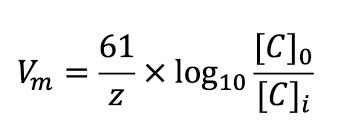
nernst equation tells you the equilibrium potential for a particular ion
R = gas constant = 8.314
T = absoulute temperature = 37
z = valence of ion (e.g = +1 for sodium, +2 for calcium)
F = faraday constant = 96485 c/mol
what is the goldman equation?
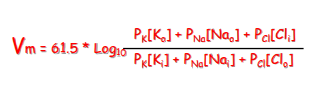
extension of the nernst equation that calculates the RMP when the membrane is permeable to more than one ion
P = membrane permebaility for the ion
for anions the concentration ratio is in/out flipped because of the negative charge
what is an IV plot?
shows the relationship between current (I)through an ion channel and the membrane voltage (V) = helps to describe how ion channels behave under different voltages
inward current = flow of positive charge into the cell, ona coltage clamp = downward deflection
outward current = flow of positive charge out of the cell = upward deflection
for negtaive ions the sign of current is reversed (current is the movement of positive charge)

how to interpret an IV plot
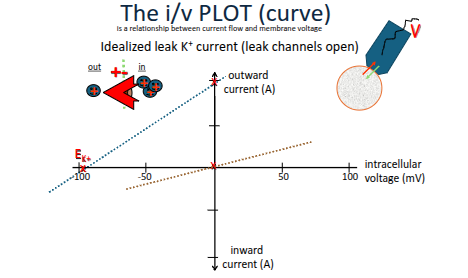
the IV relationship for a leak potassium channel is linear, forming a straight line
current increases proportionally with voltage
there is no gating- the channel is always open
the line crosses the x-axis at equilibrium potential (EK) as this is when net potasssium current is 0
if the membrane is more positive that EK the there is outward current (graph climbs upwards)
how can the slope of an IV polt be used to calculate channel conductance?
conductance (siemens) = change in I/change in V
but this is only true when the IV relation is linear such as open leak channels, ohmic channels and many passive conductances
voltage gated channes haev curved IV relationships
steep slope = big change in current for a small change in voltage = high conductance
how do we record membrane currents?
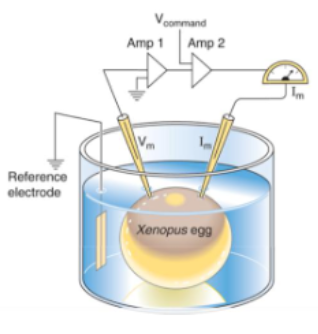
two electrode voltage clamp
uses two microelecrodes (voltage to measure membrane potential and current to hold membranr at commanded voltage)
used xenopus oocytes as they are very large and have few endogenous ion channelss, can be injected with mRNA or DNA that encodes specific ion channels
how do we study individual neurons?
extracellular recording aka cell-attached mode
place electrode just outside the neurons membrane, recording activit that leaks out when the neuron fires
you can thus measure the frequency and pattern of action potentials
this is non-invasive and does not change the intracellular environment HE you cant measure membrane optential and synaptic currents
cell attached mode = place pipette on membrane and form giga seal
what is whole cell mode patch anaylsis?
after forming pipette seals membrane you rupture the membrane patch
pipette interior becomes continuous with the cytoplasm
you can now measure full action potentials, synaptic currents etc
you can control membrane voltage and measure the current that flows in response to the voltage steps
cell held at a specific voltage and small voltage step is applied, this small change produces a small current step due to membranr resistance
we calculate resistance using ohms law (R=V/I)
what is the difference between picoamp and macro currents?
picoamp are extremely small and typical size of single ion channel openings = found when doing single channel and cell attached patch clamp
macrocurrents are much larger (nano and micro) recorded from entire cell = found when doing whole cell voltage clamp
general structure of ion channels
ion channels ar eproteins embedded in the cell memrane
inside the channel is a water-filled tunnel (aqueous pore) that allows ions to pass through
it if filled with water because the lipid membrane is hydrophobic
ions have a hydration shell (each ion surrounded by 4-8 water molecules) e.g sodium strongly binds to water so has a large hydration shell
this shell must be stripped or partially removed for ions to pass through the narrow channel pore
how is ion flow facilitated by the pore susbstituting for water?
ions cant cross the membrane with their hydration shell because water is charged and will get repelled by the lipid bilayer
ion channels therefore have a pore lined with polar groups e.g carbonyl oxygens that can replace the water molecules
this is esepcially true in potassium channels where the selectivity filter uses carbonyl oxygens to mimic water molecules
this lets the ion move through the hydrophobic membrane, ensures that only the correct ion passes (selectivity) and speeds up ion flow dramatically
why are ion channels selective?
for stabilisation to work, the ion must be exactly the right size
e.g the spacing of the carbonyl oxygen is arranged to fit potassium perfectly when dehydrated, sodium is smaller than this
when sodium enters a potassium channel, it is too small to reach the carbonyl oxygens and therefore cannot make strong stabilising intercactions so the pre cannot replace its lost water shall and sodium would be energetically unstable
what is a leak channel?
channels that are open all the time
they allow ions to move continuously across the membrane according to concentration/electrical gradients
this helps paintain resting potential
activity can change on relatively slow time scale via association with porteins or phosphorylation
provide baseline level of excitability
what is a gated channel?
open in response to a specific stimulus
voltage gated, ligand gated and mechanically gated
rapid, controlled ion flow to generate action potentials, synaptic transmission and sensory transduction
when closed they do not pass ions at all
what are the two main classes of potassium channels that generate and regulate resting membrane potential?
K2P (two-pore domain) leak channels
inward-rectifier potassium channels
what is the structure of inward-rectifier potassium channels (kir)?
made up of four subunits (tetramers) like most potassium channels
each subunit has 2 transmembrane domains and a pore forming loop between them (p-loop)
p-loop contains TVGYG sequence which gives potassium selectivity
kir channels have large intracellular (cytoplasmic) domains that modulate channel activity by interacting with magnesium, polyamines and PIP2
do not have a voltage sensing S4 helix so are not vooltage gated
what is the structure of K2P leak channels?
each subunit contains 4 transmembrane segments and 2 pore-forming domains
two identical K2P subunits assemble a dimer so can form 4 pore loops
what are the possible ways to get 4 P-domains?
4 separate proteins, each with 1 P-domain assemble to form a tetramer
2 proteins each with 2 P-domains
thus to build a potassium channel pore, you always need 4 P-domains
how does inward rectification work?
when the membrane is negative, kir channels allow potassium to flow into the cell
when the membrane becomes positive, the channel blocks potassium from flowing out
this helps stabilise resting membrane potential as potassium comes in when needed but cant leak out during depolarisation
how does K2P work?
current flows both ways fairly
no strong pore blocked by magnsium or polyamines
TWIK behaves more like a simple leak channel
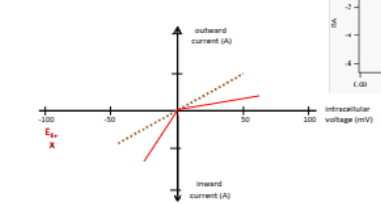
what is the I/V plot curce for an inward rectifier?
at negative voltages the channel passes large inward current
at positive voltages, outward current is very small
anesthetics and TWIK channels
TWIK channels are a subtype of K2P channels
they are normally open at rest to help set the resting membrane potential
when they open more, the membrane becomes even leakier to potassium
volatile anesthetics like insoflurane and halothen can increase the activity of TWIK
this causes hyperpolarisation therefore neurons become less excitable and there is global depression of neural activity
this leads to loss of consciousness, reduced pain perception and muscle relaxation during anesthesia
what are two key factors that affect RMP?
many leak channels like K2P are modulated by second messengers e.g cAMP or by direct action of GPCRs e,g Gβγ subunits can open certain channels, GPCR activation can open or close some K2P channels
presence of persistent sodium currents (INaP) which does not fully inactive and provides continuous small sodium leak
what did hodgkin and huxley (1952) do?
recorded currents from the squid giant axon using a voltage clamp, measuring how ionic currents depent on voltage, measured how these currents change over time and then use this to build a numerical model
how are sodium channels controlled?
at 70mV (rest) sodium channels are closed, inactivation gate ioen but activation gate shut
when the voltage rises to -45mV the activation gate opens and sodium rushes into the cell causinf the rising phase of the action potential
at positive voltages even if the membrane stays depolarised the inactivation gate closes and this stops sodium flow because channels are now inactive
during repolarisation the inactivation gate reopens
how does positive feedback make action potentials rise very fast?
action potentials are incredibly fast, membrane goes from -70mV to +30mV in less than a millisecond and this comes from a positive feedback loop
stimulus makes membrane less negative and this small depolarisation is the trigger
this opens sodium channels
this causes further depolarisation as the inside becomes more positive
this means each step amplifies the next (self reinforcing process)
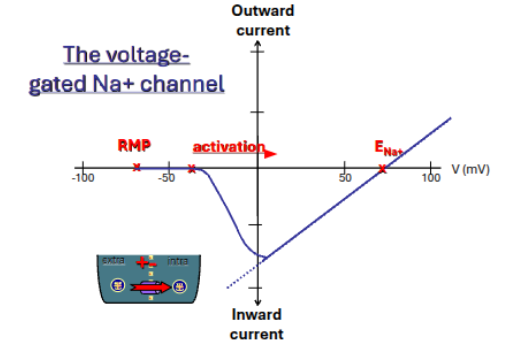
what is the I/V plot for a voltage gated sodium channel?
peak inward current (~ –20 to –10 mV):
many channels open
Na⁺ current becomes strongly inward
the curve reaches its large negative peak
above ENa (~ +60 mV):
driving force reverses sign
Na⁺ current becomes outward
what is the structure of a voltage gated sodium channel?
one large alpha subunit (the main pore forming part)
4 auxillary beta subunits that do not form the pore but modulate kinetics, gating and localisation
alpha subunit has 4 homologous domains and each domain contains 6 transmembrane helices (S1-6)
S4 = voltage sensor as it contains positively charged residues (arginines)
between S5-S6 the pore and selecitivity forms
inactivation gate in intracellular loop betwee domain III-IV
what is the ball and chain model?
explanation for fast inactivation of coltage gated ion channels
a part of the channel prtein that acts like a ball = small peptide segment that is attached to the channel by a flexible chain (stretch of amino acids)
when the channel opens, the ball swings in and plugs the inner mouth of the pore, blocking in the ion flow
what is the absolute refractory period?
voltage gated sodium channels open during an AP then quickly inactivate (ball and chain style)
when they are inactivated they cannot reopen no matter how strong the stimulus is, creating the absolute refractory period (a neuron cannot fire another action potential immediately after one has just happened)
this sets a maximum firing frequency
how does the absolute refractory period stabilise the network?
if neurons could reopen sodium channels instantly they might fire repetitively without control, form unwanted loops of excitation and generate pathological oscillations (e.g seizures)
the combo of sodium inactivation and delayed potassium opening (repolarisation) stops the membrane from re-depolarising immeditely again
what does refractoriness prevent?
prevent retrograde propagation of action potential
refracttory regions behind AP cannot fire again as the sodium channels behind the spike are inactivated meaning the spike cannot travel backwards = one-way conduction
what are shaker potassium channels?
voltage gated potasium channels
part of the Kv1 family
responsible for repolarising the membrane after an action potential
4 identical subunits, each with 6 transmembrane segments
act as delayed rectifiers = open with a delay after membrane depolarisation and this helps repolarise the cell during the action potential = limit excitability
without delayed rectifiers action potentials would be much longer
what are nicotinic acetylcholine receptors?
non selective cation channels
when acetylcholine binds, the channel opens and allows sodium to enter and potassium to leave
the mixed ion flow drives the membrane toward 40mV and each ion has its own equilibrium potential: sodium wants to bring the membrane to about 60mV and potassium bring it down to about -90mV
this -40mV is called the reversal potential
this opens voltage gated sodium channels
this is how neuromuscular junctions work
 Note
Note  Flashcards (52)