Plant Physiology 2
 Note
Note Call Kai
 Learn
Learn Practice Test
 Spaced Repetition
 Match
Match Flashcards
 Knowt Play
1/45

There's no tags or description
Looks like no tags are added yet.
46 Terms
2 H2O + 4 photons + 2 PQ + H+ (from stroma) → O2 + 4 H+ (from water, into lumen) + 2PQH2
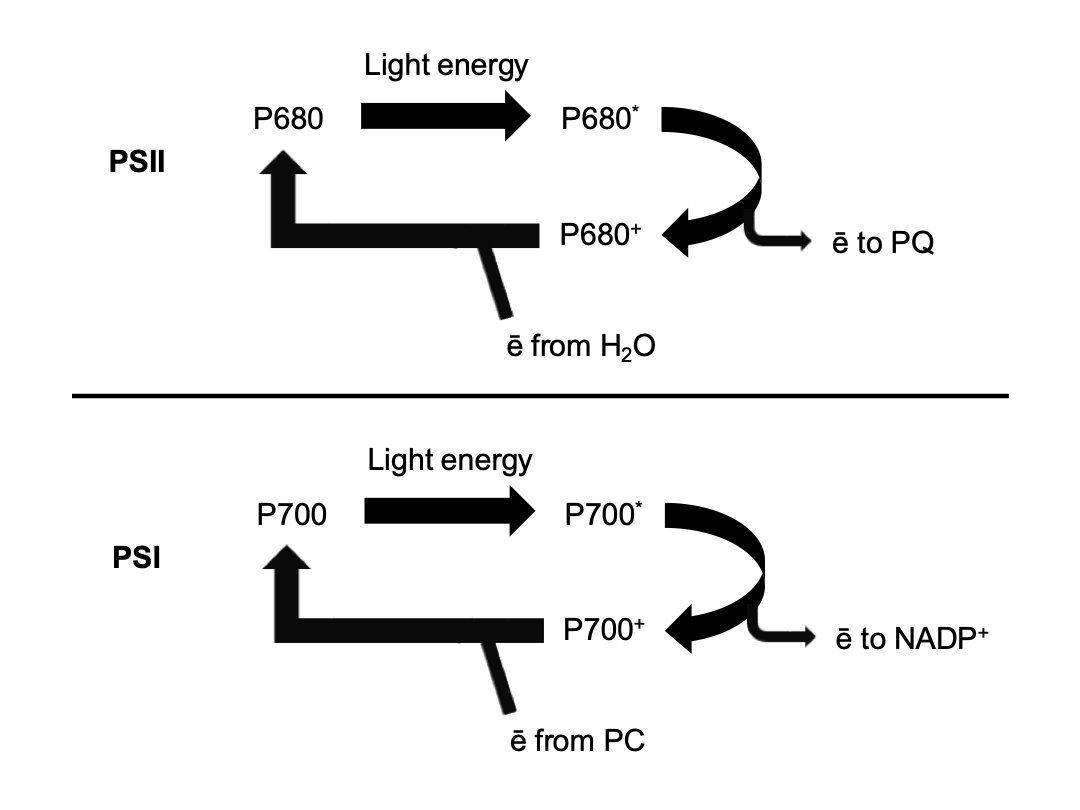
A major protein complex that absorbs light energy to initiate the electron transport chain. For one oxygen, you need four electrons, as in 2 waters. Generates 4 protons. Need 2 PQ. Mostly in stack regions (grana lamellae)
A protein complex that facilitates electron transfer between PSII and PSI.
2 PQH2 + 4 PC(Cu2+) → 2 PQ + 4 PC(Cu+) + 8 H+ (deposited in lumen). Plastocyanin (PC) is a 1 electron carrier. Stacked and unstacked regions.
A protein complex that further processes electrons and contributes to NADPH production.
4 photons + 4 PC(Cu+) + 4 Fd(Fe3+) → 4 PC (CU2+) + 4 Fd(Fe2+). PC passing on ferredoxin through many components and it eventually passes it, making it negatively charged. Unstacked (stroma lamellae)
Ferredoxin-NADP reductase (FNR)
Ferredoxin is the ultimate donor, NADPH needs 2 electrons. Produce 2, need 4 ferredoxin. Need enzymes to catalyze.
4Fd(Fe2+) + 2 NADP+ + 2 H+ → 4 Fd(Fe3+) + 2 NADPH
FNR process
1) Water splits - H+ into lumen electron donor
2) PQ is reduced into PQH2 on stroma (2 H+ required). PQ is oxidized to PQ on lumen (2 H+ deposited).
3) NADP+ + H+ → NADPH on stroma
Enzyme that synthesizes ATP using the proton gradient generated by the electron transport chain. Mostly in unstacked regions (stroma lamellae).
CF0 - Hydrophobic stalk, created H+ channels in the membrane
CF1 - Catalytic part that generates ATP.
1 ATP / 4 H+ translocated.
A small protein that carries electrons from cyt b6f to PSI. Helps out the lumen side of the membrane
A model describing the energetic changes of electrons as they move through the photosynthetic electron transport chain.
Photophosphorylation
The chemiosmotic hypothesis. An electrochemical gradient across a membrane generates a proton motive force, a source of free energy. This energy can be used to drive synthesis of ATP from ADP + Pi
Jagendorf (1960s)
Lumen side has a high H+ (low pH). In experiment, we are trying to simulate this. By changing pH - you generate the movement. Then they wanted to see if the protein gradient was enough to drive. They added a drop of ADP and phosphate into the buffer and measured how much ATP was produced. ATP was produced - proving the proton gradient is what drives it.
The series of biochemical reactions in plants that convert carbon dioxide into glucose, using ATP and NADPH from light reactions. 18 ATP and 12 NADPH used to produce glucose.
Ribulose-1,5-bisphosphate carboxylase/oxygenase, the enzyme that catalyzes the first step of the Calvin cycle. (5C).
The initial step in the Calvin cycle where CO2 is fixed to form 3-PGA, adding carbon to sugar, leading to 3-carbon phosphatase.
3 RuBP (5 carbon components each RuBP) + 3 CO2 → 6 3-PGA (1st stable carbon compound). This is driven by rubisco. We will see 18 carbon on each side. 18 C → 3 × 6 PGA.
Reduction
Reducing Phosphoglyceraldehyde.
Need 6 NADPH and 6 ATP. 6 PGA → 6TP (use NADPH and ATP to drive reaction). 1 triose phosphate is escorted out to cytosol, and eventually used for starch sucrose synthesis - main source of sugar in a cell
Regeneration
Get ADP back.
We use 5TP and regenerate it back into 3RuBP (15 C total for both) using 3 ATP. We need 9 ATP, 3 for regeneration and 6 in reduction. A single triose phosphate is 9.
Biochemical control of the Calvin Cycle
Light-dependent ion movement (stromal pH from 7→8, enzymes more active, NADPH passes electrons to ferredoxin and thioredoxin)
Redox regulation (FT system)
Triose phosphate made into starch (stroma) or sucrose (cytosol)
Starch synthesis
Synthesis of the sugar nucleotide ADP-glucose by ADP-glucose pyrophsphorylase
Elongation of the glucan chain by starch synthase
Branching enzymes are used to introduce 1-6 linkages
A range of other enzymes are used to process and pack the amylose and amylopectin into starch granule
Kinase
Adds Pi to substrate - granule is basically adding the phosphate group. It will open the entire granule. Other enzyme cannot work on it. Adding phosphate group into the starch granule (add 2 1-4 linkage). Starch made into maltose and glucose. Phosphatase catalyzes the reverse reaction (removing).
Water dikinases
Phosphorylate some of the glucosyl units within the starch granule.
Debranching enzyme
Release linear glucan chains
B-amylase
Hydrolyzes the glucans, releasing maltose (a disaccharide made up of two glucose units)
Maltose
(along with some glucose) is moved to cytosol by specific transporter. Is converted to glucose, which is then phosphorylated by hexokinase producing Glu 6-P.
The directional movement of photosynthates from areas of production (sources) to areas of consumption or storage (sinks). Xylem movement. Determined by Proximity, Development, and Vascular Connections.
Allocation
Indicate different fates of photosynthetic products. Sucrose is going to be separated into different plant cells. Whatever is allocated it can further be partitioned. Relative REM for partitioning mechanism (sink).
2 cell types in phloem
Sieve tube elements and associated companion cells
P-protein
phloem protein, used as main defense mechanism to fight against phloem leakage. if stem is broken or phloem gets damaged, they aggregate and plug really big pores at sieve plate. Blocks bottom and top of sieve tube elements. found in most angiosperms. Protects phloem against damage, such as herbivore feeding. Freely floating in the cytoplasm under normal conditions. It quickly aggregates to form a plug at the sieve plate, preventing excess loss of sap and blocking pathogen entry. Plugged with the polysaccharide callose.
Ordinary companion cell (OC)
Has plasmodesmatal connection with sieve tube elements but not with other surrounding cells (ie. bundle sheath cells). Apoplastic loading.
Transfer cells (TC)
Like OC, but with cell wall in-growths on the walls that face away the sieve tube element, increasing the area of PM on these surfaces. Apoplastic loading.
Intermediary cells (IC)
Plasmodesmatal connections with sieve tube element and with surrounding cells. Symplastic loading.
Phloem transports
Sucrose, non-reducing sugars and sugar alcohols, amino acids, some inorganic ions, most plant hormones, and specific proteins and RNAs.
Apoplastic loading
H+ sucrose symporter and proton ATPase. Make sure sucrose is continuously building up in companion cell.
Involved sugar into the apoplast and then back in the symplast of either an ordinary companion cell or transfer cell. Once in the companion cell or transfer cell it can enter the sieve tube element through plasmodesmata.
Symplastic loading
intermediary companion cells provide symplastic continuity between the surrounding cells and the phloem. These species don’t have an apoplast to symplast active transport step. Specific sugars are loaded and concentrated in phloem (not primarily sucrose). Make sugars bigger to avoid backflow.
Shade leaves
more total chlorophyll/reaction center, higher ratio of Chl b / Chl a, increased ratio of PS2 / PS1 (3:1) or more antennae chlorophyll for PS2, lower respiration rates.
Sun leaves
more Rubisco, larger pool of xanthophyll cycle components (later), lower ratio of PS2 / PS1 (2:1).
Controlling photodamage
Dissipate the excess light energy as heat
Scavenge the ROS that are produced (e.g. ROS-detoxifying enzymes such as superoxide dismutase and catalase)
Repair the photo-damage (e.g. active D1 replacement)
Zeaxanthin
Has a poorer ability to transfer absorbed light energy to chlorophyll. Instead, the absorbed energy is lost as heat.Violaxanthin would create ROS species with excess light, so mid-day has more of this (less stress on plant)