Human Anatomy and Physiology: Chapter 1 - The Human Body: An Orientation
 View linked note
 Call Kai
 Learn
Learn Practice Test
 Spaced Repetition
 Match
Match Flashcards
 Knowt Play
1/24

There's no tags or description
Looks like no tags are added yet.
Name | Mastery | Learn | Test | Matching | Spaced | Call with Kai | Chat |
|---|
No analytics yet
Send a link to your students to track their progress
25 Terms
Anatomy
The study of the structure of body parts and their relationship to one another
Physiology
Study of the function of body parts, and how they work to carry out life-sustaining activities
What are the subdivisions of anatomy?
Gross, macroscopic, regional, surface, and system anatomy
Gross/macroscopic anatomy
the study of large or visible structures
Regional anatomy
looks at all structures an a particular area of the body
System anatomy
looks at just one system
What are 3 examples of system anatomy?
cardiovascular, nervous, muscular
Surface anatomy
looks at internal structures as they relate to overlying skin
What are 2 surface anatomy examples?
visible muscle masses or veins seen on surface
Microscopic anatomy
deals with structures too small to be seen by the naked eye
Cytology
the microscopic study of cells
Histology
the microscopic study of tissues
Developmental anatomy
studies anatomical and physiological development throughout life
Embryology
the study of developments before birth
How to study anatomy?
To study anatomy, one must know anatomical terminology and be able to observe, manipulate, palpate, and awuscultate
Where are subdivisions of physiology based?
organ systems like renal or cardiovascular physiology
Where does physiology often focus?
Often focuses on cellular and molecular levels of the body
What does physiology look at?
Looks at how the body’s abilities are dependent on chemical reactions in individual cells
How to study physiology?
To study physiology, one must understand basic physical principles as well as basic chemical principles
What are examples of basic physical principles (in relation to physiology)
electrical currents, pressure, and movement
What word describes anatomy and physiology together?
inseperable
What is the principle of complementarity of structure and function?
It says that function always reflects structure, what a structure can do depends on its specific form.
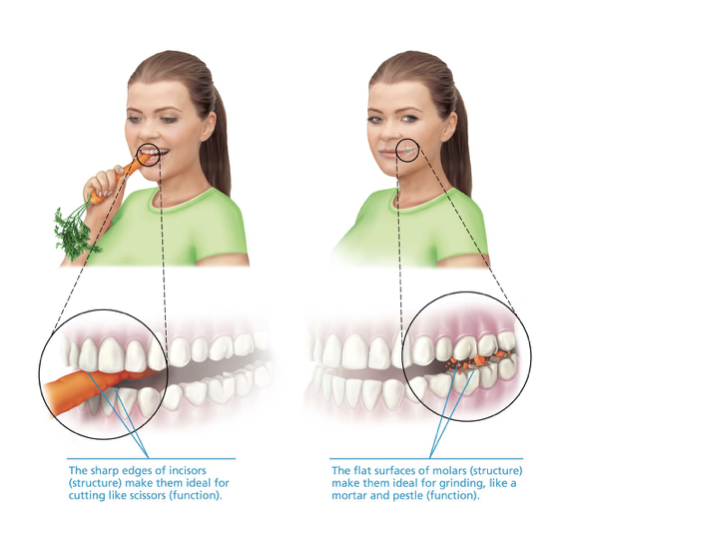
Explain this image and how it relates the principle of complementarity of structure and function
The sharp edges of incisors (structure) makes them ideal for cutting like scissors (function). While the flat surface of molars (structure) make them ideal for grinding, like a mortar and pestle (function)
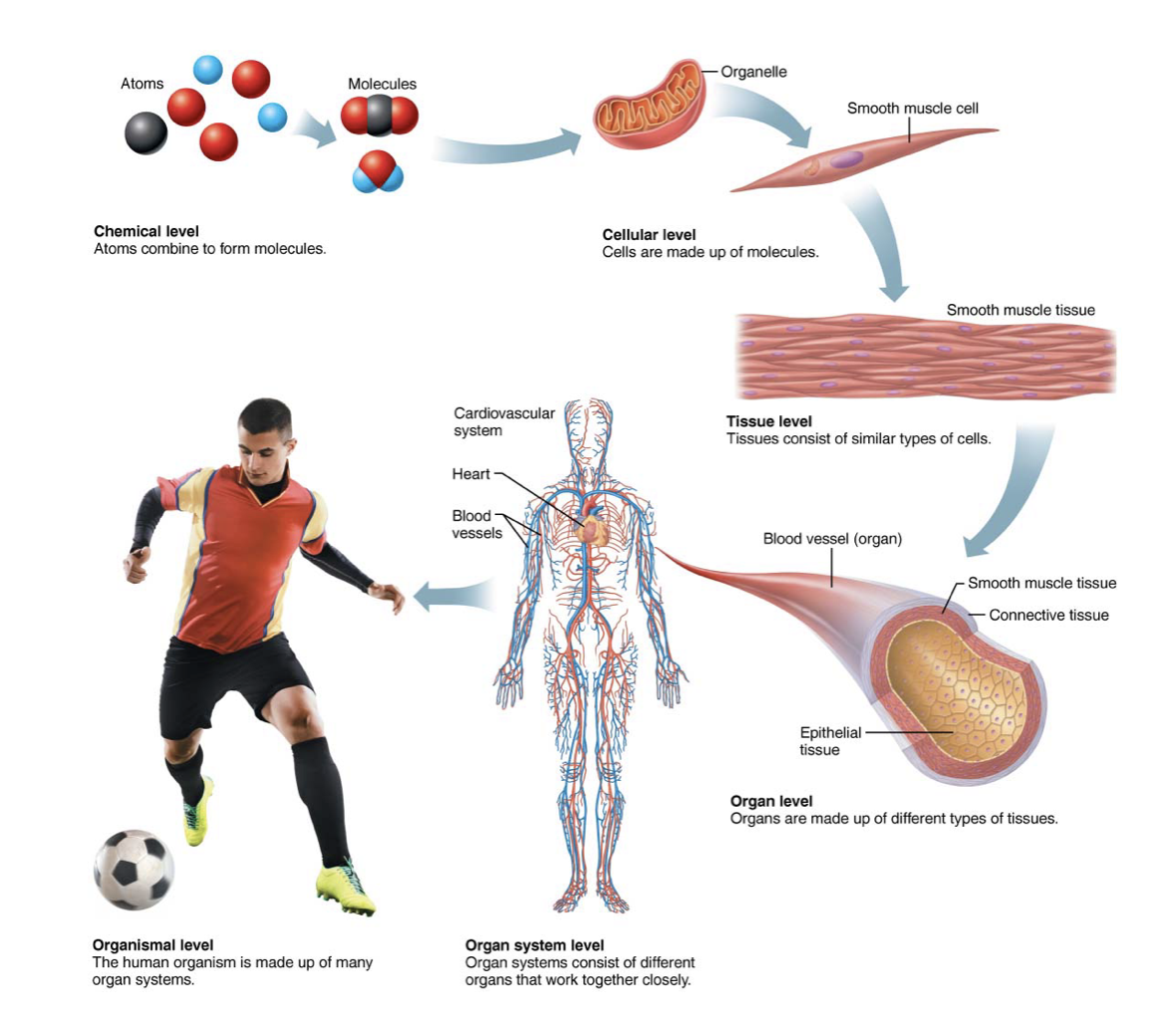
Describe this image
This diagram is showing the levels of organization in the human body—basically, how tiny pieces build up into the entire human organism. The big idea is each level builds on the level before it. Small structures combine to create increasingly complex structures until you get the whole human body.