The Nucleus - C&M Biology
 Studied by 0 people
 Call Kai
 Learn
Learn Practice Test
 Spaced Repetition
 Match
Match Flashcards
 Knowt Play
1/39

There's no tags or description
Looks like no tags are added yet.
Name | Mastery | Learn | Test | Matching | Spaced | Call with Kai |
|---|
No analytics yet
Send a link to your students to track their progress
40 Terms
Define a prokaryotic cell. Include structure and size.
No nucleus
No membrane-bound organelles
DNA located in cytoplasm (nucleoid region)
Small (~1 µm diameter)
Structurally simple
Usually unicellular
Define a eukaryotic cell. Include structure and size.
DNA enclosed within nucleus
Contains membrane-bound organelles (ER, Golgi, mitochondria)
Larger (10–100 µm diameter)
Can be unicellular or multicellular
Highly compartmentalised
Why is compartmentalisation important in eukaryotic cells?
Separates transcription (DNA → RNA) from translation (RNA → protein)
Allows tighter regulation of gene expression
Protects DNA
Allows cells to become larger (10–100 µm)
Increases cellular complexity
What problem does compartmentalisation create?
Because the DNA is enclosed in a nucleus, large molecules must move across the nuclear envelope:
mRNA must be exported
Ribosomal subunits must be exported
Transcription factors must be imported
Replication enzymes must be imported
This requires a regulated transport system.
What makes up the nuclear envelope?
Outer nuclear membrane
Inner nuclear membrane
Perinuclear space
Nuclear pore complexes (NPCs)
Nuclear lamina
It forms a double membrane around the nucleus.
What is the outer nuclear membrane continuous with? Why is this important?
The outer nuclear membrane is continuous with the endoplasmic reticulum (ER).
This means:
The space between the two nuclear membranes connects to the ER lumen.
It supports the idea that the nucleus evolved from membrane invagination.
What is special about the inner nuclear membrane?
The inner nuclear membrane contains nucleus-specific proteins.
These proteins organise the nuclear lamina and interact with chromatin.
What is the nuclear lamina?
The nuclear lamina is a fibrous network made of lamins (intermediate filament proteins) located just under the inner nuclear membrane.
What are the functions of the nuclear lamina?
Maintains nuclear shape
Provides mechanical support
Prevents nuclear envelope fragmentation
Helps organise chromatin
If disrupted, the nucleus becomes unstable.
What is the nuclear pore complex (NPC)?
The NPC is a large multi-protein channel embedded in the nuclear envelope.
It is the only route for macromolecules to move between nucleus and cytoplasm.
What is the structure of the NPC?
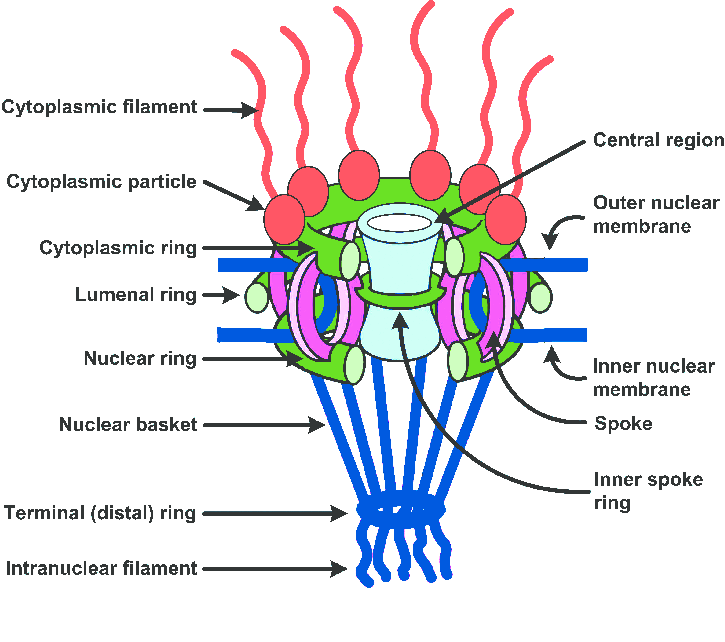
Made of ~30 proteins called nucleoporins
Has 8-fold symmetry
Contains a central channel
Has cytoplasmic fibrils
Has a nuclear basket
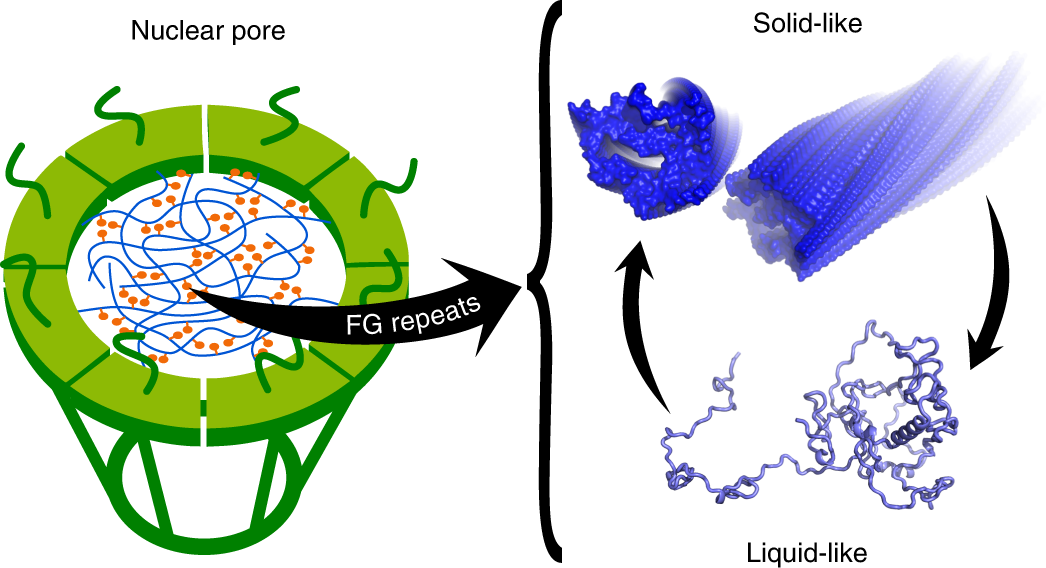
The centre contains disordered FG-repeat proteins that form a selective barrier
What are cytoplasmic fibrils?
Cytoplasmic fibrils are filament-like protein extensions that project from the cytoplasmic side of the nuclear pore complex and help capture importin–cargo complexes before they enter the pore.
What are FG repeat proteins?
FG-repeat proteins are nucleoporins in the nuclear pore complex that contain repeated phenylalanine–glycine (FG) sequences and form a selective barrier that allows transport receptors (importins/exportins) to move cargo through while blocking passive diffusion of large molecules.
What can pass through the NPC without help?
Small molecules (< ~5 kDa) can diffuse passively.
Larger proteins require active transport.
How does the NPC selectively allow transport?
The FG-repeat nucleoporins create a mesh inside the pore.
Transport receptors (importins/exportins) interact with this mesh to move cargo through.
What are importins?
Importins are transport receptors that:
Recognise the NLS
Bind cargo proteins
Carry them through the nuclear pore complex
What is a Nuclear Localization Signal (NLS)?
A short amino acid sequence that directs a protein to the nucleus.
What does an NLS typically contain?
Clusters of positively charged amino acids, especially lysine and arginine.
Explain the steps of nuclear import clearly.
A protein contains an NLS.
An importin binds to the NLS.
The importin–cargo complex passes through the NPC.
Inside the nucleus, Ran-GTP binds importin.
The cargo protein is released into the nucleus.
Importin bound to Ran-GTP returns to the cytoplasm.
Ran-GTP is hydrolysed to Ran-GDP.
What is Ran?
Ran is a small GTPase that controls directionality of nuclear transport.
What is GTPase?
A GTPase is an enzyme that binds GTP and then breaks it down (hydrolyses it) into GDP, acting like a molecular switch that turns cellular processes on and off.
Where is Ran-GTP mainly found? Why?
In the nucleus.
Because Ran-GEF is located in the nucleus and converts Ran-GDP → Ran-GTP.
Where is Ran-GDP mainly found? Why?
In the cytoplasm.
Because Ran-GAP hydrolyses Ran-GTP → Ran-GDP in the cytoplasm.
What is Ran-GAP?
Ran-GAP is a protein in the cytoplasm that converts Ran-GTP into Ran-GDP, helping maintain the direction of transport across the nuclear envelope.
What is Ran-GEF?
Ran-GEF is a protein in the nucleus that turns Ran-GDP into Ran-GTP, helping control the direction of transport into and out of the nucleus.
Why is the Ran gradient essential?
The Ran-GTP (nuclear) and Ran-GDP (cytoplasmic) distribution ensures:
Cargo release occurs only in the nucleus
Import and export are directional
Transport is not random
Without this gradient, transport would fail.
What is a Nuclear Export Signal (NES)?
A sequence that marks proteins for export from the nucleus.
What are exportins?
Exportins are transport receptors that bind cargo proteins with an NES in the presence of Ran-GTP.
Explain the steps of nuclear export clearly.
In the nucleus, cargo binds to exportin + Ran-GTP.
The complex moves through the NPC.
In the cytoplasm, Ran-GAP hydrolyses GTP.
The complex falls apart.
Exportin returns to the nucleus for reuse.
What is the nucleolus?
A dense region inside the nucleus where ribosome biogenesis occurs.
What are the four rRNAs in higher eukaryotes?
18S
5.8S
28S
5S
Which rRNAs are transcribed together?
18S, 5.8S, and 28S are transcribed as one 45S pre-rRNA.
5S is transcribed separately.
How are rRNA genes arranged in the genome?
In large tandem arrays separated by non-transcribed spacers.
What happens to 45S pre-rRNA?
It is processed (cleaved) to form:
18S
5.8S
28S
This processing occurs in the nucleolus.
What is the composition of ribosomes?
Ribosomes are:
2/3 rRNA
1/3 protein
Made of a small subunit and a large subunit
Where are ribosomal proteins made?
Ribosomal protein genes are transcribed in the nucleus, but proteins are translated in the cytoplasm.
How do ribosomal proteins reach the nucleolus?
They contain an NLS and are imported via importins through nuclear pore complexes.
Outline the full ribosome assembly pathway.
rRNA genes are transcribed in the nucleolus.
45S pre-rRNA is processed.
Ribosomal proteins are translated in the cytoplasm.
Ribosomal proteins are imported into the nucleus.
Proteins assemble onto pre-rRNA in the nucleolus.
Pre-ribosomal particles form.
Subunits are exported via nuclear pore complexes.
Mature ribosomes function in the cytoplasm.
Explain how nuclear structure and transport are linked to protein synthesis.
The nuclear envelope separates transcription from translation.
The nuclear pore complexes regulate transport.
The Ran-GTP gradient provides directionality.
Ribosomal proteins are imported.
Pre-ribosomal subunits are exported.
This allows ribosomes to assemble properly and carry out translation in the cytoplasm.
Pre Ribosomal subunits vs Ribosomal subunits
Pre-ribosomal subunits are unfinished ribosome parts made in the nucleus, while ribosomal subunits are the finished parts that join together in the cytoplasm to make proteins.

