Aerobic Respiration I
 Studied by 0 people
 Call with Kai
 Learn
Learn Practice Test
 Spaced Repetition
 Match
Match Flashcards
 Knowt Play
1/40

There's no tags or description
Looks like no tags are added yet.
Name | Mastery | Learn | Test | Matching | Spaced | Call with Kai |
|---|
No analytics yet
Send a link to your students to track their progress
41 Terms
At the end of glycolysis, we’re left with…
one molecule of pyruvate.
two molecules of pyruvate.
one molecule of succinate.
two molecules of succinate.
B
The movement of pyruvate into the mitochondrial matrix is an example of cotransport facilitated by active transport. This means that it needs…
Select all that apply
vesicles.
transport/carrier proteins.
a concentration gradient.
energy.
glucose.
B
D
Active transport requires transport/carrier proteins and a source of energy.
After glycolysis, pyruvate is…
passively transported into the mitochondrial matrix.
passively transported into the mitochondrial intermembrane space.
actively transported into the mitochondrial matrix.
actively transported into the mitochondrial intermembrane space.
C
After glycolysis, pyruvate is actively transported into the mitochondrial matrix for aerobic respiration.
There, the second stage of aerobic respiration takes place, called…
the link reaction.
the Krebs cycle.
glycolysis.
oxidative phosphorylation.
A
In the first step of the link reaction, Pyruvate is converted to…
acetyl CoA.
oxaloacetate.
triose phosphate.
acetate.
This molecule is then converted to…
acetyl CoA.
oxaloacetate.
triose phosphate.
acetate.
D
A
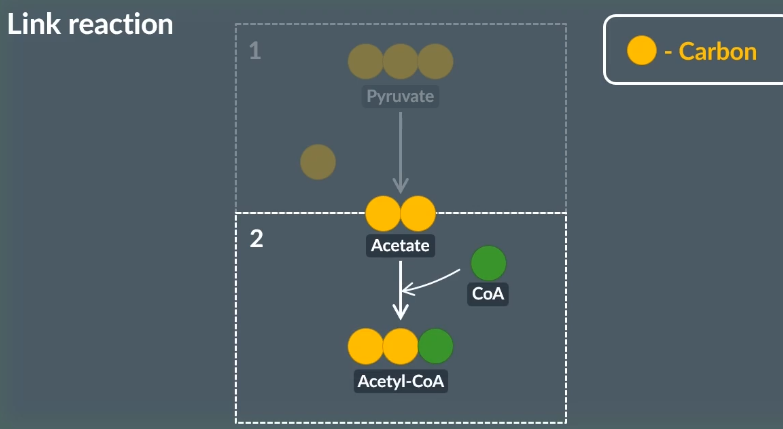
As well as losing carbon dioxide, pyruvate also loses hydrogen. So pyruvate is…
reduced.
oxidised.
dehydrogenated.
hydrated.
B
Hydrogen is transferred to a molecule of NAD, forming…
When pyruvate is converted into acetate, pyruvate loses a carbon atom in the form of…
NADH
CO2
As well as losing carbon dioxide, pyruvate also loses…
nitrogen
hydrogen
oxygen
sulfur
This is transferred to a molecule of…
ATP
FAD
NAD
NADP
B
C
Which of the following molecules is a coenzyme?
NAD
Pyruvate
Acetate
Citrate
A
The link reaction takes place in the matrix of the ………. In the first step of the link reaction, pyruvate is converted to a molecule called……..as a carbon is lost in the form of…… ……….A hydrogen atom is also lost from pyruvate, which is transferred to a molecule of…….to produce……….. In the second step of the link reaction, a molecule called……..is added, which forms a new molecule called……..
mitochondria
acetate
carbon dioxide
NAD
NADH
coenzyme-A
acetyl coa
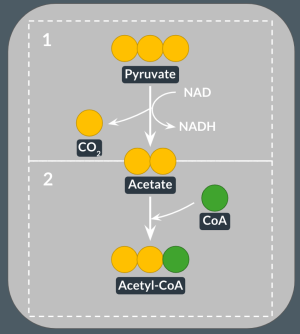
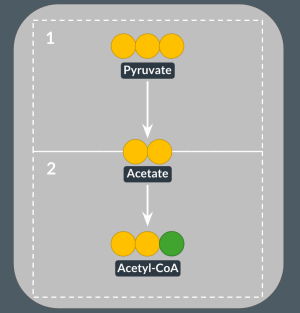
In which step(s) is a coenzyme involved?
both: In the first step, NAD that is reduced to NADH is a coenzyme. In the second step, coenzyme A is added to produce acetyl CoA.

Describe fully the link reaction, including details about all the products that are formed.
The link reaction takes place in the matrix of the mitochondria.
In the first step of the link reaction, pyruvate is converted to a molecule called acetate as a carbon is lost in the form of carbon dioxide.
A hydrogen atom is also lost from pyruvate, which is transferred to a molecule of NAD, a coenzyme, to produce reduced NAD, called NADH.
In the second step of the link reaction, a molecule called coenzyme A is added, which converts acetate into a new molecule called acetyl-CoA.

Two carbon atoms are lost during the Krebs cycle. These are lost in the form of…
CO2
CO
CH4
C2H6
A
The third stage of aerobic respiration is…
the link reaction.
the Krebs cycle.
oxidative phosphorylation.
glycolysis.
B
In the Krebs cycle, acetyl-CoA reacts with a molecule containing how many carbon atoms?
1
2
3
4
D
In the Krebs cycle, the 6 carbon molecule undergoes a series of reactions to reform the 4 carbon molecule. During these reactions, two carbon atoms are lost in the form of………
At this phase, what other molecule is produced?
ADP
ATP
NAD
FAD
NADP
carbon dioxide
B
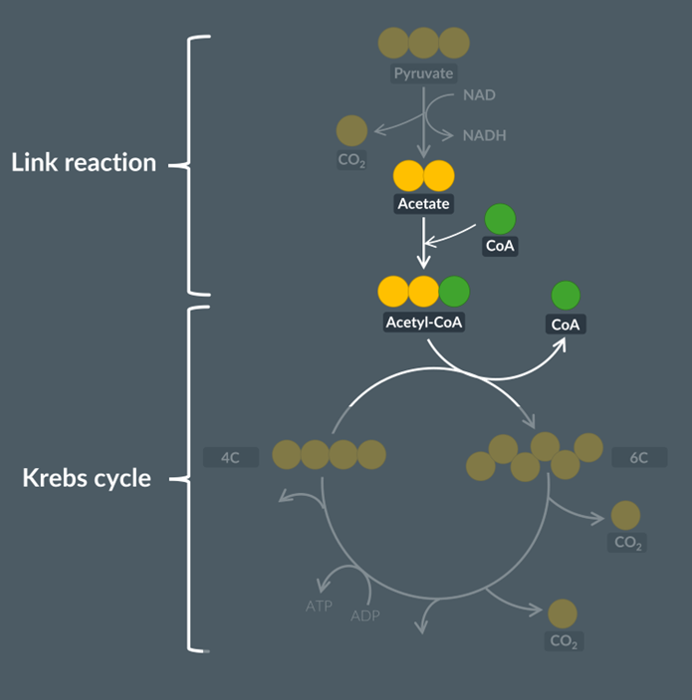
what’s the point of adding coenzyme A?
Well, the reaction of the 4 carbon molecule with acetyl-CoA is catalysed by an enzyme.
In order to function properly, this enzyme needs a coenzyme, which in this case is coenzyme A.
So, even though it’s only involved in respiration for a short period of time, CoA ensures that the Krebs cycle can take place
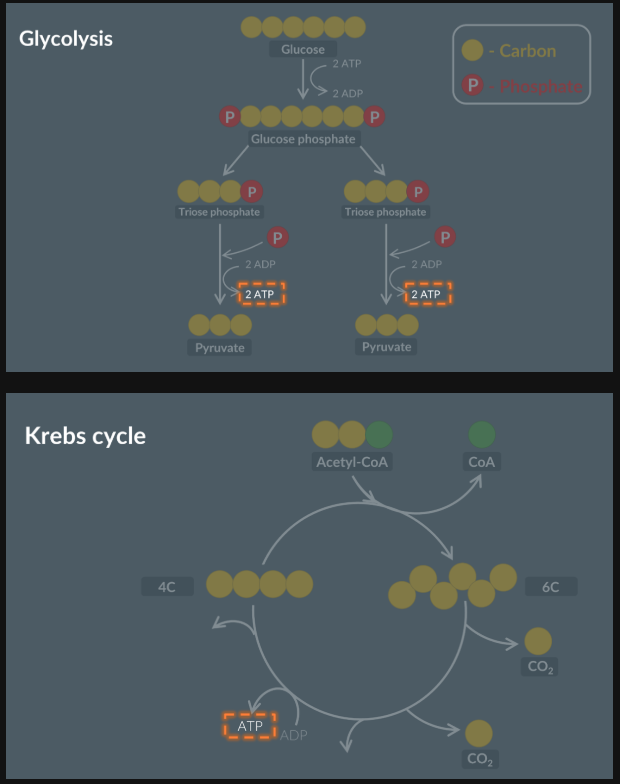
Substrate Level Phosphorelation as ATP is produced in both the Krebs cycle and glycolysis
These ATP molecules are produced in the same way in both of these stages.
The reaction to produce ATP in this way requires:
A molecule containing a phosphate group. This molecule donates a phosphate group to ADP
An enzyme to catalyse the reaction
First, the molecule that donates the phosphate group is called a ‘substrate’. This is the general name for any substance that binds to an enzyme during a reaction.
Second, the process of adding a phosphate group to a molecule is called phosphorylation.
For the exam, you won’t be expected to remember which molecule donates the phosphate group or which enzymes are involved in substrate-level phosphorylation.
You just need to know that ATP is made by substrate-level phosphorylation during both glycolysis and the Krebs cycle.
An intermediate molecule in the Krebs cycle is isocitrate. This 6 carbon molecule is converted to α-ketoglutarate, a 5 carbon molecule, by the enzyme isocitrate dehydrogenase.
Isocitrate dehydrogenase is activated by the binding of a molecule of ADP.
Using your knowledge of enzymes, explain how isocitrate dehydrogenase is activated.
Isocitrate dehydrogenase can be inhibited by the addition of a molecule named Compound 9, which is similar in structure to isocitrate.
Using your knowledge of enzymes, suggest how Compound 9 inhibits isocitrate dehydrogenase.
Binding of ADP causes a change in the active site of the isocitrate dehydrogenase enzyme. This causes the active site to change shape and become complementary to isocitrate, so it is able to bind. The enzyme is now activated.
Compound 9 acts as a competitive inhibitor and attaches to the active site of isocitrate dehydrogenase. This reduces or prevents the formation of enzyme-substrate complexes between the enzyme and isocitrate. Therefore, isocitrate dehydrogenase is inhibited.
FAD receives hydrogen during an oxidation-reduction reaction. This means FAD is…….. to form ……..
reduced
FADH2
As well as carbon dioxide and ATP, the Krebs cycle also produces…
Select all that apply
NADH
NADH2
NAD
FAD
FADH
FADH2
A
D

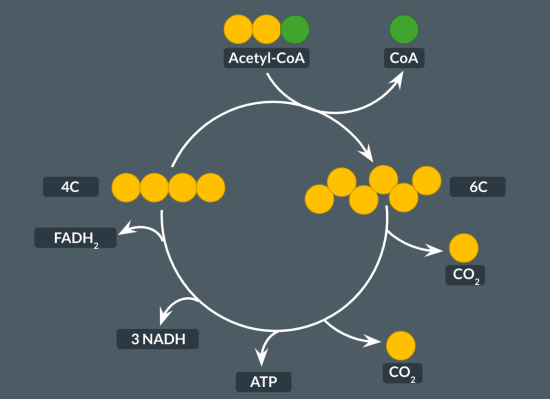
The image above shows the Krebs cycle.
Name the molecule shown by box A
How many carbon atoms does the molecule shown by box B have?
How many carbon atoms does the molecule shown by box C have?
Name all the products of the Krebs cycle.
Co-A
4
6
ATP, CO2, NADH, FADH2
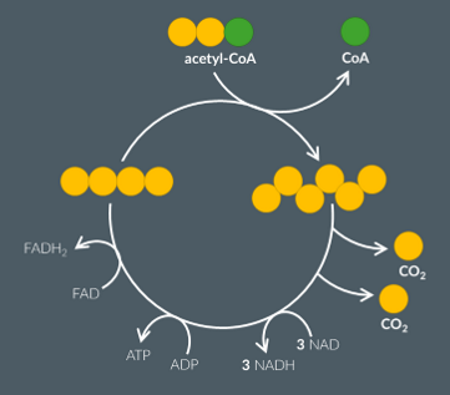
In the Krebs cycle, acetyl CoA…
reacts with a 4 carbon molecule to produce a 6 carbon molecule.
reacts with a 6 carbon molecule then loses 2 carbon atoms to produce a 4 carbon molecule.
reacts with a 5 carbon molecule to produce a 6 carbon molecule.
A
Describe fully the Krebs cycle, including details about all the molecules that are produced.
Acetyl CoA produced in the link reaction enters the Krebs cycle, where it reacts with a molecule containing 4 carbons to produce a new molecule containing 6 carbons.
Coenzyme A is removed in this reaction.
Then, in a series of oxidation and reduction reactions, the 6-carbon molecule is converted back into the 4-carbon molecule.
Carbon dioxide is produced as two carbon atoms are lost.
In addition, for every acetyl CoA molecule that enters the Krebs cycle, one ATP molecule is produced as an ADP molecule reacts with a phosphate group.
Also, intermediate molecules in the Krebs cycle lose hydrogen atoms, which reduces NAD and FAD to produce NADH and FADH2 respectively.
To be used in respiration, triglycerides need to be broken down into a molecule of glycerol and…
2 phospholipids.
3 phospholipids.
2 fatty acids.
3 fatty acids.
D
Triose phosphate takes part in…
glycolysis.
oxidative phosphorylation.
the Krebs cycle.
the link reaction.
A
Acetyl-CoA takes part in…
glycolysis.
oxidative phosphorylation.
the Krebs cycle.
the link reaction.
C
To be used in respiration, triglycerides need to be broken down into a molecule of glycerol and…
2 phospholipids.
3 phospholipids.
2 fatty acids.
3 fatty acid
D
Triose phosphate takes part in…
glycolysis.
oxidative phosphorylation.
the Krebs cycle.
the link reaction.
A
Acetyl-CoA takes part in…
glycolysis.
oxidative phosphorylation.
the Krebs cycle.
the link reaction.
C
To be used in respiration, triglycerides are broken down into…
glycerol and 3 fatty acids.
Which stage of aerobic respiration is pyruvate used in?
Glycolysis
Oxidative phosphorylation
The Krebs cycle
The link reaction
D
In aerobic respiration, the majority of amino acids containing three carbons are converted to…
In aerobic respiration, the majority of amino acids containing four or five carbon atoms are converted into molecules which are used in…
pyruvate
the krebs cycle
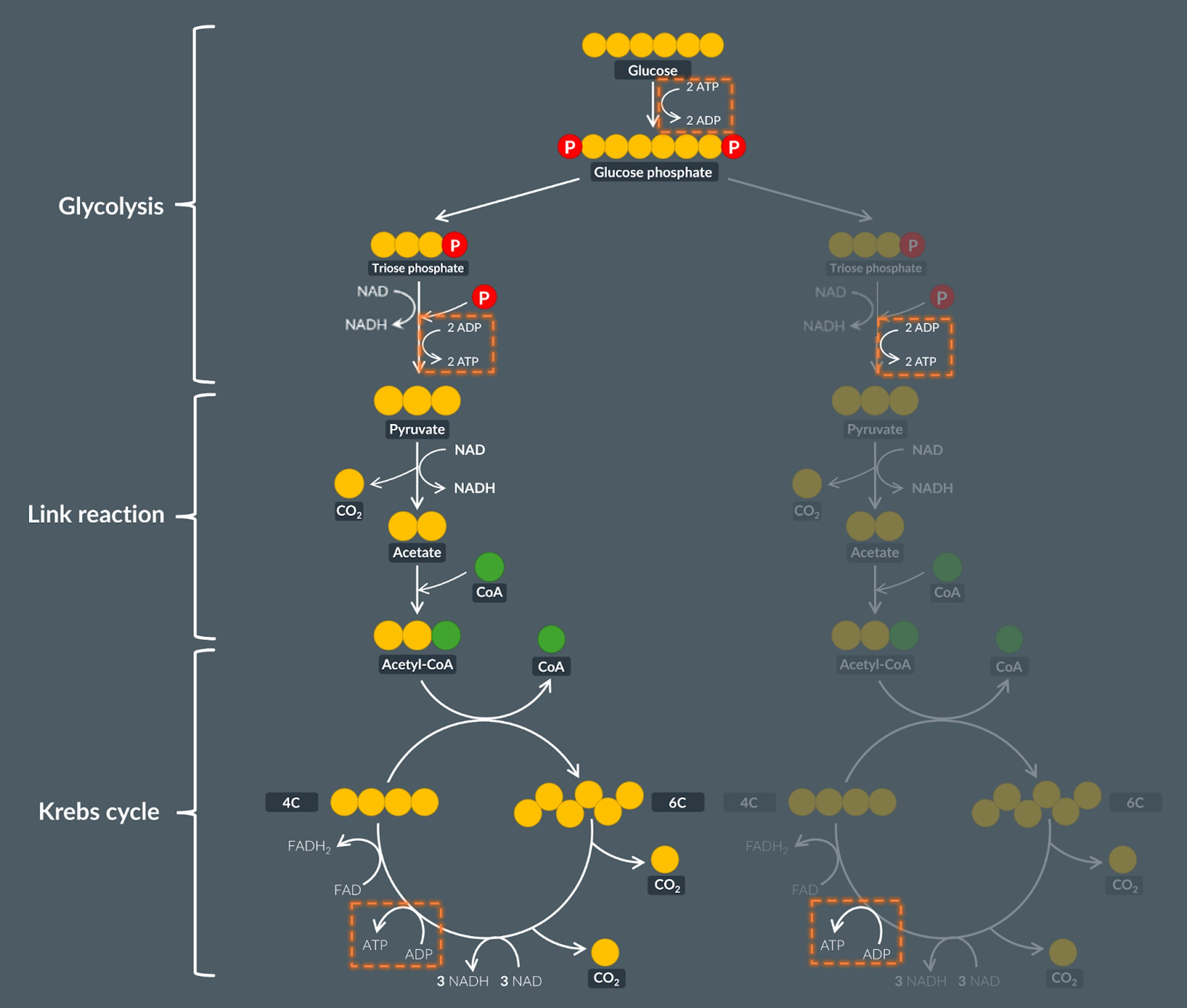
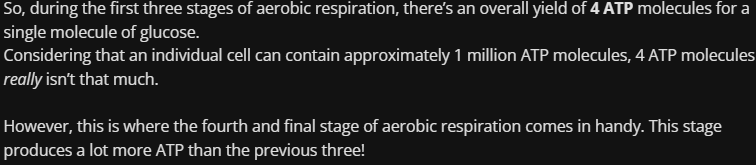
Using this diagram, we can see how much ATP is made during the first three stages of aerobic respiration from a single molecule of glucose.
Glycolysis: 2 ATP molecules break down in the first step but 4 ATP molecules are produced in total in the third step. Therefore, there’s an overall yield of 2 ATP molecules.
Krebs cycle: During each cycle, 1 ATP molecule is produced. As two cycles take place for a single molecule of glucose, there’s an overall yield of 2 ATP molecules.
In which stage(s) of aerobic respiration is CO2 produced?
Which stage(s) of aerobic respiration take place in the mitochondria?
Link reaction
Krebs cycle

In which stage(s) of aerobic respiration is NADH produced?
link reaction
Krebs cycle
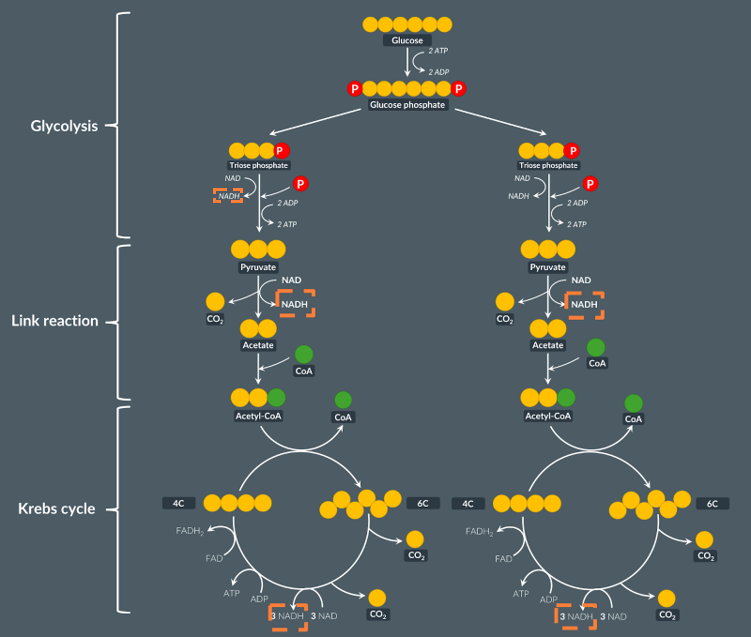
Name all the products of the link reaction.
CO2
NADH
Acetyle-CoA
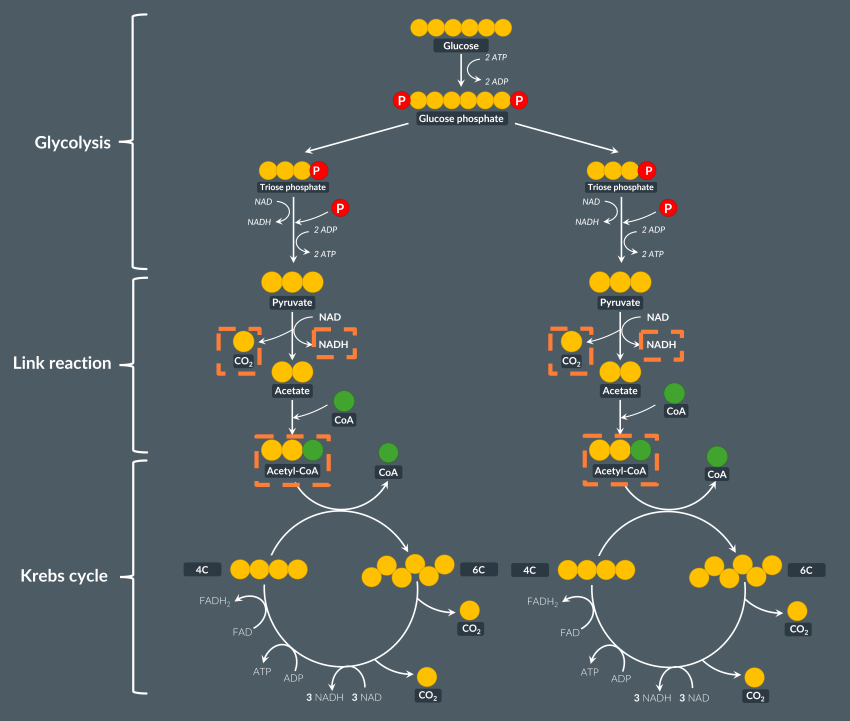
In which stage(s) does substrate-level phosphorylation take place?
Krebs cycle

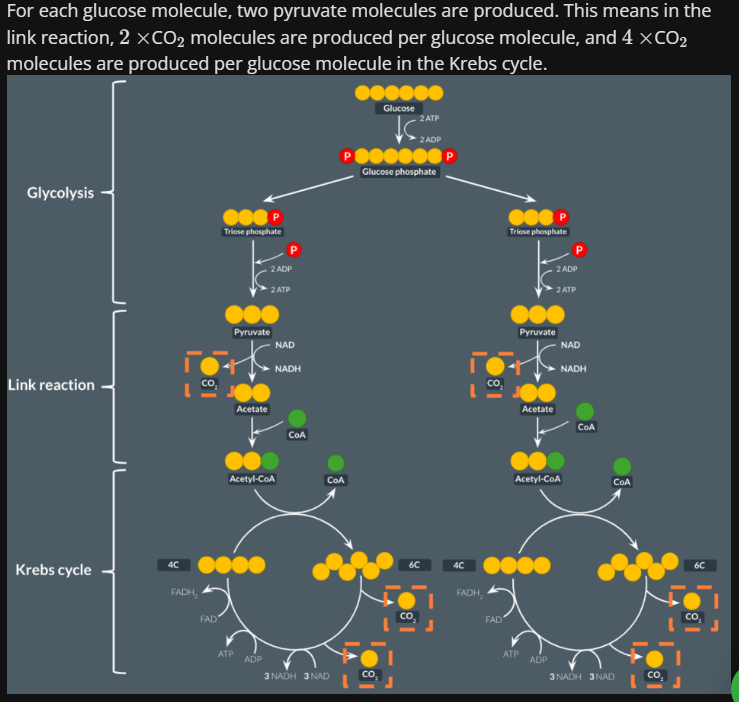
Which stage of aerobic respiration produces the most CO2 molecules per glucose molecule
krebs
In endurance sports, such as long distance running, stores of glucose in the body are often depleted after around two hours.
Using your knowledge of aerobic respiration, suggest how athletes are able to run for longer than two hours
After glucose stores have been used up in aerobic respiration, triglycerides and amino acids can be used in respiration.
Triglycerides are broken down into glycerol and three fatty acids.
Glycerol is converted into triose phosphate which can take part in glycolysis.
The fatty acids are converted into acetyl CoA molecules that can take part in the Krebs cycle.
The majority of amino acids with three carbons are converted into pyruvate which is used in the link reaction, whereas 4− and 5− carbon amino acids are converted into intermediates in the Krebs cycle.
By using amino acids and triglycerides, ATP continues to be produced in the absence of glucose stores.
This means ATP is available for use as an energy source for the contraction of muscles that allows the athlete to keep running.
’Hitting the wall’ is a phenomenon characterised by sudden fatigue and loss of energy after around two hours of running. Suggest an explanation for ‘hitting the wall’.
Triglycerides and amino acids must first be converted into a suitable form in order to be used in aerobic respiration.
These reactions take time.
‘The wall’ is hit when there is a temporary depletion of ATP, before triglycerides and amino acids are used in respiration.
 Note
Note  Flashcards (22)