W3 2(c) Biological molecules
 Call Kai
 Learn
Learn Practice Test
 Spaced Repetition
 Match
Match Flashcards
 Knowt Play
1/12

There's no tags or description
Looks like no tags are added yet.
Name | Mastery | Learn | Test | Matching | Spaced | Call with Kai |
|---|
No analytics yet
Send a link to your students to track their progress
13 Terms
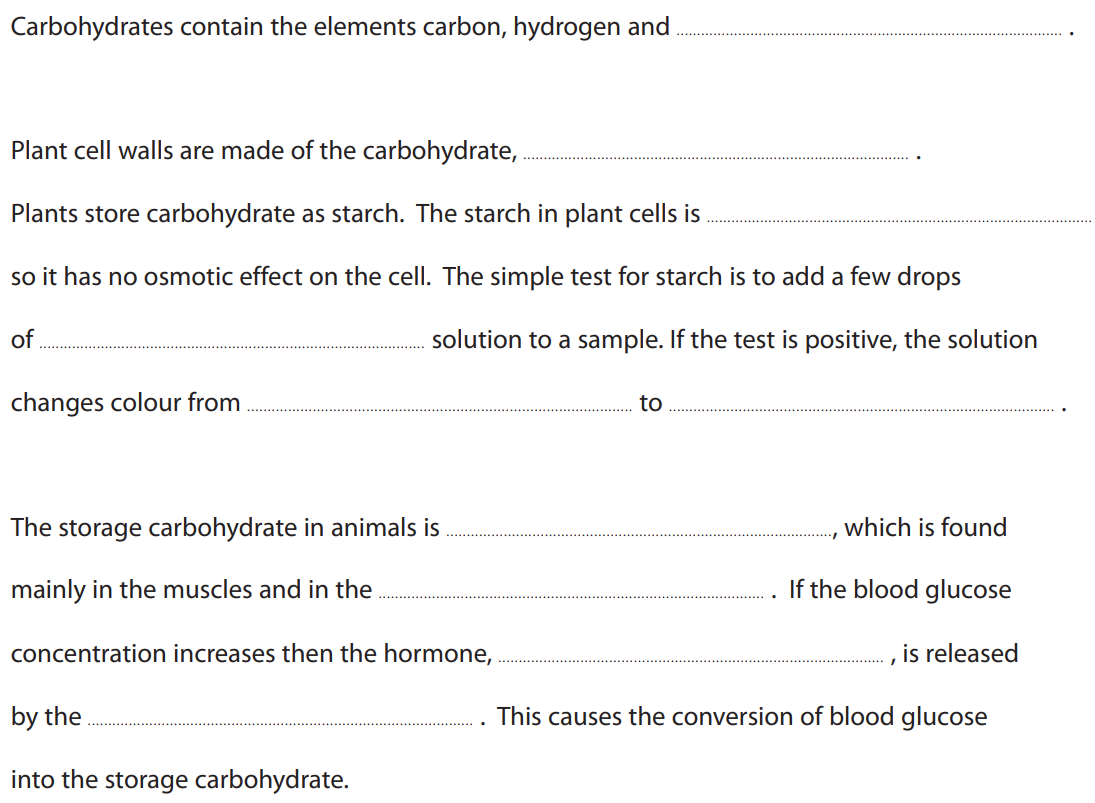
Fill in the blanks. (10 marks)
M1: oxygen / O2
M2: cellulose;
M3: insoluble / does not dissolve;
M4: iodine / I2 / KI/ iodide
M5: brown / reddish brown / yellow / orange;
M6: blue / black / blue black; (Ignore red / brick red)
M7: glycogen;
M8: liver;
M9: insulin;
M10: pancreas;
Describe the test for glucose. (3 marks)
M1: Benedict’s;
M2: heat / water bath;
M3: green / yellow / orange / red / brick red;
Describe the test for protein. (2 marks)
M1: Biuret / add NaOH and CuSO4 / albustix / eq;
M2: lilac / purple / pink; (Accept: uristicks / colour change to blue or green for 1 mark)
Describe the test for starch. (2 marks)
M1: iodine (1);
M2: blue black / blue / black / eq (1); (Allow: purple)
Describe the test for a lipid. (2 marks)
M1: mix the food in ethanol and pour into water (1); (Accept: add water and ethanol and mix)
M2: white emulsion forms (1); (Accept: white precipitate / goes cloudy / emulsion test)
Describe the role of enzymes in cells. (2 marks)
M1: catalyse / speed up / increase rate / lower activation energy / eq;
M2: (chemical) reactions / (metabolic) reactions;
Describe the location and function of amylase, protease, restriction, and ligase enzymes. (4 marks)
amylase
protease
restriction
ligase
M1 (Amylase): salivary gland / digest or breakdown starch; (Turns starch into maltose)
M2 (Protease): stomach / pancreas / allow small intestine / digest or breakdown proteins / peptides;
M3 (Restriction): bacteria / cutting DNA at certain points;
M4 (Ligase): cell nucleus / joining DNA / genes / eq;
Describe the effect of EXCESS temperature on enzyme activity. (3 marks)
M1: increased temperature causes vibrations / breaks bonds (1);
M2: causes change in shape of active site (1);
M3: enzyme denatures (1);
M4: substrate can no longer fit in / bind with enzyme (1); (Reject: reference to enzyme being killed)
Describe how changes in temperature LOW and HIGH affect enzyme activity. (3 marks)
M1: less (kinetic) energy at low temperatures;
M2: fewer collisions / less movement at low temperatures / eq;
M3: enzyme denatures; (Reject if linked to low temperature)
M4: changes active site / eq;
M5: substrate can no longer bind / eq;
Describe the effect of temperature on metabolic activity / growth of an organism. (4 marks)
M1: higher temperatures produce more growth / faster growth / eq (1);
M2: enzymes (1);
M3: more kinetic energy (1);
M4: more frequent collisions / enzyme substrate complexes form faster / eq (1);
M5: faster respiration (1);
Describe the consequence of pH 8.5 on urease. (3 marks)
M1: (rate of reaction) lower / eq (1);
M2: denatured / change in shape of active site / eq (1);
M3: urea does not bind (into active site) / fewer E/S complexes / eq (1);
Describe how a student could investigate the effect of pH on the rate of an enzyme-controlled reaction. (5 marks)
M1: use a named enzyme and substrate (e.g., amylase and starch / catalase and hydrogen peroxide);
M2: use a range of at least 3 different pH solutions (e.g., using buffer solutions);
M3: control the temperature using a water bath;
M4: measure the time taken for the substrate to disappear / product to form;
M5: Repeat the experiment at each pH to calculate an average / increase reliability (OR: calculate the rate using 1/time.
Describe the structure of a DNA molecule. (3 marks)
M1: (it consists of) two strands;
M2: (coiled together to form a) double helix;
M3: (the strands are) held together by paired bases / A-T and C-G;

