WEEKLY QUIZZES + VIDEO QUIZZES (Week 4)
 Studied by 0 people
 Call Kai
 Learn
Learn Practice Test
 Spaced Repetition
 Match
Match Flashcards
 Knowt Play
1/18

There's no tags or description
Looks like no tags are added yet.
Name | Mastery | Learn | Test | Matching | Spaced | Call with Kai |
|---|
No analytics yet
Send a link to your students to track their progress
19 Terms
The gene for nose shape is found on the X chromosome. Round nose is dominant to pointed nose.
Human individuals with XXY (an additional X chromosome) are male. Individuals with XO (only one X chromosome) are female. Individuals with XXX (three X chromosomes) are female.
A man with a round nose and a woman with a round nose have a son with Klinefelter Syndrome (genotype XXY) with a pointed nose.
Nondisjunction event (VERY RARE mistakes during meiosis) could happen in:
Meiosis II of the mother
Cystic fibrosis is a rare disorder. Mike and Phoebe are worried about the chance that their child will be affected by this condition. Both Mike’s sister and Phoebe’s paternal grandmother (her father’s mother) are affected by cystic fibrosis.
What is the probability that their first child is a carrier?
5/12
Mike and Phoebe are also worried that their child will be affected by colorblindness, a rare X-linked recessive disorder. Phoebe’s brother is colorblind. What is the probability that their first child will be affected by both cystic fibrosis and colorblindness?
1/96
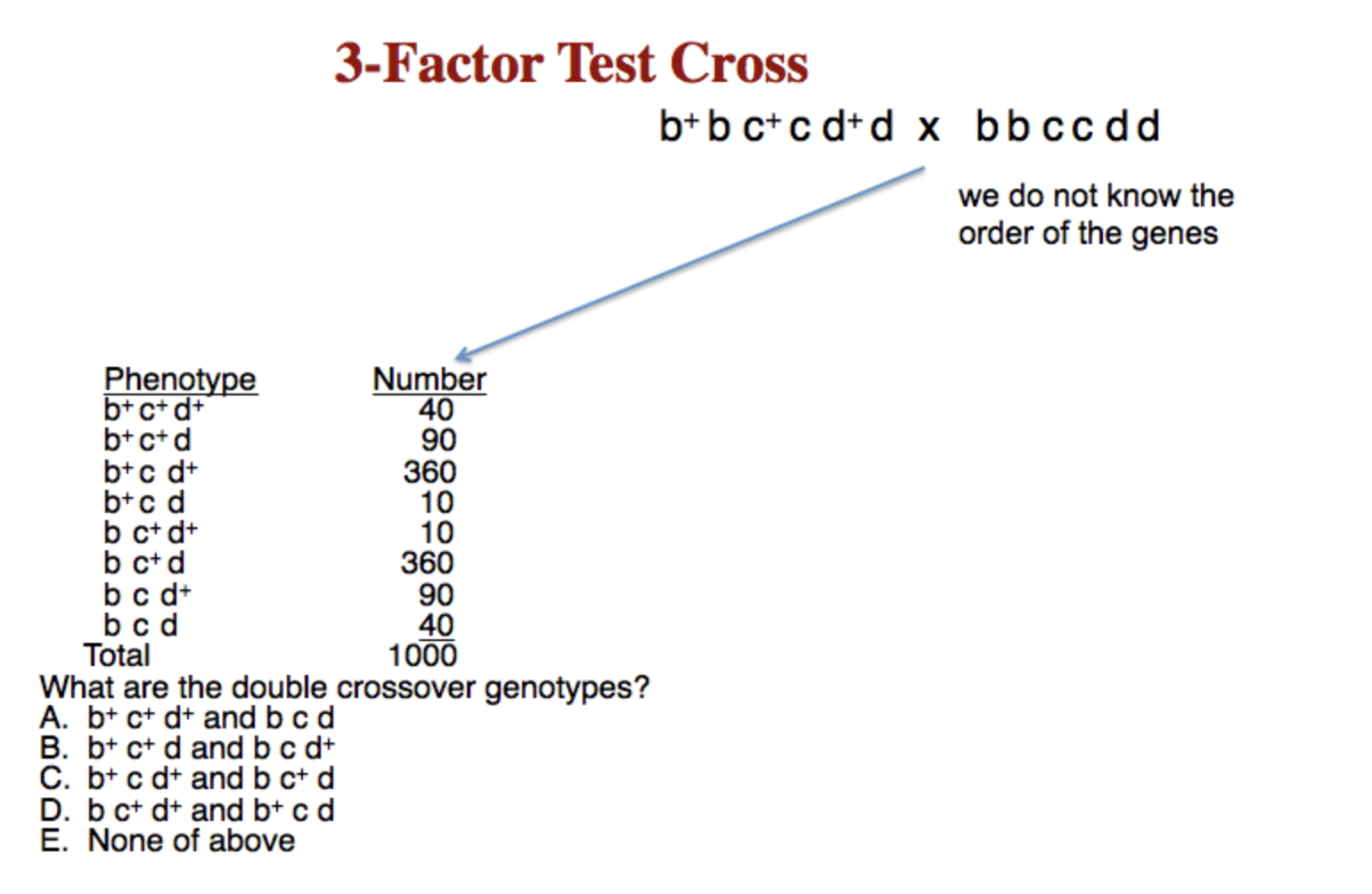
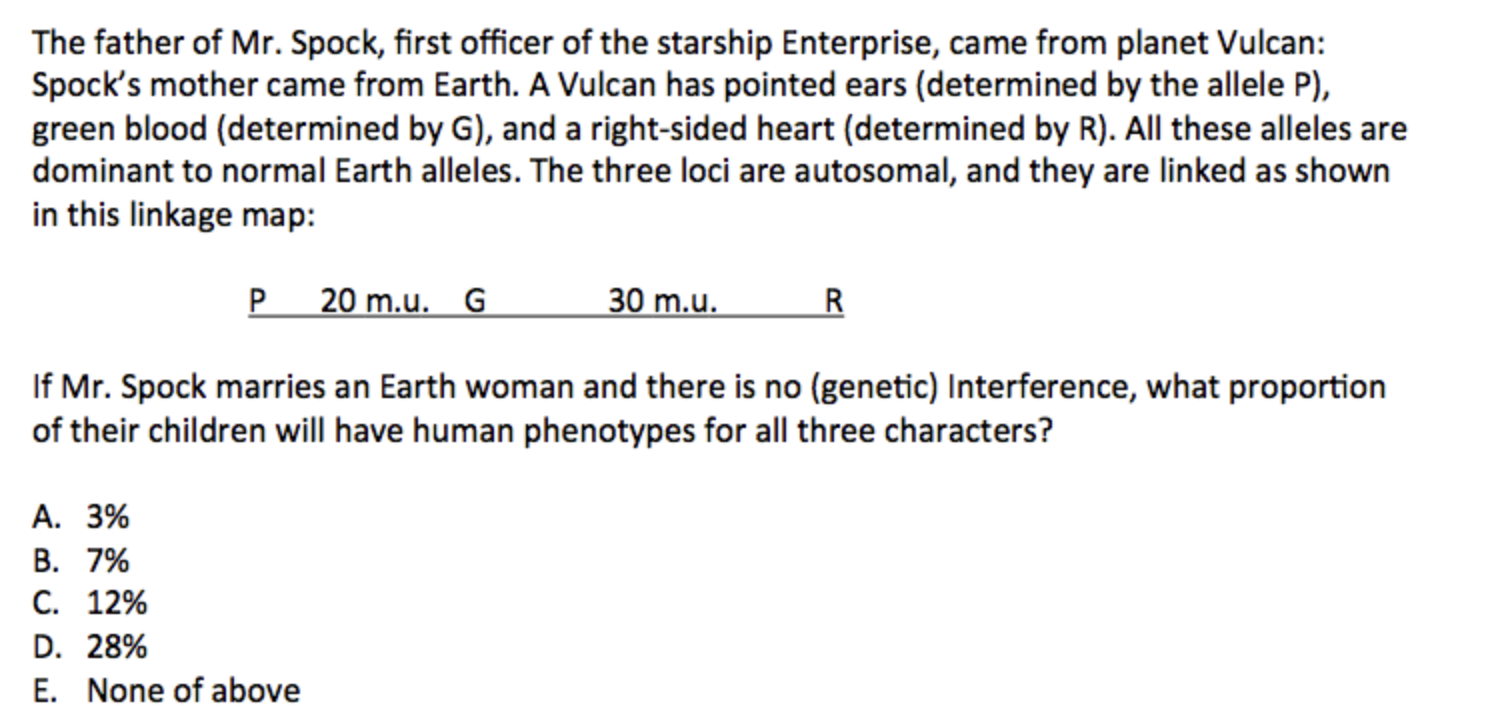
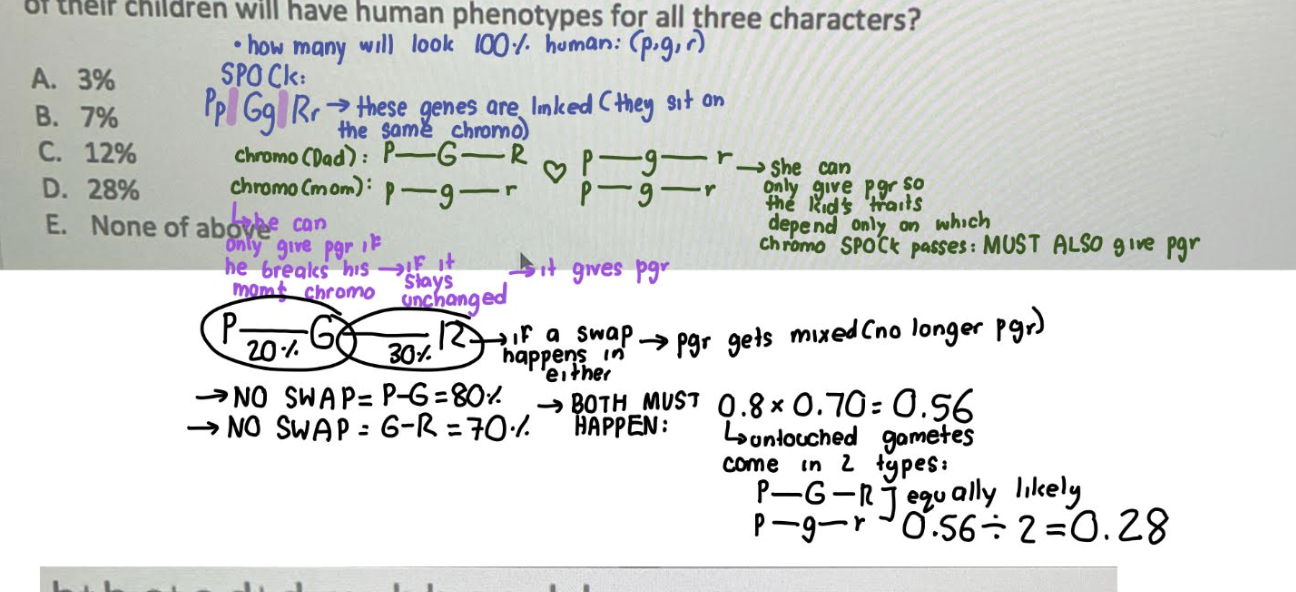
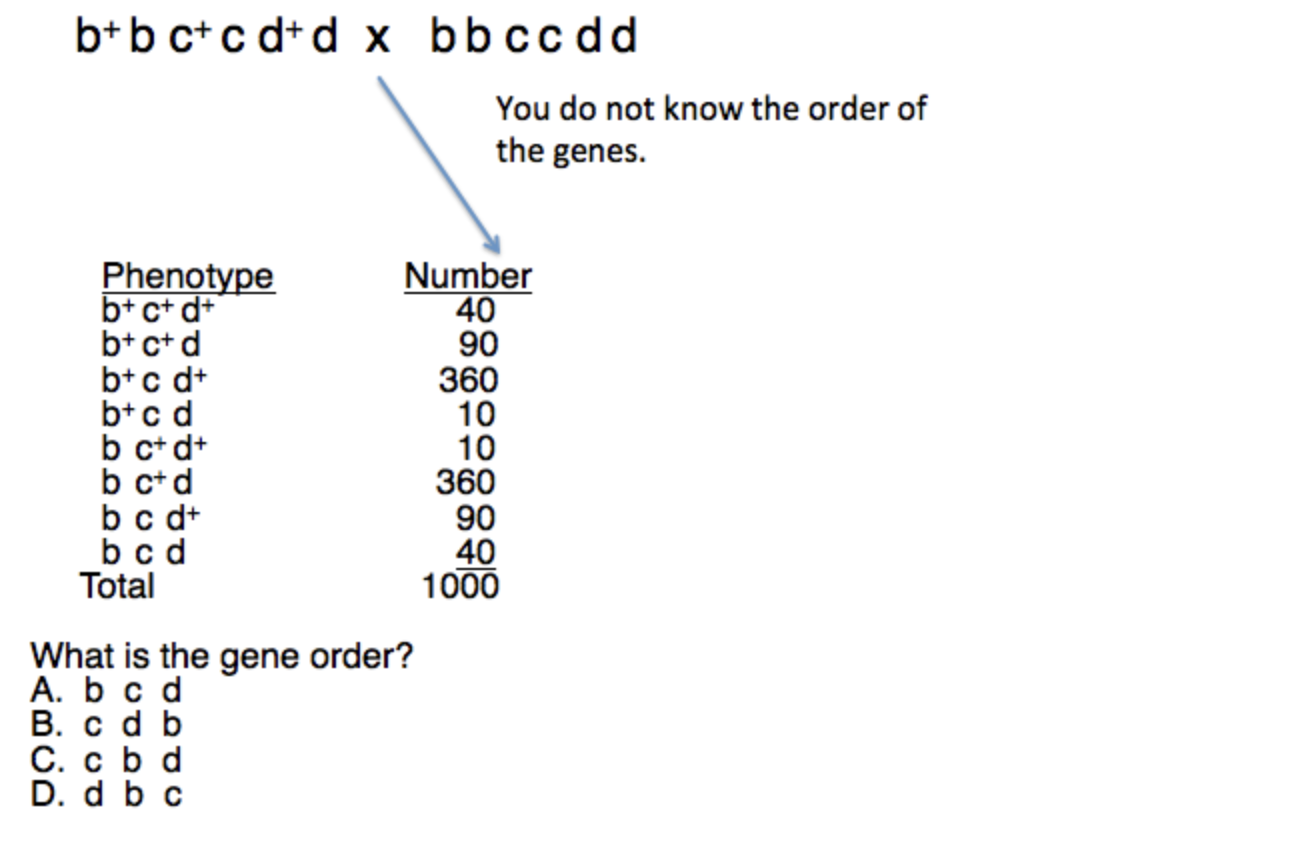
Q: One parent is heterozygous for three genes and the other is homozygous recessive. What is this called?
A: A 3-factor test cross
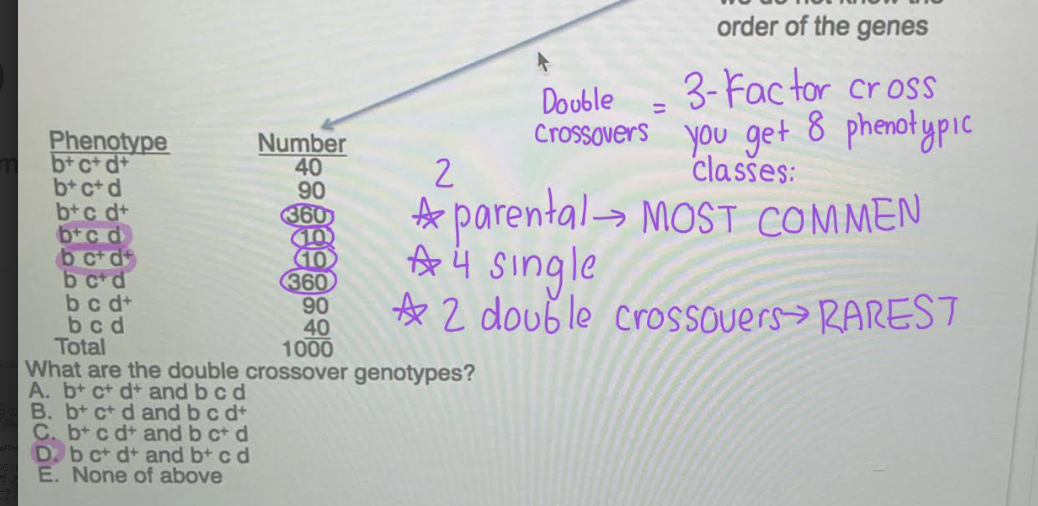
2⃣ How many phenotype classes should you ALWAYS see in a 3-factor test cross?
Q: No matter what the genes are, how many categories appear?
A: 8 phenotypic classes
In a 3-factor test cross, you get 8 phenotypic classes:
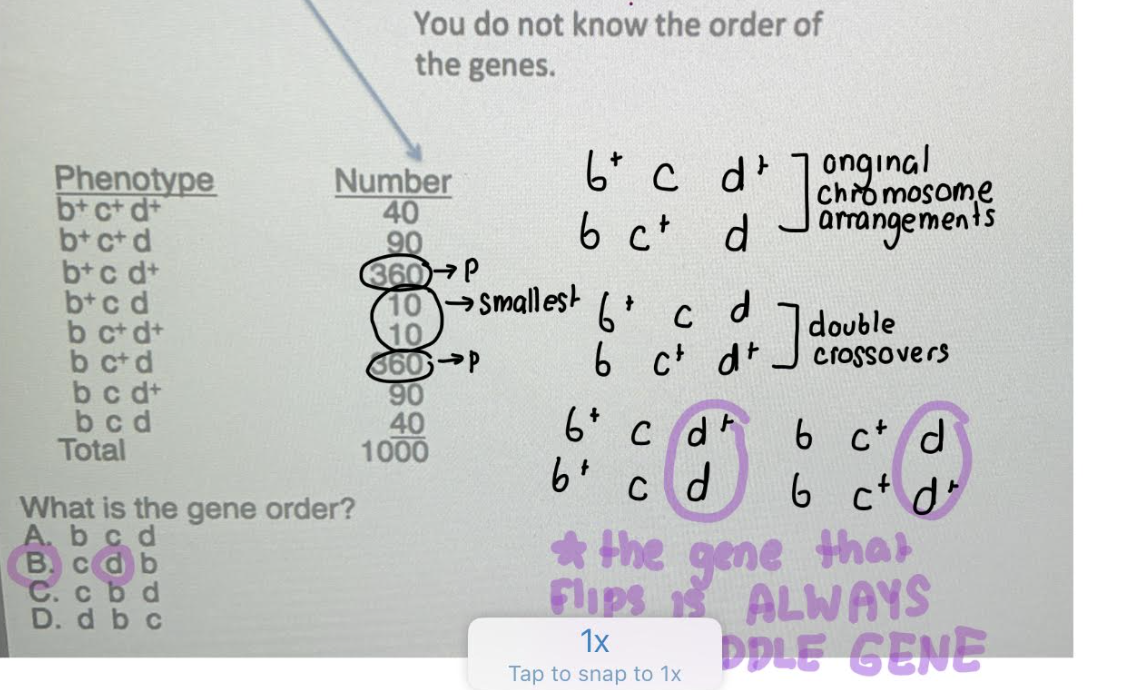
2 parental (non-recombinant) → MOST common
4 single crossovers → medium counts
2 double crossovers → RAREST
👉 Rule you can trust every time:
Double crossovers = the TWO SMALLEST numbers
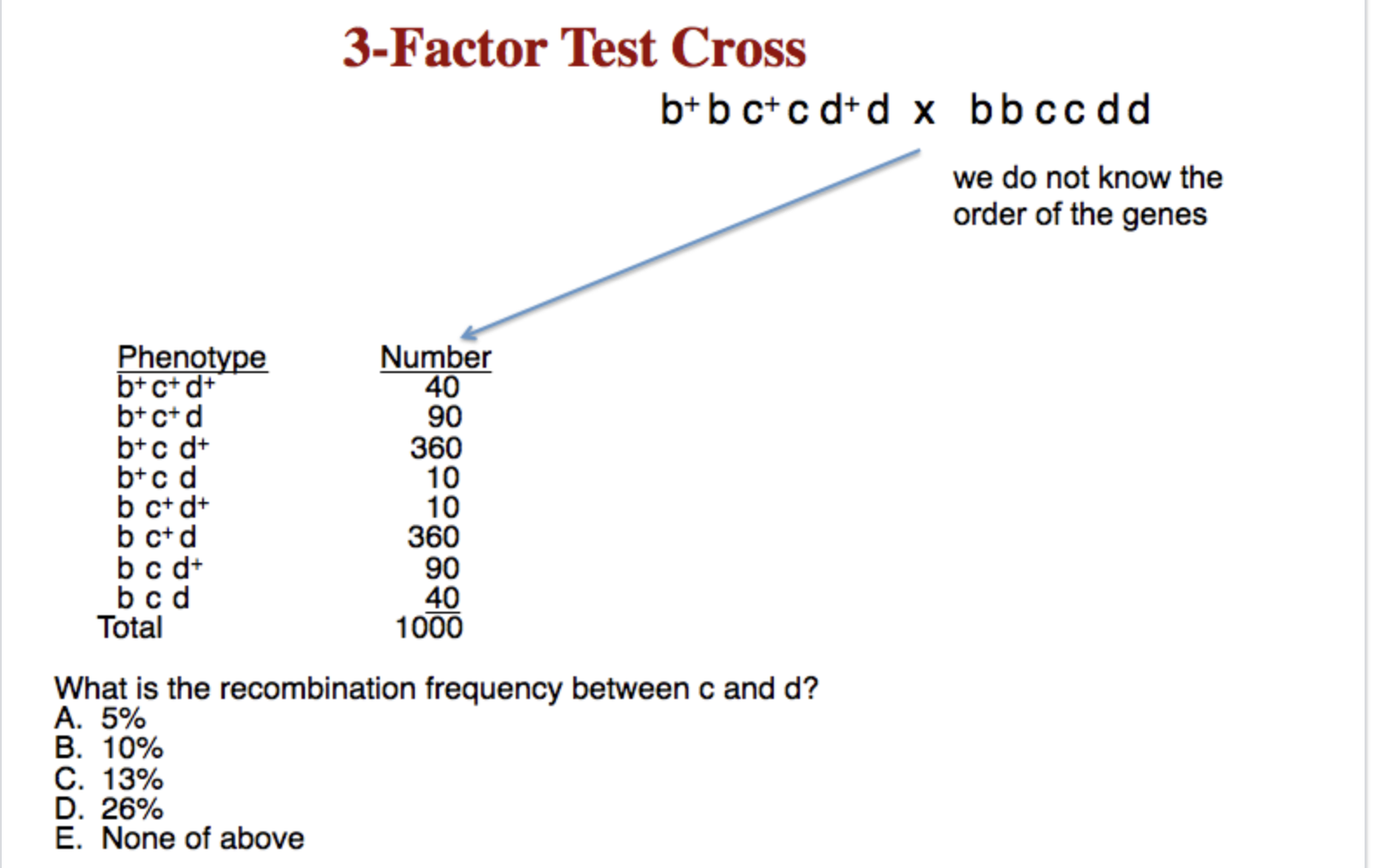
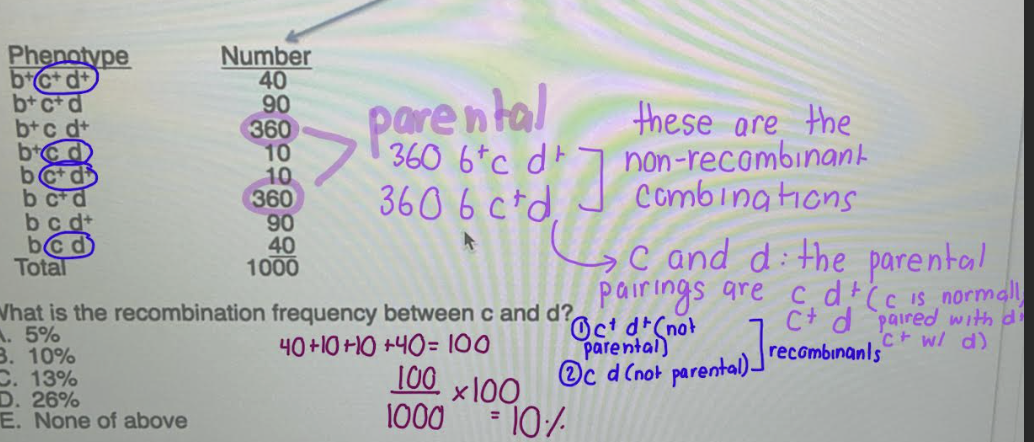
Recombination frequency: formula
(# recombinant offspring between those two genes) ÷ (total offspring) × 100
SNPs are useful because of all of the following except:
They are very stable
They have high heterozygosity
They can be easily types
There are a lot of them
They can be used for ancestry in populations
SNPs actually have LOW heterozygosity.
Why?
Because a SNP is usually just two alleles, and one of them is often very common.
Example:
A allele = 95%
G allele = 5%
Heterozygosity is:
2pq=2(0.95)(0.05)=0.095
That’s 9.5%, which is low.
Most SNPs have:
2 alleles
A haplotype is:
A set of alleles along one chromosome that are inherited together.
2. Why do haplotypes exist?
Because recombination doesn’t break up nearby markers very often.
In recessive disorders linkage studies primarily study affected individuals because:
They have high heterozygosity
They have carrier parents
They have known genotypes
They are frequent in the population
They are heterozygous for their mutation
If a disorder is recessive, then:
Affected individuals must be homozygous recessive (aa).
There is no ambiguity
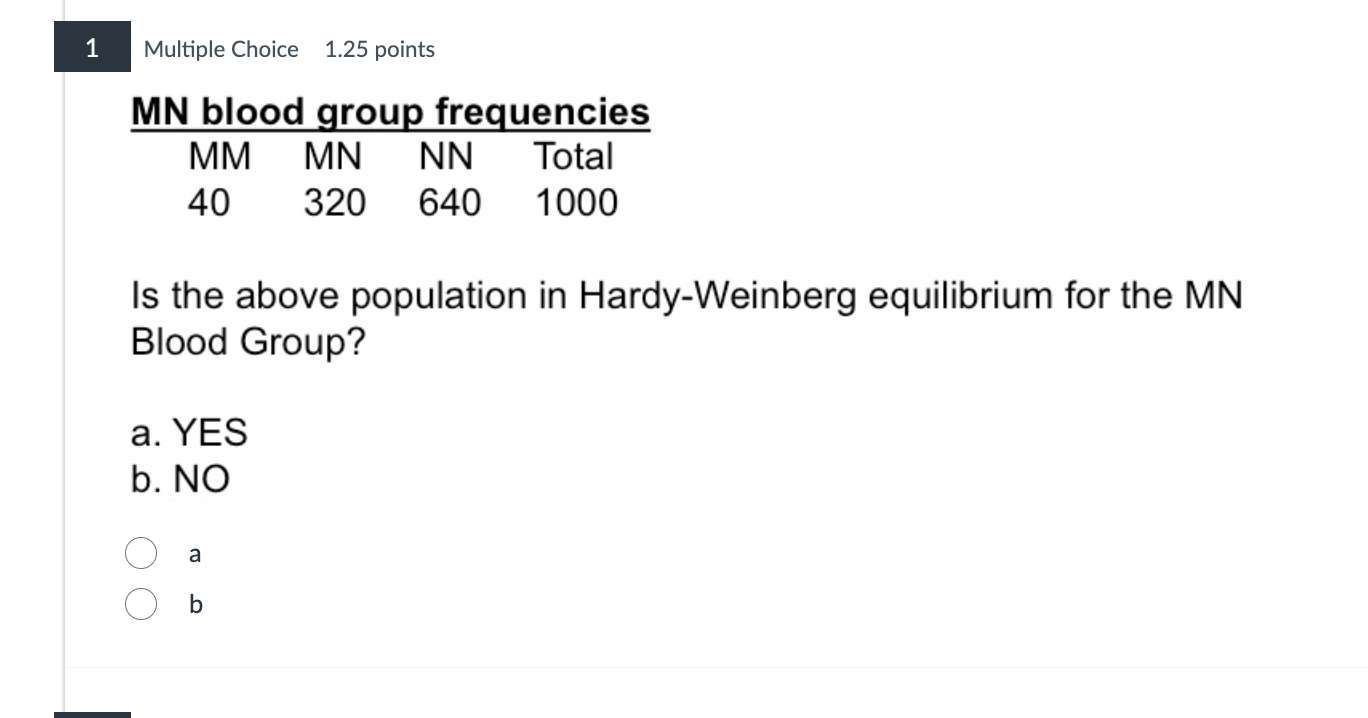
STEP 1: FIND ALLELE FREQUENCIES (NO FORMULAS) First: how many total alleles are there?
1000 people
each person has 2 alleles
👉 total alleles = 2000
Count M alleles
MM people:
40 people × 2 M each = 80 M
MN people:
320 people × 1 M each = 320 M
NN people:
0 M
Add them:
80 + 320 = 400 M alleles
Calculate p(M)
p = 400 / 2000 = 0.20
Calculate q(N)
You can count N alleles OR subtract:
q = 1 − p
q = 1 − 0.20 = 0.80
STEP 2: WHAT SHOULD THE GENOTYPES BE IF HWE IS TRUE?
We now use p = 0.20 and q = 0.80
Expected MM
p × p = 0.20 × 0.20 = 0.04
0.04 × 1000 = 40
Expected MN
2 × p × q
= 2 × 0.20 × 0.80
= 0.32
0.32 × 1000 = 320
Expected NN
q × q = 0.80 × 0.80 = 0.64
0.64 × 1000 = 640
STEP 3: COMPARE (THIS IS THE DECISION STEP)
Genotype | Observed | Expected |
|---|---|---|
MM | 40 | 40 |
MN | 320 | 320 |
NN | 640 | 640 |
Everything matches exactly.
✅ FINAL ANSWER
YES, the population is in Hardy–Weinberg equilibrium.
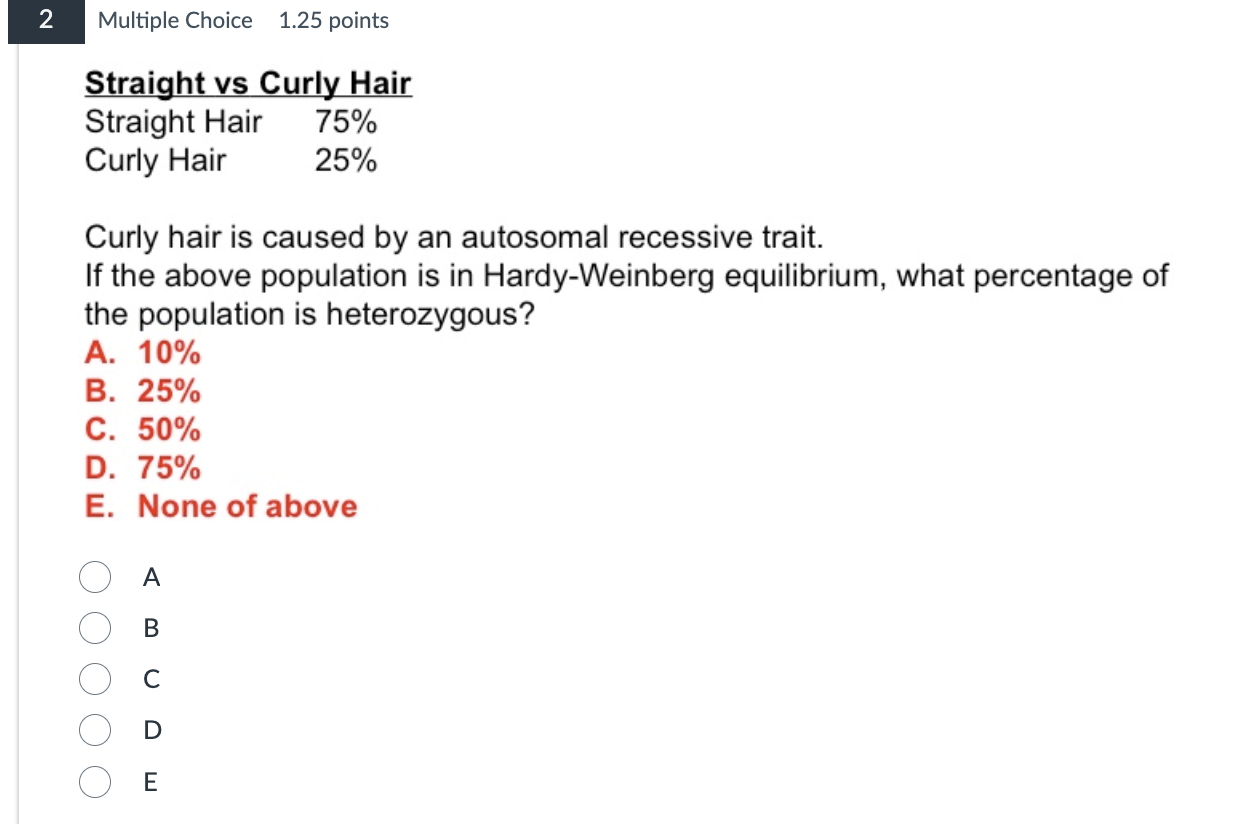
STEP 1: IDENTIFY WHAT THE 25% REPRESENTS
Curly hair is recessive
→ only aa individuals have curly hair
So:
aa = 25% = 0.25
STEP 2: FIND q (recessive allele frequency)
If:
aa = q × q
Then:
q² = 0.25
Take the square root:
q = 0.5
STEP 3: FIND p (dominant allele frequency)
Allele frequencies must add to 1:
p + q = 1
p + 0.5 = 1
p = 0.5
STEP 4: FIND THE HETEROZYGOUS FREQUENCY
Heterozygotes = Aa
To find Aa:
2 × p × q
Plug in values:
2 × 0.5 × 0.5
Multiply step by step:
0.5 × 0.5 = 0.25
2 × 0.25 = 0.50
So:
Aa = 0.50 = 50%
✅ FINAL ANSWER
C. 50%
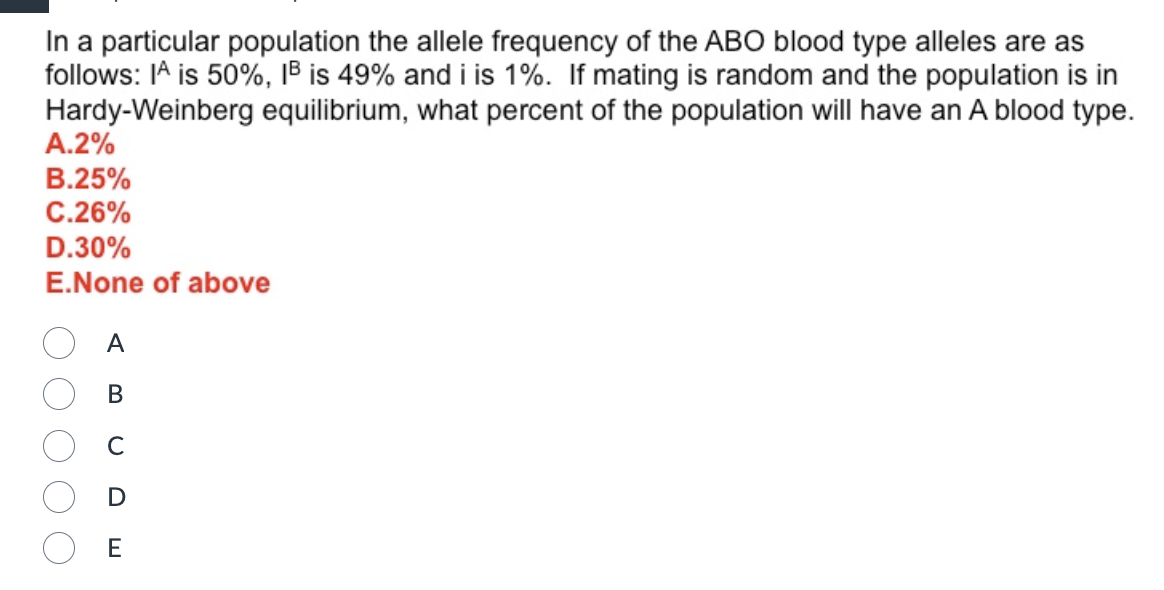
STEP 1: WHAT GENOTYPES GIVE BLOOD TYPE A?
Blood type A happens if the genotype is:
Iᴬ Iᴬ
Iᴬ i
⚠ Iᴬ Iᴮ does NOT count (that’s type AB)
So we only calculate:
IᴬIᴬ + Iᴬi
STEP 2: CALCULATE IᴬIᴬ
This is just allele × allele:
0.50 × 0.50 = 0.25
So:
IᴬIᴬ = 25%
STEP 3: CALCULATE Iᴬi
This genotype can form in two ways:
Iᴬ from mom, i from dad
i from mom, Iᴬ from dad
So we multiply by 2.
2 × 0.50 × 0.01
Do it step by step:
0.50 × 0.01 = 0.005
2 × 0.005 = 0.01
So:
Iᴬi = 1%
STEP 4: ADD THE A-TYPE GENOTYPES
25% + 1% = 26%
✅ FINAL ANSWER C. 26%
QUICK SANITY CHECK (VERY IMPORTANT)
Even though Iᴬ is 50%, not everyone with Iᴬ is blood type A, because:
many Iᴬ alleles pair with Iᴮ → AB blood type
That’s why the answer is 26%, not 50%.
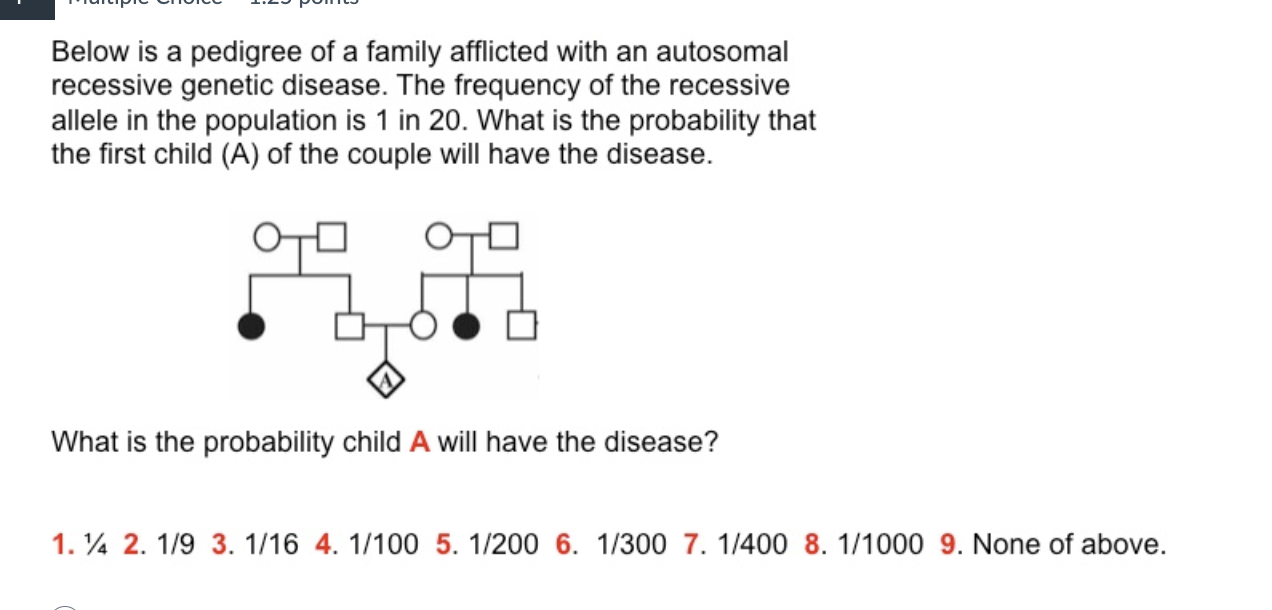
STEP 1: WHAT GENOTYPE CAUSES THE DISEASE?
Autosomal recessive disease → child must be:
aa
So:
child must get a from mom
AND a from dad
STEP 2: FOCUS ONLY ON THE TWO PARENTS
Ignore grandparents now — zoom in on the couple.
Important facts about each parent:
they are unaffected
they have an affected sibling
This tells us something very important.
STEP 3: WHAT DOES “UNAFFECTED WITH AN AFFECTED SIBLING” MEAN?
If someone has an affected sibling:
their parents must BOTH be carriers (Aa × Aa)
From an Aa × Aa cross, the children are:
AA Aa Aa aa
Probabilities:
AA = 1/4
Aa = 1/2
aa = 1/4
But the parent is NOT affected, so they cannot be aa.
Remove aa from consideration.
Remaining possibilities:
AA or Aa
Relative probabilities:
AA = 1
Aa = 2
Total = 3
So:
Probability parent is a carrier = 2/3
STEP 4: APPLY THIS TO BOTH PARENTS
Each parent:
carrier probability = 2/3
So the probability that both parents are carriers is:
2/3 × 2/3 = 4/9
STEP 5: IF BOTH PARENTS ARE CARRIERS, WHAT IS THE CHILD’S RISK?
Carrier × carrier (Aa × Aa):
AA Aa Aa aa
Probability child is affected:
1 out of 4 = 1/4
STEP 6: COMBINE EVERYTHING
We now multiply:
(prob both parents are carriers)
×
(prob child is affected if both are carriers)
So:
4/9 × 1/4
Cancel the 4:
= 1/9
✅ FINAL ANSWER 2. 1/9
 Note
Note  Flashcards (152)