Lecture 4- Proteins (cont.)
 Studied by 0 people
 Call Kai
 Learn
Learn Practice Test
 Spaced Repetition
 Match
Match Flashcards
 Knowt Play
1/62

There's no tags or description
Looks like no tags are added yet.
Name | Mastery | Learn | Test | Matching | Spaced | Call with Kai |
|---|
No analytics yet
Send a link to your students to track their progress
63 Terms
Induced fit protein confirmation
the binding of a substrate induces a conformational change in the enzyme, enhancing the fit between them
Allosteric interaction
a regulatory mechanism where the NONCOVALENT binding of a molecule at one site affects the activity at a different site on the protein.
Allosteric interactions- positively coupled
one binding reinforces the
binding of the other
Allosteric interactions- negatively coupled
one binding negatively
affect the binding of the other (mutually exclusive)
Cooperative Allosteric Transitions
occur when the binding of a molecule to one site on a protein enhances or inhibits the binding of additional molecules to other sites within the protein complex
GTP binding proteins are an example of
allosteric regulation in which GTP binding leads to conformational changes that affect protein activity.
GTP/GDP cycle in G-proteins
a process involving the hydrolyzation of GDP to GTP, leading to inactivation of the G-protein and subsequent signal transduction.
During the GTP/GDP g protein cycle, at what point is the g protein considered on
When is it bound to GTP
During the GTP/GDP g protein cycle, at what point is the g protein considered off
When it is bound to GDP or no nucleotide at all
How is the activity of GTP-binding proteins controlled
Regulatory Proteins GAP and GEF
GAP
GTPase-activating protein which stimulates the hydrolysis of GTP to GDP, thus inactivating the GTP-binding protein.
GEF
Guanosine nucleotide exchange factor that promotes the exchange of GDP for GTP, thereby activating GTP-binding proteins.
Hexokinase is an example of what type of regulation
allosteric regulation, where the enzyme's activity is modulated by the binding of an effector molecule at a site other than the active site.
Describe the hexokinase allosteric cycle
binding of glucose or other effectors to sites on the enzyme that are distinct from the active site, leading to conformational changes that enhance its enzymatic activity, thereby regulating glucose metabolism.
Protein kinases
are enzymes that modify other proteins by adding phosphate groups, typically regulating activity and function.
Protein Phosphatases
are enzymes that remove phosphate groups from proteins, reversing the action of kinases and thus regulating protein activity and function.
Src Protein Kinase phosphorylation cycle involves which protein
tyrosine
In the Src cycle, what is the first step to activating tyrosine
Dephosphorylation of the SH2 sub protein unit to loosen structure and allow binding to target proteins.
In the Src cycle, what is the second step to activating tyrosine
ligand binds to exposed SH3 domain which ADDS a phosphate group
In the Src cycle, what is the third step to activating tyrosine
Kinase domain of tyrosine can now phosphorylate to self activate
PROTEIN UBIQUITINATION
A process where 1 or multiple ubiquitin molecules are attached to a protein in order to direct it to a process like degradation or repair
Even though ubiquitylation can lead to multiple cellular processes, what it the most common
targeting of proteins for degradation by the proteasome.
Proteasome structure
a large protein complex that contains proteases
Proteasome function
degrades poly-ubiquitinated proteins
Be able to state three covalent protein modifications
and the enzymes that are involved
Phosphorylation (enzyme: kinase)
Dephosphorylation (enzyme: phosphatase)
ubiquitination (enzyme: ubiquitin ligase).
A DNA Molecule Consists of ____
Two Complementary Chains of Nucleotides running an
opposite direction
Transcription factors
regulatory proteins that bind to specific DNA sequences to control the transcription of genetic information.
2 types of transcription factors
Repressors and activators
How do RNA-processing enzymes terminate transcription
Generate the 3ʹ End of Eukaryotic mRNAs – Poly (A) tail to
terminate transcription
Poly A tail
a sequence of adenine nucleotides added to the 3ʹ end of eukaryotic mRNAs, which enhances stability and facilitates export from the nucleus.
RNA splicing
the process of removing introns and joining exons in pre-mRNA to produce mature mRNA.
introns
non-coding sequences in pre-mRNA that are removed during RNA splicing.
exons
coding sequences in pre-mRNA that remain after RNA splicing and are joined together to form mature mRNA.
Coding sequence or ORF (open reading frame)
a portion of a gene that is translated into a protein, consisting of exons that encode amino acids.
Noncoding sequences or untranslated region
regions of mRNA that are not translated into protein, including 5' and 3' UTRs.
Ribosomes
read the information on messenger RNA (mRNA)
to generate polypeptide
tRNA Molecules
Match Amino Acids to Codons in mRNA: in Sets of Three nucleotides
Codon
A sequence of Be able to draw a typical eukaryotic mRNA in mRNA that specifies a particular amino acid or stop signal during protein synthesis.
Be able to draw a typical eukaryotic mRNA
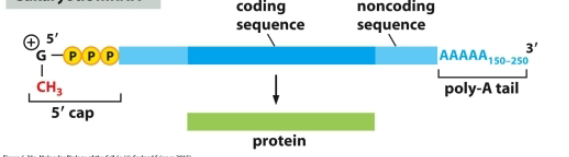
What is the central dogma in gene expression?
The central dogma in gene expression describes the flow of genetic information from DNA to RNA to protein, outlining the processes of transcription and translation.
CRISPR/CAS9
generates a double-strand cleavage
on target DNA sequence, which enables precise
gene mutations and editing using a guide RNA to direct the Cas9 nuclease.
Nuclease activity-defective versions of
CRISPR/CAS9 can be used ____
to repress or activate target gene
RNA interference (RNAi)
a biological process in which RNA molecules inhibit gene
expression or translation, by neutralizing targeted mRNA molecules
Methods for gene inactivation
RNA interference (RNAi, knock-down), Gene targeting (knock-out), Random mutagenesis.
Wobble position
refers to the flexibility in base pairing at the third position of a codon, allowing for some variability in the matching of tRNA anticodons.
GWAS (Genome Wide Association Study)
A study that identifies genetic variants associated with specific traits or diseases by scanning the genomes of many individuals.
PCR
Genes Can Be Cloned in vitro
Restriction Nucleases (Restriction enzyme)
Cut Large DNA Molecules into Specific Fragments
DNA ligase
covalently joins two DNA molecules
DNA plasmids-cloning
can be amplified in bacteria
What is the effect of DNA cloning on proteins
allows for the production of large quantities of specific proteins by inserting the gene encoding the protein into plasmids, which are then introduced into bacteria for expression and amplification.
SDS Polyacrylamide-Gel Electrophoresis (SDS-
PAGE)
a technique used to separate proteins based on their molecular weight by applying an electric field to a gel matrix.
Principles of SDS Polyacrylamide-Gel Electrophoresis (SDS-PAGE): role of SDS
helps to coat proteins with a negative charge and denatures them by disrupting hydrophobic interactions
Principles of SDS Polyacrylamide-Gel Electrophoresis (SDS-PAGE): role of mercaptoethanol
breaks disulfide bonds to ensure the proteins are fully denatured
Why is it so important to ensure proteins are fully isolated and denatured for electrophoresis
They need to be fully unfolded to linear chains to ensure they are being sorted based on size and not shape
Western Blotting
a technique used to detect specific proteins in a sample after separation by electrophoresis, utilizing antibodies for visualization.
Antigen
A molecule that was used to generate an antibody
Epitope
A small part of an antigen that is recognized by an antibody
Antibody diversity
created by somatic DNA recombination and the selection of B cells that produce different antibodies to bind various antigens.
Polyclonal antibody
An antibody produced by different B cell lineages, recognizing multiple epitopes on the same antigen.
Monoclonal antibodies
Antibodies that are identical and produced by a single clone of B cells, recognizing a specific epitope on an antigen.
Hybridoma Cell Lines
Factories That Produce Monoclonal Antibodies
What is “Protein-tagging” and how is it done?
Protein-tagging is a technique used to label proteins with a specific tag, allowing for their identification and isolation. This can be achieved through methods like genetic fusion to a reporter protein or the addition of chemical tags.
 Note
Note  Flashcards (32)