Theorems, Propositions, and Facts
 Call Kai
 Learn
Learn Practice Test
 Spaced Repetition
 Match
Match Flashcards
 Knowt Play
1/59

There's no tags or description
Looks like no tags are added yet.
Name | Mastery | Learn | Test | Matching | Spaced | Call with Kai |
|---|
No analytics yet
Send a link to your students to track their progress
60 Terms
For any subspaces S and T of the same vector space V, S ∩ T is also a subspace of V
If v1, . . . , vp are in a vector space V, then Span{v1, . . . , vp} is a subspace of V.
A set S of vectors in a vector space V is linearly dependent if and only if there is at least one vector in S that can be expressed as a linear combination of other vectors in S.
A set containing the zero vector is linearly dependent.
A set containing just one vector v is linearly independent if
and only if v does not equal 0.
A set of two vectors is linearly dependent if and only if one is a scalar multiple of the other.
Every vector space has a basis
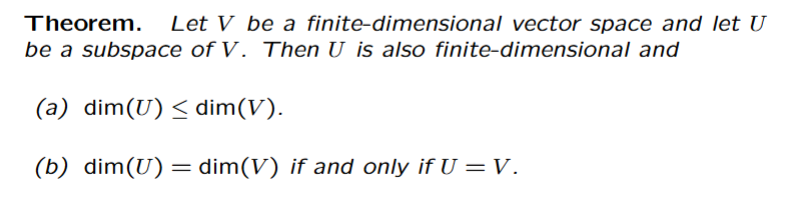
A basis of a vector space is not unique, but any two bases for V contain the same number of elements.
If that number of elements is an integer n then we say the dimension of V is n, denoted dim(V ) = n, and that V is finite-dimensional.
If V does not have a finite spanning set then V is infinite-dimensional.
The empty set is a basis for the zero subspace
The Spanning Set Theorem
A finite basis can be constructed from a finite spanning set of vectors by discarding vectors which are linear combinations of preceding vectors in the set.
The Unique Representation Theorem




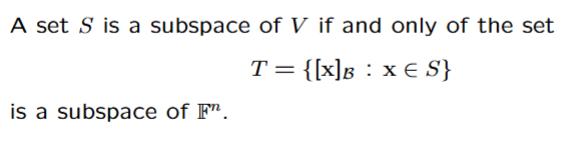
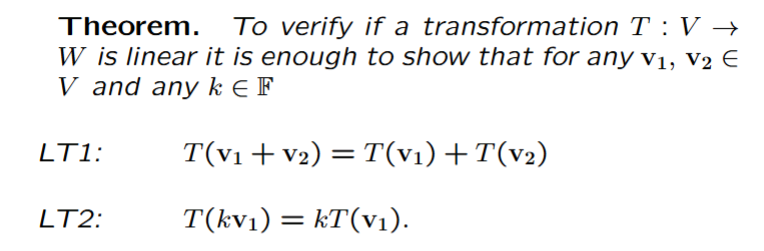





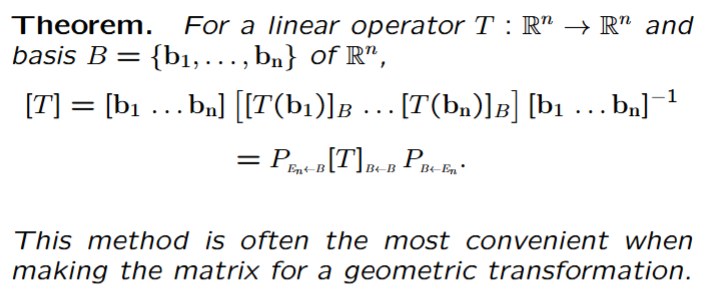
Combining Linear Transformations

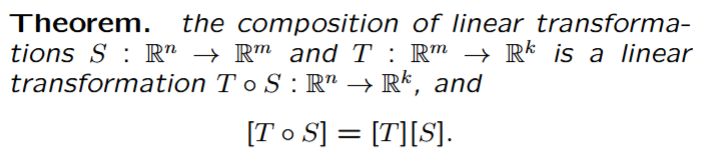
Composition of Linear Transformations
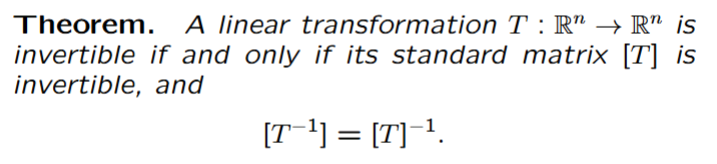
Invertible Linear Transformations
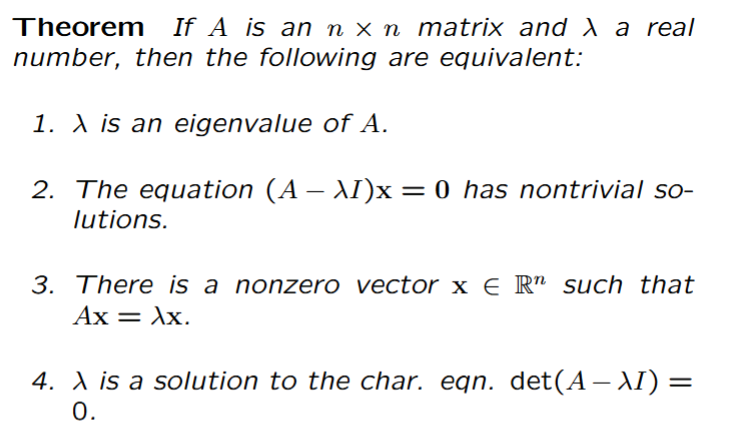
An eigenvector is NONZERO!!!!!
The roots of the characteristic equation of an nxn matrix are the eigenvalues of that matrix

λ = 0 can be an eigenvalue of A, but 0 ∈ Rn can never be an eigenvector of A!






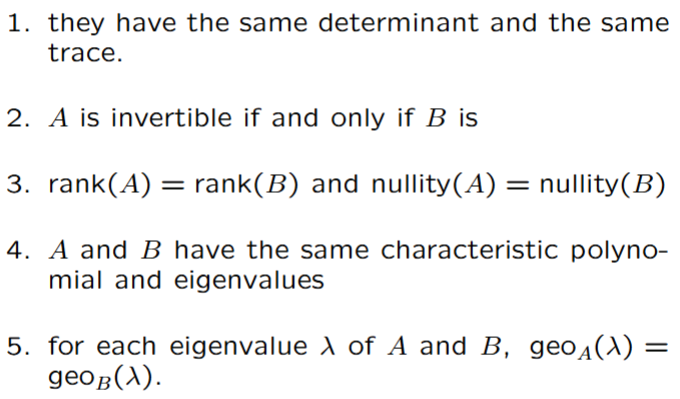
If A and B are similar matrices, then

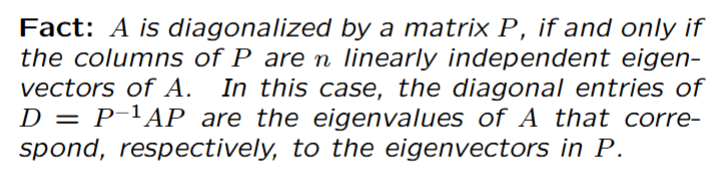


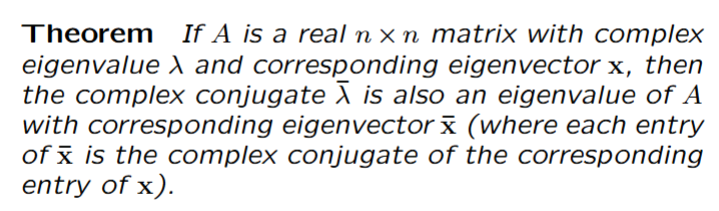
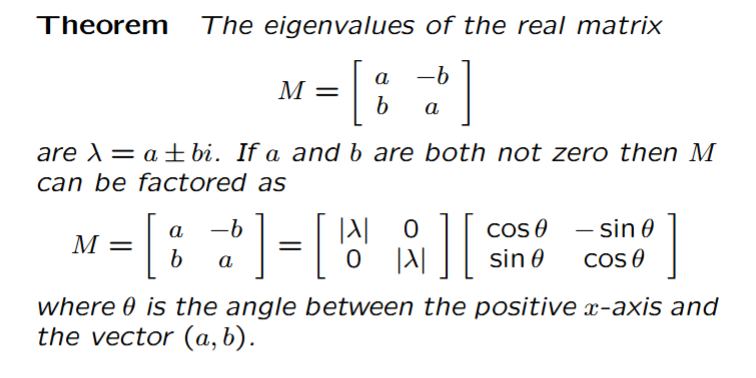
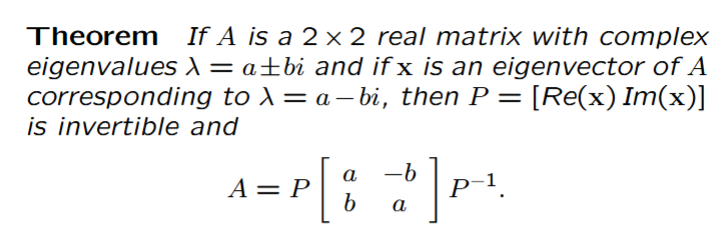



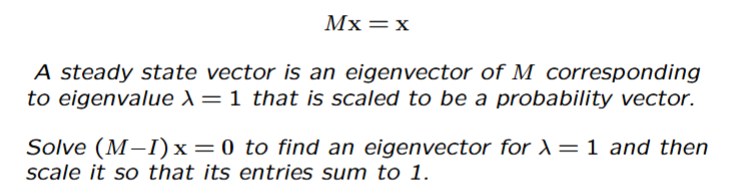
Finding a Steady State Vector