Plant Physiology: Enzymes
 Call Kai
 Learn
Learn Practice Test
 Spaced Repetition
 Match
Match Flashcards
 Knowt Play
1/40

Name | Mastery | Learn | Test | Matching | Spaced | Call with Kai | Chat |
|---|
No analytics yet
Send a link to your students to track their progress
41 Terms
Proteins make up of total dry weight
30%
Major function of proteins
Serve as enzymes. (Some are RNA)
Enzymes
Biological catalysts that greatly increase the rate of biochemical reactions
How are enzymes usually named
Named after their substrate and adding a “-ase” to the end
Catalyst
A substance that speeds up a chemical reaction WITHOUT BEING A REACTENT
Activation rate
The amount of energy that must be put in for the reaction to begin

fill the blank spots
How many diff amino acid side chains are found in nature
20
Conformation
3D arrangement of the atoms in the molecule
A change in conformation involves a breaking of the covalent bonds
False, does not involve
Denaturation involves the loss of the uniqe 3D shape leading to a loss of catalytic activity
True
Protein structure
Primary structure
Secondary Structure
Tertiary Structure
Quaternary Structure
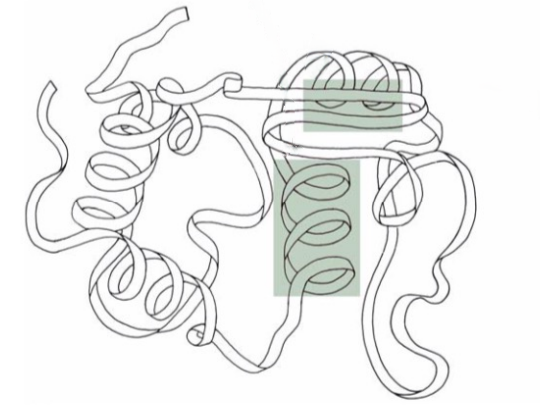
Primary protein structure
The sequence of amino acid (a.a) residues

Secondary protein structure
The regular, local structural units, held together by HYDROGEN bonds

Tertiary protein structure
Final 3D structure of polypeptide
Quaternary protein structure
The association of 2 or more separate 3D polypeptides (subunits) to form complexes

Domains
The several independently folding units of the proteins large single polypeptide chain.
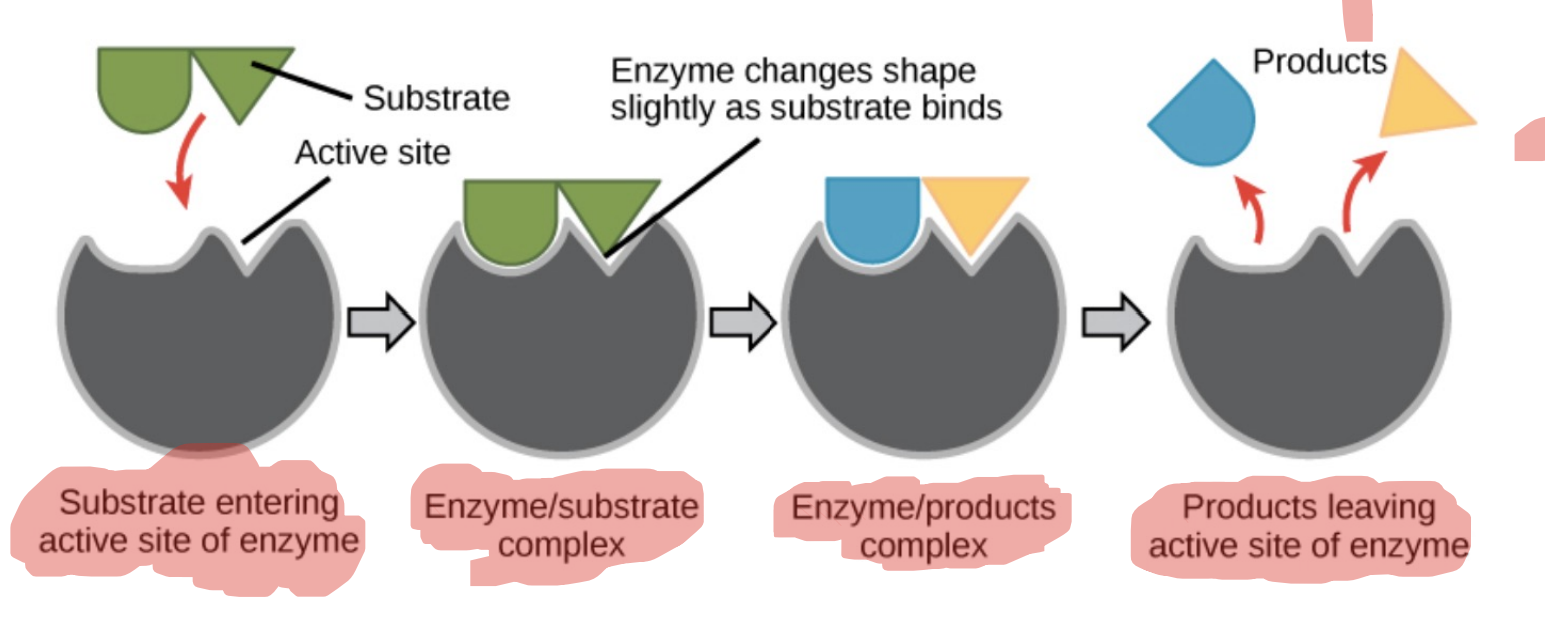
What is the region where subunits bind to when aiding with the catalytic reaction?
Active site of enzymes
Where is the active site located ?
At the interface between 2 domain
Factors that can affect/control enzyme activity
Temperature
pH
Regulatory molecules
Cofactors
Compartmentalization
Feedback inhibition
High temp = Low reaction rates (T/F)
False
Increasing or decreasing the temp outside the tolerable range affects the chemical bonds in the active site
True
Active site amino acids (a.a)residue have acidic or basic properties that are important for catalysis
True.
How does a change in pH affect the residues?
Make it hard for the substrates to bind
Regulatory molecules
Other molecules that regulate the enzymes by either increasing or reducing their activity
Activators
Molecules at increase the activity of an enzyme
Inhibitor
Molecules that reduce the activity of and enzyme
An activator or inhibitor binding is reversible
True, it doesn’t attach permanently
Inhibitor groups and their way
Competitive
Bind to an enzyme and block the substrate from binding
decreasing the reaction rate but can still reach max reaction rate with enough substrate
Noncompetitive
Doesn’t block the activation site
It attaches to another site that prevents the enzyme from doing its job
Will never reach max reaction rate even with al of substrate
Allosteric regulation
Regulatory molecule that binds to an enzyme al the allosteric site.
Can be an activator or inhibitor
Allosteric enzymes typically have few active sites located on different protein subunits
False, they have multiple active sites on diff protein subunits
Allosteric inhibitor
when bound to the allosteric site, all active sites on the protein subunits are changed to work less well
Allosteric activator
when bound to an enzyme, they cause an increase of the active sites function
Cofactors
Helper non-protein molecules that HAVE TO attach to enzymes that don’t function properly.
Cofactors attach permanently through strong covalent bonds
False, they can also attach temporarily through ionic or hydrogen bonds
Coenzymes
Organic molecule subsets of cofactores
what is the most common source of coenzymes?
Vitamins such as C for several enzymes that build protein collagen.
Enzymes are often compartmentalized
True, they are found in specific parts of the cell
Why are enzymes compartmentalised?
Find their intended substrates readily
Don’t damage the cell
Have the perfect microenvironment to work well

Explain the picture