PSYC2050 Lecture 7 - Attentional Control & Working Memory (Executive Function)
 Studied by 0 people
 Call Kai
 Learn
Learn Practice Test
 Spaced Repetition
 Match
Match Flashcards
 Knowt Play
1/29

There's no tags or description
Looks like no tags are added yet.
Name | Mastery | Learn | Test | Matching | Spaced | Call with Kai |
|---|
No analytics yet
Send a link to your students to track their progress
30 Terms
What are the two types of visual search?
Feature / Parallel Search (Pop-Out)
Conjunction / Serial Search
What is a Feature / Parallel Search (Pop-Out)?
When searching for a stimulus with distinctive features, no matter how many distractors there are it’ll be easy to find (it pops out to you)
e.g. finding a red x among a group of black x’s
Preattentive
What is a Conjunction / Serial Search?
The target stimulus has similar features to the distractors, making it more effortful and longer to find the more distractors there are
e.g. Searching for a red x among a group of black x’s and red o’s
Attentive
What is the difference between feature search and conjunction search?
Feature search is fast and unaffected by distractor size, whereas conjunction search is slower and affected by distractor size (Treisman & Gelade 1980)
What happens if there is the target is absent in a search?
When the target is absent, search time is doubled. This is because participants effortfully analyse each similar value in attempt to find the target (exhaustive search)
What is Feature Intergration Theory (FIT)?
Suggests that when you do a visual search, individual features (like colour, shape or size) are all processed automatically
This creates seperate feature maps that identifies where specific features (e.g. red or X) are located, making it easier to find individual features. This is known as feature search.
However, when a target has multiple features (e.g. a red X among red O’s and black X’s), time and attention are required to integrate those features together. This is known as conjunction search.
What are the limitations of Feature Intergration Theory (FIT)?
Features don’t always pop out
Conjunctions can lead to flat search slopes
Conjunction searches are much easier when distractors are similar to each other (Duncan & Humphreys, 1989)
What is attentional blink?
The phenomenon that the second of two targets cannot be detected or identified when it appears close in time to the first at the same location and through distractors.
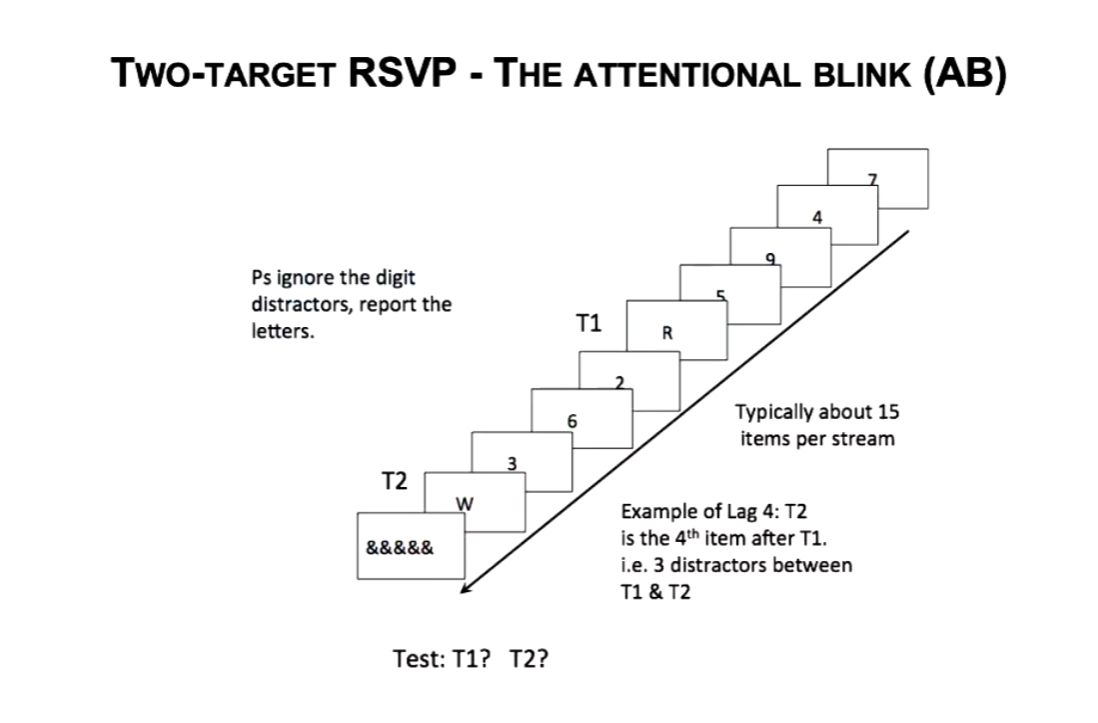
What is the analogy for RSVP that describes attentional blink?
R = Rapid
S = Serial
V = Visual
P = Presentation
What is Lag-1-sparing?
A common exception to the attentional blink, where a target presented only directly after the first target can be identified and reported accurately
What does attentional blink support?
This supports the theory of resource allocation in attention, showing how capacity is limited based on the timing and difficulty of targets.
Effects under stress in timed conditions
In an attentional blink task a more difficult target 1…
What is the Task-switching paradigm (Executive control)?
How participants can stop responding to distractors and instead switch between demands or tasks
However, participants can incur a time and error cost when switching from one task to another as they have to establish a link to their desired task while disengaging in irrelevant tasks
What did Jersild (1927) do?
Jersild (1927) had a group of participants only repeated one task, whilst another group repeated alternating tasks.
It was found that the single task group were faster in completion, and that the more similar alternating tasks are, the harder a task switch is.
What did Rogers & Monsell (1995) do?
Studied task switching by asking participants to alternate between judging letters (vowel/consonant) and numbers (odd/even).
They found that people were slower and made more mistakes after a switch, but practice and preperation had a positive effect in reducing the costs of task-switching
However, disengaging from a hard task is tough as it requires effort and concentration in the first place to focus
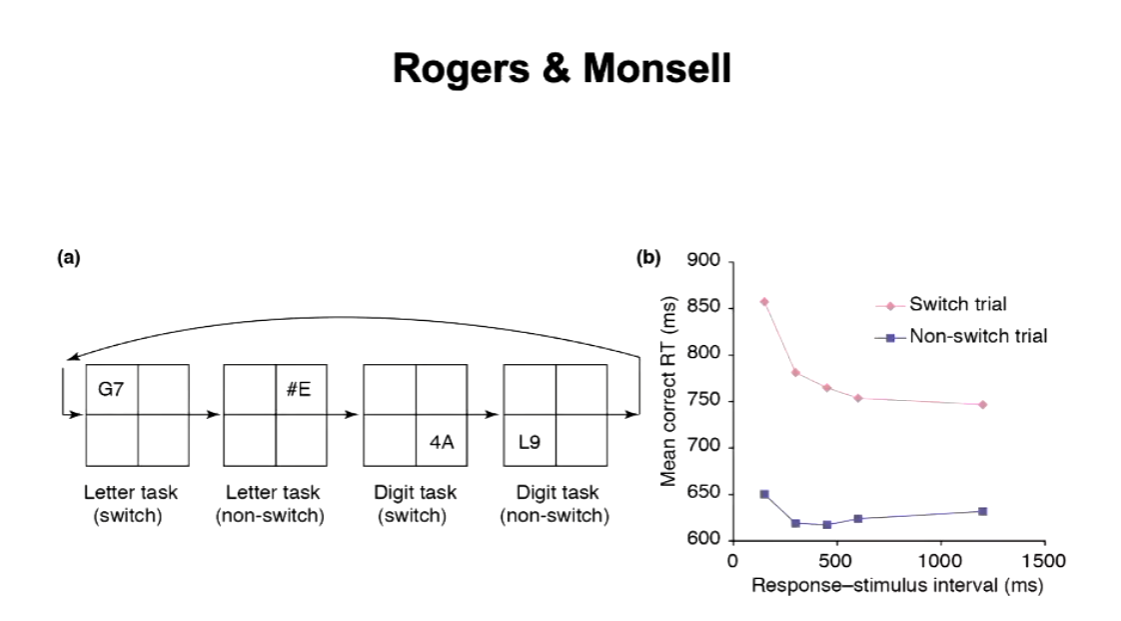
Evidence for an endogenous component in task switching costs includes:
Define automaticity
Links to Kahneman’s capacity theory: Over-learned tasks become automatic and consume fewer resources
With practice there is an improvement in performance and reduction in task effort
e.g. riding a bicycle, playing the piano etc.
How did Shiffrin & Schneider (1977) test for automacity?
They asked participants to look for target letters among distractors. In some trials, the targets and distractors stayed the same (consistent mapping), wheras in others they randomised (varied mapping).
They found that in consistent mapping trials, the pariticpants practice meant they became faster and could search automatically without needing focused attention. But when it kept changing (varied mapping), performance was slow and effortful.
What did Logan (1988) find?
Logan (1988) theorised that automaticity is based on the knowledge and memories acquired from performing a task, which we can recall to guide our responses in the present
e.g. Roger Federer has many experiences of playing tennis to where retrieving these memories and experiences are automatic and guide how to respond in his games, whereas the average person needs to consciously slow down and think on what to do
Define working memory
Working memory is involved in making decisions and initiating actions based on plans and response to environmental input
Holds a small amount of information that disappears after a few seconds if not rehearsed
Limited capacity is around 7 items
Describe Baddeley’s working memory model
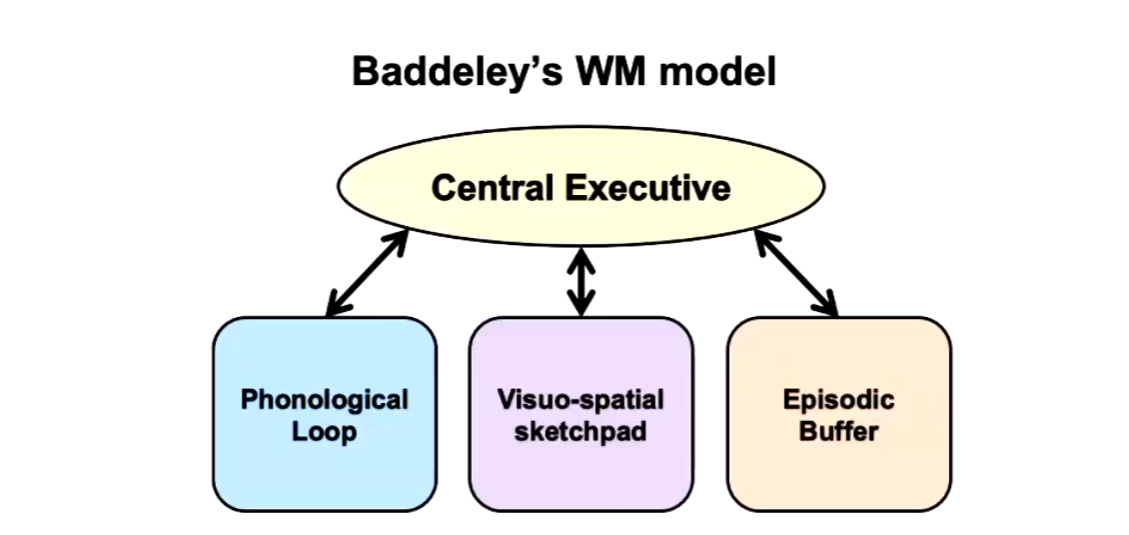
What is the Central Executive in Baddeley’s working memory model?
Central executive is the boss that controls attention and coordinates other parts. It also decides what infomation is important and where to send it
What is the Phonological Loop in Baddeley’s working memory model?
Phonological loop deals with verbal and auditory information in two parts:
Verbal store (Inner ear) holds sounds
Articulatory Rehearsal Process (inner voice) rehearses words to keep them remembered e.g. phone numbers, instructions etc.
What are the 4 key effects of the phonological loop?
Phonological Similarity Effect
Irrelevant Speech Effect
Word Length Effect
Concurrent Articulation Effect (Articulatory Suppression)
Explain the Phonological Similarity Effect
Words or letters that sound alike (e.g. B, D, P, T) are harder to remember because they get confused in the phonological store.
Explain the Irrelevant Speech Effect
Background speech (even in a language you don’t understand) disrupts verbal memory tasks as it interferes with the phonological store.
Explain the Word Length Effect
It’s easier to remember short words than long ones because shorter words take less time to rehearse in the articulatory loop.
Explain the Concurrent Articulation Effect (Articulatory Suppression)
Saying or hearing something repeatedly (like “the, the, the…”) while trying to remember something impairs rehearsal and memory performance.
What is the Visuo-spatial sketchpad in Baddeley’s working memory model?
Visuo-spatial sketchpad handles visual and spatial information, like shapes, colours, and locations.
It is important in spatial tasks such as driving or dancing, as well as manipulating visual images and orientation in space and movement.
What is the Episodic buffer in Baddeley’s working memory model?
Episodic buffer links information across visual, verbal and spatial domains
 Note
Note  Flashcards (43)