Module EFG ACC 403
 Call Kai
 Learn
Learn Practice Test
 Spaced Repetition
 Match
Match Flashcards
 Knowt Play
1/49

There's no tags or description
Looks like no tags are added yet.
Name | Mastery | Learn | Test | Matching | Spaced | Call with Kai |
|---|
No analytics yet
Send a link to your students to track their progress
50 Terms
What is the goal of data analytics in auditing?
To take advantage of relevant data and advanced analytical tools to improve efficiency and audit quality.
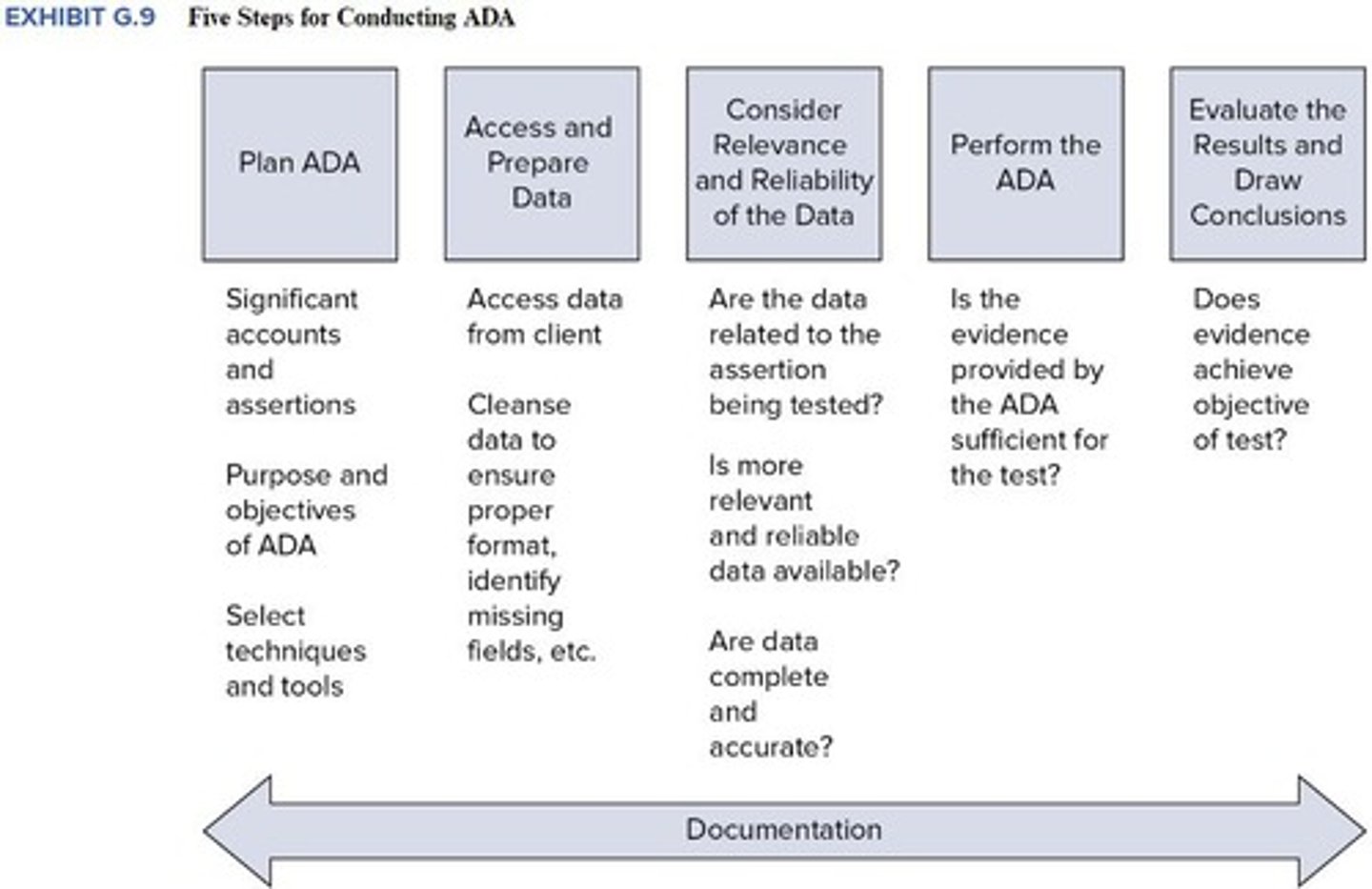
What is data analytics in auditing?
Systematic computational analysis of data that yields insights in the audit process.
What is one advantage of using audit data analytics?
It improves audit effectiveness by allowing auditors to examine full populations instead of relying on traditional sampling.
How does data analytics improve audit efficiency?
Technology can reduce the time needed to complete certain audit tasks.
In which phases of the audit can analytics be employed?
Risk assessment procedures, tests of controls, substantive analytical procedures, and substantive tests of details.
What should auditors document for audit data analytics?
Specific objectives, risks of material misstatement, data source description, nature of the analytic, tools used, and evaluation of identified matters.
What does the phrase 'If you didn't document it, you didn't do it' imply in auditing?
Documentation is essential to validate the audit process and findings.
What is robotic process automation in the context of data analytics?
Automation tools like UIPath and Automation Anywhere that streamline audit processes.
What is the significance of the phrase 'the potential applications of data analytics are almost unlimited'?
It highlights the versatility and broad applicability of data analytics in auditing.
What is the importance of evaluating matters identified during data analytics?
It helps auditors determine appropriate actions in response to findings.
What is sampling in auditing?
Drawing a conclusion about a population by examining a subset, or sample, from that population.
What is sampling risk?
The likelihood that the decision made based on the sample will differ from the decision that would have been made if the entire population had been examined.
What is a nonrepresentative sample?
A sample that differs substantially from the population on one or more key characteristics of interest.
Why are data analytics powerful in auditing?
They can examine full populations in many instances, eliminating sampling risk.
What is attributes sampling?
Used to determine the extent to which some characteristic (attribute) exists within a population of interest, primarily for controls testing.
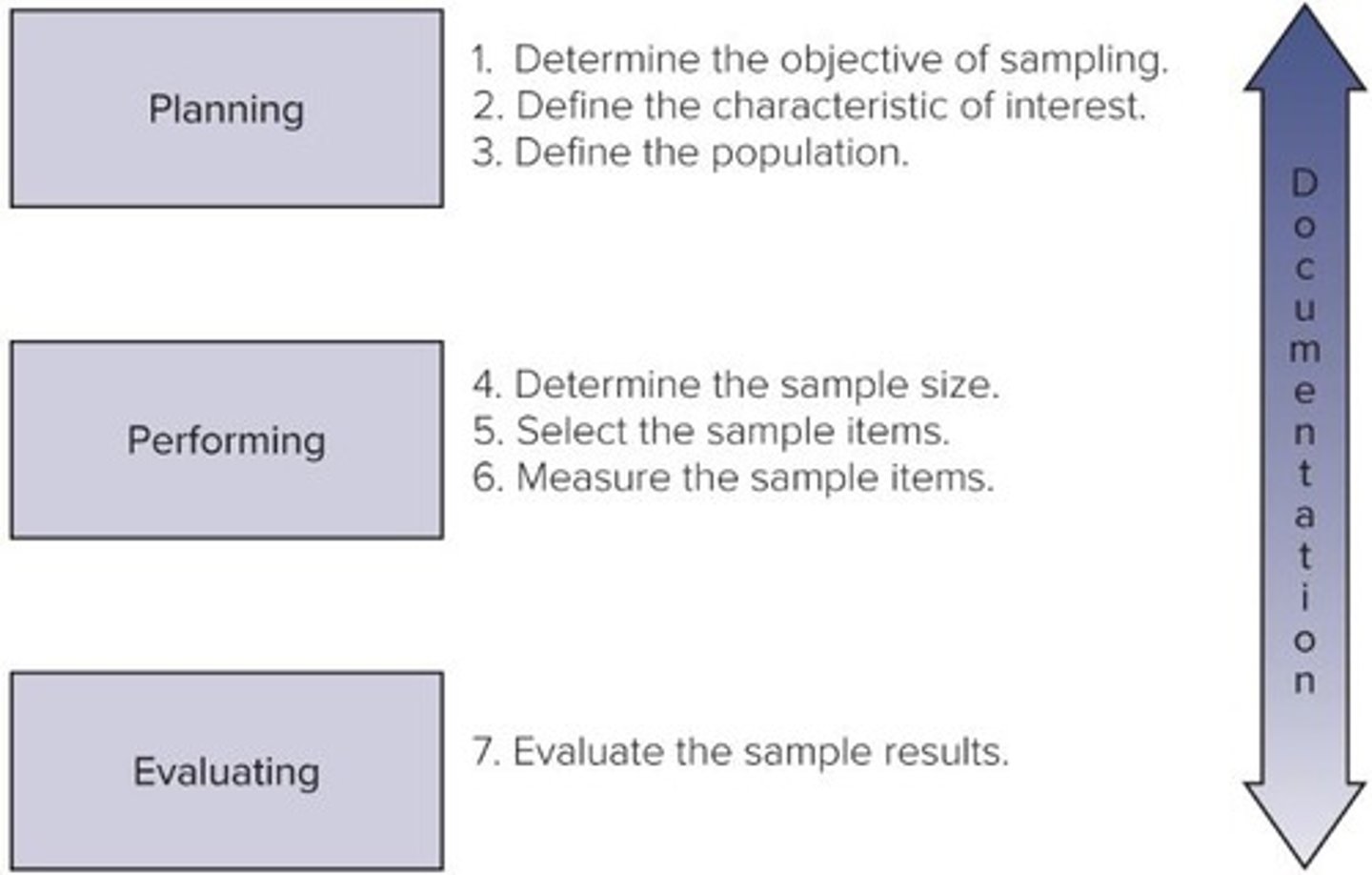
What is the first step in planning attributes sampling?
Determine the objective of sampling, focusing on relevant assertions and control activities.
What is the second step in planning attributes sampling?
Define the characteristic of interest, specifically what constitutes an exception or deviation.
What is the definition of population in the context of attributes sampling?
The set of all items about which a conclusion is desired.
What factors influence the determination of sample size?
Tolerable rate of deviation, sampling risk, expected population deviation rate, and population size.
What is the relationship between tolerable rate of deviation and sample size?
There is an inverse relationship; as the tolerable rate of deviation increases, the sample size decreases.
What is nonsampling risk?
The risk that the audit team's sample provides an incorrect conclusion for reasons other than representativeness of the sample, such as auditor error.
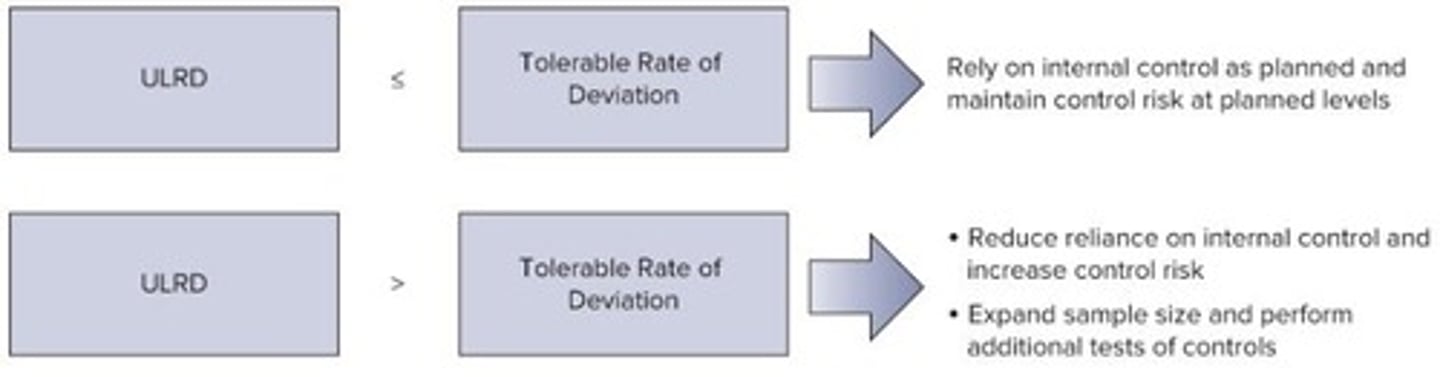
What is the sample rate of deviation?
The extent of variations found in the audit team's sample.
What is the upper limit rate of deviation?
Adjusts the sample rate of deviation to include an acceptable amount of sampling risk.
What should be considered when evaluating sample results?
Qualitative evaluations of deviations, including whether they are pervasive or isolated, intentional or unintentional.
What is the purpose of selecting sample items?
To ensure the sample is representative of the population.
How can samples be selected?
Samples can be selected randomly (unrestricted or systematic) or haphazardly.
What is the significance of measuring sample items?
It involves examining the evidence and performing the test to assess the sample's characteristics.
What is the impact of population size on sample size?
For populations of a certain size, any increase has a minimal effect on sample size.
What is attribute sampling?
A method used to determine whether a specific attribute is present in a population, often with an expected population deviation rate of 0 percent.
What is discovery sampling?
A type of attribute sampling where if an exception is found, the control is deemed ineffective.
What is variables sampling?
A sampling method used to estimate the amount or value of a characteristic in a population, typically for substantive procedures.
What are the two types of variables sampling?
Probability proportional to size sampling (PPS) and classical variables sampling.
What is Probability Proportional to Size (PPS) sampling?
A method where individual dollars are selected, and the entire related transaction is tested.
What is a major advantage of PPS sampling?
It requires smaller sample sizes than classical variables sampling and effectively identifies misstatements in accounts with overstatements.
What is a disadvantage of PPS sampling?
It provides a more conservative estimate of misstatement and is not effective for identifying understatements.
What is the first step in planning for variables sampling?
Determine the objective of sampling, which is to provide evidence regarding the fairness of relevant assertions.
What is the second step in planning for variables sampling?
Define the characteristic of interest, which is the difference between the recorded value and the audited value.
What is the third step in planning for variables sampling?
Define the population, which consists of individual dollars in the account.
What factors determine the sample size in variables sampling?
Tolerable misstatement, sampling risk, expected misstatement, and population size.
What is systematic random selection in sampling?
A method where a random starting point is chosen, and a sampling interval is used to make selections.
How is the sampling interval calculated?
By dividing the population size by the sample size.
What is the purpose of measuring sample items in variables sampling?
To perform tests and calculate the amount of misstatement for each sample.
What is the upper limit on misstatements in evaluating sample results?
It includes projected misstatement, incremental allowance for sampling risk, and basic allowance for sampling risk.
What is the risk of incorrect acceptance in sampling?
The risk that a sample will incorrectly indicate that the population is acceptable when it is not.
What is targeted testing in sampling?
An approach that combines targeted testing with nonstatistical sampling techniques.
What is the challenge with handling projected misstatements above the tolerable misstatement threshold?
It can be complex and requires careful consideration in audit sampling.
What is the significance of ensuring completeness and accuracy of the population prior to sampling?
It is crucial for obtaining reliable and valid sampling results.
What is the role of assertions in audit sampling?
Assertions determine the type of substantive procedures used and the nature of items selected for sampling.

What is the relationship between tolerable misstatement and sample size?
There is an inverse relationship; as tolerable misstatement increases, sample size decreases.
What is the relationship between expected misstatement and sample size?
There is a direct relationship; as expected misstatement increases, sample size increases.

