Genetics and Behavior
 Call Kai
 Learn
Learn Practice Test
 Spaced Repetition
 Match
Match Flashcards
 Knowt Play
1/20

Earn XP
Description and Tags
Name | Mastery | Learn | Test | Matching | Spaced | Call with Kai | Chat |
|---|
No analytics yet
Send a link to your students to track their progress
21 Terms
most traits are _____ and cannot be traced to a single gene.
polygenetic
why do polygentic traits show high variability?
because many genes contribute to the trait,creating many possible genetic combinations and a wide range of outcomes
like people aren’t just short or tall many genes contribute to this so there is a huge range from short to slightly short to average to a little tall to tall to very tall
_______ ______ are trying to figure out how much do genes matter for difference between people and how much does environment matter?
behavioral geneticists (try to tease apart nature vs. nurture to see why people differ)
they know genes + environment work together to influence development but they want to estimate how much genetic differences and environmental differences contribute to why people vary
explain twin studies and adoption studies. Why do behavioral geneticist use them?
Behavioral geneticists use twin and adoption studies to tease apart genetic (nature) and environmental (nurture) contributions to development
Twin studies: compare identical twins (share 100% of DNA) with faternal twins (share about 50% of DNA). if identical twins are more similar on trait, this provides evidence that genetic differences contribute to that trait’s variation
Adoption studies: compare adopted children with their biological relatives (shared genes) and adoptive relatives (shared rearing environment). Resemblance to biological family provides evidence for genetic contribution, but resemblance to adoptive family can provide evidence for environmental contribution
why can’t behavorial geneticists say that greater similarlity among idential twins “has to be” caused by genetics?
because social sciences doesn’t do causation, we correlation and say it can be in association with genetic varation but there can be so many other factors contributing to this like environmental factors etc
simlarly with adoption like for example lets say a adopted child is similar to their bio parents in anxiety
we can say compared to their adopted fam there is evidence that gentic differences may contribute to theiir anxiety
same thing like if adopted child is similar to adopted family
we could say there is evidence that a shared environment may contribute to this trait.
__________ the same genotpye can produce different phenotypes depending on the environment
norm of reaction
phenotype: observable/measurable characteristic/outcomes
genotype: genetic make up/DNA
How does norm of reaction relate top behavioral genetics
it shows that genetic effects depend partly on the environment: the same genotype can lead to different phenotypes in different environments
reminds us same genes do not guarnteee same outcomes like twins separated at birth
____: child has no control over it (parent provides both the child’s gene and help create the child’s environment)
passive effects
draw out the direct genetic pathway of passive effects
parent genotype( parent has genes)——- passes some genes to child (child genotype)——- child phenotype (those genes contribute to child’s characteristics)
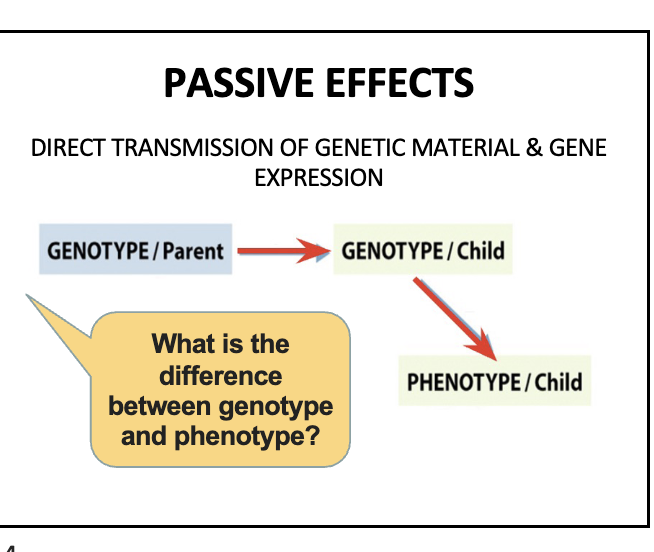
give an example of the direct genetic pathway of passive effects
tall parents (parents genotype) pass genetic variant of being tall/height to thier child (child genotype), child then grow tall (child phenotype)
draw out the indirect shaping of environment pathway of passive effects
Parent’s genotype (the parents genes contribute) ——— parent phenotype——( to characteristics of parent)——— child’s environment (those characteristics influence the environment the parent creates)———- child phenotype ( which then affects childs characteristics)

give an example of the indirect shaping of environment pathway
mom is naturally athletic
parent genotype: she has genetic characteristics that contribute to her athletic ability
phenotype of parent: she loves sports, excerises, etc
child environment: because mom is athletic, the house is filled ith sports stuff, they go outside, mom puts child in soccer and they wtach sports
child’s phenotype: child develops athelic skills
draw out the environmental forces on gene expression pathway of passive effects
so here parents genes are passed to child and childs genes are expressed through their phenotype but now we take the parents out of the picture. Different from indirect shaping of environment because now parent isnt contributing to environment. IT IS MORE SO WHAT DOES MY ENVIRONMENT DO TO MY DEVELOPMENT
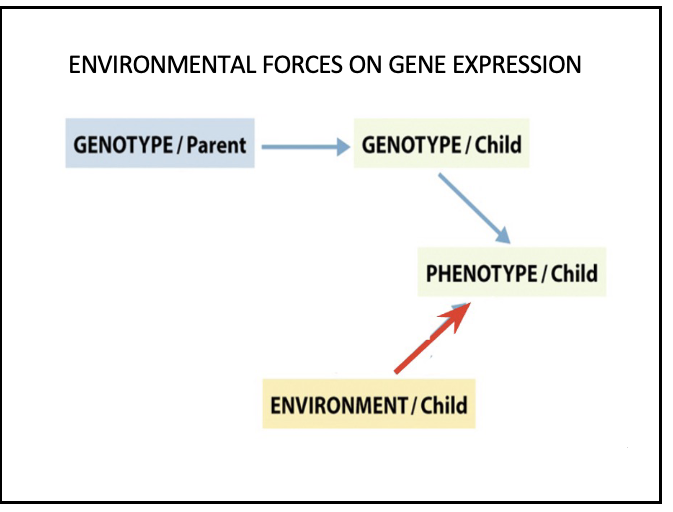
what idea does the environmental forces on gene expression pathway of passive effects relate to
norm of reactions because the genotype is the same but environment could be different like twins separated at brith. both may have in herited the gene of athelticism but one may have been more exposed to it int heir environment while another was less exposed so the genes are expressed different which effects phenotype
______: child shapes their environment
active effects
draw out the active effect
parent genotype is ——— passed down to child (child genotype)——— which is expressed in their phenotype ———- which then child impacts their environment

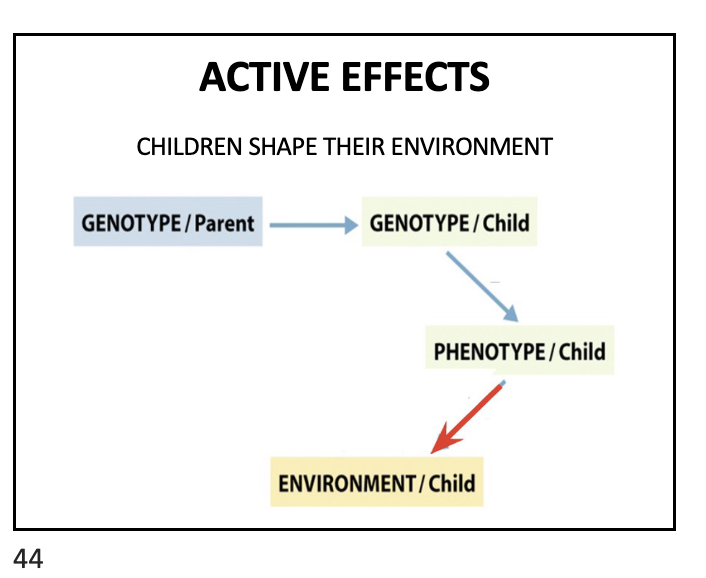
what does the arrow from child phenotype pointing to environment child mean
the childs own characteristics influence the kind of enviroments they want to experience
BEFORE passive effects parent created conditions and environment for child here
ACTIVE child helps/choose their on conditions and environment
give an example of an active effect
a child who is natrually energtic and enjoys phsycial activity may choose to join soccer and spend time with other athletic childer. their characteristics helped shape the environment they experiences
what are the characteristics of the active child we may see in active effects
evocative effects (treatment of others)
niche picking( choosinf environment i want to be in)
______= the environment can change how your genes are expressed without changing the actual DNA sequence
epigenetics

give an example of epigentics
Imagine two children have genes involved in regulating the body's stress response.
One child grows up experiencing long-term, severe stress.
Think of epigenetics like the body saying:
🌎 “We are experiencing stress ALL the time. I need to adjust how I use some of these genes.”
That prolonged environment can cause epigenetic changes that make certain stress-related genes more or less active.
That can then contribute to how strongly the child's body responds to stress later.
My environment isn't changing WHICH genes I have; it's influencing HOW some of my genes are expressed, which can contribute to differences in my phenotype.