THE WATER CYCLE
 Call Kai
 Learn
Learn Practice Test
 Spaced Repetition
 Match
Match Flashcards
 Knowt Play
1/66

There's no tags or description
Looks like no tags are added yet.
Name | Mastery | Learn | Test | Matching | Spaced | Call with Kai |
|---|
No analytics yet
Send a link to your students to track their progress
67 Terms
What is the hydrological cycle?
The hydrological cycle is the continuous movement of water between the atmosphere, land and oceans
It is a closed system meaning there are no external inputs or outputs
What are the processes of the hydrological cycle?
EVAPORATION - The sun evaporates surface water into vapour
CONDENSATION - Water vapour condenses and precipitates
FLOWS - Water runs off the surface into streams and reservoirs or beneath the surface as ground flow
How is the hydrological cycle powered by the sun?
The sun heats water in the oceans / land and evaporation occurs
Water vapour then rises into the atmosphere and condenses to form clouds - this drives the atmospheric circulation
Cloud droplets then fall back to earth as precipitation
How does the hydrological cycle use energy exchange to fluctuate human temperatures?
As water evaporates, it uses energy from its surrounding to perform this process
This cools the environment
The reverse happens when water condenses (heat is released)
This heat exchange influences the local climate
What is water defined as?
A colourless, tasteless, transparent, odourless liquid that forms the seas, rivers and precipitation
Freshwater makes up 2.5% of all earths water and approximately 1.6% of the freshwater is locked away - 68.7% of the fresh ice is within the cryosphere, the remaining 30.1% is ground water
What are the major stores of water?
Frozen water in the cryosphere = 68.7%
Groundwater in the lithosphere = 30.1%
Liquid water in the hydrosphere = 1%
Water vapour in the atmosphere = 0.2%
Water is stored unevenly around the globe because of the uneven ratio of land to sea and permeable (allows water to pass through) or porous (has spaces to store water) rock which enable aquifers to form
What are Annual fluxes?
Annual fluxes are the variations in flows due to temperature, seasons and location
Flows such as evaporation will be greatest in warmer areas due to increased heating from the sun, e.g at the equator
This then leads to high rates of precipitation at the equator, too
Stores such as ice caps will be getting smaller as a result of climate change, whereas ocean stores will be increasing for the same reason
What is the global water budget?
The global water budget is the difference between the inputs and the outputs from the different stores
Water is stored for varying amounts of time
What is residence time?
Residence time is the time water is held in a store
What is the size of water stores and residence times dictated by?
FLOWS / TRANSFERS: such as evaporation e.g heavy rainfall with little evaporation —> soil water store grows
GLOBAL FACTORS: Climate change e.g melting of glaciers and ice sheets as temperatures rise
LOCAL FACTORS: Such as human activity on a hill slope due to the changing of interception and infiltration
What happened to the water stores during the ice age (18,000 years ago)?
Roughly a third of earths surface was covered in ice sheets and glaciers
This increased the magnitude (size) of the cryosphere’s stores
But, it lowered the hydrosphere’s store (no flow of liquid water), and sea levels were over 100m lower than the present day
What is the global atmospheric circulation system?
The large-scale movement of air that redistributes heat from the equator to the poles
It also drives the formation of clouds and types of precipitation
What is the process of the Inter-Tropical Convergence Zone (ITCZ)? - low pressure
1) The equator receives more isolation, resulting in higher temperatures, causing high rates of evaporation
2) As the warm, moist air rises, it cools, condenses and forms banks of towering clouds with heavy rainfall
3) This area is a low-pressure zone known as the Inter-Tropical Convergence Zone (ITCZ) (the thermal equator)
4) It brings intense low pressure rain / monsoon conditions with its movement
5) This shows how water changes over time and in different places around the world, including how it is stored and moved
What is the positive feedback loop of the cryosphere?
Melting of the ice sheets adds water to the hydrosphere of the oceans
Ice shelves are further destabilised, which triggers ice carving (glaciers wear away rock as they move); these icebergs melt, adding to the hydrosphere stores and rising sea levels
This is a positive feedback loop (a change makes itself stronger)
What is water balance?
Water balance refers to the relationship between inputs and outputs of water in a system
Shows how much water is stored in a system
What is positive vs negative water balance?
POSITIVE:
Ground stores fill with water which results in increase surface run off, higher discharge and higher river levels
NEGATIVE:
In drier seasons, evapotranspiration exceeds precipitation, as plants absorb water, ground stores are almost empty - this produces a water deficit at the end of a dry season
What is a water surplus?
A water surplus is when there is more water entering a system than leaving it (soil becomes saturated)
Water surplus = Precipitation > Evapotranspiration
What does soil water budget show and what is it dependent on?
Shows the balance between inputs and outputs of soil store over a year
The budget depends on soil depth, type, texture and permeability
What is river discharge and its equation?
The volume of water moving past a point in a river per given time (m³ / sec or cumecs)
Q = A x V - “Q” is the discharge in cumecs, “A” is a cross-sectional area in m² and “V” is the velocity in m/s
What is the level of discharge influenced by?
Rate of precipitation
The speed at which water transfers to the river across the drainage basis
What are hydrographs and their types?
Hydrographs = used to measure discharge
Types:
Annual
Storm
What is an Annual Hydrograph (river regime)?
Annual hydrograph shows how river discharge changes over a whole year - measured in cumecs
Different conditions in different locations produce different levels of discharge over the course of a year
They may show marked seasonal peaks and low flows, greatly influenced by changes in precipitation, temperature, vegetation and geology
What is a storm hydrographs?
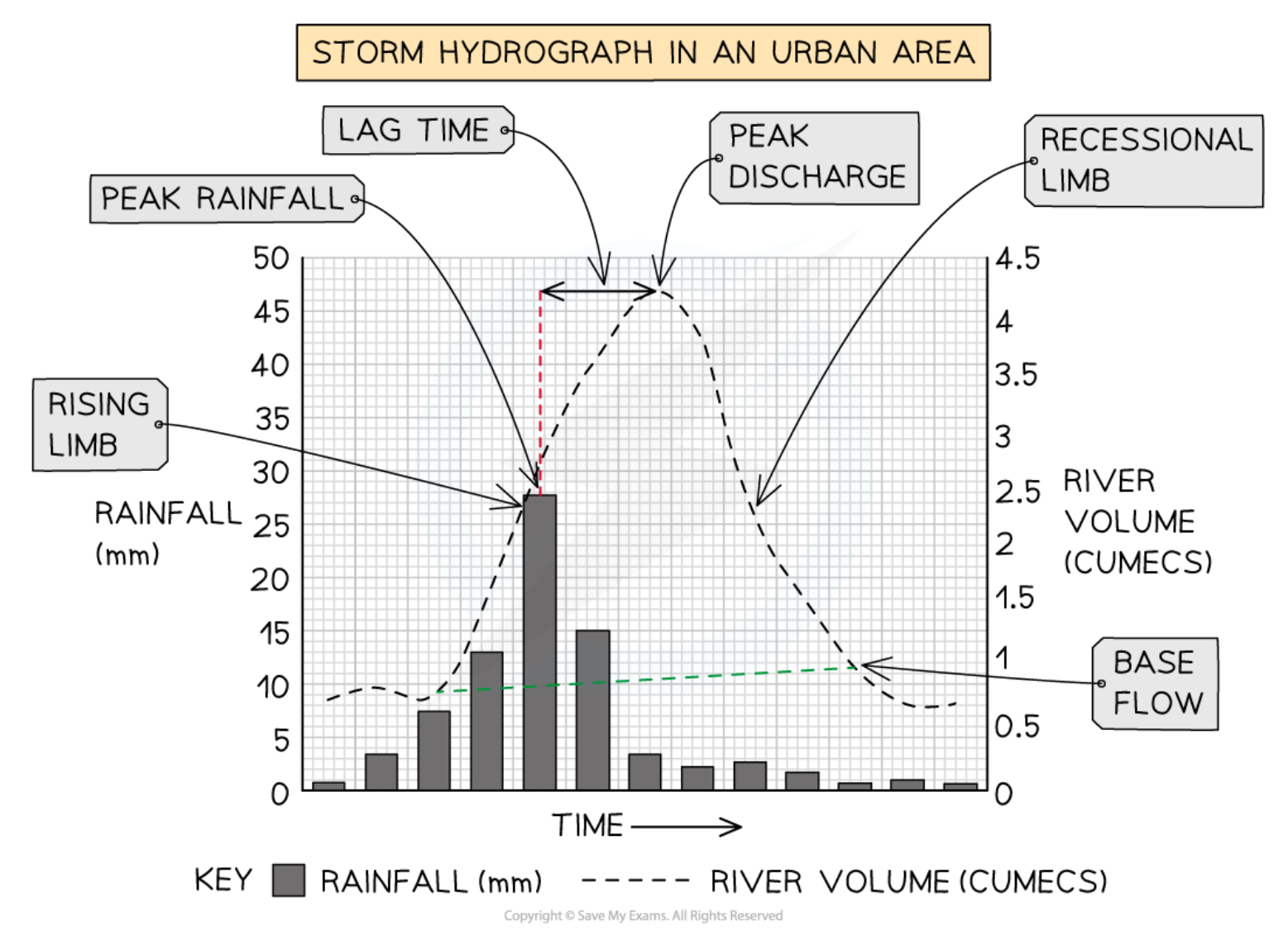
Show changes in a rivers discharge during and after a storm
Usually, they are drawn to show how a river reacts to an individual storm
They compare two variables - rainfall received during an event in mm and river discharge m³ / sec
Each storm hydrograph has a series of parts
What is the water balance equation?
Precipitation (P) = Total run off (O) + Evapotranspiration (E) ± Changes in storage (S)
P = O + E ± S
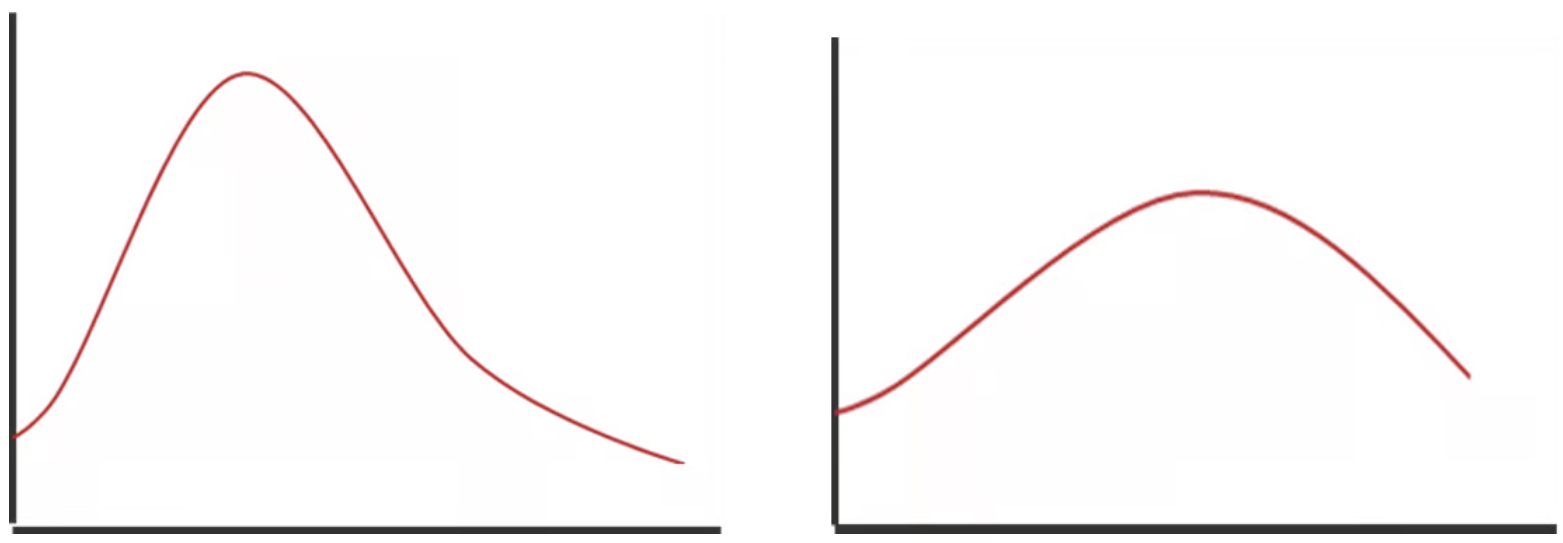
What is a flashy vs flat hydrograph?
Flashy - shows short lag time with high peak discharge
Flat - low peak discharge
What are the 3 different types of droughts?
Meteorological
Hydrological
Agricultural
When do these droughts occur and what causes them?
Meteorological = Occurs when there is a rainfall deficit - caused by changes in atmospheric circulation leading to:
A lack of precipitation as a result of short-term changes or longer-term trends
The lack of rainfall is often combined with high temperatures which increase evaporation
Agricultural = Occurs when there is a water deficiency in the soil which leads to:
Crop failure
Reduced biomass (organic material)
Hydrological = Occurs when there is a lack of water stored on the surface and underground in lakes, rivers, reservoirs and aquifers
What is the ENSO cycle?
The ENSO cycle is the movement of a warm water mass in the equatorial Pacific Ocean
Two phases:
El Niño
La Niña
(El Niño phases occur more frequently than La Niña)
What is the process of El Niño?
El Niño occurs when the sea temperatures are 0.5°C above average
This leads to warmer than average weather in the eastern pacific e.g Mexico, USA, Canada
The peak is usually in December
It occurs every 2 - 7 years
The temperature of the ocean off the coast of Peru rises an average of 6 - 8°C, causing thermal expansion and sea level rise
Water off the coast of Australia and Indonesia is cooler and precipitation is reduced leading to droughts in Australia
What are the causes of El Niño?
In an El Niño year, the trade winds are reduced or reversed (going west to east) leading to a reversal of the conditions and rising air over the eastern Pacific and descending air over the western pacific
What are the impacts of El Niño?
Increased rainfall and flooding in South America, Africa and the south of the US
Drought in Australia and Southeast Asia
Has been linked to a higher risk of colder winters in the UK
What is the process of La Niña?
La Niña occurs when sea temperatures fall below average
This brings cooler and drier than average weather in the eastern Pacific
La Niña occurs every 3 - 5 years
What are the causes of La Niña?
Stronger than usual eastward trade winds and ocean currents
These bring cold water to the surface through upwelling
What are the impacts of La Niña?
Increased rainfall in Australia and Southeast Asia
Drought conditions in the south of the US
Increases the risk of tropical storms in the Atlantic
What is the main way that human activity increases the risk of drought?
Over abstraction of:
Surface water recourses
Ground water aquifers
Over abstraction occurs due to:
Population growth - this increases the demand for both food and water
Over-cultivation (when land is farmed too intensively)
Why does deforestation increase the risk of drought?
Because deforestation reduces the ability of soil to retain water
What are the impacts of droughts on Forest Ecosystems?
Drought conditions lead to forest stress
Younger trees die, reducing tree cover
Transpiration is reduced and this decreases precipitation and humidity
This leads more trees to die
The forest becomes less resilient
Trees become more susceptible to pests and diseases
Wildfire is more common as dry vegetation and litter covered the first floor
What are the impacts of droughts on wetlands?
The lack of precipitation causes vegetation to die, which reduces:
Infiltration
Percolation
Interception
Transpiration which in turn reduces precipitation
In Australia, the droughts led to acidification of the wetlands soils and water
The drying out of wetlands soils may contribute to climate change due to increased rate of decomposition which release carbon dioxide
What are meteorological causes of flooding?
INTENSE STORMS
These led to flash flooding (short lad time)
Precipitation rate exceeds infiltration rate increasing surface run off
Rivers capacity is rapidly exceeded
Common in mountains and semi-arid areas
PROLONGED RAINFALL
Can occur during monsoon conditions such as in south-east Asia
In parts of India, 75% of their annual rainfall occurs during the monsoon
In 2019, severe monsoon rainfall in India led to flooding and over 1,600 deaths
There was 10% more rain than there 50 year average
Leads to the saturation of soil meaning the rainfall cannot infiltrate
Increases surface run off which means the water reaches the rivers more rapidly, increasing the risk of flood
SNOWMELT
Rapid snowmelt can lead to flooding
If the snow melts faster than the water can infiltrate then surface runoff increases - this may be due to soil which remains frozen
In March 2018 following heavy snowfall ‘Beast from the east’ there was significant flooding in areas of Cumbria, Lancashire and Yorkshire
OTHER PHYSICAL CAUSES
Geology of underlying rock - impermeable clay and granite
Tectonic activity results in dam failure or landslides which block river flows
Volcanic activity releases meltwater beneath ice sheets
Ice dams melt releasing glacial lake water
Impermeable surfaces in urban areas (tarmac)
What are human causes of flooding?
CHANGING LAND USE
Deforestation - reduces interception and infiltration
Overgrazing - removes the vegetation and so increases bare soil, which animals compact, reducing infiltration rates and increasing runoff
Farming - reduces vegetation cover
Urbanisation - increases impermeable surfaces
MISMANAGEMENT OF A RIVER CHANNEL
Channelisation - modifying the rivers natural flow - water reaches downstream areas faster and in larger volumes during peak discharge
Dams, flood walls and reservoirs - Overwhelmed dams cause flooding
What are the Environmental and Socio-Economic impacts of flooding?
ENVIRONMENTAL
Loss of crops
Loss of habitats
Pollution of waterways
Soil and bank erosion
Recharge groundwater stores
Recharge of wetlands
Move sediment and nutrients around the landscape
SOCIO-ECONOMIC
Loss of life, property and infrastructure
Road closures and loss of communication
Long-term rehoming of people
Cost of house insurance increases
Loss of income from employment, agriculture and / or tourism
Health risks from water contamination
Trauma and loss of possessions
Psychological impacts can be long lasting
What are the climate change impacts on inputs and outputs?
PRECIPITATION: Warner air holds more water, therefore, there would be an increase in rainfall frequency and intensity; areas most affected would be the tropics and high latitudes
SOIL MOISTURE: The areas with more precipitation means soil moisture will also increase - Overall impact of climate change is uncertain as many factors contribute to soil moisture levels and climate is just one factor
EVAPO-TRANSPIRATION: Increased evaporation over large land masses such as North America and Asia
What are the impacts of climate change on stores and flows?
STORE
Ice
Higher temperatures lead to negative mass balance
Shrinking of glaciers, ice caps and ice sheets
Reduction of glacial water for human use
Oceans
Possible increase in evaporation
Rise in sea levels as warmer water expands
Rise in frequency and intensity of tropical cyclones
Storage capacity increased by meltwater
Permafrost
Melting of permafrost and release of methane to the atmosphere, increase of greenhouse effect (positive feedback)
Surface runoff and stream flow
Increased low and high flow events (drought and floods)
Reduced infiltration with increased surface runoff
Soil moisture
Little change
What is water insecurity, water stress, water scarcity and
absolute water scarcity?
WATER INSECURITY = The lack of a reliable source and acceptable quality and quantity of water
WATER STRESS = Difficulty in accessing sufficient useable water for daily needs - It’s about pressure on water resources - 1000 to 1700m³ per person per year (e.g Pakistan has 1000 to 1300m³)
WATER SCARCITY = When the supply of water does not meet the demand - 500m³ per person per year (e.g Tunisia has 486m³)
ABSOLUTE WATER SCARCITY = Extremely limited water available to meet basic human needs - 0m³ per person per year (e.g Yemen has 125m³)
What is economic water scarcity?
Economic water scarcity occurs when there is water available but the infrastructure is not available to access the water
About 1.6 billion people face economic water scarcity
What is physical water scarcity?
Physical water scarcity occurs when there is a greater demand for water than there is supply
An estimated 4 billion people face severe water scarcity for at least one month a year
What are the physical and human causes of water insecurity?
PHYSICAL
Climate variation - can lead to drought which therefore reduces the amount of water available
Saltwater encroachment (when sea water moves into freshwater supplies, especially in coastal aquifers when sea levels rise) - reduces freshwater supply and water becomes saline (salty)
HUMAN
Over-abstraction (when more water is taken than is naturally replaces by precipitation) - Excessive withdrawal lowers water levels - leads to less reliable water supply for people, farming and industry
Jakarta and Beijing are sinking as a result of past over-abstraction of groundwater which is causing subsidence (lowering of ground surface)
What is the leading cause of water contamination?
A lack of sanitation
In developing countries, 90% of sewage flows untreated into water sources
How does agriculture affect water contamination and how will it worsen in the future?
Agriculture discharges large quantities of agrochemicals, organic matter, drug residues and sediment into water sources
As the world population increases, so does the amount of agriculture, further increasing the agricultural population
In the EU almost 40% of water sources are impacted by agricultural pollution
Cattle meat production has doubled since 1961, leading to increased manure
How does industrial pollution affect water contamination?
Every year, 300 to 400 megatonnes of waste is discharged by industry into the water system
In many countries, factory waste is discharged into water sources untreated due to a lack of regulations and a failure to challenge industries
It is estimated that 80% of Chinas groundwater is polluted
This has led to 70% of rivers and lakes to be unsafe for human use
What are the pressures on water resources?
POPULATION GROWTH
There are now over 8 billion people
Each person requires about 2 litres of clean drinking water a day to remain in good health
In addition, 18 litres per person is needed for things like sanitation and cooking
Population growth also increases the use of water for:
Energy production
Agriculture
Industry
ECONOMIC DEVELOPMENT
As countries develop, the demand for water increases because:
People have more items that use water such as dishwashers, toilets and showers
Industry increases and factories use larger quantities of water
Intensive agriculture is needed as more people eat more food, and irrigation systems (artificially watering crops) use larger quantities of water
As more people move to urban areas, the demand for water for drinking and sanitation increases
What will the future of water shortages be a result of?
Climate change
Increased demand (pop. growth)
Pollution / industry
The UN predicts that 5 billion people or two thirds of the population will face at least one month a year of water shortages
What is blue water?
Refers to the fresh liquid water found in rivers, streams, lakes and groundwater
What are the causes of water scarcity?
Lack of annual or seasonal precipitation
Lack of investment and management of water infrastructure to meet demand
Scarcity may also be a social construct due to wealth, expectation and usual behaviour
What is the impact of water supply for agriculture?
Agriculture dominates water usage
20% of the Earths land is fully irrigated (artificially watered)
The majority of this water is pumped from aquifers which is leading to irreversible groundwater depletion (removal of water faster than it can be replenished)
Areas of greatest groundwater depletion are in India, Pakistan, USA and China
Groundwater irrigation eventually discharges into the worlds oceans, and contributes to sea level rise
Why does water conflict happen?
Competing demands for:
Irrigation
Energy
Industrial
Domestic
Recreation (activities)
What are the hard-engineering schemes to increase water supply?
Water transfer schemes
Mega damns
Desalination plants (removing salt and other impurities from sea water)
What are water transfer schemes?
They move water from areas of surplus (plenty of water) to areas of deficit (lack of water)
Done by constructing systems of canals, pipes and dredging (removing sediment from the bottom of rivers, lakes or harbours) over long distances
What are mega-dams and what do they do?
Mega dams = Very large scale dam built across major rivers to store and control huge amounts of water
They provide large, reliable supplies of drinking water and reduce water insecurity, especially in areas of season precipitation
They also prevent flooding as the flow of river is controlled, and can generate electricity through hydroelectric power (HEP)
What are the negative consequences of dams?
Dams alter ecosystems - downstream ecosystems rely on water and sediment, both of which are held back by big dams, making downstream land less fertile
Dams displace people, communities and destroy cultural heritage
Flooding of the reservoir submerges land and destroys plants and animals
Dams reduce water quality and waste water - large surface areas of reservoirs increase rates of evapotranspiration and trap sediment and agricultural runoff, increasing diseases
What are desalination plants and what do they do?
Desalination plants extract the salt from seawater to enable it to be used for drinking and irrigation
What are the negative consequences of desalination plants?
Expensive, salt waste can damage marine ecosystems
The process uses large amounts of energy
Although it is a sustainable process, it is considered a hard engineered process due to the impute of technology and energy and it has an ecological impact on marine life
Sustainable water management aims to…
Minimise wastage and pollution
Provide access to safe potable water at an affordable price to all
Consider the views of all stakeholders
Guarantee an equal distribution of water between and within countries
What are the sustainable schemes of water supply / water conservation and what do they do?
SMART IRRIGATION
Replace traditional irrigation methods of sprinklers and surface flows with automated spray technology and drip irrigation systems
RAINWATER HARVESTING
Precipitation is collected from roofs and stored in water butts for repurposing in toilets and watering gardens
RESTORATION OF DAMAGED LAKES, RIVERS AND WETLANDS
To return them to their part in the natural water system
FILTRATION
Used to remove the finest particles from dirty water, making it safe to drink again
What is irrigated drainage basin management?
Aims to treat a river basin holistically to ensure 3 things:
Water is used to maximum efficiency
Equal distribution
Conserve the environmental quality of rivers and its catchments
What is a transboundary?
A river, lake or aquifer that crosses two or more political boarders between countries and regions e.g The River Nile

