Botany 301 (UNIT 1)
 Call Kai
 Learn
Learn Practice Test
 Spaced Repetition
 Match
Match Flashcards
 Knowt Play
1/75

Name | Mastery | Learn | Test | Matching | Spaced | Call with Kai | Chat |
|---|
No analytics yet
Send a link to your students to track their progress
76 Terms
UNIT 1 (PART 1)
I believe in you!
What are the primary organs of a plant?
Roots, shoots, and Leaves
What are the two main functions of roots?
Anchorage and absorption of water and nutrients.
Which vascular tissue transports water and minerals from the roots?
Xylem
Which vascular tissue transports sugars (photosynthates) from the leaves to the rest of the plant?
Phloem
Xylem vs Phloem
Xylem: moves water and minerals (mostly upwards)
Phloem: moves sugars (photosynthates) through out the plant [source → sink]
Besides transporting materials, what is another major function of stems?
Provide structural support and connect the vascular tissues between roots and leaves.
What three ingredients are needed for photosynthesis?
CO2, H2O, & Sunlight
What two products are produced during photosynthesis?
Glucose and Oxygen
Why is photosynthesis considered the most important chemical reaction for life on Earth?
Because it converts sunlight into chemical energy, produces oxygen, and creates the organic molecules that support nearly all life.
What four major classes of organic molecules are ultimately produced from photosynthesis?
Carbohydrates
Proteins
Lipids
Nucleic acids
Why are proteins especially important in living organisms?
Many proteins are enzymes that regulate nearly all biochemical reactions (photosynthesis, cellular respiration, & DNA replication, etc.).
Name five ways plants are important to humans.
Examples:
Oxygen
Food
Medicine
Building materials
Fuel
Environmental services
Cultural connection
aesthetic value
Happiness!
Why is oxygen produced during photosynthesis essential for humans?
Photosynthesis releases oxygen into the atmosphere. Most living organisms (humans) need this oxygen to survive, and some of it forms the ozone layer, which protects Earth from harmful UV radiation.
Give two examples of ecosystem services provided by plants.
Examples:
Carbon storage
Water filtration
Prevent soil erosion
Habitat for wildlife
Shoreline protection
A forest is removed from an area.
Name three ecosystem functions that may be negatively affected.
Possible answers:
Less carbon storage
Increased erosion
Habitat loss
Reduced biodiversity
Poorer water quality
Name four major threats facing plants today.
Examples:
Habitat loss
Pollution
Climate change
Population growth
Altered fire regimes
How are plants organized from smallest to largest?
Cell → Tissue → Organ → Organ System → Organism
Every plant organ contains which three tissue systems?
Dermal tissue system
Ground tissue system
Vascular tissue system
What is any given tissue made of?
one or more cell types that work together to perform a specific function.
How are plant organs, tissues, and cells related?
Each plant organ (roots, stems, and leaves) contains three tissue systems (dermal, ground, and vascular), and each tissue system is made of one or more specialized cell types.
Which four structures are found in plant cells but not animal cells?
Cell wall
Large central vacuole
Plastids
Plasmodesmata
UNIT 1 (PART 2A)
You got this!
Which plant cell structure stores water and helps maintain cell pressure?
The large central vacuole stores water and helps maintain turgor pressure, which supports the plant.
What is the structure of a plant cell vacuole?
A vacuole is a large compartment filled with aqueous (water-based) contents and surrounded by a single membrane called the tonoplast.
What are the seven major functions of the vacuole?
The vacuole functions in:
Storage
Defense
Reproduction (pigmentation)
Protection
Recycling cellular materials
Cell growth
Support (turgor pressure)
What types of substances are commonly stored in the vacuole?
The vacuole stores:
Amino acids
Proteins
Sugars
Organic acids
Inorganic ions (Ca²⁺, K⁺, Cl⁻, Na⁺, HPO₄²⁻)
How does the vacuole help defend the plant?
The vacuole can store toxic defensive chemicals such as alkaloids, terpenes, phenolics, and calcium oxalate crystals (druses and raphides) that help protect the plant from herbivores.
Give four examples of alkaloids found in plant vacuoles.
Nicotine
Caffeine
Cocaine
Tropane alkaloids
How does the vacuole contribute to pollination?
The vacuole stores water-soluble pigments (anthocyanins) that give flowers bright colors and attract pollinators.
Besides attracting pollinators, what else do anthocyanins help protect?
Anthocyanins protect young buds and aging leaves from UV damage and may also reduce insect attraction because many insects do not see red well.
How does the vacuole contribute to plant growth?
As the vacuole enlarges and fills with water, it causes the cell to expand, making it an important driver of cell enlargement.
Why do plants wilt when they lose water?
Water leaves the vacuoles, causing cells to lose turgor pressure, which makes the plant wilt.
What is a plastid?
A plant organelle that performs specialized functions such as photosynthesis, pigment production, storage, and the synthesis of important molecules.
Common types of plastids include chloroplasts, chromoplasts, and leucoplasts(such as amyloplasts, proteinoplasts, and elaioplasts).
Different plastids carry out different functions and all develop from proplastids.
What structural features are shared by all plastids?
Plastids:
Have a double membrane
Contain their own DNA
Divide independently of the rest of the cell
Develop from proplastids
According to the endosymbiotic theory, how did plastids originate?
Plastids evolved when a photosynthetic cyanobacterium was engulfed by a eukaryotic cell and became a permanent endosymbiont instead of being digested.
Why was the origin of plastids such an important event in plant evolution?
It gave plants the ability to photosynthesize, allowing them to produce their own food and paving the way for the evolution of modern plants.
Name five important functions of plastids.
Examples include:
Photosynthesis
Pigmentation
Amino acid synthesis
Lipid synthesis
Storage of lipids, carbohydrates, and proteins
Gravity sensing
Regulation of stomata
Can one plant cell contain more than one type of plastid?
Yes. A single cell may contain multiple plastid types, and plastids can differentiate from one type into another.
Which plastid carries out photosynthesis?
Chloroplasts:
Contain chlorophyll a and b
Produce sugars through photosynthesis
What is the function of chromoplasts?
Chromoplasts contain carotenoids and xanthophylls that provide yellow, orange, and red pigmentation and help protect against UV damage.
Which leucoplast has this primary function: Starch production and storage; gravity perception
Amlyoplast
Which leucoplast has this primary function: Protein storage
Proteinoplast (Aleuroplast)
Which leucoplast has this primary function: Oil storage
Elaioplast
What are etioplasts?
Etioplasts are plastids that develop in the dark and contain lamellar bodies that later develop into thylakoids when exposed to light.
What are gerontoplasts?
Gerontoplasts develop from chloroplasts during leaf senescence and are involved in the break down of photosynthetic pigments as leaves prepare to fall.
What is senescence?
Senescence is the series of changes that occur after an organism or plant organ reaches maturity, often leading to aging and eventual death of that organ.
What is abscission?
Abscission is the dropping of plant organs, such as leaves, flowers, or fruit.
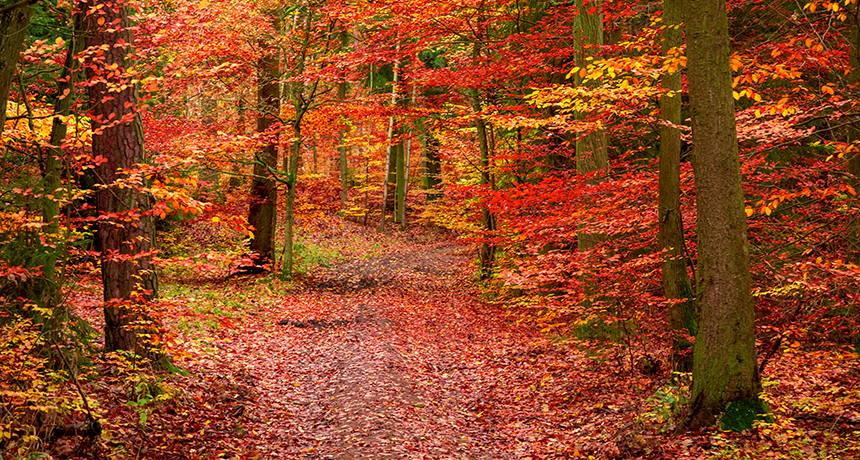
Why do leaves change color in autumn?
As chlorophyll breaks down, underlying pigments become visible. Many plants also increase production of carotenoids, xanthophylls, and anthocyanins during senescence.
What are the five major theories explaining the adaptive advantage of autumn leaf coloration?
Photoprotection Theory
Anti-Herbivory Theory
Co-evolution (Signaling) Theory
Nutrient Recovery Efficiency Theory
Detoxification Hypothesis
What is the Photoprotection Theory of autumn leaf coloration?
Anthocyanins protect leaves from excess light and fluctuating temperatures during nutrient resorption, allowing the plant to recover nutrients like nitrogen and phosphorus more efficiently before leaf drop.
What is the Anti-Herbivory Theory of autumn leaf coloration?
Bright autumn colors, especially red, may warn herbivorous insects that the tree has strong chemical defenses, reducing insect damage and overwintering pests.
What is the Co-evolution (Signaling) Theory of autumn leaf coloration?
Bright leaf colors may signal to insects that a tree is healthy and well-defended, discouraging colonization and reducing future insect infestations.
What is the Nutrient Recovery Efficiency Theory of autumn leaf coloration?
Anthocyanins may slow leaf senescence, giving the plant more time to recover valuable nutrients before the leaves are shed.
What is the Detoxification Hypothesis of autumn leaf coloration?
Anthocyanins help neutralize harmful byproducts produced during leaf senescence, protecting leaf tissues from oxidative stress while nutrients are recovered.
Gerontoplasts are plastids that develop from what?
Develop from chloroplasts during leaf senescence (aging) and are involved in the breakdown of photosynthetic pigments as the plant prepares to shed leaves.
Gerontoplasts are located where?
In aging leaves during the fall season as they lose their green color and turn yellow or red.
So, what is gerontoplasts role in the process of leaves losing their color?
gerontoplasts act as cellular "recycling centers" by breaking down the leaf's green machinery to salvage valuable nutrients before the leaf falls off.
UNIT 1 (PART 2B)
You are doing amazing!
What are the major functions of the plant cell wall?
Provides structural support
Prevents the cell from bursting
Determines cell shape and size
Acts as a selective barrier
Senses and responds to environmental stress
Stores water and regulatory molecules
What are the four main components of the plant cell wall?
Middle lamella
Primary cell wall
Plasmodesmata
Secondary cell wall (in some cells)
How is the plant cell wall formed?
The cell wall is deposited in stages:
Primary cell wall – formed first during cell expansion.
Secondary cell wall – deposited after cell growth is complete (often becomes lignified).
What is the middle lamella and what is its function?
The middle lamella is a pectin-rich layer that acts like glue, holding adjacent plant cells together.
What happens to the middle lamella as fruit ripens?
Enzymes break down pectin, weakening the middle lamella so cells separate more easily, causing fruit to soften.
Why is pectin commonly used to make jams and jellies?
Pectin is a soluble dietary fiber that forms a gel when combined with sugar and heated, giving jams and jellies their thick consistency.
What is cellulose?
Cellulose is a β-1,4 glucan, a linear polymer of glucose molecules and the most abundant organic molecule on Earth. It is the main structural component of the primary cell wall.
How does cellulose help determine the shape of a plant cell?
As turgor pressure pushes outward, strong cellulose microfibrils resist expansion and guide the cell into its final shape.
How are cellulose microfibrils produced?
Cellulose synthase enzymes in the plasma membrane produce cellulose microfibrils. These microfibrils are laid down in the same direction as microtubules, helping determine the strength and shape of the cell wall.
What are the functions of hemicelluloses, pectins, proteins, and water in the primary cell wall?
Hemicelluloses → Cross-link cellulose microfibrils.
Pectins → Form the hydrated matrix and help bind cells together.
Proteins → Modify the wall and help defend against pathogens.
Water → Moves through the wall and contributes to hydration.
What are plasmodesmata?
Plasmodesmata are cytoplasmic channels that pass through cell walls, connecting neighboring plant cells and allowing communication and transport between them.
Name the three pathways by which water moves between plant cells.
Apoplast – Through cell walls and intercellular spaces.
Symplast – Through the cytoplasm via plasmodesmata.
Transmembrane – Across plasma membranes from cell to cell.
When is the secondary cell wall formed?
After the cell has finished growing. It is deposited inside the primary cell wall and often becomes lignified.
How does the secondary cell wall differ from the primary cell wall?
Is rich in cellulose and hemicelluloses
Usually contains lignin
Lacks pectins and proteins
Is deposited after cell growth is complete
What are the major functions of lignin?
Strengthens the cell wall
Makes wood waterproof
Resists degradation
Prevents further cell growth and division once deposited
Are all secondary cell walls lignified?
No. Most are lignified, but some, such as cotton fibers, have non-lignified secondary cell walls.
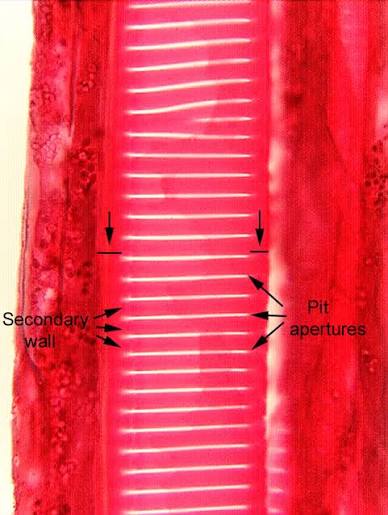
What are pits in the secondary cell wall?
Pits are areas where only the primary cell wall remains between adjacent cells, allowing transport and communication.