Unit 2-LT 14-28
0.0(0)
Studied by 10 people Call Kai
 Learn
Learn Practice Test
 Spaced Repetition
 Match
Match Flashcards
 Knowt Play
Card Sorting
1/29

Earn XP
Last updated 1:18 AM on 3/16/23
Name | Mastery | Learn | Test | Matching | Spaced | Call with Kai | Chat |
|---|
No analytics yet
Send a link to your students to track their progress
30 Terms
1
New cards
Relative Frequency
proportion of times the vent occurs out of the total number of trials
P(A)= number of times A occured/number of trials
P(A)= number of times A occured/number of trials
2
New cards

Contingency Table
P(Red)= (21+26)/(21+26+16+23)=47/86=.547
P(Male and Brown)=23/(21+26+16+23)=23/86=.267
P(Male and Brown)=23/(21+26+16+23)=23/86=.267
3
New cards
Law of Large Numbers
A procedure or event is repeated more and more times, the relative frequency approached the actual probability.
4
New cards
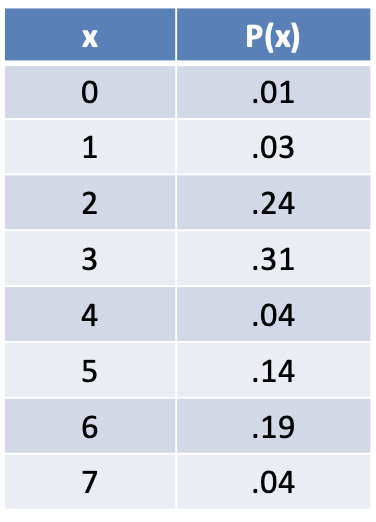
5% Rule
Rule of thumb for identifying unusual elements of a dataset.
\-Any class or neighboring classes with a total of .05 or less probability is considered unusual
\--Unusually low 0 and 1
\--Unusually high 7
\-Any class or neighboring classes with a total of .05 or less probability is considered unusual
\--Unusually low 0 and 1
\--Unusually high 7
5
New cards
Random Variable
A variable that has a single value for each outcome of an experiment. The value of the random variable is determined by chance by the outcome of the experiment.
6
New cards
Discrete Random Variable
has either a finite or countable number of values. It usually involved whole numbers, no decimals or fractions
7
New cards
Frequency Distribution
Usually present discrete random variable distributions.
8
New cards
Expected Value
of discrete random variable is denoted by E and represents the average of all possible outcomes
(Same as mean)
(Same as mean)
9
New cards
Classical (theoretical) probability
Used when each outcome in a sample space is equally likely to occur
\-situations that can be mathematically modelled
P(E)=number of outcomes in event E/
\-situations that can be mathematically modelled
P(E)=number of outcomes in event E/
10
New cards
Disjoint/mutually exclusive
cannot occur simultaneously
11
New cards
Addition Rule
applies to two or more events that are mutually exclusive
P(A or B)= P(A) +P(B)
\
Example
What is the probability of rolling a die and it landing of 2 or 5?
P(2 or 5)= P(2) +P(5)=1/6+1/6=2/6=.333
P(A or B)= P(A) +P(B)
\
Example
What is the probability of rolling a die and it landing of 2 or 5?
P(2 or 5)= P(2) +P(5)=1/6+1/6=2/6=.333
12
New cards
Not Mutually Exclusive
Must consider the common outcomes shared by the events
P(A or B)= P(A) +P(B) -P(A and B)
P(A or B)= P(A) +P(B) -P(A and B)
13
New cards
Multiplication Rule Example
What is the probability that one student will roll a 2 and another student will roll a 5?
P( 2 and 5)=P(2) x P(5)=1/6x1/6=1/36=.02777=.028
P( 2 and 5)=P(2) x P(5)=1/6x1/6=1/36=.02777=.028
14
New cards
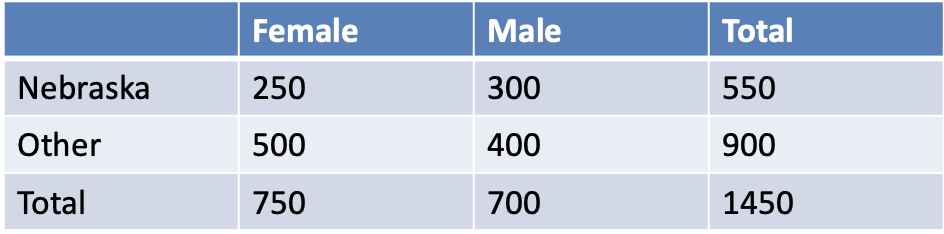
Conditional Probability
When A or B are not independent, denoted P(AlB). This means the probability of A occurring if we know B has happened.
Example
If we know that someone is a Nebraskan, what is the probability they are male?
=P(N MALE)=300/550=5.50
Example
If we know that someone is a Nebraskan, what is the probability they are male?
=P(N MALE)=300/550=5.50
15
New cards
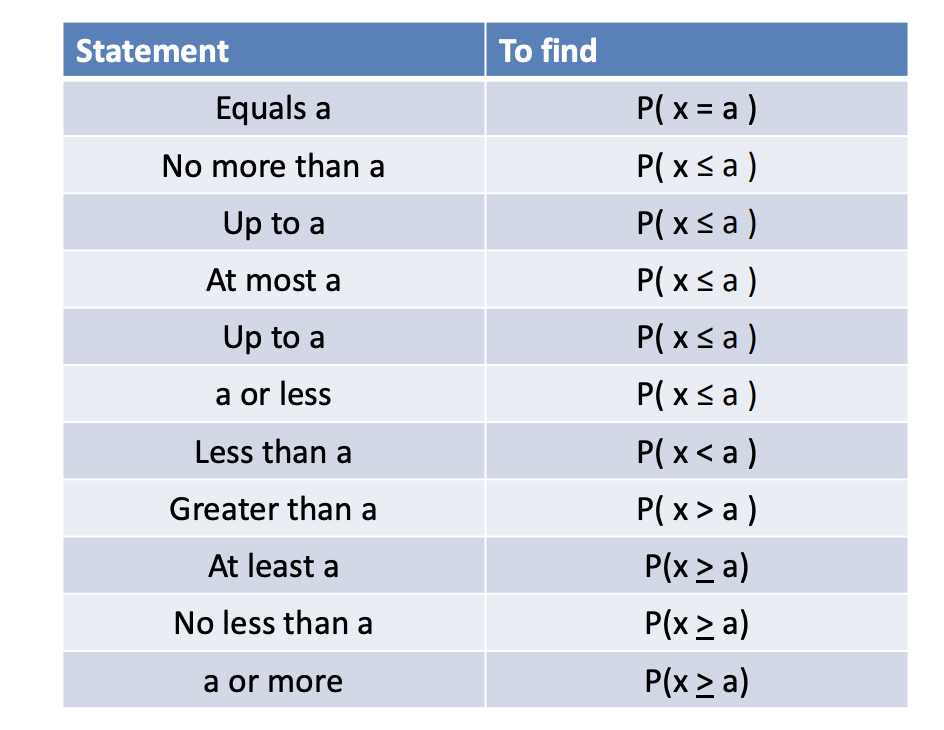
Symbolic Inequalities for Verbal Phrases
16
New cards
Poisson Distribution
Discrete Data
Must be random, must be independent, Uniformly distributed over interbal
Must be random, must be independent, Uniformly distributed over interbal
17
New cards
Binomial Probability Distribution
Discrete Data
\-each trial has one of two possible outcomes
\-The procedure has a fixed number of trials
\-The trials are independent
\-The probabilities remain constant for all trials
\-each trial has one of two possible outcomes
\-The procedure has a fixed number of trials
\-The trials are independent
\-The probabilities remain constant for all trials
18
New cards
Notation for Binomial Probability Distribution
P(S)=p probability of success
P(F)= 1 -p =q probability of failure
n is the number of trials
s is the number of successes
P(F)= 1 -p =q probability of failure
n is the number of trials
s is the number of successes
19
New cards
Continuous Random Variables
Can take on any value between two numbers
\-Typically result from measuring
\-Have infinitely many possible values spread out over an interval with no gaps
\-Usually the probability is 0 because the number of values can be infinite
\-Typically result from measuring
\-Have infinitely many possible values spread out over an interval with no gaps
\-Usually the probability is 0 because the number of values can be infinite
20
New cards
Normal Distributions
Involve continuous data
Special Characteristics- Bell shapes, symmetric, (mean,median, and mode are all the same)
Special Characteristics- Bell shapes, symmetric, (mean,median, and mode are all the same)
21
New cards
Tails
The left and right ends of the normal curve
\- never reach the baseline
\- never reach the baseline
22
New cards
Special normal called the standard normal distribution
the space between the normal curve and the baseline is equal to one square unit which allows the values of the curve points to equal probabilities for those locations
23
New cards
Normal Distribution
Asks you to determine probabilities of certain values happening within a normally distributed dataset.
24
New cards
Inverse normal distribution problems
the probability of a value or values
25
New cards
Central Limit Theorem
Uses sampling distribution
standard deviation is divided by SQRT
standard deviation is divided by SQRT
26
New cards
Estimate
A specific value or range of values used to approximate a population parameter
27
New cards
Point Estimate
A single value used to approximate a population parameter
28
New cards
Sampling Distribution
Distribution of estimates over many independent samples from the same population
29
New cards
Confidence Interval
Large number of samples are collected at a certain probability is created for each sample, approximately the required percentage of these intervals will contain the population parameter in question
30
New cards
Determining Sample Size
Use formula n = (z α/2 /(2E))2
ALWAYS round up with decimal
ALWAYS round up with decimal