planes, cross product, and span
 Studied by 0 people
 Call Kai
 Learn
Learn Practice Test
 Spaced Repetition
 Match
Match Flashcards
 Knowt Play
1/27

There's no tags or description
Looks like no tags are added yet.
Name | Mastery | Learn | Test | Matching | Spaced | Call with Kai |
|---|
No analytics yet
Send a link to your students to track their progress
28 Terms
plane through p with normal vector n consists of all points r such that
vector from p to r is orthogonal to n
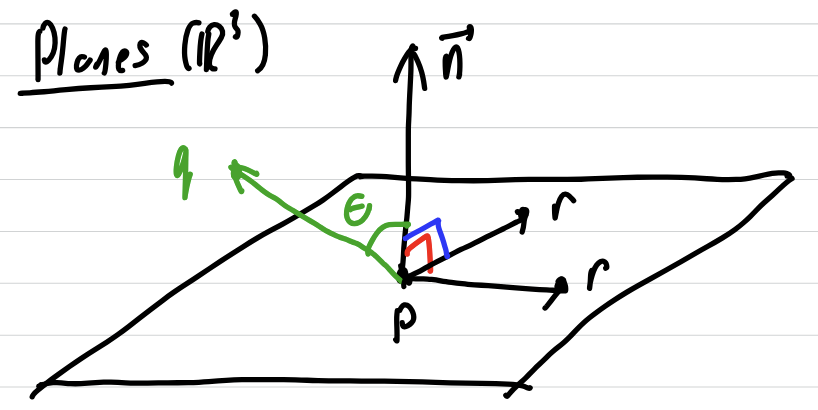
vector form of plane
n • (r-p) = 0
scalar form of plane
ax + by + cz = d
line can be described by a point p on line and a normal vector n orthogonal to line; line consists of all r such that
n • (r - p) = 0 i.e. ax + by = c
how to find parallel planes
find points p ± normalized n
planes are n • ((x y z) - p1 or p2) = 0
cross product geometrically
vector orthogonal to both u and v (that are not parallel)
-a x b =
b x a
right hand rule
curl fingers from a to b, thumb is direction of a x b
calculation of a x b =
det ( i j k in first column | components of a in second | components of b in third)
k (a x b) =
ka x b = a x kb
a x (b + c) =
a x b + a x c
(b + c) x a =
b x a + c x a
a x a =
0
magnitude of cross product
||a||||b||sinθ
a • (a x b) =
0
b • (a x b) =
0
area of a parallelogram with sides a and b is
magnitude of their cross product
volume of parallelepiped
area of the base || a x b|| * ||c||cosθ where θ is the angle between c and a x b
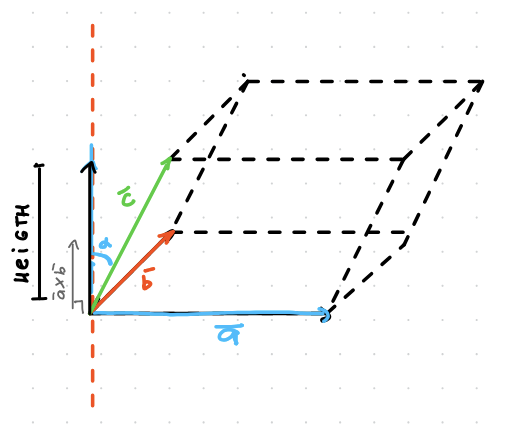
volume of parallelepiped with det
|det [ a b c ]| (the three vectors that define it)
span of vectors
all possible linear combos of those vectors
span (a, b) =
{ ta + sb | t, s are real}
span of two vectors is the xy-plane if
they are NOT collinear
span of two vectors is a line if
they ARE collinear
span of two vectors is a point if
both are zero vector
plane containing a point and a line
find line's direction vector and vector connecting point to line, cross product is plane's normal vector
equation through point perpendicular to a line
direction vector of line becomes normal vector of plane, then plug in point
vector parallel to plane intersection
cross product of two planes’ normal vectors
better volume of a parallelepiped
|a•(b x c)|
 Note
Note  Flashcards (152)