Geometric Reasoning
 Call Kai
 Learn
Learn Practice Test
 Spaced Repetition
 Match
Match Flashcards
 Knowt Play
1/19

Earn XP
Description and Tags
Geometric Reasoning to remember
Name | Mastery | Learn | Test | Matching | Spaced | Call with Kai | Chat |
|---|
No analytics yet
Send a link to your students to track their progress
20 Terms
Angle at the centre
The angle subtended by an arc at the centre is twice the angle subtended by the same arc at any point on the circumference.

Angle in a semi-circle
The angle subtended by a diameter at the circumference is always a right angle (90 degrees).

Angles in the same segment
Angles subtended by the same arc (or chord) at the circumference are equal.
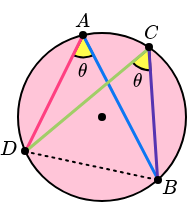
Cyclic quadrilateral opposite angles
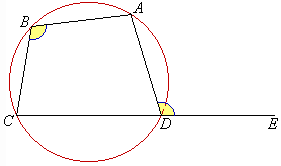
The opposite angles of a cyclic quadrilateral (a four-sided shape where all vertices touch the circumference) add up to 180 degrees.

Cyclic quadrilateral exterior angle
The exterior angle of a cyclic quadrilateral is equal to the interior opposite angle.
Tangent and radius
A tangent to a circle is perpendicular (90 degrees) to the radius drawn to the point of contact.

Tangents from an external point
Two tangents drawn to a circle from the same external point are equal in length.

Alternate segment theorem
The angle between a tangent and a chord through the point of contact is equal to the angle in the alternate segment.

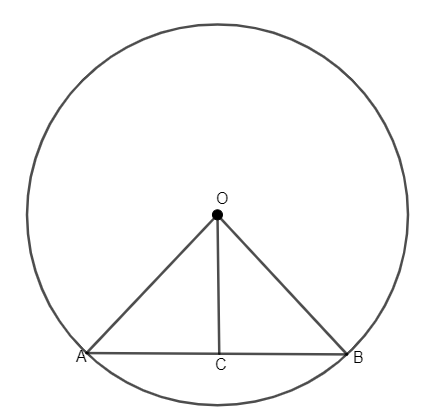
Perpendicular from centre bisects chord
A straight line drawn from the centre of a circle to bisect a chord is perpendicular to the chord.
Angles on a straight line
Angles on a straight line always add up to 180 degrees.

Angles around a point
Angles around a single point always add up to 360 degrees.

Vertically opposite angles
Vertically opposite angles formed by two intersecting straight lines are equal.

Angles in a triangle
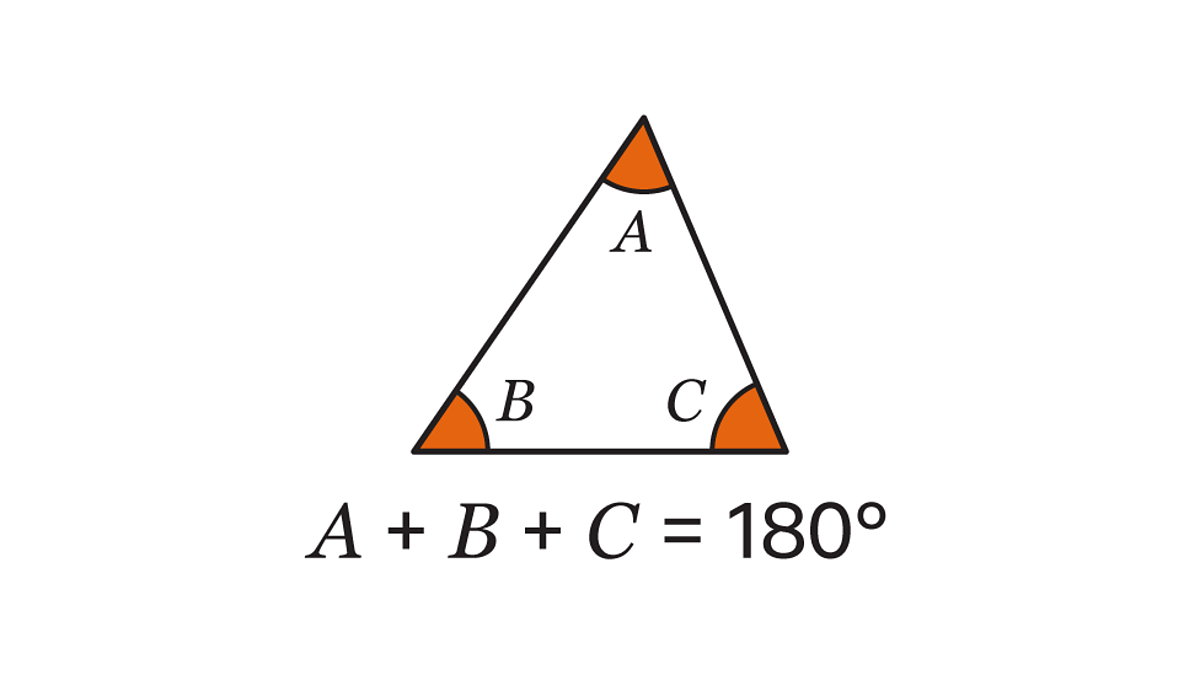
The interior angles of any triangle always add up to 180 degrees.
Exterior angle of a triangle
The exterior angle of a triangle is equal to the sum of the two interior opposite angles.

Base angles of an isosceles triangle
The angles opposite the equal sides in an isosceles triangle are equal.

Alternate angles
Alternate angles formed by a transversal crossing parallel lines are equal (often called Z-angles).

Corresponding angles
Corresponding angles formed by a transversal crossing parallel lines are equal (often called F-angles).
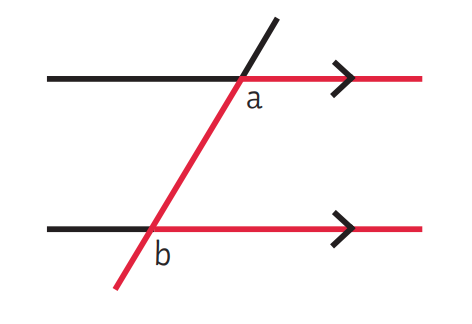
Co-interior angles
Co-interior (allied) angles formed by a transversal crossing parallel lines add up to 180 degrees (often called C-angles).

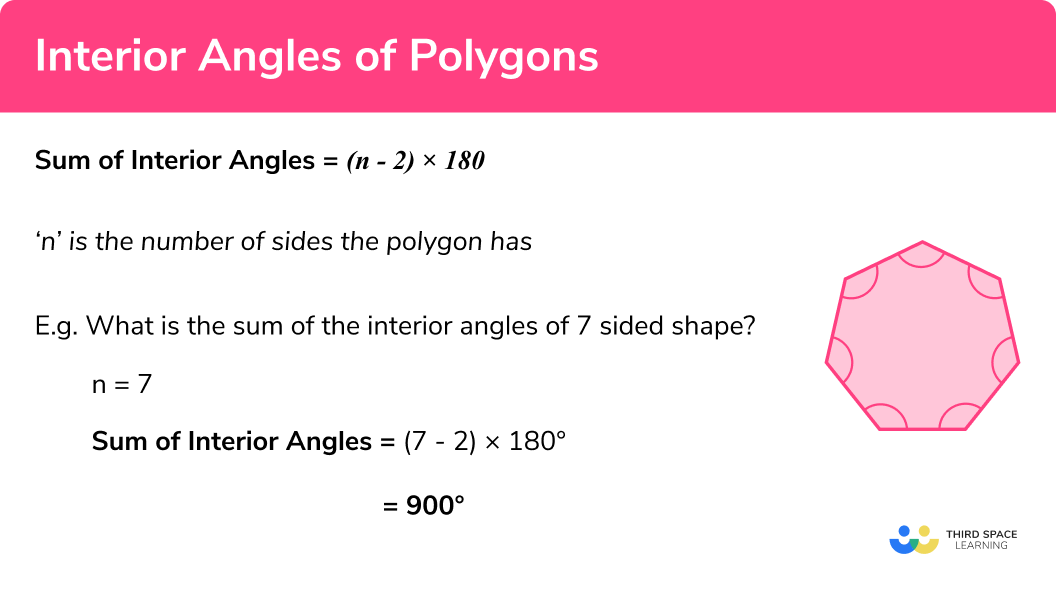
Interior angles of a polygon
The sum of the interior angles of an n-sided polygon is calculated using the formula: (n - 2) * 180 degrees.
Exterior angles of a polygon
The sum of the exterior angles of any convex polygon is always 360 degrees.
