PSY341 Exam 1
 Call Kai
 Learn
Learn Practice Test
 Spaced Repetition
 Match
Match Flashcards
 Knowt Play
1/122

There's no tags or description
Looks like no tags are added yet.
Name | Mastery | Learn | Test | Matching | Spaced | Call with Kai | Chat |
|---|
No analytics yet
Send a link to your students to track their progress
123 Terms
Trauma
The response to a deeply distressing or disturbing event that overwhelms individuals, causing feelings of helplessness, altering one's sense of self, emotions, and experience of the world.
Acute Trauma
Trauma with a clear start and end, such as a car crash or natural disaster.
Chronic Trauma
Trauma that occurs over a longer period of time, like consistent abuse or rape.
Major Trauma
Severe trauma affecting a person's sense of security and perception of the world.
Minor Trauma
Traumatic events that do not involve violence or disasters but cause significant distress, like bullying or psychological abuse. Really common forms of trauma that can happen frequently
Single-generation Trauma
Trauma experienced by one person in a family that does not affect later generations.
Multi-generational Trauma
Trauma that continues to impact members of a generation years after it occurred, like the effects of slavery on African Americans.
Vulnerability
Involves uncertainty, risk, and emotional exposure.
Shame
Belief that one is inherently bad, positively correlated with addiction, depression, suicide, bullying, aggression, violence, and eating disorders.
Primary Emotions
Fear, anger, sadness, shock - the initial emotions experienced after a traumatic event.
Secondary Emotions
More complex emotions that take longer to develop after a traumatic event, such as guilt, shame, despair, suffering, hopelessness, grief.
Core Belief
Deep-seated beliefs about oneself (e.g., "I'm bad").
Intermediate Beliefs
Attitudes, rules, and assumptions that influence behavior (e.g., "People can't be trusted").
Automatic Thoughts
Thoughts that spontaneously arise in response to stressors (e.g., "I'm going to fail").
Reactions
Emotional, behavioral, and physiological responses to environmental stressors.
Cognitive Dissonance
The mental discomfort experienced when holding conflicting beliefs or attitudes.
Coregulation
The process of interpersonal regulation of emotion and physiology characterized by attunement and interdependent responding, happening on a physiological level through synchronization of cortisol, brain stimulation, EDA, and heart rate with family members and romantic partners.
Fight, Flight, Freeze, and Fawn
The main possible reactions to trauma in terms of the stress response, where individuals may choose to fight, flee, freeze, or be agreeable to gain protection.
Validation
Affirming a person's emotions as valid and acceptable, helping decrease emotional discomfort in the long term by letting them know it's okay to feel what they are feeling.
Problem Solving
Providing solutions to issues, which can be helpful in some cases but not all, as immediately giving advice may overlook acknowledging the person's emotions and cause them to feel stuck.
Innate Immunity
The first line of defense against pathogens, including barriers like inflammation, with trauma amplifying this response in the short term.
Adaptive Immunity
A slower immune response that "remembers" infections to mount strategic responses, with trauma weakening this adaptive response in the long term.
Telomeres
Caps at the end of DNA strands protecting chromosomes, shortening with each replication, and accelerated by childhood trauma, aging a person on a cellular level.
*Too short telomeres damage chromosomes (index of cellular age)
Allostasis
Constant adjustment of physiological parameters to maintain stable function, impacted by chronic stress leading to neural function consequences.
Homeostasis
Maintaining stable physiological parameters within a certain range, disrupted by chronic stress or severe trauma, leading to health issues.
Allostatic Load
Prolonged neurochemical imbalance from chronic stress negatively impacting normal neural function, associated with various health problems and elevated in individuals who have experienced significant trauma.
Headwinds and tailwinds asymmetry
People tend to notice adversarial headwinds more than helpful tailwinds, impacting our perception of bias and discrimination.
Helps us see how bias and discrimination impact us. Sometimes we don’t see or register its impact on our ability to get ahead because of its subtlety.
Most of us tend to ignore or forget about advantages we’ve received but remember the obstacles we’ve overcome.
ex) white people not understanding the trauma and how steep the road is people of color have to cross.
Microaggressions
Indirect, subtle, unintentional discrimination against marginalized groups, impacting self-view and potentially leading to further trauma.
Person-first language
Centers the person before the identity, such as "person with depression," aiming to avoid categorization solely by identity.
Sex
Refers to sex traits at birth like chromosomes and external genitalia.
Racial capitalism
A racially hierarchical political economy sustained by imperialism, militarism, and labor exploitation.
Race
A social construct based on shared physical characteristics.
social construct based on the idea that groups share outward physical characteristics.
Interpersonal racism
Racism between individuals, like Mexicans being racist toward Cubans.
Medical model of disability is it problematic
emphasizes the role of the medical field in understanding disability.
Problematic: Considers disability something to diagnose, treat, and “cure” suggesting there is something broken that needs fixing.
Gatekeeping based on medical diagnosis is problematic because of access to medical diagnosis intersects with classism
Sizeism
Discrimination based on body size.
Systemic trauma
contextual features of environments and institutions that give rise to trauma, maintain it, and impact posttraumatic response
Social Determinants of Health
Social risks that influence health and well-being positively or negatively, including access to healthcare, education, income, neighborhood, and social community. They occur where people live, learn, work, and play but affect the family immediately
SEAM Model
A model promoting positive attachment consisting of Safety, Emotional container, Availability, and Mind in Mind components.
Internalized Voicelessness
Impairment in advocating for oneself due to racism, leading to becoming victims of others' perceptions.
Racism impairs the ability to advocate for oneself because doing so is potentially dangerous. Children and adults can become victims and prisoners of others’ perceptions of them.
Internalized Devaluation
Idolization of whiteness and demonization of color, are perpetuated in society, leading to disparities like higher arrest rates for Black individuals.
The idolization of whiteness and the demonization of color. It is perpetuated and reinforced throughout the society.
(ex. Black kids are more likely to be arrested.)
There are twelve types of evidence-informed positive parenting strategies. Name and describe three
Time in: Spending quality time with your child
Reading together, arts and crafts
Attuned attentive listening: Listening to your child and showing that you did listen and understand what they are saying
Catch the child being good and offer specific praise: Noticing behavior you want to see (good) and praising your child for it.
“Good job on bringing your dishes to the sink”
Routines: having a clear routine that helps your child go throughout their day
Bedtime routine
Ignoring Minor negative behaviors: Ignoring minor bad behaviors in your child, not yelling at them for it.
Not yelling at your child for the makeup they chose to wear (adolescents)
Being a role model: making good choices and setting a good example for your child.
Not being wasted in front of them
Distraction and positive messaging: Not yelling No at your child and instead distracting them or teaching them a valuable lesson
Kid touching hot stove tell them why they can not do that and ask if they want to help make cupcakes batter instead
Rewards and privileges: Rewarding your child to keep up good behaviors
Getting good grades maybe a frozen yogurt trip
The law of logical consequences: Allow the child to experience the fallout of their actions or behaviors can be incurable
“There are a lot of toys and books on your floor” The child may get a hint to pick up room
Collaborative problem solving: The Caregiver assigns child behaviors on a specific spectrum from a minor negative behavior to a safety issue. The behaviors in the middle are open to negotiation and compromise.
Parent and child discussing the problem of a too-early curfew. On Fridays your curfew can be extended by 1 hour (problem solved)
Teach self-soothing behaviors to caregivers and children: Teach kids and adults healthy self care habits
Drinking tea, taking bubble bath, exercise
Time out: Time out
caregiver uses it by remaining calm, stating the behavior they want their child to stop and/or stating the behavior they wish to observe, warning their child that the consequence of disobeying will be a time-out, counting down to the time-out, and then putting their child, if they do not respond to the warning and countdown, on a time-out in a safe setting for a specified amount of time. Some caregivers use a timer that should be set to a number of minutes less than or equal to the child’s age
Collaborative Problem Solving
Assigning child behaviors on a spectrum and negotiating compromises, like extending curfew, to solve issues effectively.
Parenting Styles
Authoritative (nurturing with firm limits), Authoritarian (strict and directive), Permissive (nurturing but lax), Uninvolved (less responsive or involved).
Describe the six steps in the pyramid model of how Adverse Childhood Experiences impact health and mortality
Adverse childhood experiences: Trauma (i.e. sexual assault)
Disrupted neurodevelopment: Heightened activity in the amygdala, stress hormone dysregulation, decreased executive function )
Social, emotional, and cognitive impairment: (no trust in people or adults) (frequently anxious)
Adoption of health risk behaviors: (begin smoking, drinking)
Disease, disability, and social problems: (lung cancer, cirrhosis, don't show up to work)
Early death: (die at age 40)
Beginning with ACE each one can affect the one above it. (ace affects neurodevelopment and neurodevelopment affects social impairment)
ACE can have an impact on a child’s development which leads to long term consequences
Describe how the ace impact health and mortality
Beginning with ACE each one can affect the one above it. (ace affects neurodevelopment and neurodevelopment affects social impairment)
ACE can have an impact on a child’s development which leads to long term consequences
Insidious trauma
Not known or recognized as harmful (hidden) Not easy to tell it is traumatic
Obvious
It is known as harmful (Domestic violence) It is and a person can tell it is traumatic
Brown lists three things in the “vulnerability armory.” List, and define vulnerability armor.
vulnerability armor are: An armor we use to protect ourselves from being vulnerable
foreboding joy
perfectionism
numbing
define and give an example of three things in vulnerability armor
Foreboding joy: a continuum that runs from rehearsing tragedy to what I call a perpetual disappointment. Preparing for the worst when things are going good in life Paradoxical dread that clamps down on momentary joyfulness (expecting to not get a position you want so it doesn’t hurt as much)
Perfectionism: Doing everything perfect so you will never feel shame
Numbing: embrace of weather deadens the signs of pain of discomfort and pain. (ex. Doing drugs)
Guilt
Is when the individual feels that they did something bad and is negatively correlated with addiction, depression, suicide, bullying, aggression, violence, and eating disorders
Is vulnerability a weakness or courage
Vulnerability is courage you are opening yourself up to the chance of getting hurt but having the better ability to connect with others. Being vulnerable pushes you to take great risks by leaving yourself open to the world.
Describe Bartholomew’s two-dimensional model of attachment. List the four attachment styles described and list their qualities in terms of (1) high versus low avoidance, (2) high versus low anxiety, (3) beliefs about the self, (4) beliefs about others, (5) high versus low self-esteem, and (6) high versus low sociability
Bartholomews' two-dimensional model of attachment has a x axis of low and high anxiety, and a y axis of low avoidance and high avoidance. Within the 4 quadrants there are different qualities a person can have that can have an affect on their relationship style. The 4 qualities are:
Low avoidance and low anxiety: A SECURE ATTACHMENT
Belief about the self: Positive
Belief about others: Trusting
Self-esteem: high
Sociability: High
Mate: With other individuals who have a secure attachment
I'm okay, you’re okay
High avoidance and low anxiety: A DISMISSIVE ATTACHMENT
Belief about self: Positive
Belief about others: Not trusting
Self-esteem: High
Sociability: No
Mate: With other individuals a preoccupied attachment
I'm okay You’re not okay
Low avoidance and high anxiety: A PREOCCUPIED ATTACHMENT
Belief about self: Negative
Belief about others: Positive trusting
Self-esteem: Low
Sociability: High
Mate: With others who have Dimissive attachment
I'm not okay, You’re okay
High avoidance and high anxiety: A FEARFUL ATTACHMENT
Belief about self: Negative
Belief about others: Negative
Self-esteem: Low
Sociability: Low
Mate: Other fearful people
I'm not okay You’re not okay
what makes a secure attachment
Low avoidance and low anxiety:
Belief about the self: Positive
Belief about others: Trusting
Self-esteem: high
Sociability: High
Mate: With other individuals who have a secure attachment
I'm okay, you’re okay
What makes a dismissive attachment
High avoidance and low anxiety:
Belief about self: Positive
Belief about others: Not trusting
Self-esteem: High
Sociability: No
Mate: With other individuals a preoccupied attachment
I'm okay You’re not okay
What makes a preoccupied attachment
Low avoidance and high anxiety:
Belief about self: Negative
Belief about others: Positive trusting
Self-esteem: Low
Sociability: High
Mate: With others who have Dismissive attachment
I'm not okay, You’re okay
What makes a fearful attachment
High avoidance and high anxiety:
Belief about self: Negative
Belief about others: Negative
Self-esteem: Low
Sociability: Low
Mate: Other fearful people
I'm not okay You’re not okay
Describe how trauma relates to attachment style
We tend to mate with people who share similar attitudes about ourselves
If YOU believe that YOU’RE BAD and others are good, you are likely to find a PARTNER who thinks YOU are BAD and that THEY’RE GOOD
Are traumatized brains damaged or specialized? Why or why not? provide an example of each
Yes, experiences of trauma damage brains because of the release of cortisol which damages brain development. Damaged brains are also specialized they are more likely to
Orient to angry faces more quickly
Are more accurate at identifying angry faces
Have a better memory for aggressive stimuli
Recall negative events with more necessary
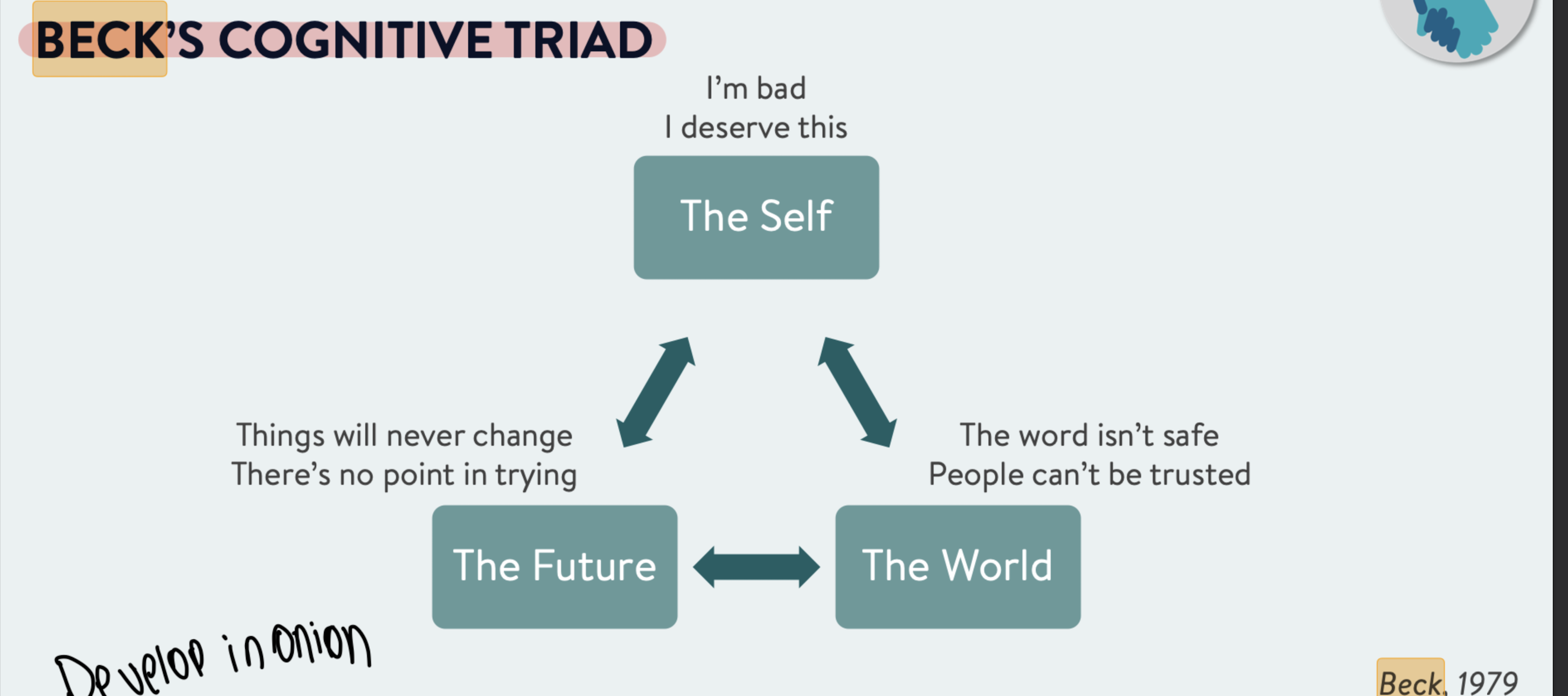
What is Beck’s cognitive triad
Never-ending circle of how the view of the self affects the view of the world and the view of the future
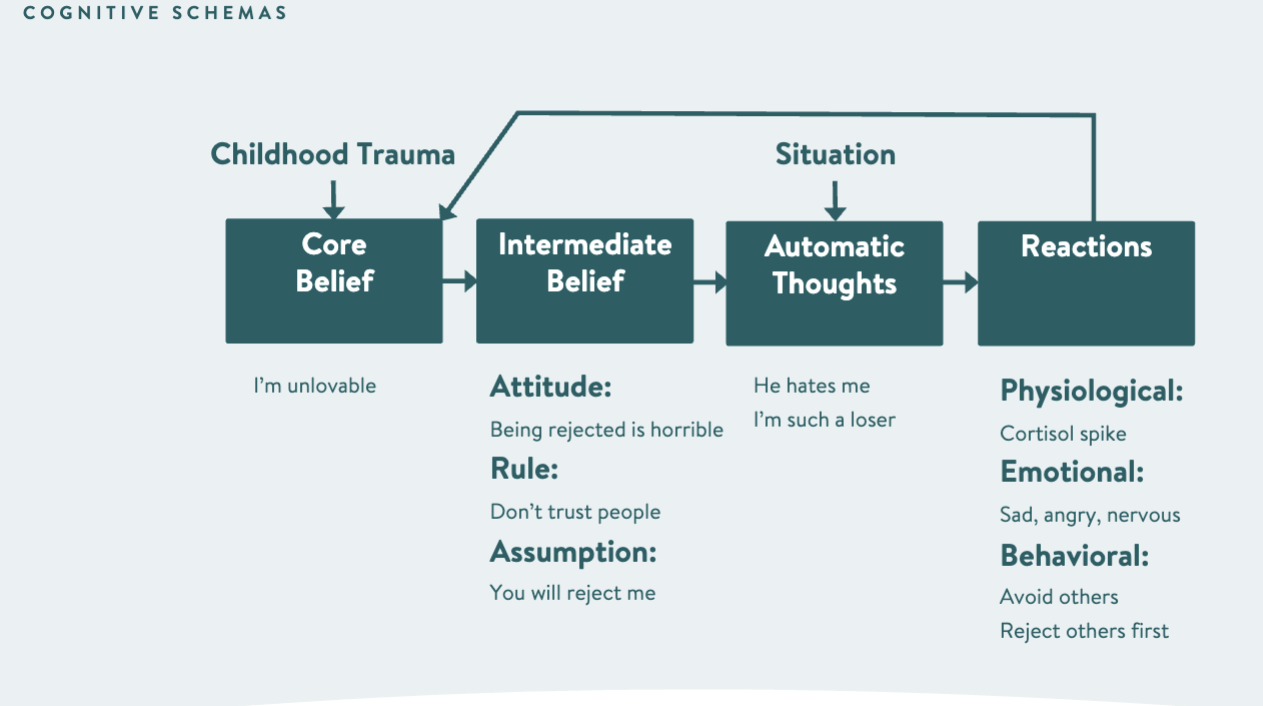
Describe the four elements that make up the cognitive onion. Define each and describe their relationship to each other
The 4 elements that make up the cognitive onion are: from deeper layer of onion to outer layer of onion
Core belief: What you believe about yourself deep down (i.e. I’m bad)
Intermediate beliefs: Attitudes, rules, and assumptions (i.e. People can’t be trusted)
Automatic thoughts: Thoughts that automatically pop into your head when you experience a stressor. (i.e. I’m going to fail)
Reactions: Your emotional, behavioral, and physiological responses to environmental stressors (Being sad, crying)
The core belief affects the intermediate belief which affects the automatic thoughts which affects the reactions AND THEN STARTS THE PROCESS ALL OVER AGAIN.
Describe the cognitive model of psychopathology. List and define each element and give an example of a situation and resulting sequence following this model
Show how childhood trauma can affect an individual's core belief, which then affects their intermediate belief which then affects their automatic thoughts that are caused by a situation and then affects their reactions which then circle back to their core belief.
Discusses how cognitive schemas comprise core beliefs, intermediate beliefs, automatic thoughts, reactions to those thoughts and how they are all connected.
An example would be if someone thought the world was dangerous, they may not trust people or settings outside of their home, so they do not put themselves in situations that might be dangerous (going to a party). If they are in a stressful situation, they might have the automatic thought that someone is following them which results in emotions like fear and anxiety, and cause their heart rate and breathing to increase. This reaction then strengthens their core belief.
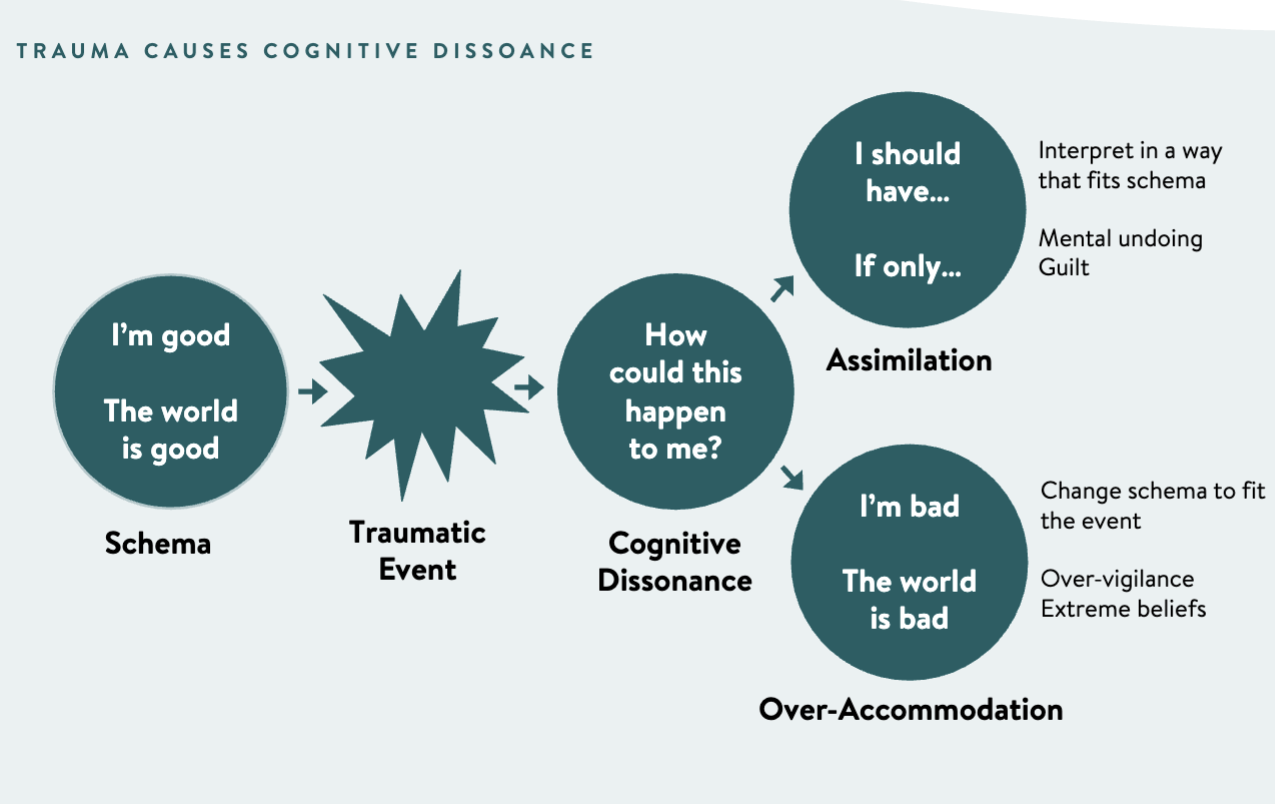
Describe the model of cognitive dissonance created by trauma
The cognitive dissonance model shows how one can have the SCHEMA that they are good and the world is good and how a traumatic event can affect them.(trauma affects their schema). This effect causes the individual to wonder how could this happen to them which is known at the phenomenon COGNITIVE DISSONANCE. From there the person can experience ASSIMILATION: which is them thinking what they should have done and if only… They interpret in a way that fits their schema and the mental undoing of guilt. This can create consonance. After cognitive dissonance the person can also experience OVER-ACCOMODATION: where they believe they are and the world is bad. These individuals change their schema to fit the event and are over-vigilant and have extreme beliefs.
How does coregulation develop through the lifespan
Parents scale back regulatory influence over time
WAY MORE HELP WHEN INFANT COMPARED TO TEEN
A lot of caregiver regulatory influence from infant to preschool
During preschool the child realizes mom and themselves are separate people: at this stage the baby learns to say no
During adolescence there is an increase in youth self-regulation; all the way up to young adulthood.
NEED ENOUGH FOR CHILD TO LEARN BUT STILL FEEL SAFE AND SUPPORTED.
Describe how to coregulate and provide emotional support to others. Describe at least three effective ways
You can coregulate by validating the person’s emotions.
Key components of validation are awareness and acceptance.
In early childhood, this includes mimicry, attuned facial expressions, emotion labeling, and soothing
As the child gets older this includes paraphrasing and reflection.
Describe how to coregulate and provide emotional support to others. Describe at least three ineffective ways
Being unresponsive or unattuned
Criticizing, invalidating, or attempting to shut it down
Catching the negative emotion yourself
Jumping to give advice
Is validation helpful? Why or why not
helpful because you affirm a person that it is okay to be feeling what they are feeling. You let the person know that it is okay to come with you with negative emotions as well as their happy ones. You are able to decrease emotional discomfort in the long term
Is problem solving helpful? Why or why not?
can be helpful in some cases but NOT ALL. Immediately giving advice can frustrate someone when they just wanted someone to talk to and not get a lecture from. You do not acknowledge the emotion the person is feeling and instead steamroll over it. This can cause a person to feel stuck because they didn’t get a chance to process whatever emotion they were feeling before fixing the problem.
What are the main three possible reactions to trauma in terms of the stress response
The main three possible reactions to trauma in terms of the stress response are FIGHT, FLIGHT, and FREEZE, AND FAWN.
Why might you choose one stress response versus the other in a threatening situation
FLIGHT: one might choose to flee a situation when they know they can not fight their “attacker” and have a chance to escape. In this case their behavioral response is to AVOID.
FIGHT: one might choose to fight in a situation when they stand a chance and can win, or they’re protecting someone (i.e. parents and kids). Their behavioral response is to APPROACH.
FREEZE: one might choose to freeze when they’re powerless to fight or flee so they submit and play dead.
These individuals tend to blame themselves
FAWN one might choose to be really agreeable with a group in order to gain their help for protection.
How are these systems impacted by stress and trauma?
Chronic stress leads to arousal pathology where there is constant deviation from regular physiological parameters
Homeostasis: Acute stress can trigger the body's fight-or-flight response, leading to temporary deviations from homeostasis. However, the body is generally well-equipped to return to a balanced state once the stressor is removed. Chronic stress or severe trauma, on the other hand, may disrupt the body's ability to maintain homeostasis, contributing to the development of health issues.
Allostasis: Allostasis involves adaptive responses to stress, but chronic stress or trauma can lead to a state of maladaptive allostasis. Prolonged activation of stress response systems, such as the hypothalamic-pituitary-adrenal (HPA) axis, can result in dysregulation and contribute to allostatic load.
Allostatic Load: The ongoing activation of stress response systems without sufficient recovery time can contribute to allostatic load. High allostatic load is associated with an increased risk for various health problems, including cardiovascular disease, metabolic disorders, and mental health issues. Individuals who have experienced significant trauma may be at a higher risk for elevated allostatic load.
Is minor trauma really minor?
Minor trauma is not really minor it can continue to build up to become major and have big cumulative impacts.
It is not always recognized as traumatic by others which makes us prone to self-blame when they occur.
Why is insidious trauma so harmful?
It is HARMFUL because we do not recognize the impact of trauma which causes us to be more damaged by it.
When people do not recognize the trauma they are re-traumatized and our wound is repeated
It perpetuates the self-blame cycle and deepens symptoms.
what is social identity
Physical, social, and mental characteristics of individuals. (i.e. race, gender, and sexual identity)
List different types of social identity based on the ADDRESSING FRAME WORK
Social identity: Physical, social, and mental characteristics of individuals. (i.e. race, gender, and sexual identity)
Age: A 20 year old
Disability: with down syndrome
Disability acquired: Paralyzed from accident
Religion: Catholic
Ethnicity: Mexican
Social status: Lower class
Sexual orientation: Asexual
Indigenous heritage: Navajo
National origin: U.S.A.
Gender: Non-binary
what is the addressing framework
Age
Disability (congenital)
Disability (acquired)
Religion
Ethnicity
Social status
Sexual orientation
Indigenous heritage
National origin
Gender
define intersectionality and give an example
The interconnected nature of social categorizations, such as race, class, and gender, regarded as creating overlapping and interdependent systems of discrimination or disadvantage.
A black gay women ( being a minority gender ties in with her minority race, and sexual orientation) can affect her getting the same opportunities as others.
Provide an example and describe how microaggressions impact development and functions
(ex) Oh you’re really good at math for being a girl
(ex) I'm surprised you’re a Hispanic who is really good at reading.
They can affect the view we have of ourselves without even realizing it
It can lead us to question and judge ourselves which can further traumatize us.
The slap: Unexpected microaggressions in contexts thought to be safe can mess with our trust in people.
Do microaggressions matter? Why or why not?
YES, microaggressions do matter the little things can build up and cause further harm to us.
Define person first (centered) language
Centers the person before the identity
Person with depression
Define identity centered language
centers the identity before the person
Depressed person
Why might you use one versus the other?
I would personally use the person's centered language because I do not want to categorize them by their identity and cause them to feel like a distinction and not a person. If we believe there is nothing more than to us than our identity that can send us into a crisis
define sexual orientation
Someone's romantic sexual attraction or lack thereof
Lesbian, gay.
define gender
Someone’s innermost concept of self
Trans male
define human giver syndrome
deeply buried, unspoken assumption that women should give everything, every moment of their lives, every drop of energy to the care of others.
Mothers are frequent sufferers of this syndrome they give and give themselves to their children and families, etc.
How does human-giver syndrome contribute to discrimination and violence
Women are not seen as human beings who have needs but are seen as vessels that will provide for every need and can be control
They do not own or have any control over anything including their bodies
define chattel enslavement
the buying, selling, trading, inheriting, and ownership of enslaved African American people as property.
provide a contemporary example of racial capitalism and chattel enslavement
An example would be mass incarceration: prison labor sustains many major companies and allows for greater profit
(ex) child labor or child prostitution
Ethnicity
markers of a shared group such as cultural, traditional, and family bonds
Racialization
the categorization of people according to race
define institutionalized racism and give an example
systemic racism that exists as the foundation of our institutions including in education, government, finance justice, healthcare, religion, housing, and employment
Racial profiling from police officers to brown and black people
define white saviorism and provide an example
an unfair and unjust treatment of non-white people where a white person is inaccurately depicted as “saving” “uplifting” or “rescuing” non-white people. Nonwhite people are wrongly depicted as passive recipients of white beneficence rather than active and powerful agents
(ex) catholic missionary work (building a school) people view them as a saviors to the individuals they worked with at their mission trips
what is the individual model of disability is it problematic?
places the responsibility on the disabled individuals to deal with the challenges that come with having a disability
Problematic: suggest that tools like discipline and sacrifice ALONE can free people from oppression
what is the social model of disability is it problematic?
holds that disabled people are not impaired by their bodies or diagnoses but by ableist ideologies and social constructions
Problematic: ableist perspective suggests that disabled people do not fit their society
Ableist society creates and maintains obstacles that isolate disabled people.
what is the economic model of disability is it problematic?
how much money someone can earn, how much work they can do or how productive they are.
Problematic: categorizes them and high and low-functioning
Intersects with classism because it suggests that worth relates to productivity
what is the tragedy model of disability is it problematic?
treats disability as something that is tragic or inherently involves loss.
Problematic: prioritizes acquired disabilities and makes assumptions about people’s lives
Treats them as objects of pity.