AP Bio Unit 6: Heredity
 Multiple Choice & FRQ
 Call Kai
1/79

Earn XP
Description and Tags
Name | Mastery | Learn | Test | Matching | Spaced | Call with Kai | Chat |
|---|
No analytics yet
Send a link to your students to track their progress
80 Terms
Asexual Reproduction
Mitosis, produces exact copies in single-celled or simple multiceullar eukaryotes
Sexual Reproduction
Reproductive cells in reproduction in complex multicelled organisms are produced by meiosis and create variation in offspring.
Meiosis
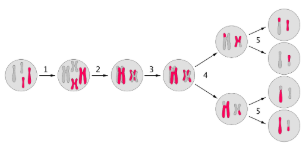
The type of cell division that creates gametes each with half of your genetic information.
Gametes
Haploid, 23 chromosomes, Egg & sperm cells
Haploids
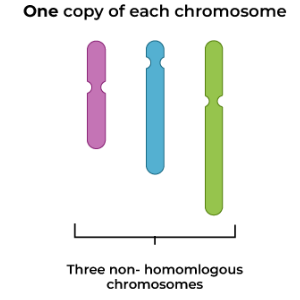
1N - unpaired chromosomes (ex: gametes)
Diploids
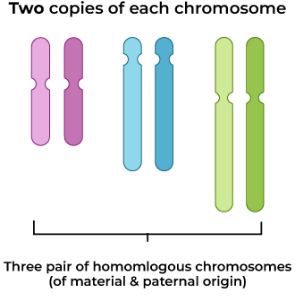
2N - two complete sets of chromosomes, one from each parent (ex: zygotes)
Zygotes
Diploids, 46 chromosomes (23 homologous pairs), when gametes combine
Somatic Cells
Diploid, any cell that’s not reproductive
Homologous Chromosomes
Each chromosome from each parent has a match (homolog) and genes are the same, but alleles can be different.
Humans have __ unique chromosomes, __ in total
23, 46
XX
Female
XY
Male
Meiosis Stages
Meiosis I & Meiosis II
Meiosis I
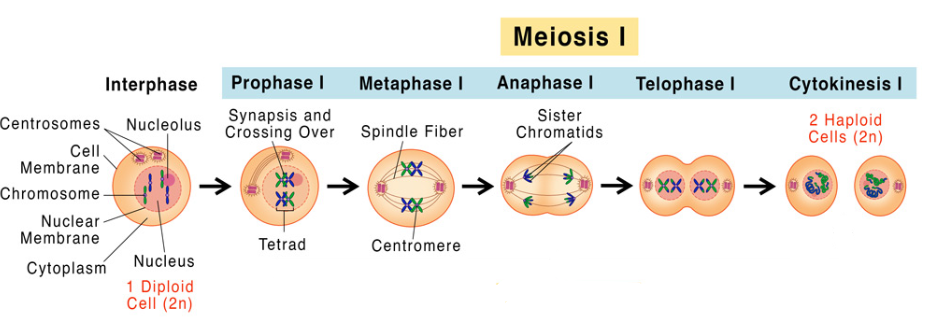
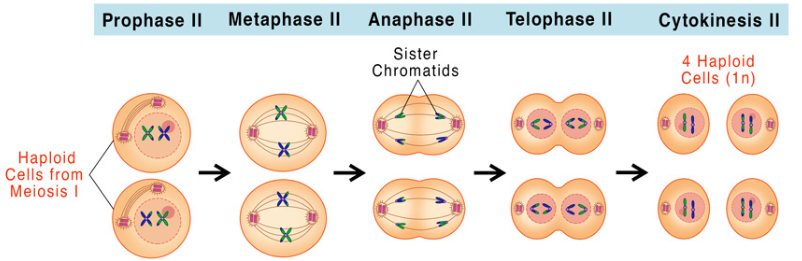
Starts with 1 cell with 46 chromosome pairs (92 sister chromatids) and ends with 2 haploid cells, each with 23 chromosome pairs (46 sister chromatids).
Meiosis II
Starts with the 2 haploid cells with 23 chromosome pairs each (46 sister chromatids), and ends with 4 haploid cells, each with 23 single chromosomes (23 chromatids).
Genetic Variation
Increases the likelihood that some members of a population will survive (natural selection). Sexual reproduction also increases variation in populations through independent assortment, crossing over, or random fertilization.
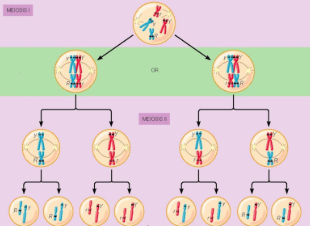
Independent Assortment of Chromosomes
Occurs in Meiosis I, where chromosome pairs line up in any order and are sorted independently of one another. This contributes to genetic diversity because each gamete will have a unique combination of chromosomes.
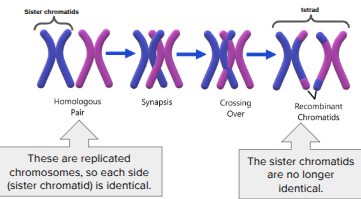
Crossing Over
Occurs in Prophase I, where two chromosomes (one from the mother, one from the father) line up and their parts switch. This contributes to genetic diversity because it will result in a brand new mix of alleles (traits) in the final gametes.
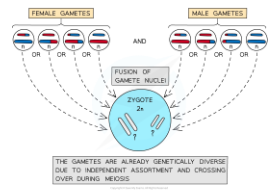
Random Fertilization
Any sperm may randomly fertilize any egg. This contributes to genetic diversity because there are countless unique combinations that can be made.
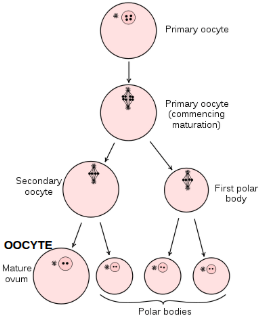
Oogensis
The process of egg (ovum) formation in females. It occurs in the ovaries and involves meiosis, resulting in one mature egg cell (ovum) and three smaller polar bodies that eventually degenerate.
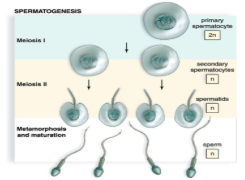
Spermatogenesis
Spermatogonia (spermatocyte) divide to create four genetically unique haploid sperm from each original spermatogonium.
Errors in Meiosis
Nondisjunction, breaking of chromosomes
Nondisjunction
Problems with the meiotic spindle cause daughter cells to have too many or too few chromosomes (can occur in meiosis I or meiosis II). This can result in trisomies or monosomies, often leading to miscarriage.
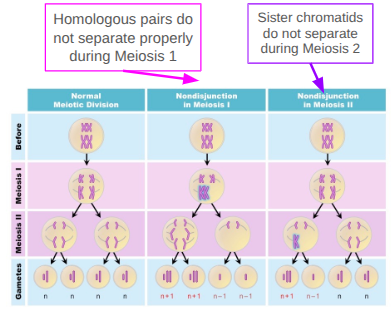
Trisomy
Zygotes with 3 copies of a chromosome
Monosomy
Zygotes with 1 copy of a chromosome
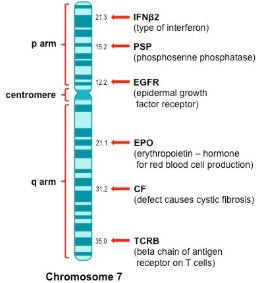
Chromosome Maps
Genes are mapped to chromosomes
Distance is determined by the frequency of crossover
Genes closer together or closer to the centromere are less likely to switch positions
#s on the side = % chance of swtiching
How Deletion Changes Chromosome Structure
Removes a chromosomal segment

How Duplication Changes Chromosome Structure
Repeats a segment

How Inversion Changes Chromosome Structure
Reverses a segment within a chromosome

Translocation
Moves a segment from one chromosome to another nonhomologous one

Gregor Mendel
He documented inheritance in peas and found that traits come in alternate versions, an organism inherits 2 alleles (1 from each parent) for each characteristic, and some traits mask others.
Mendel’s Laws
Law of Segregation, Law of Independent Assortment, & Law of Dominance
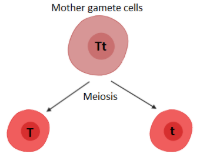
Mendel’s Laws: Law of Segregation
During meiosis (anaphase I), homologous chromosomes and their alleles separate. Each allele for a trait is packaged into a separate gamete.
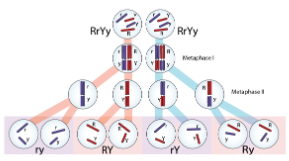
Mendel’s Laws: Law of Independent Assortment
Different genes separate into gametes independently because the non-homologous chomrosomes aligned independently during metaphase I. This is only applies for genes on separate chromosomes or on the same chromosome, but far apart.
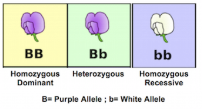
Mendel’s Laws: Law of Dominance
Hybrid offspring will only inherit the dominant trait in the phenotype. The suppressed alleles are recessive.
Phenotype
The physical appearance of a trait
Genotype
An organism’s genetic makeup
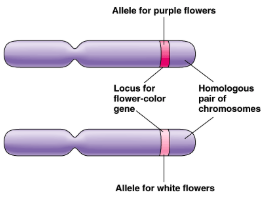
Allele
Different versions of a gene at the same location on homologous chromosomes
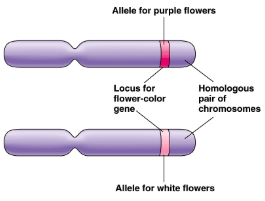
Locus
The physical location of an allele on a chromosome
Homozygous
PP or pp
Heterozygous
Pp
Dominant Allele
A functional protein that masks other alleles. If it’s homozygous dominant, 100% of the functional protein is produced. If it’s heterozygous, only 50% of the functional protein is produced.
Recessive Allele
An allele that often makes a malfunctioning protein
Test Cross
Conducted when an organism has the dominant phenotype, but unknown genotype (homozygous dominant or heterzygous?). It’s tested by crossing the organism with one that is homozygous recessive.
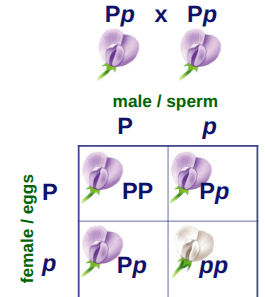
Monohybrid Cross
The cross between two individual organisms accounting for only one trait
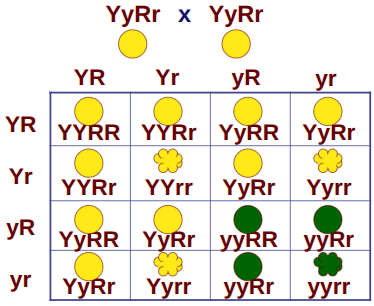
Dihybrid Cross
The cross between two individual organisms accounting for two traits
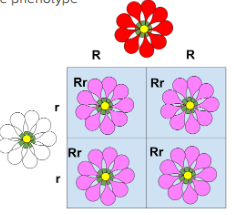
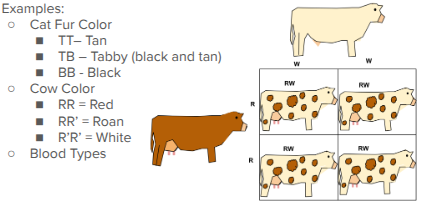
Incomplete Dominance
When heterozygotes show an intermediate phenotype
Codominance
When neither allele is dominant and both alleles show up individually in the phenotype
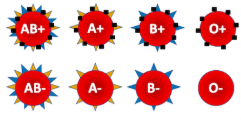
Multiple Alleles
When some traits have more than 2 forms of the gene (like blood types)
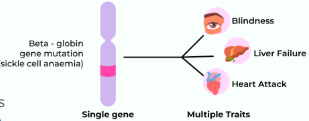
Pleiotrophy
When a gene affects more than one phenotypic character
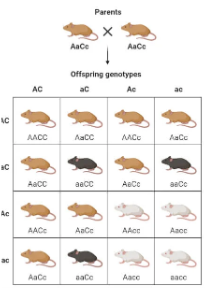
Epistasis
The interaction of two or more genes to control a single phenotype. Usually, 1 gene masks another gene. In photo: cc is albino, regardless of the A allele
Polygenic Inheritance
Some phenotypes are determined by the additive effects of 2 or more genes on a single character. Many human traits are an example of this (skin color, height, eye color, etc)
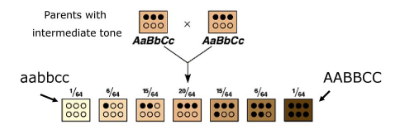
Environmental Influence on Phenotype
The environment can affect an organism’s phenotype (ex: human skin color influenced by UV radiation)
Autosomes
Contains genes that code for traits unrelated to the sex of the individual
Sex Chromosomes
Contains genes that code for the sex of the individual as well as other traits.
Sex-Linked Traits (X-linked)
Males only get their X from their mother, making it common for them to get an X-linked disorder because only one X needs to be affected.
Females get an X from each parent, making it uncommon for an X-linked disorder to show up in females because both of the x chromosomes must be recessive.
Sex-Linked Traits (Y-linked)
Uncommon because there are very few traits (only 26 genes). Also, traits are only passed from father to son, so females cannot have Y-linked disorders.
X-inactivation
When female mammals inherit two X chromosomes, one becomes inactivated during embryonic development to prevent over expression.
Non-Nuclear Inheritance
In animals, mitochondria are passed on through eggs cells and not sperm cells.
In plants, mitochondria and chloroplasts are passed on through ovules (female gametes) and not pollen grain (male gametes).
Genetics & Probability
Mendel’s law of segregation and independent assortment reflect the same laws of probability that apply to tossing coins or rolling dice.
Rule of Multiplication
Chance that 2 or more independent events will occur together.
Possible different gamete combinations = 2n (n = number of chromosome pairs)
Rule of Addition
Chance that an event can occur 2 or more different ways. Found by adding up all the separate possibilities.
Chi-Squared Statistical Analysis
A statistical method to determine if a difference between observed data and expected data is due to chance, or if it is due to a relationship between the variables you are studying.
The goal of it is to either fail to reject or reject the null hypothesis.
Null Hypothesis
There is no significant difference between the observed and expected frequencies.
Degrees of Freedom
The number of categories in your data minus one (n-1)
p-value (0.05)
The probability of observing data compared to expected, assuming the null hypothesis is true.
Critical Value
The intersection point between the degrees of freedom and p-value.
Chi-squared Value > Critical Value
Results are significant and you should reject your null hypothesis.
Chi-squared Value < Critical Value
Results are not significant and you would fail to reject your null hypothesis.
Why Might You Reject Your Null Hypothesis?
Small sample size, sample is not representative of the larger sample, or the genes do not show independent assortment (linked or sex-linked)
Pedigree
A chart of the genetic history of family over several generations.
Females in Pedigrees
Circle
Males in Pedigrees
Squares
Affected Person in Pedigrees
Shaded in, someone who expresses the phenotype of the trait the pedigrees is tracking.
Unaffected Person in Pedigrees
Unshaded, someone who expresses the other phenotype of the trait the pedigree is tracking (opposite of affected).
Carrier
Someone who carries both alleles versions (heterozygous).
*Not all pedigrees show this
Autosomal Dominant
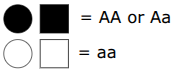
Autosomal Recessive
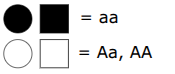
X-linked Recessive
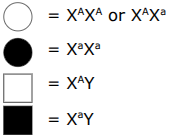
Mitochondrial Inheritance
In animals, mitochondria are passed on only through egg cells, so the mother determines the offspring’s mitochondrial DNA and traits. That means, if the mother is affected, ALL of her offspring will be affected.