Development dynamics
 Studied by 0 people
 Call Kai
 Learn
Learn Practice Test
 Spaced Repetition
 Match
Match Flashcards
 Knowt Play
1/37

Earn XP
Description and Tags
Name | Mastery | Learn | Test | Matching | Spaced | Call with Kai |
|---|
No analytics yet
Send a link to your students to track their progress
38 Terms
Is HDI (Human Development Index) social, economic or environmental and what’s it’s value?
Social, Economic and Environmental and is valued at 0.621 (131st in the world).
Is life expectancy social, economic or environmental and what’s it’s value?
Social and is valued at 68 years.
Is adult literacy social, economic or environmental and what’s it’s value?
Social and is valued at 74%.
Is infant mortality social, economic or environmental and what’s it’s value?
Social and is valued at 34 per 1000 birth.
Is GDP (Gross domestic Product per capita) social, economic or environmental and what’s it’s value?
Economic and is valued at $1709.
Geopolitics definition?
How are a countries world politics influenced by geographical factors.
What continent is India in?
Asia
How large is India (in comparison to other countries of the world)?
India is the 7th largest country in the world by land mass.
What’s India’s nearby countries?
Pakistan, Sri Lanka, Bangladesh, Nepal.
What’s India’s nearby oceans?
Indian Ocean, Arabian Sea, Bay of Bengal.
What place is India ranked globally in environmental quality?
India is ranked as the 155th country out of 177 in a global ranking on environmental quality.
How much does it cost India to keep up it’s environmental quality rating?
This costs India around $80 billion per year (5.7% of its total economy).
Environment definition?
The atmosphere (pollution), the green space, wildlife, rivers and water systems etc.
What is Aviva?
A large transnational corporation (TNC), with headquarters in the UK. Aviva is the UK's largest insurance company.
Where are Aviva’s call centres?
Perth (Australia), Norwich (UK) and Sheffield (UK).
Give two advantages of Aviva?
Bring much needed money to the Indian economy, creating 1000s of jobs.
Increase development levels, investing in infrastructure.
Give two disadvantages of Aviva?
A fifth of all call centre jobs outsourced, weakening the UK economy.
Retain profits, and pay tax in the UK. This limits the economic benefit to Bangalore.
Give four reasons ‘why India’ (Aviva)?
Wages much lower (India = £1,200, UK = £12,000) The cost of operation is lower by up to 60%.
Improvements in education levels.
Fewer safety restrictions = longer hours
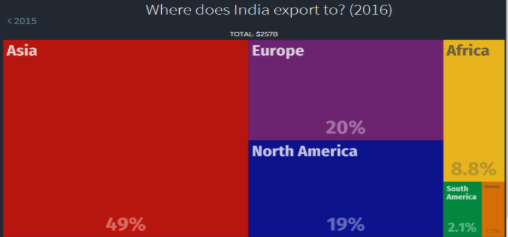
Where does India export to (2016)?
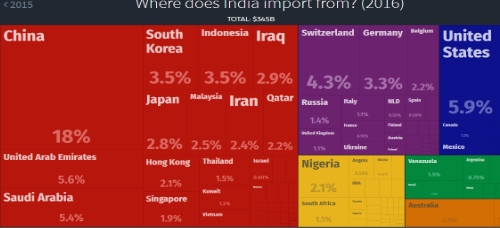
Where does India import to (2016)?
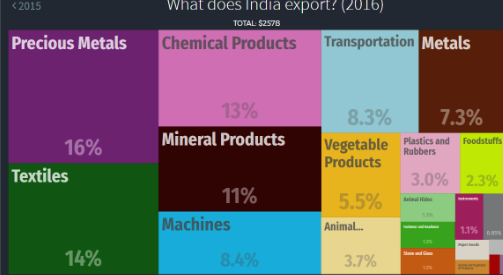
What does India export (2016)?
What other major economies are nearby, that help promote economic development?
China, a major economy and superpower. India and China have existing political tensions and India is a former British colony.
Is India landlocked? Which countries are easily accessed?
India isn’t landlocked, so it can easily transport goods internationally by boat. India aims to become a major transport hub within south east Asia.
Is India a large or small country? What about its population?
India is a large country, with good access to resources such as coal. India’s population is rapidly growing, totals 1.324 billion (2016). This makes India the second most populous country in the world.
Explain India’s development over time?
India has had rapid development in past decades resulting in India being identified as an emerging country, rather than a developing country.
Explain India’s employment?
The general trend in employment has been a loss of primary employment, with an expansion of the services sector.
Explain India’s exporting/importing?
India’s imports and exports have grown, as India buys and sells more products internationally. India’s total imports have grown by almost 1500% since 1980.
Explain India’s development in terms of GPD?
India’s development has been unequal. and has led to contrasting development levels. Compare the dark regions (higher GDP) to the lighter colours (lower GDP).
What controls India’s geopolitics?
It’s history, geography, international context and domestic policies.
India’s global geopolitics?
India is a member of the G20 (the twenty most developed economies in the world). These countries meet every year, and discuss world trade issues.
India’s geopolitics in Asia?
The partitioning of India and Pakistan (1947) came with riots and mass casualties. The effects are still felt today: The relationship between India and Pakistan is far from healthy and both countries are nuclear armed.
Effects of ‘solid water pollution’?
Indian cities generate 100 million tonnes of waste each year.
40% of urban waste in India is just simply not collected, and is allowed to rot on the streets.
Effects of ‘water pollution’?
India has the capacity the deal with just 1/6 of its sanitation produced.
Over 100 Indian cities directly dump untreated sewage into the Ganges.
Effects of ‘air pollution’?
Major issue in India, with wood burning and vehicle emissions behind the primary cause.
Natural methods of fuel production (wood burning) constitute 90% of rural energy, and 24% of urban energy. These biomass house burners are the leading cause of greenhouse gas emissions.
Rate of change in female literacy rates vs mens?
Rate of change in female literacy rates (11.8%) greater than males (6.8%) between 2001-2011.
Economic Development on Different Age and Gender Groups (elderly 50+)?
Access to better healthcare, which may prolong their life. Do not possess necessary skills so may lag behind. Socially, changes to the Indian society may be difficult to adapt to.
Economic Development on Different Age and Gender Groups (young adults)?
Access top universities, receiving a world class education = compete for the highest skilled and paid jobs = more equal society.
Economic Development on Different Age and Gender Groups (Females: The BIGGEST winners)?
Emancipation of women = equal access to a high quality education and healthcare system, which enables them access to highly skilled jobs that are well paid.
 Note
Note  Flashcards (76)