PR2155 IC2 pathophys
0.0(0)
Studied by 0 people Call Kai
 Learn
Learn Practice Test
 Spaced Repetition
 Match
Match Flashcards
 Knowt Play
Card Sorting
1/51

Earn XP
Description and Tags
Last updated 4:24 AM on 3/6/23
Name | Mastery | Learn | Test | Matching | Spaced | Call with Kai | Chat |
|---|
No analytics yet
Send a link to your students to track their progress
52 Terms
1
New cards
What are the seven fundamental functions of the liver?
MESSSDI
Metabolism
Excretion
Storage
Synthesis
Secretion
Detoxification
Immune function
Metabolism
Excretion
Storage
Synthesis
Secretion
Detoxification
Immune function
2
New cards
What is the storage function in the liver?
Storage of blood
Nutrient-rich blood flows through the liver before entering systemic circulation.
Nutrient-rich blood flows through the liver before entering systemic circulation.
3
New cards
What is the role of the liver in nutrient metabolism?
The liver is involved in **carbohydrate, lipid, and protein** metabolism, including
* glucose buffer function → maintaining blood glucose levels,
* lipid oxidation and synthesis
* protein synthesis and degradation (deamination→ urea cycle)
* glucose buffer function → maintaining blood glucose levels,
* lipid oxidation and synthesis
* protein synthesis and degradation (deamination→ urea cycle)
4
New cards
What is glucose buffer function?
The liver stores glucose as glycogen
blood glucose levels are **high**: Glucose → glycogen (stored)
blood glucose levels are **low**: Glycogen → glucose, amino acid→ glucose (gluconeogenesis)
\
This helps to maintain stable blood glucose levels.
blood glucose levels are **high**: Glucose → glycogen (stored)
blood glucose levels are **low**: Glycogen → glucose, amino acid→ glucose (gluconeogenesis)
\
This helps to maintain stable blood glucose levels.
5
New cards
What is the role of the liver in lipid metabolism?
The liver is involved in the
* **oxidation of fatty acids**, lipolysis (breaking down of fats to supply energy),
* synthesis of fats from proteins and carbohydrates
* synthesise cholestrol, phospholipids, lipoproteins
* **oxidation of fatty acids**, lipolysis (breaking down of fats to supply energy),
* synthesis of fats from proteins and carbohydrates
* synthesise cholestrol, phospholipids, lipoproteins
6
New cards
What is oxidative deamination?
Liver **removes the nitrogenous content** of amino acids to form urea (amino acid) and uric acid (DNA), which are **excreted** in urine and feces.
7
New cards
What is the role of the liver in protein synthesis?
The liver synthesizes
* albumin and plasma proteins
* blood coagulation factors.
* albumin and plasma proteins
* blood coagulation factors.
8
New cards
What are the blood coagulation factors synthesized by the liver?
Fibrinogen, prothrombin, factor VII
9
New cards
What are some markers for poor liver function → poor protein synthesis?
1. low albumin level → affects oncotic pressure
2. prothrombin time, clotting ability of the patient
\
10
New cards
Which vitamin is needed in the formation of prothrombin, factor VII, IX, X
Vitamin K
11
New cards
Where is factor VII produced?
Liver sinusoidal endothelial cells, overall endothelial cells
12
New cards
What is bilirubin?
Bilirubin is a **bile pigment that** is produced from the **breakdown of haemoglobin by microphage**
It is excreted by the liver and can cause jaundice if it accumulates in the blood.
It is excreted by the liver and can cause jaundice if it accumulates in the blood.
13
New cards
What is the enterohepatic circulation of bile salts?
95% Bile salts are reabsorbed in the **terminal ileum** and then transported back to the liver through the portal vein.
\
This process is known as the enterohepatic circulation of bile salts.
\
This process is known as the enterohepatic circulation of bile salts.
14
New cards
what is the difference between conjugated and unconjugated bilirubin?
1. Unconjugated bilirubin → not polar, not excreted in the urine
2. Conjugated bilirubin → polar, more easily excreted
15
New cards
How does the liver detoxify?
Phase I
Phase II
1. Main purpose is to make the metabolites more polar and hydrophiliic so they can be excreted more easily
Phase II
1. Main purpose is to make the metabolites more polar and hydrophiliic so they can be excreted more easily
16
New cards
What is the role of the liver in the storage of vitamins and minerals?
The liver stores fat-soluble vitamins A, D, E, and K, as well as minerals like iron and copper.
17
New cards
How does the liver involve in immune function?
1. Remove bacterial from blood coming from portal vein (from small intestine, bacteria present)
2. **Hepatic macrophage system**
1. **Kuffer cells**
1. large phagocytic macrophages
2. Lines the hepatic venous sinuses
18
New cards
What is Jaundice and what is its threshold?
Yellow coloration of skin, sclera, mucous membrane due to **excess level of circulating bilirubin**.
\
Bilirubin level exceeds **1.2 mg/dL.**
\
Bilirubin level exceeds **1.2 mg/dL.**
19
New cards
What are the two mechanisms that cause excess bilirubin in the blood?
Increased production
Decreased excretion
Decreased excretion
20
New cards
What are the three types of jaundice?
Pre-hepatic, intrahepatic, and obstructive (post-hepatic).
21
New cards
What kind of bilirubin increases in prehepatic jaundice?
Increase in unconjugated
* produced too much
* excess hemolysis of erythrocytes
* normal liver cannot process excess amount of bilirubin
* produced too much
* excess hemolysis of erythrocytes
* normal liver cannot process excess amount of bilirubin
22
New cards
What are some causes of prehepatic jaundice?
Excess RBC hemolysis
* Too much bilirubin from heme
Reduced hepatic uptake
* Too much bilirubin from heme
Reduced hepatic uptake
23
New cards
What kind of bilirubin increases in intrahepatic jaundice?
Increase in unconjuaged (hepatocellular damage cannot conjugate)
Increase in conjugated (inflammation obstruct flow)
Increase in conjugated (inflammation obstruct flow)
24
New cards
What are some causes of intrahepatic jaundice?
Hepatitis
Cirrohsis
Liver cancer
Reduced liver cells funciton and capacity
Cirrohsis
Liver cancer
Reduced liver cells funciton and capacity
25
New cards
What kind of bilirubin increases in Obstructive (post hepatic) jaundice?
Normal unconjugated
Increased conjugated (obstructed flow to the intestine)
Increased conjugated (obstructed flow to the intestine)
26
New cards
What are some causes of obstructive jaundice?
Onsctruction of outflow
Gall stones
Tumours
Gall stones
Tumours
27
New cards
What are the feaces colors for the three different types of jaundice?
Prehepatic → normal or dark
Intrahepatic → variable
Obstructive → light color
Intrahepatic → variable
Obstructive → light color
28
New cards
What is unconjugated hyperbilirubinemia and what are the causes?
1. Unconjugated hyperbilirubinemia is an excess of unconjugated bilirubin in the blood, which can occur due to drug-induced **immune hemolytic anemia (higher break down of RBC)**
\
2. G6PD deficiency.
29
New cards
What is conjugated hyperbilirubinemia and what are the causes?
Conjugated hyperbilirubinemia is an **excess of conjugated bilirubin in the blood**, which can occur due to
* viral hepatitis
* alcoholic liver disease
* non-alcoholic steatohepatitis
* drug-induced liver injury.
* viral hepatitis
* alcoholic liver disease
* non-alcoholic steatohepatitis
* drug-induced liver injury.
30
New cards
What are some drugs that can cause dose-dependent drug-induced liver injury?
1. Paracetamol, salicylates, tetracycline.
31
New cards
What are some drugs that can cause dose-independent drug-induced liver injury?
1. Anaesthetics (e.g. halothane), anti-depressants (e.g. MAOIs), anti-malarials (e.g. Fansidar), anti-inflammatory (e.g. NSAIDs), statins (e.g. simvastatin).
32
New cards
What are the types of liver injury?
hepatocellular
Cholestatic
* intrahepatic
* Extrahepatic
Cholestatic
* intrahepatic
* Extrahepatic
33
New cards
What are the parameters changes that indicate Hepatocellular liver injury?
Significantly Raised AST ALT levels
\
little or no increase in ALP and bilirubin
\
little or no increase in ALP and bilirubin
34
New cards
What are the parameters changes that indicate **intrahepatic cholestatic** liver injury?
little or no increase in AST ALT
\
Significantly Raised ALP
\
Little or no increase in bilirubin
\
Significantly Raised ALP
\
Little or no increase in bilirubin
35
New cards
What are the parameters changes that indicate extrahepatic cholestatic liver injury?
little or no increase in AST ALT
\
Significantly Raised ALP
\
Significant increase in bilirubin
\
Significantly Raised ALP
\
Significant increase in bilirubin
36
New cards
What are the lab parameter for testing liver synthetic functions?
1. Serum albumin
2. Prothrombin time (clotting factor activity)
\n
37
New cards
What are the lab parameter for testing excretory function of the liver?
1. Serum Bilirubin levels
2. Gamma-glutamyltransferase GGT
38
New cards
What is liver cirrhosis?
irreversible fibrosis. Scar tissue formation from liver injury.
39
New cards
What are some general impact of cirrhosis?
* Widespread hepatocyte loss
* Distortion of normal liver architecture
* Disrupts hepatic vasculature (**obstructed blood flow**) → **portal hypertension**
* Distortion of normal liver architecture
* Disrupts hepatic vasculature (**obstructed blood flow**) → **portal hypertension**
40
New cards
What are some conditions that can cause cirrhosis?
* Hepatitis B, C and D
* NAFLD
* NASH
* Many others
* NAFLD
* NASH
* Many others
41
New cards
Brief pathogenesis of cirrhosis.
Initiation phase:
* hepatocytes injured → Release cytokines
\
Perpetuation phase
* cytokines activate stellate cells →stimulate production of collagen matrix→ fibrosis
* hepatocytes injured → Release cytokines
\
Perpetuation phase
* cytokines activate stellate cells →stimulate production of collagen matrix→ fibrosis
42
New cards
What are the two general complication of cirrhosis?
1. progressive hepatocyte dysfunction → affect basic 7
2. Portal hypertension
43
New cards
What are some complication of portal hypertension?
1. Ascites
2. Esophageal varices
3. Rectal varices
4. Distended abdominal veins
5. Splenomegaly
44
New cards
How does ascites happen in cirrhosis?
* high pressure causing fluid to flow out of portal circulation into peritoneal cavity
\
mechanism
* Portal hypertension→ **increased hydrostatic pressure** in the portal circulation
* Decreased synthesis of albumin→ **decreasing intravascular oncotic pressure**
* Under-filling of circulation and reduced aldosterone metabolism in the liver→ activation of RAA system
\
mechanism
* Portal hypertension→ **increased hydrostatic pressure** in the portal circulation
* Decreased synthesis of albumin→ **decreasing intravascular oncotic pressure**
* Under-filling of circulation and reduced aldosterone metabolism in the liver→ activation of RAA system
45
New cards
What is portal hypertension?
1. Portal hypertension is a major complication of cirrhosis, caused by an increase in venous pressure in the portal system due to obstructed blood flow.
46
New cards
How does esophageal varices happen?
bleeding, hematemisis and malena→ **buldging** esophageal varices to **relief pressure in the portal vein**, burst if too big
47
New cards
What are some manifestation of hepatic failure (hepatocellular dysfunction?
Coma
* accumulation of ammonia, crossing the BBB, toxic
Jaundice
* accumulation of excess bilirubin
Bleeding tendencies
* impaired hepatic synthesis of clotting factors
Anemia
Hypoalbuminemia
* (not able to make enough albumin, periphery odema)
Hyperammonemia
* cerebral dsyfunction
Impatired **estrogen metabolism**
* Males: hypogonadism & gynecomastia
* accumulation of ammonia, crossing the BBB, toxic
Jaundice
* accumulation of excess bilirubin
Bleeding tendencies
* impaired hepatic synthesis of clotting factors
Anemia
Hypoalbuminemia
* (not able to make enough albumin, periphery odema)
Hyperammonemia
* cerebral dsyfunction
Impatired **estrogen metabolism**
* Males: hypogonadism & gynecomastia
48
New cards
Describe the stages of alcoholic liver disease.
Alcoholic fatty liver → Alcoholic hepatitis → Cirrhosis
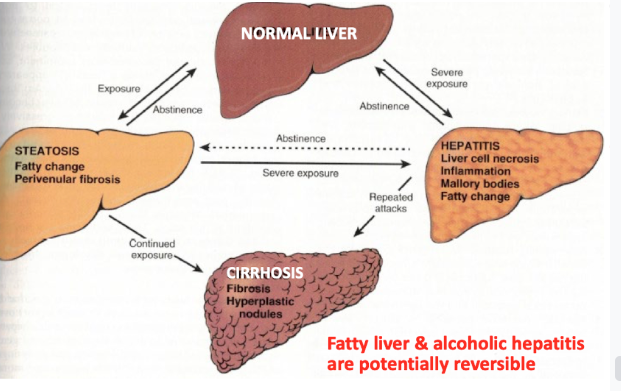
49
New cards
What happens in alcoholic fatty liver?
Fatty change
Perivenular fibrosis
\
**Clinical features**
Elevated AST and ALT
Hepatomegaly +/-
Reversible and steatosis usually disappears after 3 montjs of abstinence
Perivenular fibrosis
\
**Clinical features**
Elevated AST and ALT
Hepatomegaly +/-
Reversible and steatosis usually disappears after 3 montjs of abstinence
50
New cards
What happens in alcoholic hepatitis?
Liver cell necrosis
Inflammation
Mallory bodies
Fatty change
Features of protal hypertension
\
**Clinical features**
Jaundice
Hepatomegaly
Complications of portal hypertension +/-
AST ALT elevation
\
better 5 years survival if you stop drinking
Inflammation
Mallory bodies
Fatty change
Features of protal hypertension
\
**Clinical features**
Jaundice
Hepatomegaly
Complications of portal hypertension +/-
AST ALT elevation
\
better 5 years survival if you stop drinking
51
New cards
What happens in alcoholic cirrhosis?
Fibrosis
Hyperplastic nodules
Encephalopathy
Features of portal hypertension
\n **Clinical features**
Higher risk of developing hepatocellular carcinoma
Varices; hemorrhage
acites
Hyperplastic nodules
Encephalopathy
Features of portal hypertension
\n **Clinical features**
Higher risk of developing hepatocellular carcinoma
Varices; hemorrhage
acites
52
New cards
What is the pathophysiology behind NAFLD?
* NAFLD→ insuline resistance.
* Insulin resistance→ leads to incerase release of free fatty acids from adipocytes due to overactive lipoprotein lipase.
* which leads to **increased levels of circulating insulin**. Insulin resistance causes the **liver to produce more glucose than it needs,** which leads to an accumulation of fat in the liver
\
* **Lipid accumulation** → toxicity (change cell signalling pathways that regulate metabolism and stress response that can potentiate liver cell injury or death)
\
* dyslipidemia, obesity, and a sedentary lifestyle. These factors can lead to the **accumulation of fat in the liver** and promote inflammation, which can further damage liver cells
* Insulin resistance→ leads to incerase release of free fatty acids from adipocytes due to overactive lipoprotein lipase.
* which leads to **increased levels of circulating insulin**. Insulin resistance causes the **liver to produce more glucose than it needs,** which leads to an accumulation of fat in the liver
\
* **Lipid accumulation** → toxicity (change cell signalling pathways that regulate metabolism and stress response that can potentiate liver cell injury or death)
\
* dyslipidemia, obesity, and a sedentary lifestyle. These factors can lead to the **accumulation of fat in the liver** and promote inflammation, which can further damage liver cells