BIOM 1060 (Module 3)
 Call Kai
 Learn
Learn Practice Test
 Spaced Repetition
 Match
Match Flashcards
 Knowt Play
1/18

There's no tags or description
Looks like no tags are added yet.
Name | Mastery | Learn | Test | Matching | Spaced | Call with Kai |
|---|
No analytics yet
Send a link to your students to track their progress
19 Terms
Classifications of bones
Long bones
Longer than wide
Help with movement
Examples: femur, humerus
Short bones
Small and cube-shaped (equal length, width, and thickness)
Give stability
Examples: wrist (carpals), ankle (tarsals)
Flat bones
Thin, flat, and usually curved
Protect organs
Examples: skull, ribs, sternum
Irregular bones
Odd-shaped
Have special jobs (support/protection)
Examples: vertebrae, pelvis
Sesamoid bones
Small bones in tendons
Help reduce friction
Example: kneecap (patella)
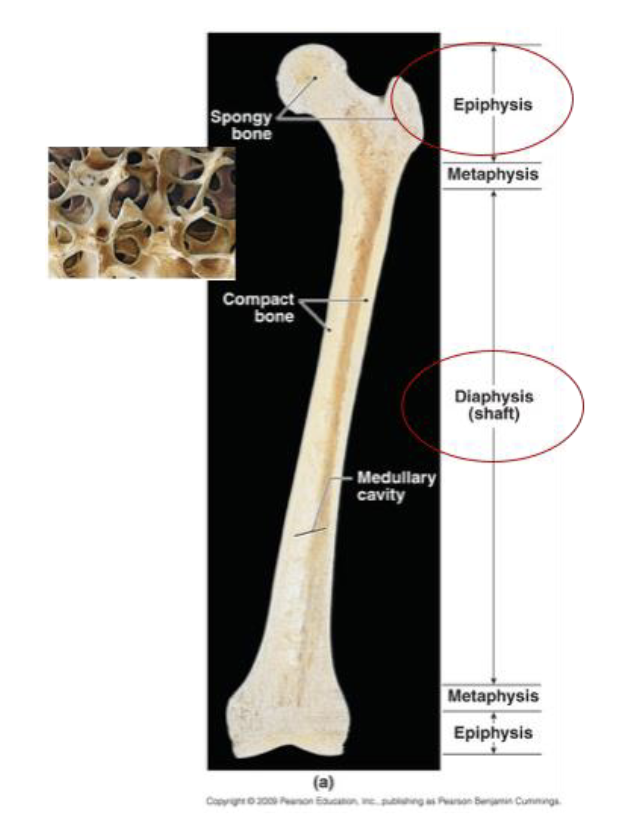
Gross structure and key anatomical features of long bones
Compact bone: Dense outer layer
Spongy bone: Honeycomb like bone found within
Connective tissue:
Periosteum covers outside of the impact bone
Endosteum covers the inside portion
Long Bone structure:
Diaphysis: Forms long axis, tubular shaft
Epiphyses: The end of long bones, made up of compact bone and spongy bone
Metaphysis: Region between diaphysis and epiphysis and contains the growth plate
The axial skeleton
1. Cervical: 7 vertebrae
2. Thoracic: 12 vertebrae
3. Lumbar: 5 vertebrae
4. Sacrum: one bone formed from fusion of
several (5) bones, articulates with hip
5. Coccyx: fused (4) bones
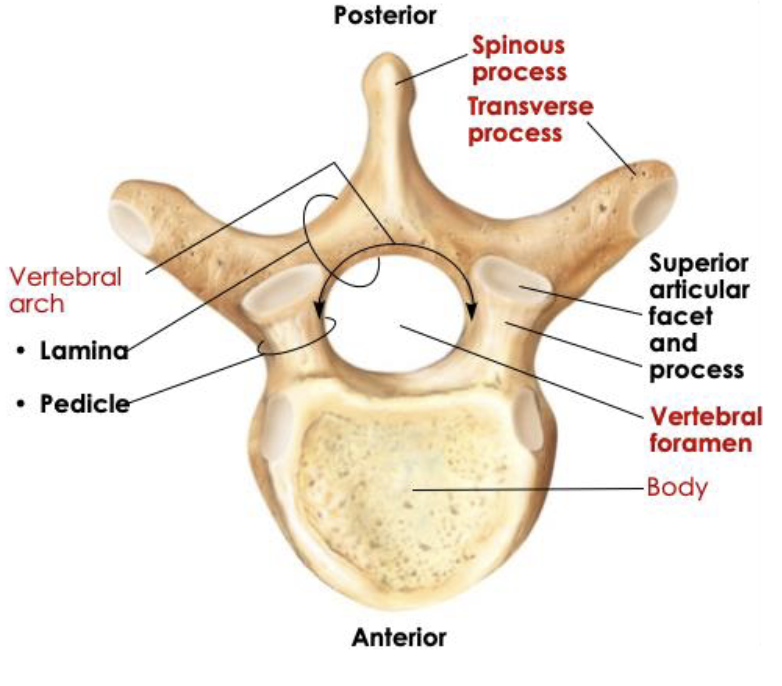
Common structure of all vertebrae
Cervical: Small oval body, large vertebral foramen
Thoracic: Heart shaped body, smaller vertebral foramen, large transverse process
Lumbar: Large oval body, triangular vertebral foramen, small transverse
Joints of the vertebral column
Intervertebral discs – cushion-like pad between vertebrae that act as shock absorbers
Thoracic cage
Composed of ribs, sternum and thoracic cage
Protects the organs and support upper limbs
Upper limbs
Arms: Hummeruss
Forearm: radius and ulna
Hand: carpals (8), metacarpals (5), phalanges (14)
Lower limbs
Thigh: Femur and patella
Leg: Tibia and Fibula
Foot: tarsals (7), metatarsals (5), phalanges (14)
Understand changes to the skeleton during development, ageing, and disease.
Development
Skeleton starts as cartilage → ossifies in embryo
Long bones start ossifying at 8 weeks and finish at 25 weeks
Growth continues in childhood/adolescence and stop around 25 years
Age-related bone changes
Children: more bone formation than resorption (bone growth)
Young adults: formation = resorption (stable)
Adults: less bone formation than resorption (bone loss begins)
Osteoporosis
Resorption > formation → low bone mass
Common in elderly (especially women)
Prevention: weight-bearing exercises

