Lesson 9: Meiosis and Gametogenesis
 Studied by 6 people
 Call Kai
 Learn
Learn Practice Test
 Spaced Repetition
 Match
Match Flashcards
 Knowt Play
1/27

There's no tags or description
Looks like no tags are added yet.
Name | Mastery | Learn | Test | Matching | Spaced | Call with Kai |
|---|
No analytics yet
Send a link to your students to track their progress
28 Terms
What is sexual reproduction?
Mixing genomes from two different progenitors.
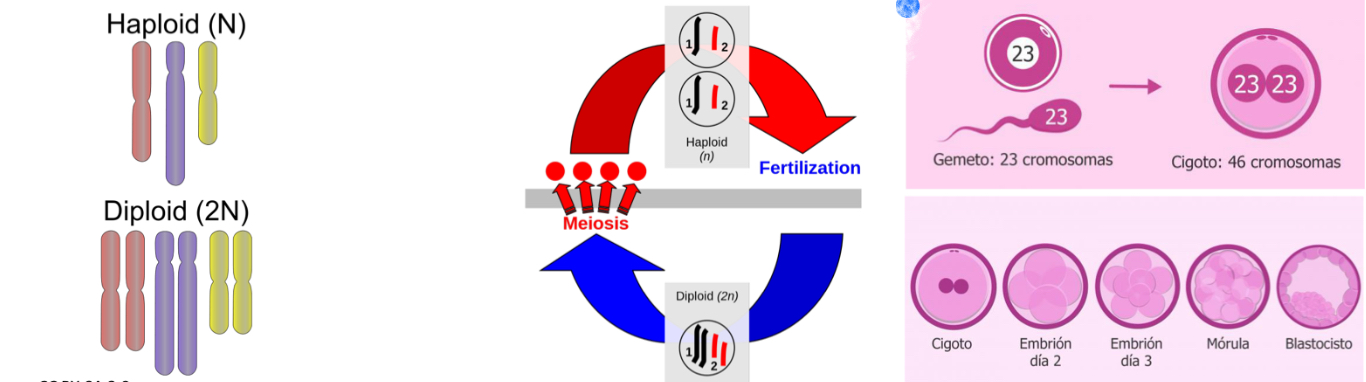
It is based on 2 phenomena.
What are the 2 phenomena of sexual reproduction
Cells are divided by meiosis (gametogenesis) which reduces by half the chromosome number (2n => n) (diploid→haploid)
Cell fusion: during fertilization two different genomes are joined. Haploid gametes unit to form a diploid zygote (n + n => 2n)
What is the meiosis and what is its purpose?
Special type of cell division necessary for sexual reproduction in eukaryotes:
diploid cell nucleus is divided generating four haploid nuclei.
▪ Ensures genetic variability: genetic recombination
- DNA fragments are exchanged between homologous chromosomes producing a different genetic combination in each gamete
Characteristics
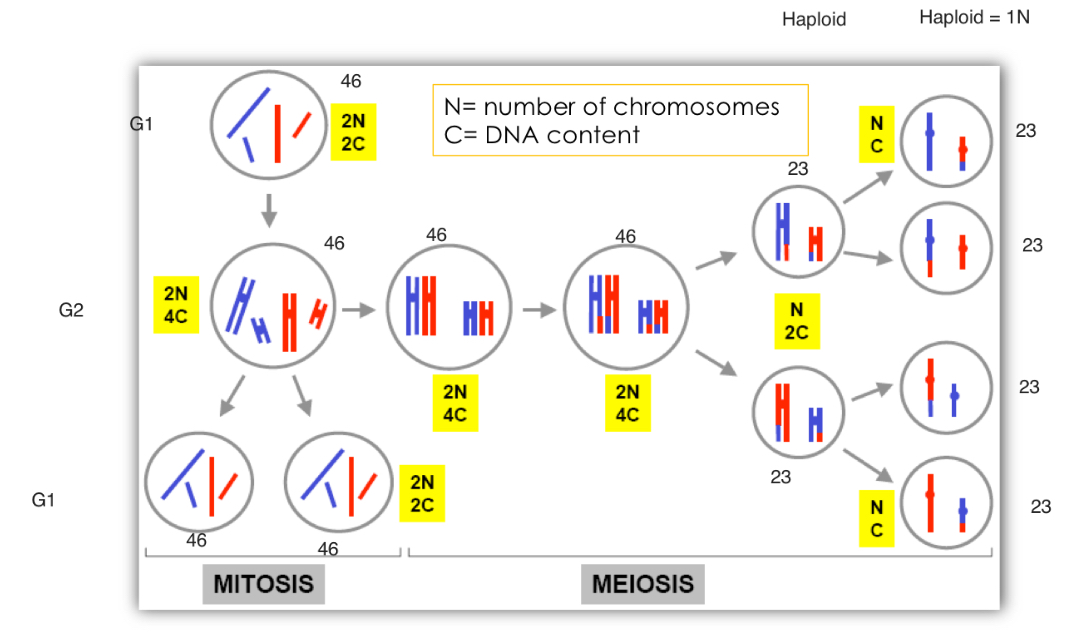
It consists of two sequential nucleus divisions and there is no genetic material duplication.
▪ Meiosis begins with one diploid cell containing two copies of each chromosome (one from the mother and one from the father) and ends with 4 haploid cells
Hoe many meiotic divisions happen during the meiosis?
2
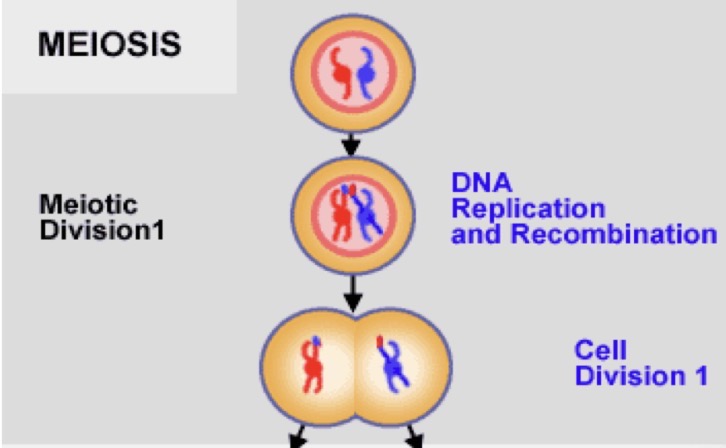
What happens in the first meiotic divison?
•The homologous chromosomes are separated.
•Two daughter nuclei are generated, each with a pair of homologue chromosomes (haploid nuclei).
• Genetic variability:
•Chromosomes are randomly distributed
•Genetic recombination
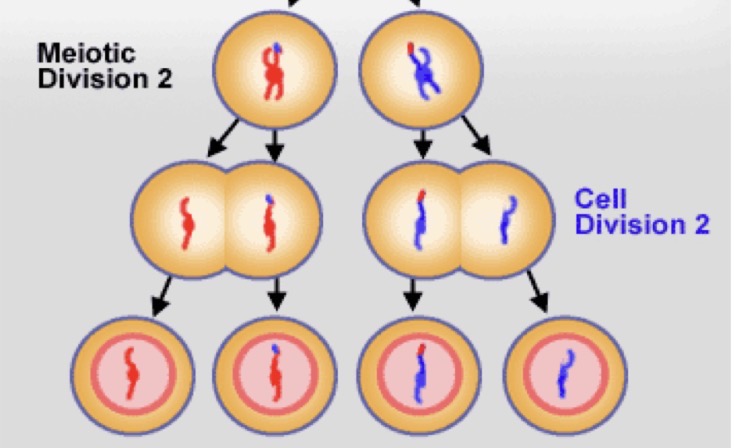
What happens in the second meiotic divison?
• Sister chromatids are distributed among the daughter nuclei.
• Four haploid cells containing one copy of each
chromosome (a sister chromatid) (haploid nuclei).
What are the steps of the meiosis?
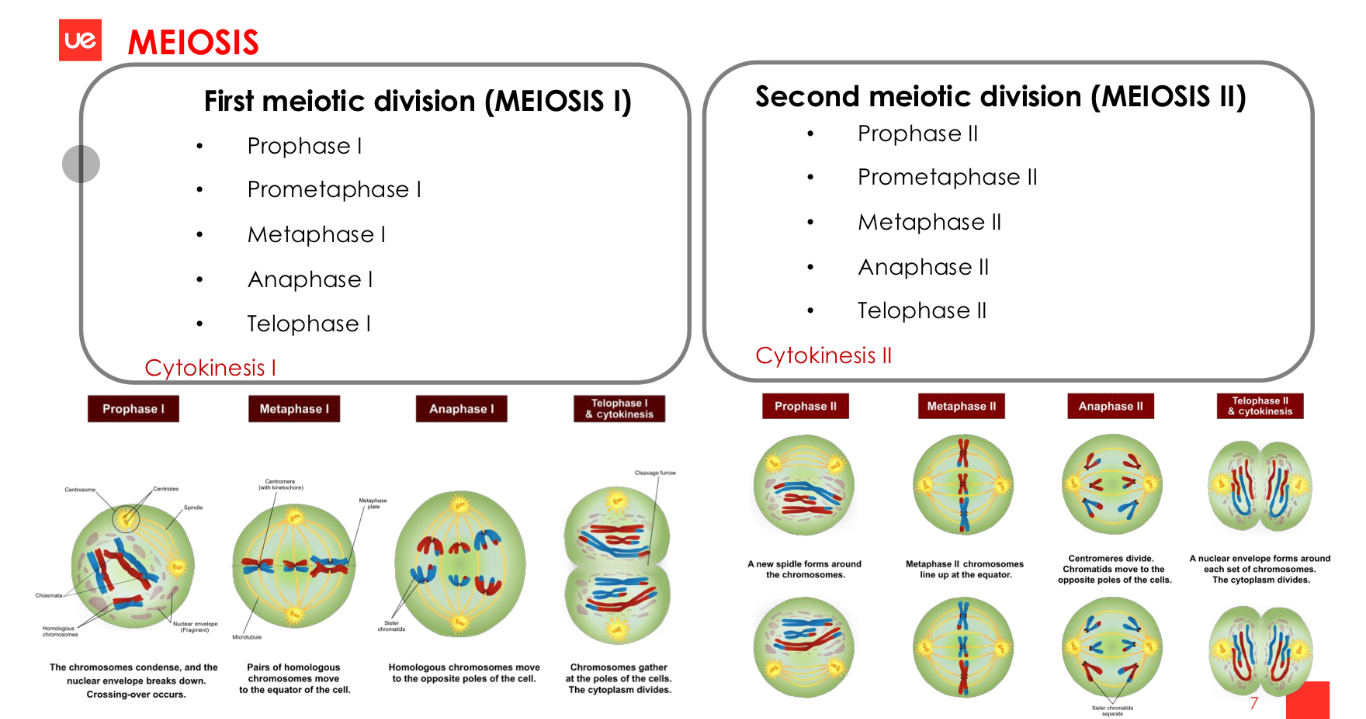
Why is the Prophase 1 special and what happens during the phase?
-longest phase of meiosis
-DNA is exchanged between homologous chromosomes in a process called homologous recombination.
What are the stages of the Prophase 1?
a) leptotene
b) zygotene
c) pachytene
d) diplotene
e) diakinesis.
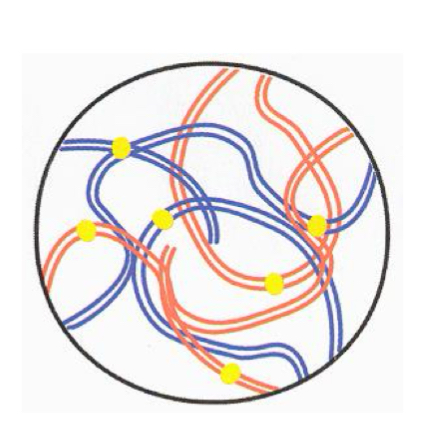
What happens during Leptotene?
-Start of the Formation of Meiotic spindle
-Two sister chromatids are so tightly bound that they are indistinguishable to each other
-chromosomes condensed and bind to the nuclear membrane at their telomeres
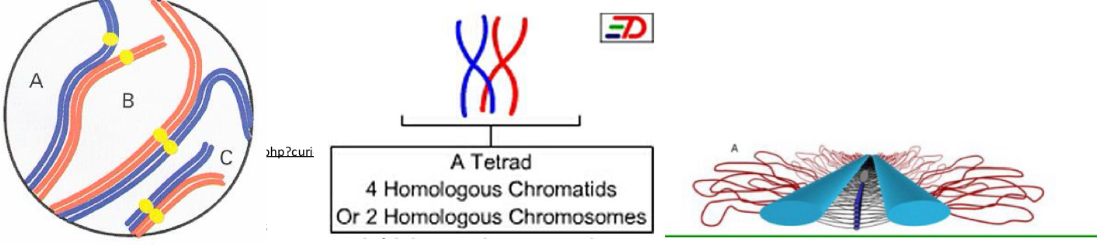
What happens during Zygotene?
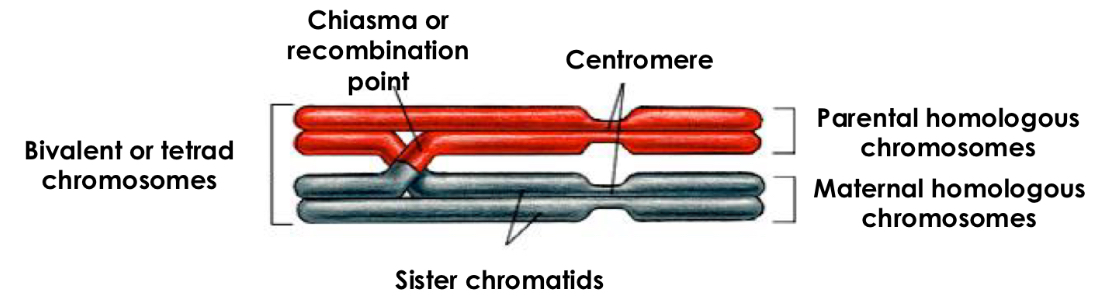
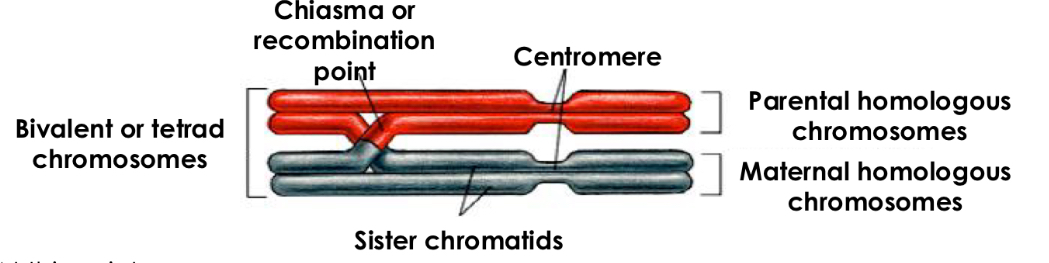
Synapsis: Homologous chromosomes line up with each other into homologous chromosomes pairs
→ bivalent or tetrad chromosomes: paired chromosomes
Synapsis is facilitated by the synaptonemal complex:
protein structure that closes in a zipper-like fashion, ensuring proper pairing
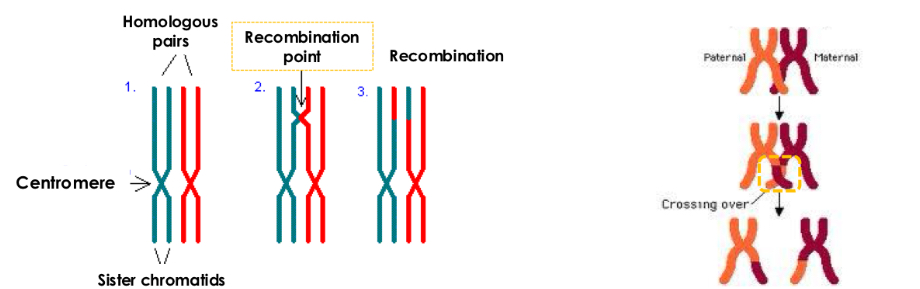
What happens during Pachytene?
- Chromosomal crossing-over occurs (homologous recombination):
→ non-sister chromatids may exchange segments over regions of homology.
- This recombination occurs through recombination nodules: multienzymatic complexes that appear at the exchange sites (chiasmata or recombination points)
- Recombination implies that the DNA double helix is broken and lately fused again.
What happens during Diplotene?
-synaptonemal complex degraded and homologous chromosomes start seperating
-homologous chromosomes remain tightly boudn at chiasmata
-Meiosis may be paused: Human fetal oogenesis
→ all developing oocytes get to this stage and stop before birth (7. month of embryonic development) and remain until puberty
What happens during Diakenesis?
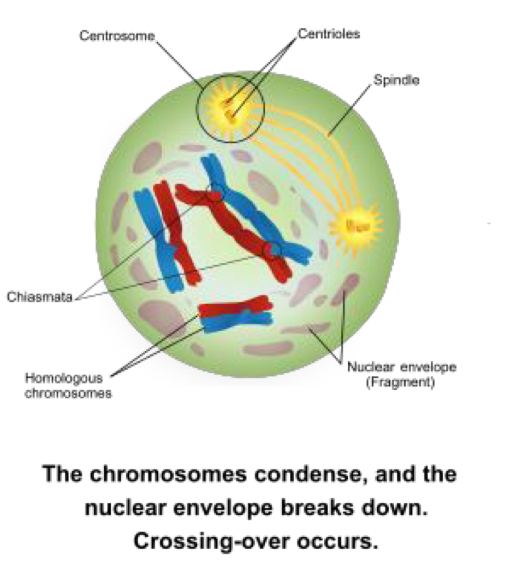
-chromosomes condense further - first point in meiosis where the four parts of the tetrads are actually visible
-chiasmatas clearly visible
-closely resembles prometaphase
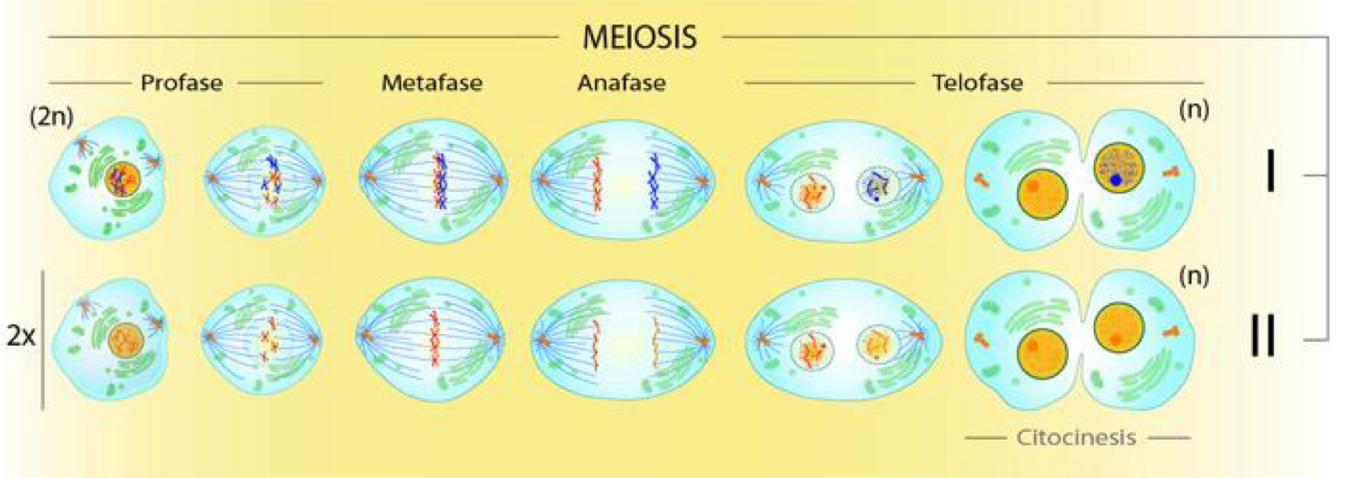
First Meiotic divison
Prophase 1
Prometphase 2: similar to Mitosis
Metaphase 1: Homologous pairs aligned along equatorial plane
Anaphase 1: seperation of homologous pairs
Telophase 1: two haploid nuclei
Similarities of Meiosis and Mitosis
➢ Formation of Chromosomes.
➢ The spindle apparatus (microtubules of cytoskeleton) orchestrates their movements.
➢ Nucleus and cytoplasm are divided.
Differences between Meiosis and Mitosis
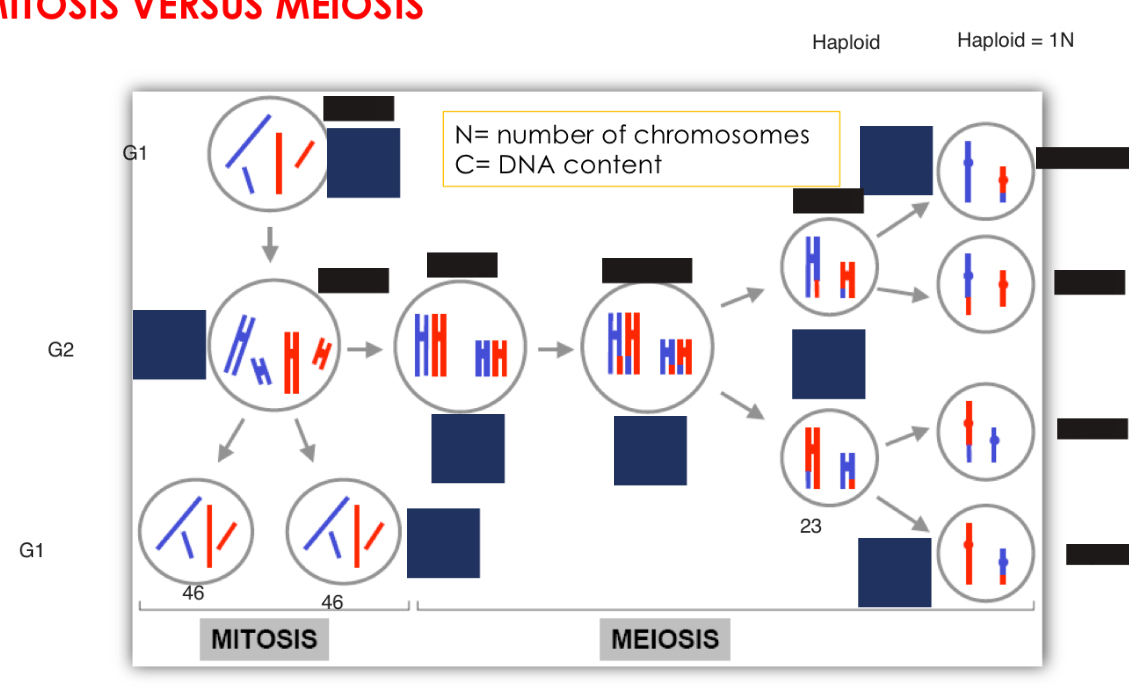
Mitosis:
→ Dna replication always followed by 1 cell divison
→ 2 diploid daughter cells are formed
→ short period of time
→ Each chromosomes is independent
→ each daughter cell has exactly same genetic informaion that the progenitor cell
Meiosis:
→ DNA replication always followed by 2 cell divisons
→ 4 haploid daughter cells are formed
→ can be paused or sustained for long periods
→ Homologous chromosomes paired forming bivalent chromosomes
→ genetic recombination occurs
GAMETOGENESIS
What are the 2 types of cells in adults?
Somatic cells and Germ cells
Somatic cells (every cell except germ cells)
-form the body of multicellular organisms
-cells that make up all the tissues and organs of an individual
Germ cells
-originate early in developement and located in gonads (ovaries and testes)
-include gametes and their specfiic precurser cells
-form mature gametes (egg and sperm)
-repdroduction of organism
Germ cells and haploid gamete formation:
Sexual reproduction, Specialized cells and biological significance
• Sexual reproduction: carried out by diploid organisms, in which each cell contains two copies of the chromosomes, inherited from each of the progenitors
• Specialized cells involved in sexual reproduction: gametes (sperm and eggs). They are haploid cells generated by meiosis, that will fuse (sexual reproduction).
• Biological significance: once they fuse (fertilisation), two haploid gametes (from two organisms) will form a new cell, in which both genomes are shuffled and generate a diploid genome of a new organism (zygote).
➢ The activated egg (fertilization) can give rise to a
complete new individual within a matter of days or weeks (mitosis).
Where does Gametogenesis occur?
→ occurs in the gonads (ovaries and testes)
What are the types of Gametogenesis?
Male gamete synthesis: spermotogenesis
→ Initiated during puberty (10-14 years old)
Female Gamete synthesis: Oogenesis
→ during fetal development, maturation arrested at the first stage of meiotic divison (prophase 1)
→ no further developement until sexual maturity
→ during 3rd month of fetal developement it is possible to become mature female gametes
What are the types of gametes?
Sperm cell
→ small and motile
→ ready for the propagation of paternal genes
Oocyte
→ large and immotile
→ ensures the survival of maternal genes
→ huge ammount of material
→ protective cover
What is the function of gametes?
Ensure the transmission of the genes they carry and form a zygote
 Note
Note  Flashcards (43)