AP Stats Unit 6 Vocabulary
0.0(0)
Studied by 8 people Call Kai
 Learn
Learn Practice Test
 Spaced Repetition
 Match
Match Flashcards
 Knowt Play
Card Sorting
1/20

Earn XP
Description and Tags
Last updated 9:14 PM on 9/21/22
Name | Mastery | Learn | Test | Matching | Spaced | Call with Kai | Chat |
|---|
No analytics yet
Send a link to your students to track their progress
21 Terms
1
New cards
Random Variable
Takes numerical values that describe the outcomes of some chance process.
2
New cards
Discrete random variables
A random variable that may assume either a finite number of values or an infinite sequence of values.
3
New cards
Probability distribution
Gives a random variable's possible values and their probabilities.
4
New cards
Expected Value
The expected value of a random variable is its theoretical long-run average value, the center of its model. Denoted u or E(X), it is found by summing the products of variable values and probabilities.
5
New cards
Mean (expected value) of a random variable
Multiply each possible value by its probability, then add all the products.
6
New cards
Variance of a random variable
An "average" of the squared deviation {(xi minus the mean of x) squared} of the values of the variable X from its mean.
7
New cards
Standard deviation
The square root of the variance.
8
New cards
Continuous random variable
Takes all values in an interval of numbers. The probability distribution of X is described by a density curve. The probability of any event is the area under the density curve and above the values of X that make up the event.
9
New cards
Linear Transformation
Adding or subtracting a constant (a), multiplying or dividing by a constant (b), or both. We write a linear transformation of the random variable X in the form Y = a + bx.
10
New cards
Linear Transformations (Adding/Subtracting and Multiplying/Dividing)
Adding/Subtracting:
Adds (a) or subtracts (a) from measures of center and location (mean, median, quartiles, percentiles). Does not change the shape or measures of spread (range, IQR, standard deviation).
Multiplying/Dividing:
Multiplies or divides measures of center and location (mean, median, quartiles, percentiles) by (b). Multiplies or divides measures of spread (range, IQR, standard deviation) by (b). Does not change the shape of the distribution.
Adds (a) or subtracts (a) from measures of center and location (mean, median, quartiles, percentiles). Does not change the shape or measures of spread (range, IQR, standard deviation).
Multiplying/Dividing:
Multiplies or divides measures of center and location (mean, median, quartiles, percentiles) by (b). Multiplies or divides measures of spread (range, IQR, standard deviation) by (b). Does not change the shape of the distribution.
11
New cards
Independent random variables
Knowing the value of one variable does not tell you anything about the value of the other.
12
New cards
Binomial setting
consists of (n) independent trials of the same chance process, each resulting in a success or a failure, with probability of success (p) on each trial.
13
New cards
Four conditions of a binomial setting (BINS)
B: Binary; The possible outcomes of each trial can be classified as "success" or "failure."
I: Independent; Trials must be independent, that is knowing the result of one trial must not tell us anything about the result of any other trial.
N: Number; The number of trials (n) of the chance process must be fixed in advance.
S: Success; There is the same probability of success on each trial.
I: Independent; Trials must be independent, that is knowing the result of one trial must not tell us anything about the result of any other trial.
N: Number; The number of trials (n) of the chance process must be fixed in advance.
S: Success; There is the same probability of success on each trial.
14
New cards
Binomial random variable
The count of X successes in a binomial setting.
15
New cards
Binomial distribution
The probability distribution of X in a binomial setting.
16
New cards
Binomial coefficient
The number of ways of arranging (k) successes among (n) observations.
17
New cards
Large Counts condition
When np is greater than or equal to 10 and n(1-p) is greater than or equal to 10.
18
New cards
Geometric setting
Consists of repeated trials of the same chance process in which the probability (p) of success is the same on each trial, and the goal is to count the number of trials it takes to get one success.
19
New cards
Geometric random variable
If Y = the number of trials required to obtain the first success, then Y is a geometric random variable.
20
New cards
Geometric distribution
The probability distribution of Y in a geometric setting.
21
New cards
Normal approximation
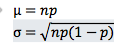
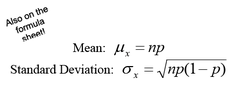
Says that if X is a count of successes having the binomial distribution with parameters n and p, then when n is large, X is approximately normally distributed with mean np and standard deviation square root of np(1-p).