Example receptors: Pacinian Corpuscle + Photoreceptors
 Call Kai
 Learn
Learn Practice Test
 Spaced Repetition
 Match
Match Flashcards
 Knowt Play
1/8

There's no tags or description
Looks like no tags are added yet.
Name | Mastery | Learn | Test | Matching | Spaced | Call with Kai |
|---|
No analytics yet
Send a link to your students to track their progress
9 Terms
What are pacinian corpuscles?
Pressure receptors in the dermal layer of the skin enabling you to sense changes in pressure all over your body.
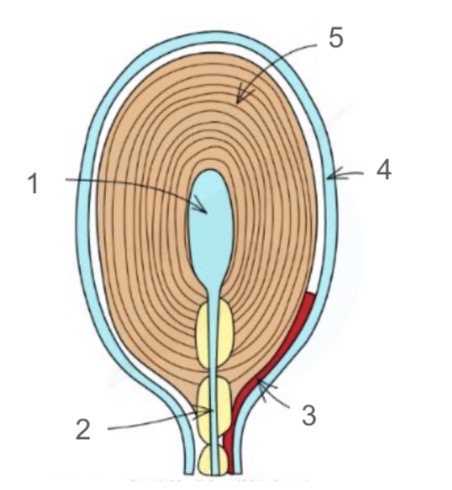
Label the pacinian corpuscle
Sensory neurone ending
Sensory neurone axon
Blood capillary
Capsule
Layers of connective tissue with gel between
Describe the generator potential in the pacinian corpuscle
The lamellae deform, pressing on the sensory neurone ending.
This stretches the neurone’s membrane, causing it to change shape.
This opens stretch-mediated sodium ion (Na+) channels in the membrane, increasing its permeability to Na+.
Na+ diffuses into the neurone, depolarising it and resulting in a generator potential.
If this change in ion concentration, and so charge, reaches the threshold, an action potential is triggered.
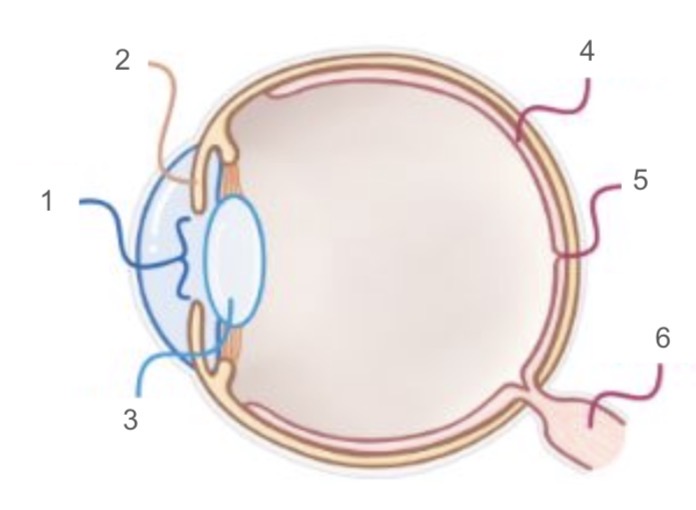
Label the structures of the eye
Pupil
Iris
Lens
Retina
Fovea
Optic nerve
Where are the photoreceptors located in the eye?
Rods- located around the peripheral of the retina
Cones- densely packed in the fovea
Describe the generator potential in photoreceptors
Light hits photopigments, which are light- sensitive proteins in photoreceptor cells.
Light bleaches and causes a chemical change in the photopigments.
This increases the permeability of photoreceptor cells to sodium ions.
An influx of sodium ions causes a generator potential.
If this reaches threshold, a bipolar sensory neurone carries a signal to the optic nerve and then the brain.
What happens if too much light is picked up by these receptors?
The photopigment can basically run out, making the receptors exhausted. This can lead to temporary or permanent blindness.
How many cone cells are connected to a neurone? How does this help?
One cone cell connected to a single sensory neurone. This gives cone cells a high visual acuity as separate impulses will be sent to the brain for each cone cell receiving the stimulus. But, it gives cone cells a low light sensitivity, as the impulse received from one cone cell is unlikely to generate an action potential in the sensory neurone.
How many rod cells are connected to a neurone? How does this help?
There are multiple rod cells connected to a single neurone. This gives rod cells a low visual acuity as one single impulse will be sent to the brain for all the rod cells receiving the stimulus. But, it gives rod cells a high light sensitivity, as the impulses received from many rod cells are more likely to generate an action potential in the sensory neurone.