Ch 9 - Musculaar System - road map
 Call Kai
 Learn
Learn Practice Test
 Spaced Repetition
 Match
Match Flashcards
 Knowt Play
1/30

There's no tags or description
Looks like no tags are added yet.
Name | Mastery | Learn | Test | Matching | Spaced | Call with Kai |
|---|
No analytics yet
Send a link to your students to track their progress
31 Terms
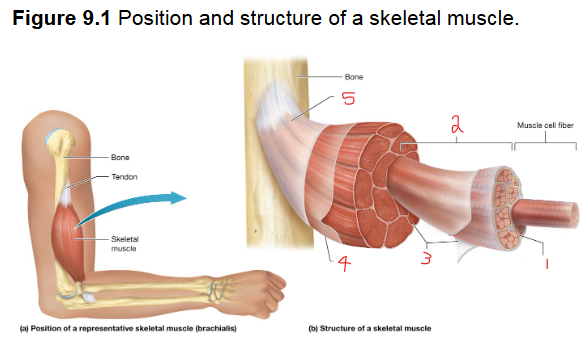
Endomysium
1 - this is the thin layer of ECM that surrounds skeletal muscle fibers
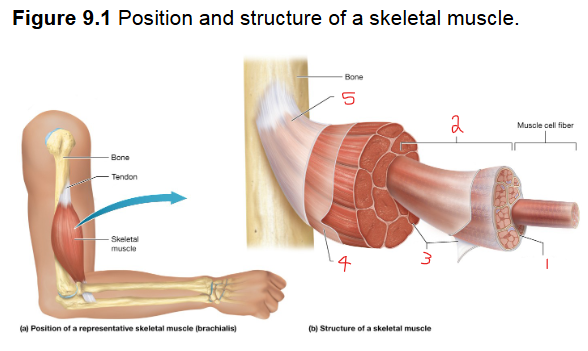
Fascicle
2 - a group of 10 to 100 muscle fibers bundled together
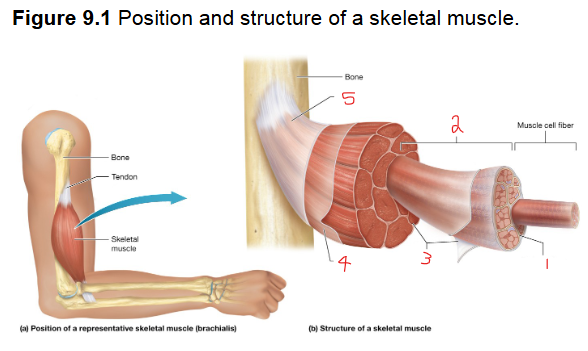
Perimysium
3 - connective tissue that surrounds a fascicle
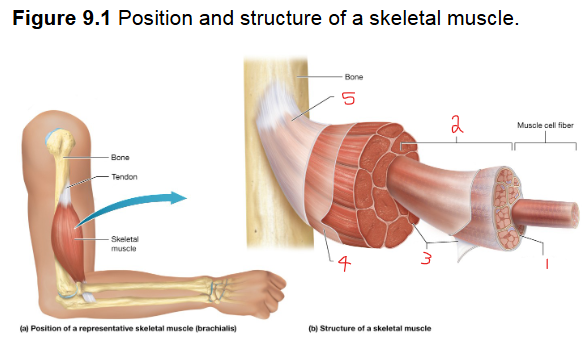
Epimysium
4 - all of the fascicles in a muscle are surrounded by this layer of CT
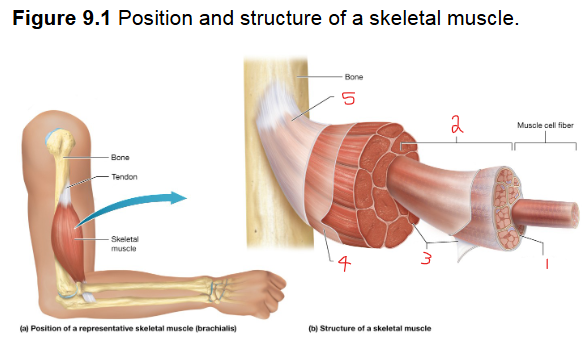
Fascia
5 - the most superficial connective tissue sheath of the epimysium
Tendons
Attach muscle to bone
(or another part that the muscle moves)
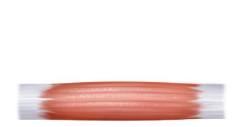
Parallel muscle
Evenly spaced fascicles, tendon about the same width as muscle
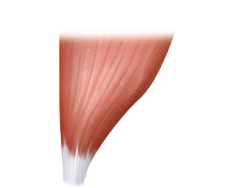
Convergent muscle
Large at one end uniformly tapers to a single tendon
Ex. pectoralis major
Pennate
looks like one side of a Feather because of the way that fibers and fascicle attach to the tendon at an angle
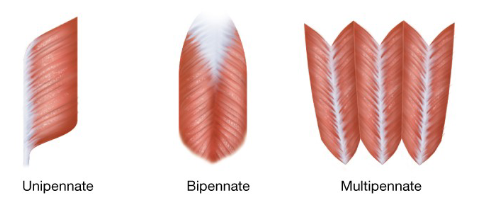
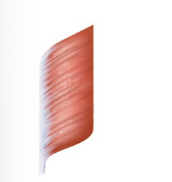
Unipennate
single tendon, fascicles feather out from only one side ex. flexor pollicis
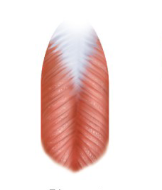
Bipennate
Single tendon, vesicles feather out from both sides ex. Rectus femoris
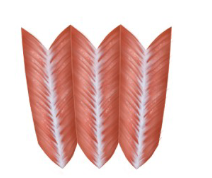
Multipennate
Made of several tendons, physical attachments look like several feathers attached to each other
ex. Deltoid
Naming muscles based on function (5)
muscles named based on functions include flexors, extensors, levators, adductors and abductors
Flexors
Function for flexing, Decreases angle between bones
Extenders
Function for extension, Increase the angle between bones
Levator
Any muscle that functions to raise or elevate a body part ex. the muscle that lifts the eyelid or the one that lifts the upper lip
Adductor
Pull towards the body, primarily in legs
Abductors
Pulls away from the body, primarily in legs
Actions
Body movements produced by skeletal muscles because of their ability to generate muscle tension
Prime mover
Also called Agonist, muscle that provides most of the force required for a given movement, opposite to antagonist
Antagonist
Usually on the opposite side of joint from Agonist partner, opposes and slows action to prevent hyperextension and make movements more graceful
Agonist
Also called Prime Movers, muscle that provides most of the force required for a given movement, opposite to antagonist
Synergist
muscles that work together with Agonist, guide movement making it smoother
Fixators
Hold bone in place, anchoring function, do not move,
makes movements more efficient and reduces risk of injury
Origin
Part muscle attaches to that is fixed
Ex. the bicep attaches to the scapula which remains stationary
Origin and insertion can switch for muscles that act on more than one joint
Insertion
Part muscle attaches to that moves
Ex. bicep connects to the radius which moves
Origin and insertion can switch for muscles that act on more than one joint
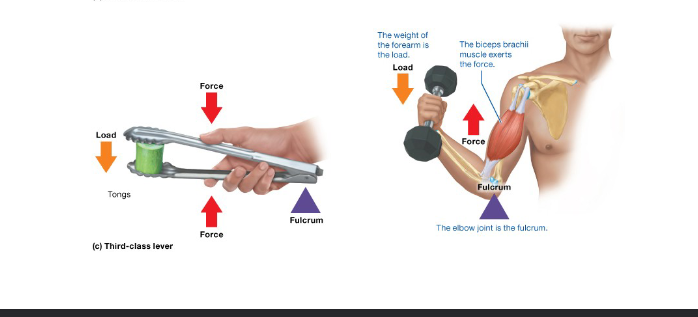
Lever system (components)
Four components
Lever = bones
Load = weight of body part being moved
Force = tension generated by the muscles, applied to lever to move the load
Fulcrum = joint where movement occurs
Fulcrum
Joint where movement occurs
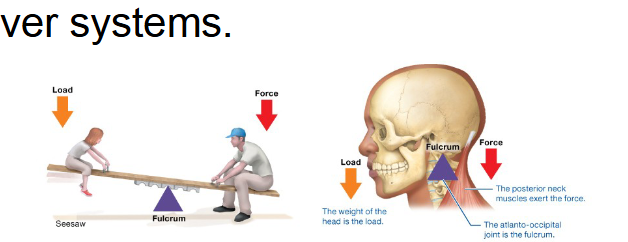
First class lever
Seesaw, load joint then Force
Joint between tension generated by muscle and weight of body part
Ex. atlanto-occipital joint (neck joint)
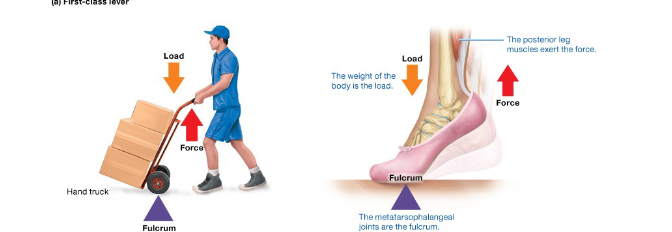
Second class lever
Weight of body part between joint and tension generated
load in middle force applied to one side and Fulcrum is on the other
Uncommon, usually only in toes, ex. the ankle joint (talocrural joint)
Third class lever
Tension generated between joint and weight of body
Force in the middle of load on one side fulcrum on the other ex.Elbow joint