astronomy: chapter 0
 Studied by 3 people
 Call Kai
 Learn
Learn Practice Test
 Spaced Repetition
 Match
Match Flashcards
 Knowt Play
1/90

Earn XP
Description and Tags
idek anymore man.
Name | Mastery | Learn | Test | Matching | Spaced | Call with Kai |
|---|
No analytics yet
Send a link to your students to track their progress
91 Terms
The celestial sphere is best described as:
An imaginary sphere used to map the sky
The apparent daily motion of stars across the sky is caused by:
Earth’s rotation on its axis
Stars that never rise or set are called
Circumpolar stars
The point in the sky directly overhead an observer is called the
zenith
Which coordinate system depends on the observer’s location and time?
horizon coordinate system
Altitude is measured
above the horizon
Azimuth is measured
along the horizon
Right Ascension is most similar to
longitude
Declination is most similar to
latitude
Right Ascension is measured in
hours
What is the celestial equator?
The projection of Earth’s equator onto the celestial sphere
Why does the horizon coordinate system change throughout the night?
Because Earth rotates and the system depends on the observer’s position
What is a constellation in modern astronomy?
An officially defined region of the sky
Why are constellations not true physical groupings of stars?
The stars only appear close together but are far apart in space
What is the ecliptic?
The apparent yearly path of the Sun across the sky
Explain why planets are always found near the ecliptic.
Planets orbit in nearly the same plane as Earth
What is precession, and how does it affect the position of the North Star over time?
A slow wobble of Earth’s axis that changes the celestial poles over time
Describe the motion of circumpolar stars as seen from Earth.
They move in circles around the celestial pole and never set
Explain one advantage of using the equatorial coordinate system instead of the horizon system.
It does not change with time or location
How did early sky charting help civilizations on Earth?
Navigation, calendars, timekeeping, and cultural purposes
planet
one of eight major bodies that orbit the sun, visible to us by reflected sunlight
star
a glowing ball of gas held together by its own gravity and powered by nuclear fusion in its core
galaxy
gravitationally bound collection of a large number of stars. the sun is a star in the milky way galaxy
universe
the totality of all space, time, matter, and energy
astronomy
branch of science dedicated to the study of everything in the universe that lies above earth’s atmosphere
constellations
a human grouping of stars in the night sky into recognizable patterns
celestial sphere
imaginary sphere surrounding earth to which all objects in the sky were once considered to be attached
rotation
spinning motion of a body about an axis
north celestial pole
point on the celestial sphere directly above earth’s north pole
south celestial pole
point on the celestial sphere directly above earth’s south pole
celestial equator
the projection of earth’s equator onto the celestial sphere
celestial coordinates
pair of quantities—right ascension and declination—similar to longitude and latitude on earth, used to pinpoint locations of objects on the celestial sphere
declination
celestial coordinate used to measure latitude above or blow the celestial equator on the celestial sphere
right ascension
celestial coordinates used to measure longitude on the celestial sphere. the zero point is the position of the sun at the vernal equinox
solar day
the period of time between the instant when the sun is directly overhead (i.e., noon) to the next time it is directly overhead
diurnal motion
apparent daily motion of the stars caused by earths rotation
sidereal day
the time needed between successive risings of a given star
revolving
when an object orbits around another (the earth around the sun)
ecliptic
apparent path of the sun, relative to the stars on the celestial sphere, over the course of a year
zodiac
the 12 constellations on the celestial sphere through which the sun appears to pass during the course of a year
summer solstice
point on the ecliptic where the sun is at its northernmost point above the celestial equator, occurring on or near june 21
winter solstice
point on the ecliptic where the sun is at its southernmost point below the celestial equator, occurring on or near december 21
seasons
changes in average temperature and length of day that result from the tilt of earths (or any planets) axis with respect to the plan of its orbit
equinox
earths rotation axis is perpendicular to the line joining earth to the sun
autumnal equinox
date on which the sun crosses the celestial equator moving southward, occurring on or near september 22
vernal equniox
date on which the sun crosses the celestial equator moving northward, occurring on or near march 21
tropical year
the time interval between one vernal equinox and the next
sidereal year
time required for the constellations to complete one cycle around the sky and return to their starting points, as seen from a given point on earth. earths orbital period around the sun is 1 sidereal year
precession
slow change in the direction of the rotation axis of a spinning object, caused by some external gravitational influence
phases
appearance of the sunlit face of the moon at different points along its orbit, as seen from earth
new moon
phase of the moon during which none of the lunar disk is visible
quarter moon
lunar phase in which the moon appears as a half disk
sidereal month
time required for the moon to complete one trip around the celestial sphere
synodic month
time required for the moon to complete a full cycle of phases
eclipse
event during which one body passes in front of another, so that the light from the occulted body is blocked
lunar eclipse
celestial event during which the moon passes through the shadow of earth, temporarily darkening its surface
partial eclipse
celestial event during which only a part of the occulted body is blocked from view
total eclipse
celestial event during which one body is completely blocked from view by another
solar eclipse
celestial event during which the new moon passes directly between earth and the sun, temporarily blocking the suns light
umbra
central region of the shadow cast by an eclipsing body. the central region of sunspot, which is its darkest and coolest part
penumbra
portion of the shadow cast by an eclipsing object in which the eclipse is seen as partial. the outer region of sunspot, surrounding the umbra, which is not as dark and not as cool as the central region
annular eclipse
solar eclipse occurring at a time when the moon is far enough away from earth that it fails to cover the disk of the sun completely, leaving a ring of sunlight visible around its edge
triangulation
method of determining distance based on the principles of geometry. a distant object is sighted from two well-separated locations. the distance between the two locations and the angle between the line joining them and the line to the distant object are all that are necessary to ascertain the objects distance
cosmic distance scale
collection of indirect distance measurement techniques that astronomers use to measure distances in the universe
baseline
distance between two observing locations used for the purposes of triangulation measurements. the larger the baseline, the better the resolution attainable
science
step by step process for investigating the physical world based on natural laws and observed phenomena
theory
framework of ideas and assumptions used to explain some set of observations and make predictions about the real world
Our Galaxy is about 1 million times larger than Earth. (T/F)
false
The stars in a constellation are physically close to one another. (T/F)
false
The solar day is longer than the sidereal day. (T/F)
true
The seasons are caused by the precession of Earth’s axis. (T/F)
false
A lunar eclipse can occur only during the full phase. (T/F)
true
The angular diameter of an object is inversely proportional to its distance from the observer. (T/F)
true
If we know the distance of an object from Earth, we can determine the object’s size by measuring its parallax. (T/F)
false
If Earth rotated twice as fast as it currently does, but its motion around the Sun stayed the same, then
the night would be half as long
A long, thin cloud that stretched from directly overhead to the western horizon would have an angular size of
90 degrees
When a thin crescent of the Moon is visible just before sunrise, the Moon is in its
waning phase
If the Moon’s orbit were a little larger, solar eclipses would be
more likely to be annular
If the Moon orbited Earth twice as fast, but in the same orbit, the frequency of solar eclipses would
stay the same
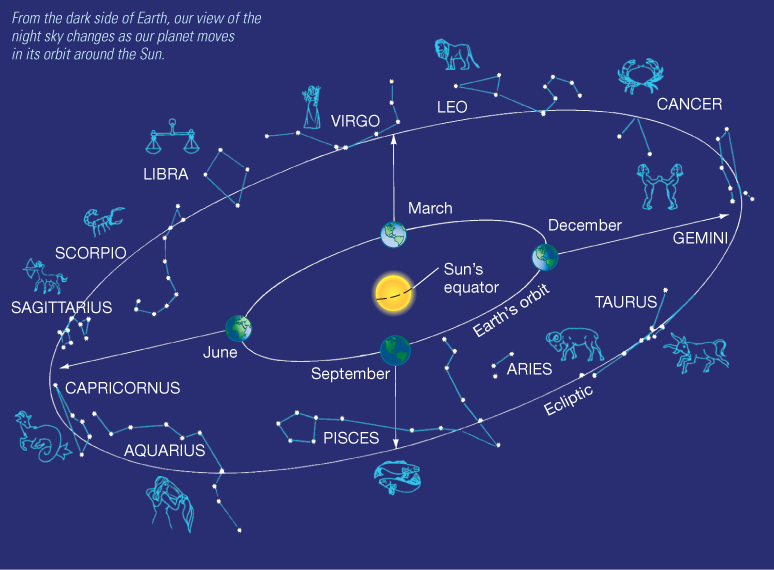
According to Figure 0.8 (The Zodiac), in January the Sun is in the constellation
aquarius
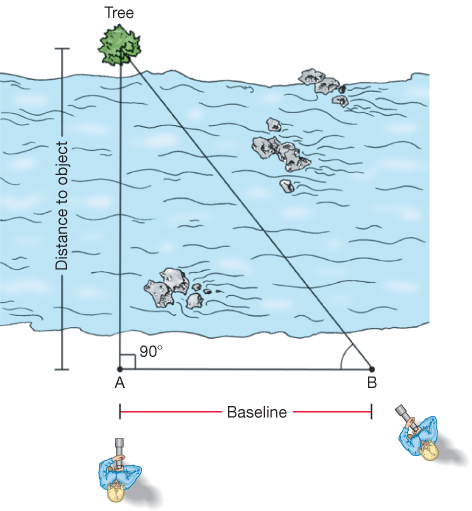
In Figure 0.19 (Triangulation), using a longer baseline would result in
a more accurate distance to the tree
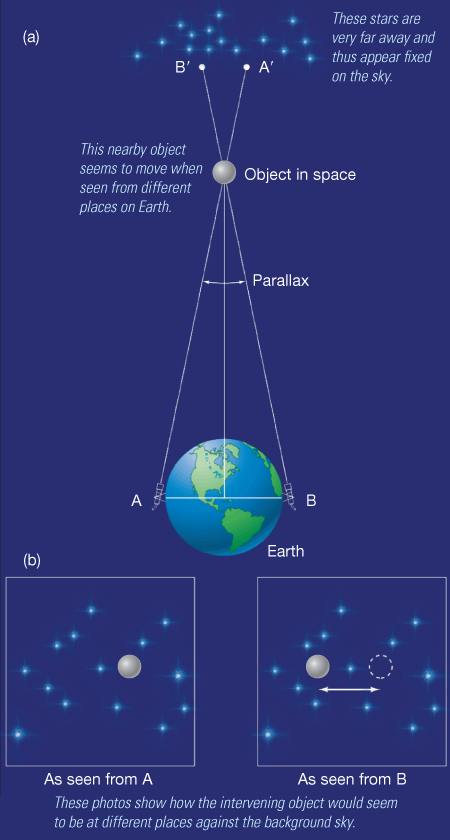
In Figure 0.20 (Parallax), a smaller Earth would result in
a smaller parralax angle
The vernal equinox is now just entering the constellation Aquarius. In what constellation will it lie in the year a.d. 10,000?
scorpius
Given that Earth orbits at 150,000,000 km from the Sun, through what distance does Earth move in a second? An hour? A day?
29.9 km, 1.08 × 10⁵ km, 2.58 × 10⁶ km
How, and by roughly how much, would the length of the solar day change if Earth’s rotation were suddenly to reverse direction?
it would decrease by 8 minutes
How long does it take for the Moon to move a distance equal to its own diameter of angular 0.5°?
(a) 33 arc minutes, (b) 33 arc seconds, (c) 0.55 arc seconds; 56.4 minutes
Given that the distance to the Moon is 384,000 km, and taking the Moon’s orbit around Earth to be circular, estimate the speed (in kilometers per second) at which the Moon orbits Earth.
1 km/s
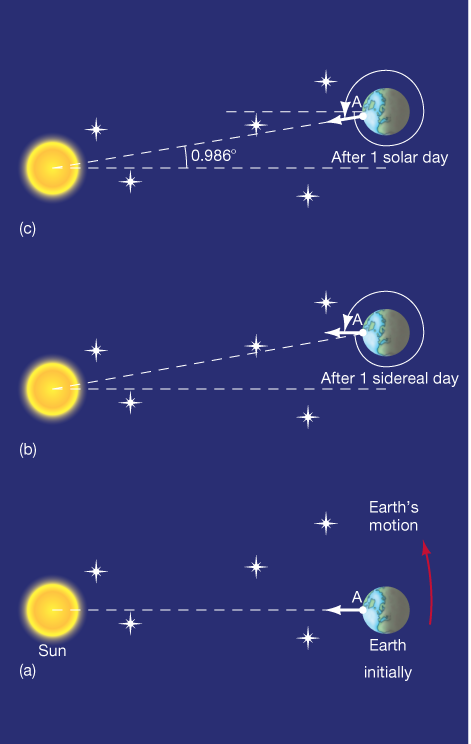
Use reasoning similar to that illustrated in Figure 0.7 to verify that the length of the synodic month (the time from one full Moon to the next; Section 0.3) is 29.5 days.
it is!
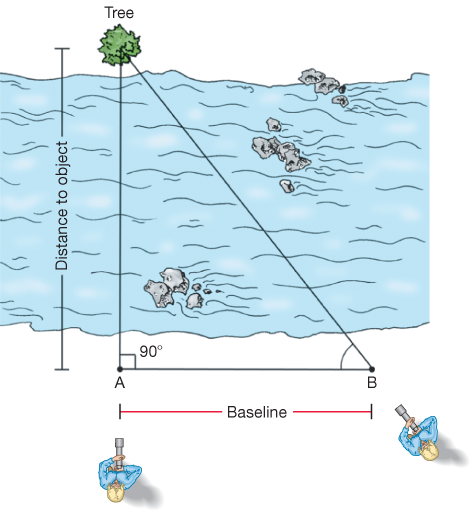
The baseline in Figure 0.19 is 100 m and the angle at B is 60°. By constructing the triangle on a piece of graph paper, determine the distance from A to the tree.
173 m
Use reasoning similar to that in Discovery 0-1 (but now using a circle centered on the object and containing the baseline) to determine the distance to an object if its parallax, as measured from either end of a 1000-km baseline, is
(a) 57,300 km, (b) 3.44 × 10⁶ km, (c) 2.06 × 10⁸ km
What would the measured angle in Discovery 0-1 have been if Earth’s circumference were 100,000 km instead of 40,000 km?
2.9 degrees
 Note
Note  Flashcards (64)