Pe final - sports + dance
0.0(0)
 Studied by 1 person
 Call Kai
 Learn
Learn Practice Test
 Spaced Repetition
 Match
Match Flashcards
 Knowt Play
Card Sorting
1/118

There's no tags or description
Looks like no tags are added yet.
Last updated 6:07 PM on 6/12/23
Name | Mastery | Learn | Test | Matching | Spaced | Call with Kai |
|---|
No analytics yet
Send a link to your students to track their progress
119 Terms
1
New cards
How many players are there on a volleyball court? (per team)
6
2
New cards
How many touches per team? (volleyball)
3 touches consecutively per team
3
New cards
How does a volleyball game start?
coin toss (to decide who starts) & service (how the game starts)
4
New cards
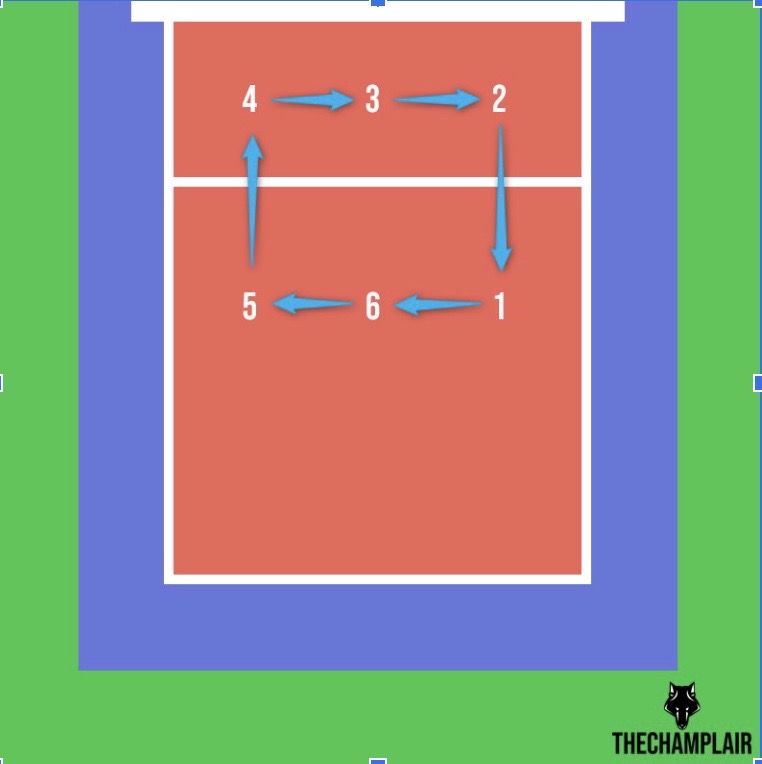
What are the positions for volleyball?
1- setter
2 - Right side hitter
3 - Middle hitter
4 - Setter
5 - Outside hitter
6 - Middle blocker/Libero
2 - Right side hitter
3 - Middle hitter
4 - Setter
5 - Outside hitter
6 - Middle blocker/Libero
5
New cards
How does the rotation for volleyball go?
Clockwise
6
New cards
Volleyball rule 1
The ball can only be hit up to three times per side (in addition to blocking) before it must go over the net.
7
New cards
Volleyball rule 2
If two or more teammates contact the ball simultaneously, it is considered one play. Neither player, however, may touch the ball again until another teammate touches it.
8
New cards
Volleyball rule 3
A volleyball player can serve underhand or overhand, but can’t step over the end line until after contacting the ball. The serve (or any volleyball hit) can graze the net as it goes over the net.
9
New cards
Volleyball rule 4
The volleyball serve must first be hit by the opposing team with a bump, or underarm pass, before it can be hit with a set, block or attacking shot.
10
New cards
Volleyball rule 5
A team will rotate one spot in a clockwise manner each time it regains the volleyball serve from the opposing team.
11
New cards
Volleyball rule 6
A volleyball player can’t reach over the net except on a follow-through or to make a block (and only after the opponent contacts the ball).
12
New cards
Volleyball rule 7
6 players on the floor at any one time - 3 in the front row and 3 in the back row.
13
New cards
Volleyball rule 8
The volleyball can be played off the net on a serve or during a volley.
14
New cards
Volleyball rule 9
If you fail to serve the ball over the net successfully your opponent team gets a point.
15
New cards
Volleyball rule 10
You cannot catch, hold, or throw the ball.
16
New cards
Setter
The setter is the main contributor to the offense of the volleyball team.
One of the requirements of the setter is having a delicate touch to set the ball perfectly for one of the attacking players.
Communication is extremely important for the setter because they need to get the rest of the players on the same page.
Without the setter, there wouldn’t be hard spikes or technical ball movement.
One of the requirements of the setter is having a delicate touch to set the ball perfectly for one of the attacking players.
Communication is extremely important for the setter because they need to get the rest of the players on the same page.
Without the setter, there wouldn’t be hard spikes or technical ball movement.
17
New cards
Outside Hitter
The outside hitter is the lead attacker in the offensive strategy. To be a successful outsider hitter, you must be able to jump high, be quick on your feet, and be ready to adapt to different situations.
\
The volleyball won’t always be placed where the outside hitter would like, so they need to be prepared for hits from a variety of places.
\
The volleyball won’t always be placed where the outside hitter would like, so they need to be prepared for hits from a variety of places.
18
New cards
Right Side Hitter
The right-side hitter, these players need to be a perfect balance of both offense and defense.
They will also get many opportunities to hit the volleyball, so similar to the outside hitter, jumping ability is vital.
The main difference that sets the right-side hitter apart is their defensive responsibility. Being able to receive the serve from the opposing team is just one of the many requirements of this specialized position.
They will also get many opportunities to hit the volleyball, so similar to the outside hitter, jumping ability is vital.
The main difference that sets the right-side hitter apart is their defensive responsibility. Being able to receive the serve from the opposing team is just one of the many requirements of this specialized position.
19
New cards
Middle hitter
The middle hitter is the tallest player on the volleyball team. Their main role for the team is being the first line of defense against the opposing team’s hits.
The middle hitter needs to read the other team’s attackers to quickly raise his or her arms above the net in a blocking attempt. However, this is not a defense-only position.
The middle hitter will have chances for quick points throughout the set.
The middle hitter needs to read the other team’s attackers to quickly raise his or her arms above the net in a blocking attempt. However, this is not a defense-only position.
The middle hitter will have chances for quick points throughout the set.
20
New cards
Libero
\
The libero can become confusing for non-volleyball players. They can only play on the back row of the court, and because of this, are the ideal person to receive a hit from the opposite team.
There are set rules the libero needs to follow, such as not attacking the ball at the net, playing a set for an attacker from the front, and more.
You can always tell a libero apart from the rest of the team because they wear a different colored jersey.
The libero can become confusing for non-volleyball players. They can only play on the back row of the court, and because of this, are the ideal person to receive a hit from the opposite team.
There are set rules the libero needs to follow, such as not attacking the ball at the net, playing a set for an attacker from the front, and more.
You can always tell a libero apart from the rest of the team because they wear a different colored jersey.
21
New cards
Ball movement
Dribble and passing
22
New cards
Key to good basketball
Dribble, passing and shooting
23
New cards
Scoring
2 points or 3 points, free throw on a foul is worth 1 point
24
New cards
Different types of shots
lay up, free throw, 2 pointer, 3 pointer
25
New cards
Passes & Dribbling
chest pass, overhead pass, bounce pass, overhead pass, and one-handed push pass
26
New cards
\# of players
5 on each team on the court
27
New cards
Game starts
with Jump ball at the center court
28
New cards
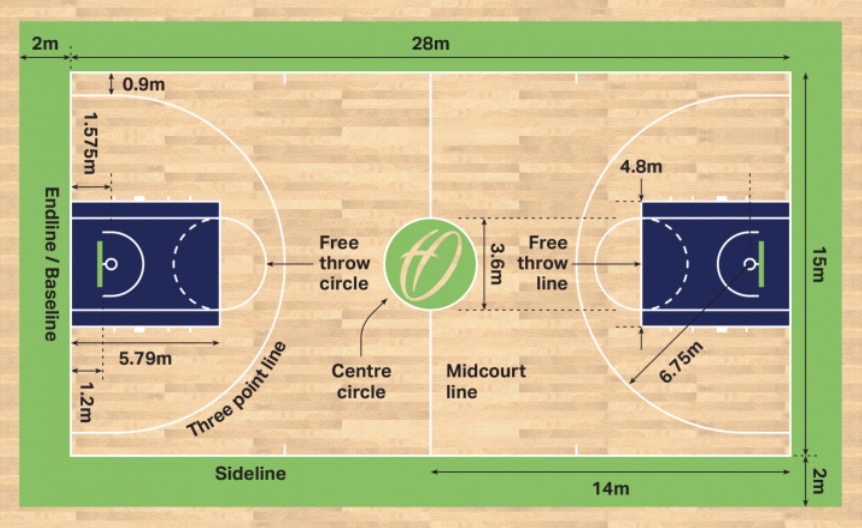
Basketball rule 1
Only five players per team are allowed to be on the court
29
New cards
Basketball rule 2
You can not run with the ball in your hands
30
New cards
Basketball rule 3
The team with the most points win
31
New cards
Basketball rule 4
If one team throws or dribbles the ball out of bounds its the opposing team’s ball
32
New cards
Basketball rule 5
You move with the ball by dribbling
33
New cards
Basketball rule 6
A team is permitted to have 5 fouls per quarter
34
New cards
Basketball rule 7
Taking more than two steps is considered a travel
35
New cards
Basketball rule 8
The player hand needs to be on top of the ball while dribbling
36
New cards
Basketball rule 9
The ball must stay in bounds
37
New cards
Basketball rule 10
A full basketball game consists of 4 quarters of 10 minutes
38
New cards
Center
The center is the tallest player on each team, playing near the basket.
On offense, the center tries to score on close shots and rebound.
But on defense, the center tries to block opponents’ shots and rebound their misses.
On offense, the center tries to score on close shots and rebound.
But on defense, the center tries to block opponents’ shots and rebound their misses.
39
New cards
Power Forward
The power forward does many of the things a center does, playing near the basket while rebounding and defending taller players.
\
But power forwards also take longer shots than centers.
\
But power forwards also take longer shots than centers.
40
New cards
Small Forward
The small forward plays against small and large players. They roam all over on the court. Small forwards can score from long shots and close ones.
41
New cards
Point Guard
The point guard runs the offense and usually is the team’s best dribbler and passer.
The point guard defends the opponent’s point guard and tries to steal the ball.
The point guard defends the opponent’s point guard and tries to steal the ball.
42
New cards
Shooting Guard
The shooting guard is usually the team’s best shooter. The shooting guard can make shots from long distances and also is a good dribbler.
43
New cards
What is the NBA?
The NBA is the National Basketball Association. It’s a professional basketball league in North America.
44
New cards
What is the WNBA?
The WNBA is the Women’s National Basketball Association. It is also a professional basketball league in North America, but specifically for women.
45
New cards
How many players per team (in soccer)?
11 players per team on the court at once
46
New cards
How the ball gets transferred on the field?
dribble pass and shoot
47
New cards
Soccer rule 1
There can be a maximum of 11 players on one team
48
New cards
Soccer rule 2
The duration of a game is 90 minutes
49
New cards
Soccer rule 3
A game begins with a kick-off from the center of the field, a coin toss before the game determines which team takes the kick-off at the start of the game.
50
New cards
Soccer rule 4
The ball is out of play when it has wholly passed over the goal line or touchline
51
New cards
Soccer rule 5
The number of goals scored determines the outcome of a game
52
New cards
Soccer rule 6
A player is offside if they are ahead of their second to last opponent
53
New cards
Soccer rule 7
A foul is an action considered to gain an unfair advantage for one team
54
New cards
Soccer rule 8
Free kicks are taken from the spot the offence occurred
55
New cards
Soccer rule 9
A penalty kick is awarded if a player commits an offence in their penalty area
56
New cards
Soccer rule 10
A throw-in takes place when the ball has gone out of play over the touchline
57
New cards
Soccer rule 11
A goal kick is awarded when the ball goes over the goal line
58
New cards
Soccer rule 12
A corner kick must be taken from the side of the field the ball went out
59
New cards
Forward positions
Striker, center forward, wingers
60
New cards
Midfielder positions
Left Mid, Right Mid, Center Mid, Attacking Mid, Defensive Mid
61
New cards
Defender positions
\
*Center back, Full Back (Left Back, Right Back), Wing Backs, Sweeper (RARE)*
*Center back, Full Back (Left Back, Right Back), Wing Backs, Sweeper (RARE)*
62
New cards
Soccer final position
***Goalkeeper***
63
New cards
Goalkeeper
The goalkeeper's primary role is to protect the team's goal and prevent the opposing team from scoring.
They are the only player allowed to use their hands within the penalty area and are responsible for making saves, organizing the defense, and distributing the ball.
They are the only player allowed to use their hands within the penalty area and are responsible for making saves, organizing the defense, and distributing the ball.
64
New cards
Defender
Defenders include center-backs (or central defenders) and full-backs.
Their main responsibility is to defend their team's goal and prevent the opposing team's forwards from scoring.
Center-backs focus on the central area of defense, while full-backs operate on the flanks, supporting both defense and attacking play.
Their main responsibility is to defend their team's goal and prevent the opposing team's forwards from scoring.
Center-backs focus on the central area of defense, while full-backs operate on the flanks, supporting both defense and attacking play.
65
New cards
Midfielders:
Midfielders are positioned between the defenders and forwards.
They play a crucial role in controlling the game by linking defense and attack.
There are different types of midfielders, including central midfielders, defensive midfielders (holding midfielders), attacking midfielders, and wide midfielders (wingers).
Their roles involve ball distribution, maintaining possession, creating chances, and supporting both defense and attack.
They play a crucial role in controlling the game by linking defense and attack.
There are different types of midfielders, including central midfielders, defensive midfielders (holding midfielders), attacking midfielders, and wide midfielders (wingers).
Their roles involve ball distribution, maintaining possession, creating chances, and supporting both defense and attack.
66
New cards
Forwards
Forwards, also known as strikers or attackers, are responsible for scoring goals.
They operate closest to the opposing team's goal and aim to receive passes, create scoring opportunities, and put the ball in the back of the net.
There are different types of forwards, such as center-forwards and wide forwards (wingers).
They operate closest to the opposing team's goal and aim to receive passes, create scoring opportunities, and put the ball in the back of the net.
There are different types of forwards, such as center-forwards and wide forwards (wingers).
67
New cards
Equipment needed for soccer
\
* soccer ball
* cleats
* goals
* shin guards
* goalie gloves (if you’re the goalie)
* soccer ball
* cleats
* goals
* shin guards
* goalie gloves (if you’re the goalie)
68
New cards
Batter
A team sends one batter out to the field at a time.
The batter competes against the entire opposing team, which will strategize in a bid to prevent the batter from getting to the bases before the ball does.
The game begins with the batter hitting the ball, thrown by the pitcher, with **a bat**. He or she will then drop the bat and run, attempting to make it to **first base** before the ball, depending on where the ball lands.
The batter competes against the entire opposing team, which will strategize in a bid to prevent the batter from getting to the bases before the ball does.
The game begins with the batter hitting the ball, thrown by the pitcher, with **a bat**. He or she will then drop the bat and run, attempting to make it to **first base** before the ball, depending on where the ball lands.
69
New cards
Pitcher
The pitcher throws, or pitches, the ball from the pitcher’s mound.
He or she must always stand with both feet on the **pitcher’s rubber** (a rectangular area on the mound)when making the pitch.
The rubber and the mound are all on level ground.
However, once the ball has been hit, the pitcher must ensure that neither foot is on the rubber.
The pitcher usually pitches from under the arm and the ball should pass through a strike zone.
The location of the strike zone, an imaginary area from the chest to just below the knee, depends on the pitcher’s position and stature.
Height is an advantage for pitchers, as well as upper body agility and strength.
He or she must always stand with both feet on the **pitcher’s rubber** (a rectangular area on the mound)when making the pitch.
The rubber and the mound are all on level ground.
However, once the ball has been hit, the pitcher must ensure that neither foot is on the rubber.
The pitcher usually pitches from under the arm and the ball should pass through a strike zone.
The location of the strike zone, an imaginary area from the chest to just below the knee, depends on the pitcher’s position and stature.
Height is an advantage for pitchers, as well as upper body agility and strength.
70
New cards
Catcher
Positioned in a crouch behind the home plate, the catcher plays a crucial role in helping to gain points.
Helping to throw balls ahead of the batter before he or she can reach the bases, the catcher also catches balls fielded from third base.
A catcher must also call pitches and communicate the number of outs, strikes, and whatever is going on at the home base to the rest of the players.
Helping to throw balls ahead of the batter before he or she can reach the bases, the catcher also catches balls fielded from third base.
A catcher must also call pitches and communicate the number of outs, strikes, and whatever is going on at the home base to the rest of the players.
71
New cards
First baseman
The first baseman of each team will stand at the first base, to the right of the pitcher.
He or she will catch throws at first base in order to prevent the other team from scoring.
He or she will catch throws at first base in order to prevent the other team from scoring.
72
New cards
Second baseman
You will find the second baseman at the second base, which is positioned opposite the home base across the field.
Also known as the second bagger sometimes, he or she does not usually stand at the exact right angle that marks the second base, but more towards the first base instead.
The second baseman may catch balls at second base, as well as help the first baseman, or even throw balls to the pitcher to help eliminate the opponent, depending on where the ball ends up.
Second base players are commonly right-handed.
Also known as the second bagger sometimes, he or she does not usually stand at the exact right angle that marks the second base, but more towards the first base instead.
The second baseman may catch balls at second base, as well as help the first baseman, or even throw balls to the pitcher to help eliminate the opponent, depending on where the ball ends up.
Second base players are commonly right-handed.
73
New cards
Shortstop
The shortstop stands between the second and third bases, and is responsible for balls that end up in that area.
In fact, most balls actually do end up there. The shortstop has many responsibilities, including catching and fielding, and are very versatile and agile players.
This is perhaps the most difficult position on the field.
In fact, most balls actually do end up there. The shortstop has many responsibilities, including catching and fielding, and are very versatile and agile players.
This is perhaps the most difficult position on the field.
74
New cards
Third baseman
The remaining base is reserved for the third baseman. This area is the corner diagonally opposite the first base.
The third baseman has to catch the hits that land around his or her area, in addition to their most important responsibility - to throw the ball, if they get it, to the catcher before the opponent reaches home plate.
The third baseman has to catch the hits that land around his or her area, in addition to their most important responsibility - to throw the ball, if they get it, to the catcher before the opponent reaches home plate.
75
New cards
Outfielders
There are three outfielders, and their positions are called right fielder, centre fielder, and left fielder.
The outfielders are positioned outside the area marked by the four bases (infield square), with the right one standing closest to first base.
Their job is to catch and throw balls that fly out of the infield, backing up their teammates at the bases.
Because of their distance from the rest of the game, outfielders are usually strong throwers.
The outfielders are positioned outside the area marked by the four bases (infield square), with the right one standing closest to first base.
Their job is to catch and throw balls that fly out of the infield, backing up their teammates at the bases.
Because of their distance from the rest of the game, outfielders are usually strong throwers.
76
New cards
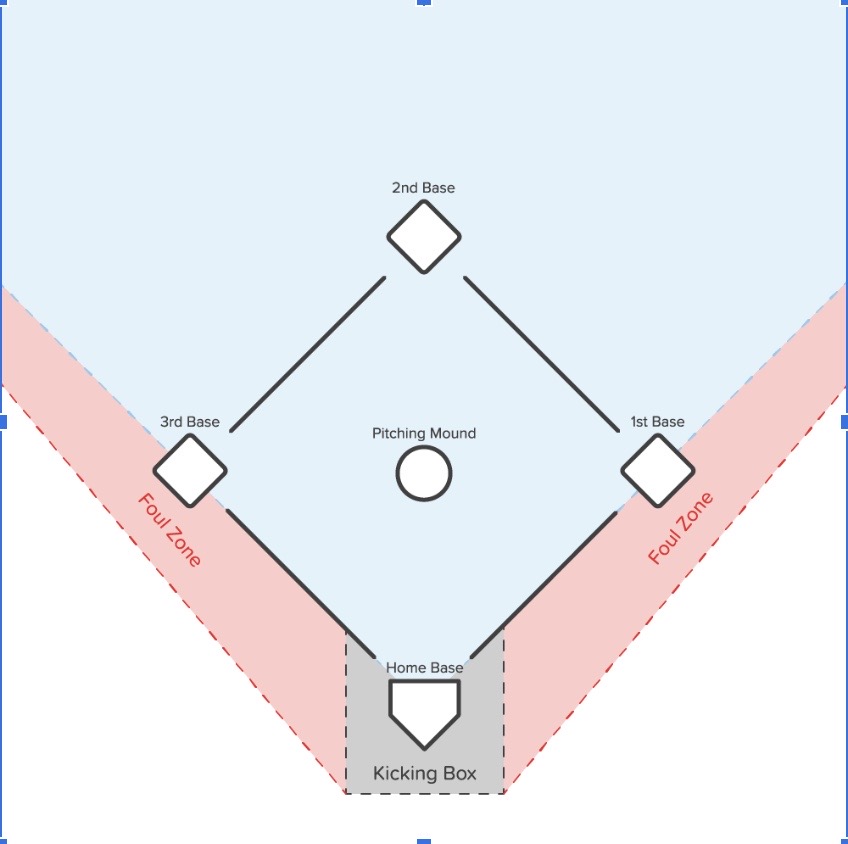
Softball field
1. Home base
2. 1st base
3. 2nd base
4. 3rd base
\
Foul zone is on the outside of the path from home base to 1st base and home base to 3rd base
77
New cards
Strike zone
The strike zone is defined as the volume of space above home plate and between the batter's knees and the midpoint of their torso.
78
New cards
What is a good pitch?
Softball slow pitch, underhand pitch, across the home plate and within the boundaries of shoulder and knees of the batter
79
New cards
Umpire
An official who watches a game or match closely to enforce the rules and arbitrate on matters arising from the play.
80
New cards
Foul ball
A batted ball:
* Settles in foul territory between home and first base
* Settles between home and third base
* Settle s past past first or third base in or over foul territory
* While in/over foul territory, touches the person of an umpire or player, or any object foreign to the natural ground.
* Settles in foul territory between home and first base
* Settles between home and third base
* Settle s past past first or third base in or over foul territory
* While in/over foul territory, touches the person of an umpire or player, or any object foreign to the natural ground.
81
New cards
Striker
When a batter is charged with three strikes during his time at bat.
82
New cards
Homerun
A hit ball where the batter advances to all three bases and returns to home plate safely without an error committed by a fielder.
83
New cards
Types of homerun
“Out of the park”: a ball hit over the outfield fence in fair territory
“in the park”: meaning the batter advanced around all of the bases and returned to home plate before the fielding team could tag the batter out.
“in the park”: meaning the batter advanced around all of the bases and returned to home plate before the fielding team could tag the batter out.
84
New cards
Infield
An infield hit is an outcome in softball in which the batted ball stays in the infield, but neither the batter nor any runners are put out.
85
New cards
Double
A hit ball where the batter advances to second base safely without an error committed by a fielder.
86
New cards
Triple
A hit ball where the batter advances to third base safely without an error committed by a fielder.
87
New cards
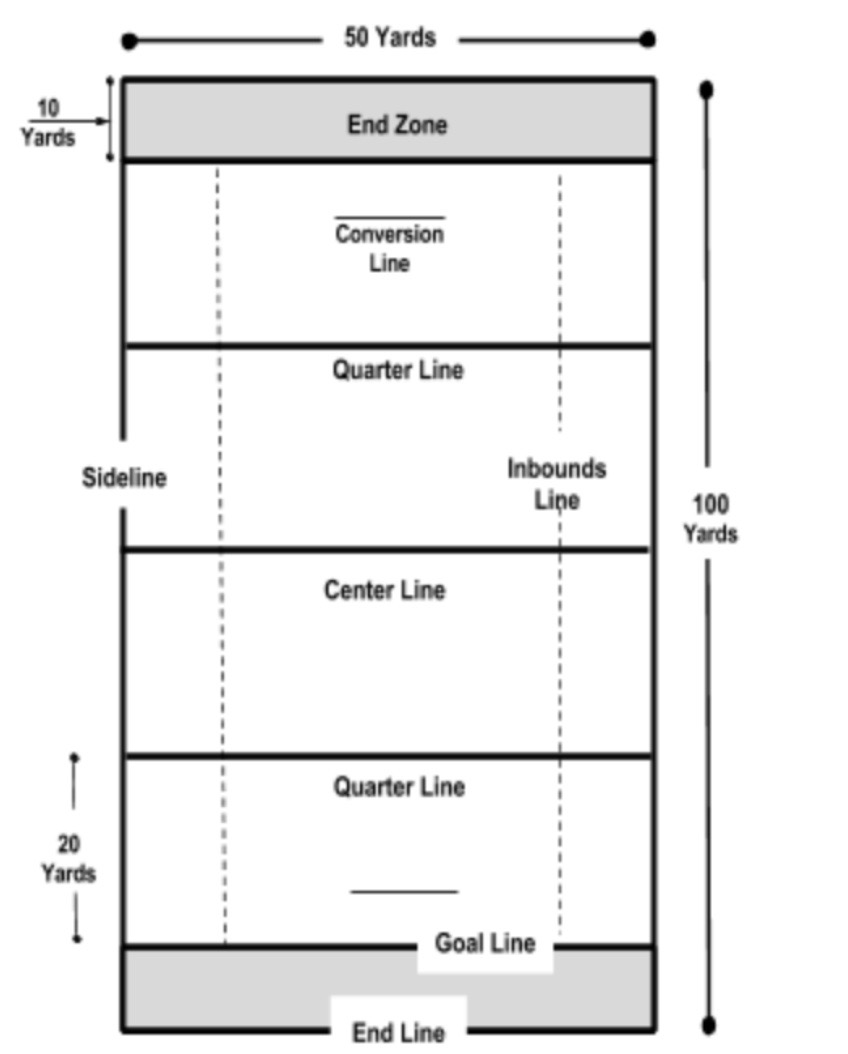
Flag football field
1. End line
2. quarter line
3. center line
4. quarter line
5. conversion line
6. end zone
88
New cards
Lengths of flag football field
**Is in yards and split in:**
1. 4x 20 yards
2. 2 end zones of 10 yards each
1. 4x 20 yards
2. 2 end zones of 10 yards each
89
New cards
Passing patterns (flag football)
* Down & in
* Down & Out
* Hook in
* Hook out
* Hook & Go
* Z in
* Z out
* Quick in
* Quick Out
* Hail Mary
* Down & Out
* Hook in
* Hook out
* Hook & Go
* Z in
* Z out
* Quick in
* Quick Out
* Hail Mary
90
New cards
Equipment needed (flag football)
* Flag football belt and flags
* Shorts without pockets
* Mouthguard
* Football cleats
* Football gloves
* Shorts without pockets
* Mouthguard
* Football cleats
* Football gloves
91
New cards
How to score (flag football)
6 points by getting a touchdown, and you can gain 1 extra point if it’s from the 3 yard line, and 3 extra points if it’s from the 10 yard line.
A safety can earn you 2 points, if an offensive player is down with the ball in their own end zone.
A safety can earn you 2 points, if an offensive player is down with the ball in their own end zone.
92
New cards
How does the game start (flag football)
Play begins with a kick-off at the start of each half.
93
New cards
How many downs can you have in order to score? (flag football)
4 downs
94
New cards
Flag football offense positions
Quarterback, center, wide receiver, running back
95
New cards
Flag football defense positions
Defensive, safety, rusher
96
New cards
Quarterback
The quarterback receives the snap and passes the ball or hands it off (they aren’t allowed to run with the ball after the snap).
97
New cards
Center
The center snaps the ball to the quarterback and then can run for a pass as a receiver.
98
New cards
Wide receiver
Depending on the play, some 5 on 5 teams field three receivers, or a couple receivers and a running back.
The receiver runs designated routes to catch a pass (usually right and left receivers).
The receiver runs designated routes to catch a pass (usually right and left receivers).
99
New cards
Running back
The running back takes a hand off and runs with the ball or throws it. They’re also eligible to receive a pass.
100
New cards
Defensive back
The defensive back covers wide receivers, either man-to-man or zone.
 Note
Note  Flashcards (27)