Business Law-Chapter 1 and 2
 Studied by 0 people
 Call Kai
 Learn
Learn Practice Test
 Spaced Repetition
 Match
Match Flashcards
 Knowt Play
1/159

There's no tags or description
Looks like no tags are added yet.
Name | Mastery | Learn | Test | Matching | Spaced | Call with Kai |
|---|
No analytics yet
Send a link to your students to track their progress
160 Terms
Law
•Enforceable rules governing relationships among individuals and between individuals and their society.
−Law and government regulations affect almost all business activities.
−To make good business decisions, a basic knowledge of the laws and regulations governing these activities is beneficial—if not essential.
•In today’s business world, knowing what conduct can lead to legal liability is not enough.
Liability
−The state of being legally responsible (liable) for something, such as a debt or obligation.
Businesspersons must develop critical thinking and legal reasoning skills so they can evaluate how laws might apply to a given situation and determine the best course of action
•Various areas of the law may influence business decision making.
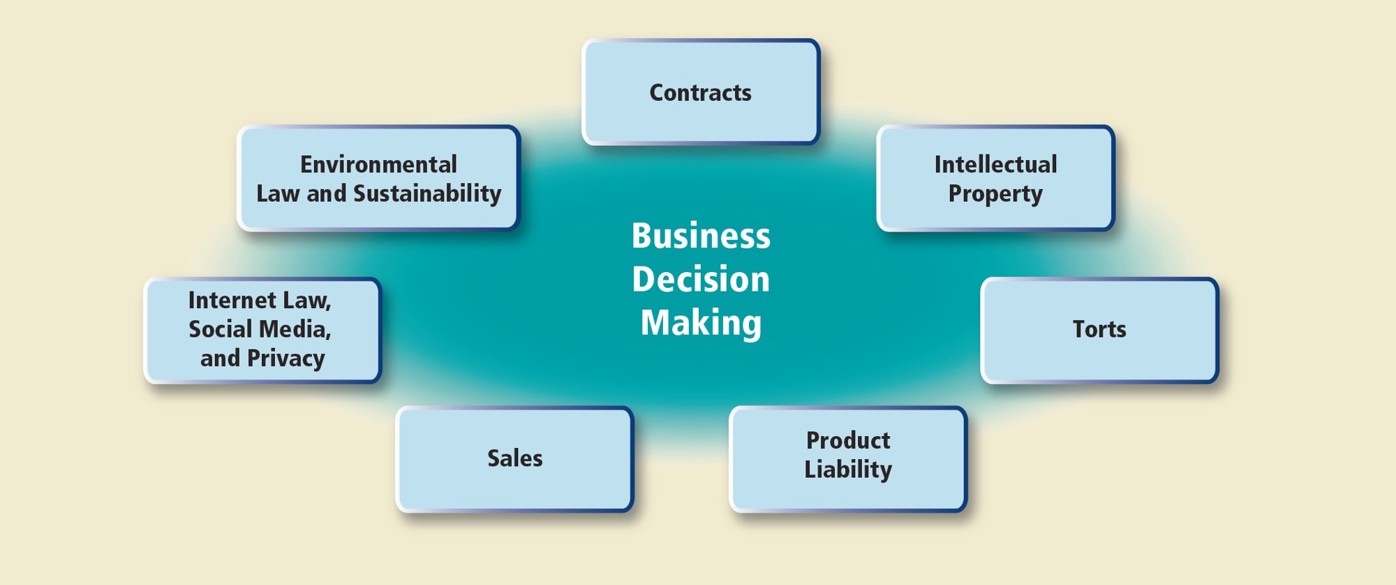
Ethics and Business Decision Making
•Today, business decision makers need to consider not just whether a decision is legal, but also whether it is ethical.
−Ethics generally is defined as the principles governing what constitutes right or wrong behavior.
−The underlying reason for bringing some lawsuits is a breach of ethical duties.
−Many legal conflicts involve ethical issues that often cannot be ignored.
Sources of American Law
•are classified as either primary or secondary.
Primary Source
−, or sources that establish the law, include the following:
-The U.S. Constitution and the constitutions of various states
-Statutory law—including laws passed by Congress, state legislatures, or local governing bodies
-Regulations created by administrative agencies, such as the Federal Trade Commission
-Case law and common law doctrines
Secondary Sources
are books and articles that summarize and clarify the primary sources of law.
Examples: Legal encyclopedias, treatises, articles in law reviews, and compilations of law
Constitutional Law
•Law that is based on the U.S. Constitution and the constitutions of the various states.
−The Constitution is the supreme law of the land and is the basis of all law in the United States.
-A law in violation of the Constitution, if challenged, will be declared unconstitutional and will not be enforced, no matter what its source.
Tenth Ammendment
−to the U.S. Constitution reserves to the states all powers not granted to the federal government.
-Each state in the union has its own constitution.
-Unless it conflicts with the U.S. Constitution or a federal law, a state constitution is supreme within the state’s borders.
Statutory Law
•The body of law enacted by legislative bodies (as opposed to constitutional law, administrative law, or case law).
Federal and state statues
-A federal statute is passed by Congress and applies to all states.
-A state statute is passed by a state legislature and applies only within the state’s borders.
Ordinances
−Regulations passed by a local governing unit, such as a city or a county
-commonly have to do with city or county land use (zoning ordinances), building and safety codes, and other matters affecting the local comm
Statutory Conflicts
•Tension may sometimes arise between federal, state, and local laws.
Uniform Law
•A model law created by the National Conference of Commissioners on Uniform State Laws and/or the American Law Institute for the states to consider adopting.
−Each state has the option of adopting or rejecting all or part of a uniform law.
If the state adopts the law, it becomes statutory law in that state.
The Uniform Commercial Code
•The Uniform Commercial Code (U C C) facilitates commerce among the states by providing a uniform, yet flexible, set of rules governing commercial transactions.
Administrative Agency
-The body of law created by administrative agencies in order to carry out their duties and responsibilities.
−A federal or state government agency created by the legislature to perform a specific function, such as to make and enforce rules pertaining to the environment
- constitute a dominant element in the regulatory environment of business.
Executive Agency
An administrative agency within the executive branch of government.
Independent regulatory agency
-An administrative agency that is not considered part of the government’s executive branch and is not subject to the authority of the president.
State and Local Agencies
•Commonly, a state agency is created as a parallel to a federal agency.
Case Law
The rules of law announced in court decisions
Case law interprets:
-Statutes
-Regulations
-Constitutional provisions
-Other case law
Case law governs
all areas not covered by statutory law or administrative law and is part of our common law tradition.
The Common Law Tradition
•Because of our colonial heritage, much of American law is based on the English legal system.
Judges in the United States still apply common law principles when deciding cases.
Early English Courts
After the Norman Conquest of 10 66, the king’s courts sought to establish a uniform set of customs for England as a whole
Remedy
•The relief given to an innocent party to enforce a right or compensate for the violation of a right.
Court of law
•A court in which the only remedies that can be granted are things of value, such as money damages.
Remedies at law
−A remedy available in a court of law.
Damages
A monetary award sought as a remedy for a breach of contract or a tortious act.
Courts of Equity
•When individuals could not obtain an adequate remedy in a court of law, they petitioned the king for relief.
−A court that decides controversies and administers justice according to the rules, principles, and precedents of equity.
Remedies in equity
•A remedy allowed by courts in situations where remedies at law are not appropriate.
Examples: Injunction, specific performance, rescission and restitution, or reformation
Breach
To violate a law, by an act or an omission, or to break a legal obligation that one owes to another person or to society.
Equitable Maxims
General propositions or principles of law that have to do with fairness (equity).
•The equitable doctrine of laches can be used as a defense.
Laches
The equitable doctrine that bars a party’s right to legal action if the party has neglected for an unreasonable length of time to act on his or her rights.
Defense
Reasons that a defendant offers in an action or suit as to why the plaintiff should not obtain what he or she is seeking.
Defendant
One against whom a lawsuit is brought, or the accused person in a criminal proceeding.
Plaintiff
-petitioner
−A party that initiates a lawsuit.
Respondent
-Defendent
−The party who answers a complaint or other proceeding.
The doctrine of latches
arose to encourage people to bring lawsuits while the evidence was fresh
Time periods for different types of cases are now usually fixed
by statutes of limitations.
Statute of limitations
A federal or state statute setting the maximum time period during which a certain action can be brought, or certain rights enforced.
After the time allowed under a statute of limitations has expired, no lawsuit can be brought, no matter how strong the case was originally
Whoever seeks equity must do equity
. Anyone who wishes to be treated fairly must treat others fairly.
Where there is equal equity, the law must prevail
The law will determine the outcome of a controversy in which the merits of both sides are equal
One seeking the aid of an equity court must come to the court with clean hands.
The plaintiff must have acted fairly and honestly
Equity will not suffer a wrong to be without a remedy
Equitable relief will be awarded when there is a right to relief and there is no adequate remedy at law.
Equity regards substance rather than form
Equity is more concerned with fairness and justice than with legal technicalities.)
Equity aids the vigilant, not those who rest on their rights
Equity will not help those who neglect their rights for an unreasonable period of time
•The establishment of courts of equity in medieval England resulted in two distinct court systems:
−Courts of law
−Courts of equity
•The courts had different sets of judges and granted different types of remedies.
•During the nineteenth century, most states in the United States adopted rules of procedure that resulted in the combining of courts of law and equity.
−A party now may request both legal and equitable remedies in the same action, and the trial court judge may grant either or both forms of relief.
−Certain vestiges of the procedures used when there were separate courts of law and equity still exist.
Initiation of lawsuit
Action at Law- by filing a complaint
Action in equity-filing a petition
Decision
Action at Law- jury or judge
Action in equity-by judge NO JURY
Result
Action at Law- judgment
Action in equity- decree
Remedy
Action at Law- monetary damages of property
Action in equity- injunction, specific performance, or rescission
Case Precedents and Case Reporters
•Judges attempted to be consistent and to base decisions on the principles suggested by earlier cases, and they considered new cases with care because they knew their decision would make new laws.
−Each interpretation became part of the law on the subject and thus served as a legal precedent.
•In the early years of common law, there was no single place or publication where court opinions, or written decisions, could be found.
Today, cases are published in volumes called reporters and are also posted online
Precedent
-A court decision that furnishes an example or authority for deciding subsequent cases involving identical or similar facts.
Reporter
A publication in which court cases are published (reported)
Stare decisis
•The practice of deciding new cases with reference to former decisions, or precedents, became a cornerstone of the English and American judicial systems and formed a doctrine known as ___________
−A common law doctrine under which judges are obligated to follow the precedents established in prior decisions.
−Under the doctrine of ____________ judges are obligated to follow the precedents established within their jurisdictions.
Jurisdiction refers
to a geographic area in which a court or courts have the power to apply the law
−Stare decisis has two aspects:
-A court should not overturn its own precedents unless there is a compelling reason to do so.
-Decisions made by a higher court are binding on lower courts.
Controlling Precedents-The Doctrine of Stare Decisis
•Precedents that must be followed within a jurisdiction are called controlling precedents.
are a type of binding authority
Binding authority
-Any source of law that a court must follow when deciding a case.
Examples: Constitutions, statutes, and regulations that govern the issue being decided, as well as court decisions that are controlling precedents within the jurisdiction
Stare Decisis and Legal Stability
•The doctrine of stare decisis:
−Helps the courts to be more efficient
−Makes the law more stable and predictable
When There Is No Precedent
•Occasionally, courts must decide cases for which no precedents exist, called cases of first impression.
−In deciding cases of first impression, courts often look at
persuasive authorities.
Persuasive authority
—Any legal authority or source of law that a court may look to for guidance but need not follow when making its decision.
−Sources of persuasive authority include:
-Precedents from other jurisdictions
-Legal principles and policies underlying previous court decisions or existing statutes
-Issues of fairness, social values and customs, and public policy (governmental policy based on widely held societal values)
-Unpublished opinions (those not intended for publication in a printed legal reporter)
Stare Decisis and Legal Reasoning
•In deciding what law applies to a given dispute and then applying that law to the facts or circumstances of the case, judges rely on the process of legal reasoning.
Legal Reasoning
—The process of reasoning by which a judge harmonizes their opinion with the judicial decisions in previous cases.
Basic Steps in Legal Reasoning
•The basic steps of the legal reasoning process are commonly referred to as the I R A C (Issue, Rule, Application, and Conclusion) method.
−Issue—What are the key facts and issues?
−Rule—What rule of law applies to the case?
−Application—How does the rule of law apply to the particular facts and circumstances of this case?
−Conclusion—What conclusion should be drawn?
Case on point
-A previous case involving factual circumstances and issues that are similar to those in the case before the court.
There Is No One “Right” Answer-Stare Decisis and Legal Reasoning
•Many people believe that there is no one “right” answer to every legal question.
−Thus, the outcome of a particular lawsuit before a court cannot be predicted with certainty.
-Good arguments can usually be made to support either side of a legal controversy.
-Each judge has her or his own personal beliefs and philosophy which, at least to some extent, shape the legal reasoning process.
Restatements of the Law Clarify and Illustrate the Common Law
•The American Law Institute (A L I) has published compilations of the common law called Restatements of the Law, which generally summarize the common law rules followed by most states.
−The Restatements are an important source of legal analysis and opinion, and judges often rely on them in making decisions.
Courts Interpret Statutes
•A judge’s function is not to make the laws but to interpret and apply them.
−Because judges have some flexibility in interpreting and applying the law, different courts often arrive at different conclusions in cases that involve nearly identical issues, facts, and applicable laws.
If a judge is hearing a case with a fact pattern similar, but slightly different than a case they have ruled on before, what should the judge do?
a.Rule in any way they want
b.Rule as they believe other courts would rule
c.Don’t rule
d.Rule in a similar fashion as the previous case
Jurisprudence
The science or philosophy of law.
−How judges apply the law to specific cases depends in part on their philosophical approaches to law.
-Thus, involves learning about different schools of legal thought and how the approaches to law characteristic of each school can affect judicial decision making.
−There are four schools of jurisprudential thought:
-Natural law school
-Positivist school
-Historical school
-Legal realism
Natural Law
The oldest school of legal thought, based on the belief that the legal system should reflect universal (“higher”) moral and ethical principles that are inherent in human nature.
−According to the natural law theory:
-A higher law applies to all human beings.
-If each written law does not reflect the principles inherent in natural law, then it loses its legitimacy and need not be obeyed.
Natural Law
•The oldest school of legal thought, based on the belief that the legal system should reflect universal (“higher”) moral and ethical principles that are inherent in human nature.
−The notion that people have “natural rights”
stems from the natural law tradition.
Positive law, or national law
• is the written law of a given society at a particular time.
−In contrast to natural law, it applies only to the citizens of that nation or society.
Legal positivism
−A school of legal thought centered on the assumption that there is no law higher than the laws created by a national government.
§Laws must be obeyed, even if they are unjust, to prevent anarchy.
§A judge who takes this view will probably be more inclined to defer to an existing law than would a judge who adheres to the natural law tradition.
Historical School
—A school of legal thought that looks to the past to determine what the principles of contemporary law should be.
−The historical school emphasizes the evolutionary process of law by concentrating on the origin and history of the legal system.
−The legal doctrines that have withstood the passage of time—those that have worked in the past—are deemed best suited for shaping present laws.
§Hence, law derives its legitimacy and authority from adhering to the standards that historical development has shown to be workable.
−Followers of the historical school are more likely than those of other schools to strictly follow decisions made in past cases.
Legal realism
•A school of legal thought that holds that the law is only one factor to be considered when deciding cases and that social and economic circumstances should also be taken into account.
−Legal realists believe that the law can never be applied with total uniformity.
§Because judges have different personalities, value systems, and intellects, different judges will bring different reasoning processes to the same case.
−Legal realism strongly influenced the growth of what is sometimes called the sociological school.
•Jurists who adhere to this philosophy of law are more likely to depart from past decisions than are jurists who adhere to other schools of legal thought
Sociological school
-A school of legal thought that views the law as a tool for promoting justice in society.
•The law may be broken down according to several classification systems.
−Substantive law and procedural law
−Federal law and state law
−Private law and public law
§Private law deals with relationships between private entities.
§Public law addresses the relationship between persons and their governments.
−National law and international law
Criminal law and civil law
Procedural law
-Law that establishes the methods of enforcing the rights established by substantive law.
Substantive law
Law that defines, describes, regulates, and creates legal rights and obligations.
Civil Law
•The branch of law dealing with the definition and enforcement of all private or public rights, as opposed to criminal matters.
−Civil law spells out the rights and duties that exist between persons and between persons and their governments, as well as the relief available when a person’s rights are violated.
-Typically, in a civil case, a private party sues another private party who has failed to comply with a duty
Criminal Law
—The branch of law that defines and punishes wrongful actions committed against the public.
−Criminal acts are defined and prohibited by local, state, or federal government statutes.
-Thus, criminal defendants are prosecuted by public officials, such as a district attorney (D.A.), on behalf of the state, not by their victims or other private parties.
Cyberlaw
•An informal term used to refer to all laws governing electronic communications and transactions, particularly those conducted via the internet.
−Courts have had to adapt traditional laws to unique situations.
−Legislatures at both the federal and the state levels have created laws to deal specifically with such issues.
Citation
—A reference to a publication in which a legal authority—such as a statute or a court decision—or other source can be found.
−In addition to being published in sets of books, most federal and state laws and case decisions are available online.
United States Code
−All federal laws passed by Congress are arranged by broad subject in the United States Code (U.S.C.).
Administrative Rules
−Rules and regulations adopted by federal administrative agencies are initially published in the Federal Register, a daily publication of the U.S. government, and later incorporated into the Code of Federal Regulations (C.F.R.).
Finding Statutory and
Administrative Law
•Laws are often referred to in their codified form—that is, the form in which they appear in the federal and state codes where they are compiled by subject.
−State codes
passed by state legislatures are collected in state publications and follow the U.S.C. pattern of arranging law by subject.
•There are two types of courts in the United States:
−Federal courts
−State courts
•Both systems consist of several levels, or tiers, of courts.
−Trial courts, in which evidence is presented and testimony given, are on the bottom tier.
−Decisions from a trial court can be appealed to a higher court, which commonly is an intermediate court of appeals, or appellate court.
−Decisions from these intermediate courts of appeals may be appealed to an even higher court, such as a state supreme court or the United States Supreme Court.
State Court Decisions
•Decisions from state trial courts are typically filed in the office of the clerk of the court, where the decisions are available for public inspection.
•Written decisions of the appellate, or reviewing, courts are published and distributed in print and online.
−The reported appellate decisions are published in volumes called reports or reporters, which are numbered consecutively and published by each state.
§State court opinions appear in regional units of the West’s National Reporter System, which divides the states into different geographic areas.
§Most lawyers and libraries have these reporters because they report cases more quickly and are distributed more widely than the state-published reporters.
After appellate decisions have been published, they are normally cited by the name of the case and the volume, name, and page number of the reporter(s) in which the opinion can
•Federal district court
Decisions are published unofficially in the Federal Supplement.
•Opinions from the circuit courts of appeals are reported unofficially in the Federal Reporter.
•Cases concerning federal bankruptcy are published unofficially in the Bankruptcy Reporter.
•The official edition of the United States Supreme Court decisions is the United States Reports.
•Unofficial editions of Supreme Court cases include the Supreme Court Reporter and the Lawyers’ Edition of the Supreme Court Reports.
Old Case Law
•On a few occasions, this text cites opinions from old, classic cases dating to the nineteenth century or earlier.
−Some of these are from the English courts.
−The citations to these cases may not conform to the descriptions just presented because the reporters in which they were originally published were often known by the names of the persons who compiled the reporters.
 Note
Note  Flashcards (26)